Jon Nazareth
Western Thunderer
Here are some pictures of my latest offering. This wagon was supposed to be the best modelled yet but it turned out far from being that well, in my eyes anyway. Going from the pictures it looks okay, I hope, but it was a struggle getting there.
All of my wagons have been made with plasticard and Evergreen strip except this one. The sizes of the timbers for the underframe were so large that I had to make them out of wood, beech to be precise.

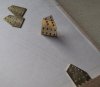
This is a typical jig/setup for making the under frame. I normally make a separate jig for each wagon but you can see that I've shortened this one for some reason. If making a wooden frame then I would use the little 'comma' clamps to hold all together while the wood glue sets. With styrene clamping is not such a problem and I find that I can hold the pieces in position by hand until the Mek Pak sets. With wooden frames I tend to use two clamps and you can just see a hole where the second clamp would have been positioned. This set up was not my idea but came from a chap in Oz.

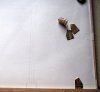
This picture shows the set up for painting with a single colour. A simple 'handle' screwed to the base which allows the wagon to be held in any position. To be able to let the whole thing dry off, the handle is clamped in the vice.
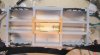
There isn't any strength to a wooden or a styrene frame. This little idea takes care that forces aren't put directly onto the buffer beam as if they were, the beam would simply pull off. This was an idea picked up from a G3 member. I used to have awful problems with getting the 10BA nuts to start until I thought of the idea of turning down a short length of the rod. The nut can be slipped over the end and turned until it catches without the palaver of trying to old it in place with one hand while trying to turn the nut with the other. You can also see that I'm not too fussed with the appearance of the underside of my models.
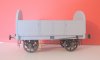
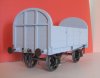
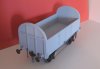
This was quite a large wagon with 4' 3" wheels. I though that my Open A was big but, this one is bigger.
The nuts that hold the W irons are 16BA opened out to take 14BA cheese head screws. They are cheaper than bolts and they don't get to be seen. All of the other nuts, and they number in the hundreds, just, are 16BA opened out to take a 1/32" rivet. To my eye they look just like a coach bolt. The whole thing was scratch built including axle boxes. Parts not were the buffer bases, the draw hooks, the brake rack, the little safety hooks and the brake lever which were supplied by Mike Williams. He also managed to sort out the W irons from a cad drawing that I sent to him. The wheels came from Mark Wood which were machined by myself.
I have one more wagon to build in the form of a carriage truck and am awaiting the spring hangers as we speak. After that, I'll be working on my version of Lion. It won't be exactly like the original, I say that before I even start, so a new name will have to be thought up.
I hope that some of you may find the above of interest and maybe even some of you will be tempted to try G3.
Jon
All of my wagons have been made with plasticard and Evergreen strip except this one. The sizes of the timbers for the underframe were so large that I had to make them out of wood, beech to be precise.
This is a typical jig/setup for making the under frame. I normally make a separate jig for each wagon but you can see that I've shortened this one for some reason. If making a wooden frame then I would use the little 'comma' clamps to hold all together while the wood glue sets. With styrene clamping is not such a problem and I find that I can hold the pieces in position by hand until the Mek Pak sets. With wooden frames I tend to use two clamps and you can just see a hole where the second clamp would have been positioned. This set up was not my idea but came from a chap in Oz.
This picture shows the set up for painting with a single colour. A simple 'handle' screwed to the base which allows the wagon to be held in any position. To be able to let the whole thing dry off, the handle is clamped in the vice.
There isn't any strength to a wooden or a styrene frame. This little idea takes care that forces aren't put directly onto the buffer beam as if they were, the beam would simply pull off. This was an idea picked up from a G3 member. I used to have awful problems with getting the 10BA nuts to start until I thought of the idea of turning down a short length of the rod. The nut can be slipped over the end and turned until it catches without the palaver of trying to old it in place with one hand while trying to turn the nut with the other. You can also see that I'm not too fussed with the appearance of the underside of my models.
This was quite a large wagon with 4' 3" wheels. I though that my Open A was big but, this one is bigger.
The nuts that hold the W irons are 16BA opened out to take 14BA cheese head screws. They are cheaper than bolts and they don't get to be seen. All of the other nuts, and they number in the hundreds, just, are 16BA opened out to take a 1/32" rivet. To my eye they look just like a coach bolt. The whole thing was scratch built including axle boxes. Parts not were the buffer bases, the draw hooks, the brake rack, the little safety hooks and the brake lever which were supplied by Mike Williams. He also managed to sort out the W irons from a cad drawing that I sent to him. The wheels came from Mark Wood which were machined by myself.
I have one more wagon to build in the form of a carriage truck and am awaiting the spring hangers as we speak. After that, I'll be working on my version of Lion. It won't be exactly like the original, I say that before I even start, so a new name will have to be thought up.
I hope that some of you may find the above of interest and maybe even some of you will be tempted to try G3.
Jon


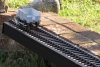




 . I was going to cut through one of the edges of the angle at the node points to aid bending but I'm not sure that I am going to like the thrupenny bit look. I'll have a go at bending freehand first and if that doesn't work then It's out with the saw. I've drawn it out on a piece of 18mm ply because not only was it the only thing I could find that was big enough but also because I can bang pins into it should the need arise and it may very well do if I need to bend that angle. None of the cuts for the sections where they meet an upright are true angles as they all change as you move along the curve. These will all need to be cut by hand and then filed to fit making another job I'm not looking forward to
 . This memory thing gets to us all, eventually. If I go down the riveting road, what do I do with 300 brass rivets and nuts? I'll have to think about this one.