
You are using an out of date browser. It may not display this or other websites correctly.
You should upgrade or use an alternative browser.
You should upgrade or use an alternative browser.
Liver & Fry's workbench
- Thread starter Liver & Fry
- Start date


Liver & Fry
Western Thunderer
Lovely looking van.
Do you know how long they lasted or if any made it into BR?
Thanks
Josh
It's thought very few made it into BR but one of the later examples was seen at Darlington in 1950.
- James
Liver & Fry
Western Thunderer
I finally sorted those axleboxes!
In order to allow the axleboxes to accommodate the vertical movement of the floating bearing end within the spring carrier, I had to ream out above the pre-cast hole and then attach the box to the leaf springs, so not to risk gluing the bearing in place:

I then painted the remainder of the underframe but apparently neglected to take any photos before I started typing this, so that one will have to wait...
Been looking at end detailing and it appears vac, air and steam heat pipes are in order, along with two lamp brackets at each end. Thankfully I have everything required for this so will likely add these tomorrow evening.
- James
In order to allow the axleboxes to accommodate the vertical movement of the floating bearing end within the spring carrier, I had to ream out above the pre-cast hole and then attach the box to the leaf springs, so not to risk gluing the bearing in place:
I then painted the remainder of the underframe but apparently neglected to take any photos before I started typing this, so that one will have to wait...
Been looking at end detailing and it appears vac, air and steam heat pipes are in order, along with two lamp brackets at each end. Thankfully I have everything required for this so will likely add these tomorrow evening.
- James
Liver & Fry
Western Thunderer
And as promised...
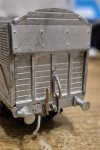

I think we're getting close to seeing some green... (Brake levers will go on after an initial coat on the solebar). Probably need to fit the roof too, as that will also be painted green!
- James
I think we're getting close to seeing some green... (Brake levers will go on after an initial coat on the solebar). Probably need to fit the roof too, as that will also be painted green!
- James

John Duffy
Western Thunderer
James, do you have a source for the colour information? The L&Y wagon books describes as "hearsay evidence" that the first 50 may have been painted a "very light pastel green." There is no reference to the roof and that seems somewhat unlikely. I obviously have an interest having the 7mm version.And as promised...
View attachment 235045
View attachment 235046
I think we're getting close to seeing some green... (Brake levers will go on after an initial coat on the solebar). Probably need to fit the roof too, as that will also be painted green!
- James
John
Liver & Fry
Western Thunderer
James, do you have a source for the colour information? The L&Y wagon books describes as "hearsay evidence" that the first 50 may have been painted a "very light pastel green." There is no reference to the roof and that seems somewhat unlikely. I obviously have an interest having the 7mm version.
John
The reference to the roof comes from the history/livery information provided in the kit instructions by David Geen: "The green even extended to the roof". It surprised me too!
The photo on page 386 of the wagon book, showing a rake of fish vans, references two of the rake as being "probably green". That same photo shows a freshly painted white example, whereby the roof matches the body and I guess the implication there could be that the white livery followed the pattern set by the green examples.
Page 375 references the colour coding of perishable vans, although does not mention roof colour.
Nigel Digby references the various van colours in his third "Liveries of the Pre-Grouping Railways" book, but again, this does not specify roof colour.
Additionally, I have seen someone else model a red gunpowder van with a red roof to match (whilst I know you should never model a model, it has to have been based on something) and so, between that and the David Geen comment, I've deduced that the special liveried wagons had their roofs painted to match - Or at the very least, that's how I'm planning to model them currently.
I hope that helps?
- James
Liver & Fry
Western Thunderer
Speaking of green...

The photo and the yellow tinted lighting of the room doesn't do it justice, but the shade I've gone with is Revell 59:

I felt this fitted the described colour quite nicely (as does Revell 49 for the blue of the Dia.64 Butter Van). Of course, we'll never know the exact shades used!
I've also cut and fitted the roof, albeit unpainted at this time. In fact, only the one side of the van has been painted, as the paint is quite thin and needed three coats to get a satisfactory application.
- James
The photo and the yellow tinted lighting of the room doesn't do it justice, but the shade I've gone with is Revell 59:
I felt this fitted the described colour quite nicely (as does Revell 49 for the blue of the Dia.64 Butter Van). Of course, we'll never know the exact shades used!
I've also cut and fitted the roof, albeit unpainted at this time. In fact, only the one side of the van has been painted, as the paint is quite thin and needed three coats to get a satisfactory application.
- James
Liver & Fry
Western Thunderer
Some more sporadic progress has been made; both sides have now been painted and the first (half) coats have been made on the ends. The roof has been painted and vents have been added. The brake levers have also finally been fitted:

With the exception of the handrails on each door, the van is now physically complete. Paint wise, the green needs finishing on the ends and then the details (buffers, pipework, ironwork etc) need picking out in black. A cost of varnish will follow and then it'll be time for transfers.
I'm back to work Monday and so I'd like this done (or as close as possible) by then...
- James
With the exception of the handrails on each door, the van is now physically complete. Paint wise, the green needs finishing on the ends and then the details (buffers, pipework, ironwork etc) need picking out in black. A cost of varnish will follow and then it'll be time for transfers.
I'm back to work Monday and so I'd like this done (or as close as possible) by then...
- James
Liver & Fry
Western Thunderer
It feels like this build took longer than it ought to, but now that it's done, I can't help but smile at the thing:
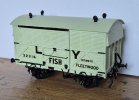


It's certainly different! But I like different and I'm glad I let the intrusive thoughts win back when I read Digby's notes on colourful L&Y vans.
Speaking of which:

It's going to be a rather bright rake when done...
The Dia.64 Butter Van is next, but modelling is likely going to be a weekend only event until May as I'm back to work tomorrow and need to crack on with my post grad in the evenings, as well as finding time to start off the veg plot for another season. No rest for the wicked!
- James
It's certainly different! But I like different and I'm glad I let the intrusive thoughts win back when I read Digby's notes on colourful L&Y vans.
Speaking of which:
It's going to be a rather bright rake when done...
The Dia.64 Butter Van is next, but modelling is likely going to be a weekend only event until May as I'm back to work tomorrow and need to crack on with my post grad in the evenings, as well as finding time to start off the veg plot for another season. No rest for the wicked!
- James

oldravendale
Western Thunderer
From the long ago days when we were allowed to catch our own fish. Just sayin'
Brian
Brian
L&Y Dia.64 Butter Van
Liver & Fry
Western Thunderer
It's barely been two weeks, but it feels like an age since I last did any modelling! That said, the PgCert is in full swing and when I have had any time to myself I've just wanted to crash out and rest, so I'm somewhat surprised to have found motivation this evening!
The plan is to continue the plan from before: build the next in the trio of the "rainbow vans"; this being the Dia.64 Butter Van. This is another David Geen kit but I've found it easier to get my head around now I've had some experience with the Dia.72.
The focus tonight has been on the main body:
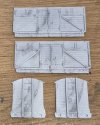
These were the respective parts prior to cleaning the flash. I have begun the process of putting the body together, but at this half way stage I'm letting the respective halves set before continuing further:

It's not much of an update, but just a reminder (mostly to myself) that I'm still here and haven't totally been consumed by coursework!
- James
The plan is to continue the plan from before: build the next in the trio of the "rainbow vans"; this being the Dia.64 Butter Van. This is another David Geen kit but I've found it easier to get my head around now I've had some experience with the Dia.72.
The focus tonight has been on the main body:
These were the respective parts prior to cleaning the flash. I have begun the process of putting the body together, but at this half way stage I'm letting the respective halves set before continuing further:
It's not much of an update, but just a reminder (mostly to myself) that I'm still here and haven't totally been consumed by coursework!
- James
Liver & Fry
Western Thunderer
I've been slowly chipping away at the Dia.64 as and when I've had time. The body is now "complete" with four sides and a floor:
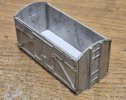
I've also fitted the w-irons and made a start on the brake rigging:

Reading both the notes provided and the chapter on Dia.64 vans in Coates' L&Y wagon book (volume 2), it would seem the build might be quicker than I anticipated, insofar as it would appear originally these vans were built with through vac and air pipes only, with full vacuum brakes being retrofitted around 1909/1910. Thus, if this is to be a blue van (pre-1908) then I don't need to incorporate the vacuum cylinder.
Coates suggests that, originally, the brake setup was a standard "two shoes per vehicle" arrangement. Unfortunately no photos seem to exist showing the vans as built so I'm going to have to look at other contemporary L&Y vehicles to fathom which wheels the shoes would act on.
- James
I've also fitted the w-irons and made a start on the brake rigging:
Reading both the notes provided and the chapter on Dia.64 vans in Coates' L&Y wagon book (volume 2), it would seem the build might be quicker than I anticipated, insofar as it would appear originally these vans were built with through vac and air pipes only, with full vacuum brakes being retrofitted around 1909/1910. Thus, if this is to be a blue van (pre-1908) then I don't need to incorporate the vacuum cylinder.
Coates suggests that, originally, the brake setup was a standard "two shoes per vehicle" arrangement. Unfortunately no photos seem to exist showing the vans as built so I'm going to have to look at other contemporary L&Y vehicles to fathom which wheels the shoes would act on.
- James
Liver & Fry
Western Thunderer
Todays post is a lesson in the importance of research!
Previously, based on the evidence in front of me, I commented that the Dia.64s were built with through pipes only and that vacuum cylinders weren't fitted until approximately 1910. Coates states in his book that the original drawing, No.5741, has not survived, before making the above suggestions. However, upon asking around on L&Y groups on a popular social media site, if anyone might know anything about the general arrangement of L&Y wagons brakes (thinking I was now modelling an unfitted morton set up), someone kindly shared a copy of "lost" drawing No.5741, dated 05/04/1905 and signed by Mr Hughes. The "lost" drawing clearly shows a vacuum cylinder and arrangement pretty much in keeping with the later style.
So, with that, it appears I'm back to building the kit as intended with the vacuum cylinder in place!
- James
Previously, based on the evidence in front of me, I commented that the Dia.64s were built with through pipes only and that vacuum cylinders weren't fitted until approximately 1910. Coates states in his book that the original drawing, No.5741, has not survived, before making the above suggestions. However, upon asking around on L&Y groups on a popular social media site, if anyone might know anything about the general arrangement of L&Y wagons brakes (thinking I was now modelling an unfitted morton set up), someone kindly shared a copy of "lost" drawing No.5741, dated 05/04/1905 and signed by Mr Hughes. The "lost" drawing clearly shows a vacuum cylinder and arrangement pretty much in keeping with the later style.
So, with that, it appears I'm back to building the kit as intended with the vacuum cylinder in place!
- James
Liver & Fry
Western Thunderer
Speaking of brake gear...
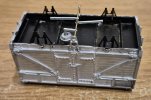
Far more straight forward than the Dia.72 was!
- James
Far more straight forward than the Dia.72 was!
- James
Liver & Fry
Western Thunderer
More progress tonight, after I finished studying for the evening, saw the wheels, axle guards and brake shoes fitted:

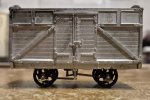
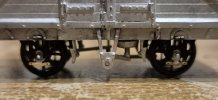
I'm allowing myself weekends off so I'm hoping to get the physical build finished by Sunday evening and painting can then be done as and when thereafter.
- James
I'm allowing myself weekends off so I'm hoping to get the physical build finished by Sunday evening and painting can then be done as and when thereafter.
- James
Liver & Fry
Western Thunderer
I surprised myself by actually meeting the deadline I set* and getting the van built and ready for painting over the course of this weekend:
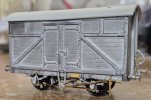
*The roof detail and handrails will be fitted after initial painting.
Since the previous post, axlebox covers, springs, brake levers, buffers, drawhooks and brake pipes have all been fitted, along with the roof.
I've even put a first coat of blue on the roof...
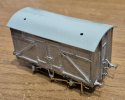
I'm happy with how this has progressed until now but accept the painting will very much continue as and when. At least the last photo can whet the appetite for what's to come in the meantime!
- James
*The roof detail and handrails will be fitted after initial painting.
Since the previous post, axlebox covers, springs, brake levers, buffers, drawhooks and brake pipes have all been fitted, along with the roof.
I've even put a first coat of blue on the roof...
I'm happy with how this has progressed until now but accept the painting will very much continue as and when. At least the last photo can whet the appetite for what's to come in the meantime!
- James
Liver & Fry
Western Thunderer
Both sides and the roof have now received two coats of the blue:

The ends will follow and then it'll be back to black for the ironwork and underframe.
Meanwhile the torpedo vents have been painted in preparation:
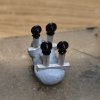
It's coming along, slowly but surely...
- James
The ends will follow and then it'll be back to black for the ironwork and underframe.
Meanwhile the torpedo vents have been painted in preparation:
It's coming along, slowly but surely...
- James
Liver & Fry
Western Thunderer
The painting continues here on the workbench!
The ends have now received two coats of blue and the underframe has been painted black:
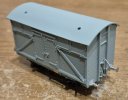

Black ironwork, roof detailing and eventual lettering to follow, but when that'll be is another question entirely!
- James
The ends have now received two coats of blue and the underframe has been painted black:
Black ironwork, roof detailing and eventual lettering to follow, but when that'll be is another question entirely!
- James
Liver & Fry
Western Thunderer
*Taps Microphone* Is this thing on?
Why hello! It's been a while, hasn't it? Turns out the final push for that PgCert took over more of my time than I had anticipated, so much so that aside from a trip to the York show with @Herb Garden and a brief sanity reset putting pipework on a Bachmann 37, it's been a model free month!
That said, my final deadline (he says, hopefully) was today and so I figured it was about time I finished that Butter Van...

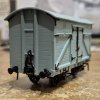
So with that, tonight's focus has been on the ironwork. I normally enjoy this job less, as it can be quite fiddly for my liking, but I'm quite pleased with how smoothly this went and the finished look of it.
Jobs left to do include roof detailing, handrails and lettering. Hopefully I'll find my groove again soon and this one will be done soon enough.
Oh, and if anyone is interested, here is said 37:

I fitted the as supplied detail pack, but with 'Rusty Rails' 3D printed snowploughs - Can highly recommend as these fit prototypically to the bufferbeam, without interfering with the bogie swing (something Bachmann themselves have never sussed!). I then fitted wire loop couplings:

- James
Why hello! It's been a while, hasn't it? Turns out the final push for that PgCert took over more of my time than I had anticipated, so much so that aside from a trip to the York show with @Herb Garden and a brief sanity reset putting pipework on a Bachmann 37, it's been a model free month!
That said, my final deadline (he says, hopefully) was today and so I figured it was about time I finished that Butter Van...
So with that, tonight's focus has been on the ironwork. I normally enjoy this job less, as it can be quite fiddly for my liking, but I'm quite pleased with how smoothly this went and the finished look of it.
Jobs left to do include roof detailing, handrails and lettering. Hopefully I'll find my groove again soon and this one will be done soon enough.
Oh, and if anyone is interested, here is said 37:
I fitted the as supplied detail pack, but with 'Rusty Rails' 3D printed snowploughs - Can highly recommend as these fit prototypically to the bufferbeam, without interfering with the bogie swing (something Bachmann themselves have never sussed!). I then fitted wire loop couplings:
- James
Liver & Fry
Western Thunderer
Over the past day or so I've pushed on with the roof detailing, building up from a blank canvas to literally model a, er, canvas...
Using the same method as on the Dia.3, I cut the respective parts in preparation:

These were then fitted in turn:

As before, I used some colour catcher paper, cut and pressed to shape:
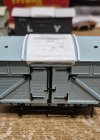
Before adding a plasticard strip across the centre line of the roof:

This was allowed to dry overnight before painting this evening:

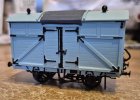

The torpedo vents have also now been fitted.
Having not painted the sheet on the Dia.3, I took the opportunity to correct this and make it match:

A satisfying evening's work and another task ticked off!
Next comes the lettering...
- James
Using the same method as on the Dia.3, I cut the respective parts in preparation:
These were then fitted in turn:
As before, I used some colour catcher paper, cut and pressed to shape:
Before adding a plasticard strip across the centre line of the roof:
This was allowed to dry overnight before painting this evening:
The torpedo vents have also now been fitted.
Having not painted the sheet on the Dia.3, I took the opportunity to correct this and make it match:
A satisfying evening's work and another task ticked off!
Next comes the lettering...
- James