Lubrication service on a small lathe

ceejaydee

Western Thunderer
I daresay that as the classic backgeared headstock design of lathe would have been driven by a flat belt which could be joined so stripping the headstock for belt replacement was not an original consideration.
I have a Drummond 4" Round Bed that has had it's flat belt replaced with a V belt although this has been cut and joined so again negating the requirement to strip the headstock for a belt change.
 

RichardG

Western Thunderer
Do either of these fit?
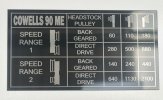
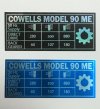
Yes the second design is just right! I did a search for "cowells lathe rating plate" and found them on eBay this morning. I guess I'm not the first to wash the ink off the original, and someone has found a market.
DSC_2528.jpeg
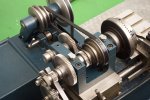
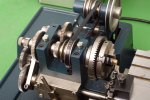
The Cowells uses a pair of sewing machine belts, so really easy to buy and cheap as chips. The part number is MB-410, which seems to mean “machine belt, 410 mm”. If only all part numbers were so simple!
DSC_2525.jpeg
When I started the motor, the machine duly flung drops of oil right down my shirt. As if to tell me, "all done!"
DSC_2532.jpeg
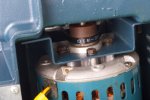
This exercise began when the motor kept on stalling. I looked at the the motor pulley and saw the belt was running on the boss of the pulley, not in the groove. The last person who changed the belts fitted the wrong length, and used the larger diameter of the boss to make the bottom belt fit. So the ratio of the gearing was higher than it should be, and everything was running faster than I thought it was.
DSC_2533.jpeg
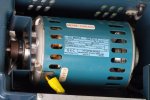
I wonder, is this the original motor or a replacement? If it is the original, surely it hasn’t got much life left?

I have read about people putting a 3-phase motor into these machines to give continuously-variable control of the speed of the motor. So fewer belt moves. I need to sit and wait, see how the machine behaves itself. I haven’t persuaded it to stall yet, and it is clearly running at its proper speeds. The new speed plate will finish the job when it arrives.

 

RichardG

Western Thunderer
I have a Drummond 4" Round Bed that has had it's flat belt replaced with a V belt although this has been cut and joined so again negating the requirement to strip the headstock for a belt change.
Reassembling the headstock on the Cowells wasn't desperately difficult.

I tightened the Allen screw in the triple pulley a tad more than finger tight, then used a rubber mallet to tap the spindle left and right until the assembly spun freely without any end float. Then tightened down the bearings until they were catching, backed them off and then put everything else back. So I can grasp the chuck and see the spindle turns freely, but however hard I push and pull I cannot feel any play.

The Allen screw in the triple pulley can now be released and tightened at will, to use the back gear or direct drive.
 

Nigel Cliffe

Western Thunderer
I wonder, is this the original motor or a replacement? If it is the original, surely it hasn’t got much life left?

I have read about people putting a 3-phase motor into these machines to give continuously-variable control of the speed of the motor. So fewer belt moves. I need to sit and wait, see how the machine behaves itself. I haven’t persuaded it to stall yet, and it is clearly running at its proper speeds. The new speed plate will finish the job when it arrives.

I'd expect the motor to last absolutely ages. If the machine has been used every day for the last 40+ years, maybe the motor is tired, but for typical use of "now and then", its not likely to be on its last legs.

Continuous variable speed could be nice, but I find that the three top-belt options nearly all my needs - I've had a 12 speed Cowell for over 30 years.

Nigel
 

RichardG

Western Thunderer
I'd expect the motor to last absolutely ages.

Well, I started this excercise because the motor kept on stalling, and the machine would not produce enough torque to turn a diameter much bigger than 6 mm. I could see the primary drive belt was worn, and so I renewed both belts so I would know everything was as good as it could be before investigating a replacement motor. I had no idea the primary reduction ratio was wrong because the wrong length of belt had been installed incorrectly.

This morning I have turned some aluminium 25 mm diameter down to 23 mm in three passes, and the swarf is continuous. The improvement could not be greater. So for the time being, I am hoping the motor is still good.

DSC_2537.jpeg
The machine has a few signs of wear and tear on the bed right next to the headstock. Of course, I don't know whether this means it was used a great deal by a careful owner who made a couple of slips; or was used quite rarely by an owner who was a bit slap dash. Such is the joy of owning what is probably a fourth- or fifth-hand machine. Still, I reckon it will see me out.
 

simond

Western Thunderer
I am reminded of the craze in the late 70’s of “jacking up“ the rear of your Capri or Cortina, and fitting big wheels “so it looks like a dragster”.

the big wheels effectively put the car in second when still in first, the overdrive effect gave fantastic mpg on the motorway, but ensured the one thing the car could not do was compete in a drag race. :)
 

RichardG

Western Thunderer
I gave this post its heading "lubrication service" because I wasn't sure where it would take me, but really the task was a belt swap plus cleaning up.

The instructions for changing the belt on the Cowells ME90 are here (scroll down the page):
Cowells Lathe – Woody's Workshop
in case they are useful to someone else one day.

The machine now smells of engine oil, something I never noticed before I started but hopefully this will fade away before it impregnates the rest of the hobby room.

This excercise is now complete except for adding the new label whenever it arrives.
 

paulc

Western Thunderer
I am reminded of the craze in the late 70’s of “jacking up“ the rear of your Capri or Cortina, and fitting big wheels “so it looks like a dragster”.

the big wheels effectively put the car in second when still in first, the overdrive effect gave fantastic mpg on the motorway, but ensured the one thing the car could not do was compete in a drag race. :)
Or go around corners at more than a sedate pace .
 

RichardG

Western Thunderer
I do understand the basic Cowells bed design has been inherited from an early cantilever one and allows very high precision work to be produced. I nearly got one instead of the Hobbymat, they were an awful lot cheaper back then and made just down the road from me in Great Bentley, but I couldn’t consider one now given the current prices.

When I bought my Cowells, a second-hand machine cost around £2,000 (more if there are plenty of tools included) and prices have stayed much the same since then. I was a bit troubled about paying so much money for something with no known provenence, but now I have taken mine to pieces and rebuilt it I can see they are built to last forever. For example the gears are steel (and 6.4 mm wide) not nylon; the bed is iron not aluminium. The principal "lifed" parts are the motor and switchgear (and the belts) and my concerns about the motor turned out to be unfounded.

My opinion is, I am happy to have the money sitting in this lathe instead of a pension fun. When I become too decrepit to be able to use it, I can sell it for most or all of what I paid, and I will have had the enjoyment of using it instead of the anxiety of watching investment rates.

The price of a new Cowells is definitely eye-watering but, a bit like houses and cars, a used one will do the job just as well. As a hobbyist, I doubt I will put any discernable wear and tear on it. So I think a s/h Cowells is a good buy!
 

Ian@StEnochs

Western Thunderer
Certainly agree with you there Richard. When I was looking for a small milling machine I looked at the offerings from the trade. Proxxon got a lot of recommendations, it is cheap, but when I really examined it I was put off by its aluminium and plastic construction. Luckily I saw a Cowells on eBay at a buy it now price and not too far away and bought it. Excellent machine, built to last.
 

RichardG

Western Thunderer
I bought a book, "The Compact Lathe" by Stan Bray, second edition 2004. Published by Special Interest Model Books.

And I am reading it avidly. About half-way into it in one evening. It is really good for the person who used a larger machine at school or at work, and wants a refresher text to help them apply their distant knowledge to a smaller machine.

A very good book to keep with or instead of the owner's manual which came with the machine.
 

John_B

Western Thunderer
I bought a book, "The Compact Lathe" by Stan Bray, second edition 2004. Published by Special Interest Model Books.

And I am reading it avidly. About half-way into it in one evening. It is really good for the person who used a larger machine at school or at work, and wants a refresher text to help them apply their distant knowledge to a smaller machine.

A very good book to keep with or instead of the owner's manual which came with the machine.
I've quickly skimmed through it on line ( The Compact Lathe By Stan Bray : Free Download, Borrow, and Streaming : Internet Archive ) and it looks very useful. I've got a one of the "cheap" Chinese lathes that I'm about to start using, which I think is a bit bigger than the ones being talked about here. The last lathe I used was the monstrous Smart & Brown Model A that my Dad bought when I was considering doing an engineering apprenticeship (I didn't!), but that was decades ago so I'm a bit rusty. Do you think this book is worth buying?

IMG_20260524_181045_191.jpg
 

RichardG

Western Thunderer
Do you think this book is worth buying?

Yes I do.

Well, it works for me on three levels. It confirms things I remember from my schooling more than 46 years ago. It tells me things which were irrelevant to a classroom environment, like taking drills and work out of chucks to avoid straining the jaws. And there are fresh things which will be good to know. The writer clearly knows his subject and he is writing from first-hand knowledge and not by cribbing from other people.

The book tells you what you can reasonably hope to achieve using a small machine. For example, for a traction engine nothing larger than one-inch scale. Though I think the larger road wheels for such a machine will be impossible. So for model railway subjects, the implication is up to Gauge 3.

There are some data tables of the sort we saw in books before we had the Internet, but having them here doesn't detract from the rest of the book. I think it is worth the £12 (even if there is a free download) because a book is easier to take to the sofa or out into the garden to sit down with and study.
 
Last edited:

Bob Essex

Western Thunderer
Stan Bray was the editor of Model Engineer for a considerable number of years and wrote many of the Argus Books engineering series dealing with a wide range of subjects. All written in a good and practical way and easy to understand.

I'm glad you started this thread as it has been most interesting as are your comments on the value of good quality tools as opposed to cheaper options. I do think though that it needs care to understand what each individual machine not only provides at a basic level but what it could undertake given the appropriate additional tooling, which is where substantial costs can ocurr if one is not careful. This can reveal that some machine equipent looks cheap to begin with but will be expensive in the long run while others may not. Personally I always try and get the best option for the long term while trying not to pay more than I need to. The Hobbymat lathe and Milling machine have both proved worthwhile over the longer term, I've had them around 35 years now I think and both have worked hard for their living and repayed the investment several times over in pure monetary costs while extra tooling was available reasonably because they use common standards rather than only being suitable for dedicated stuff at high cost.

Bob
 
Top