Rivermead Central

40057

Western Thunderer
Martin

Turntables are very space-hungry things. As we know that you have a B-L Royal Scot, you are going to need at least an 18 inch table. Unless of course you have ambitions for a Princess or a Britannia, when a 22 inch will be required. My rough calculation says that if you have a double track loop at the rear, then the MPD and turntable, and then the approach road in and out of Central at the front the total width is going to be close to three feet. That is a long stretch to the back roads - I know that you won't be shunting or messing about with couplings there, but they will be clockwork engines which have to be manually started and stopped. And quite likely wound as well, at times.

If it was all electric I would suggest putting the t/table into one of the corners, but you are going to need to be able to physically drive your engines on and off that one too. Even on my little layout, I get plenty of exercise during a running session as you can't just sit back and turn a knob (or these days, press some buttons!).

John

A turntable is a ‘must have’ but requires a lot of base-board. The corners at the north end of the room are not available because they are behind the ‘half submerged’ track of the Cavendish Goods branch. The corners at the south end of the room could be used by taking access off the Cavendish Goods branch before it starts its descent. The trouble being they are out of reach or at least difficult to reach. The one other option is to move Rivermead Central (or at least shorten a couple of platforms) and have the turntable just south of the station. The baseboard there would not need to have room for a track (the line to Rivermead Central) in front of the turntable. The issue then is access to the turntable would be over track with a raised centre 3rd rail.

There will be a workable solution, I’m sure. I regard a turntable as essential so, whatever other compromises need to be made to accommodate one, will be made. I have a pre-WW2 Bassett-Lowke turntable that needs minor work. Shorter than the post-WW2 dark grey version. Moreover, my turntable has factory-fitted Lowko Track. I don’t have a Princess or a Britannia!
 

John R Smith

Western Thunderer
I have a pre-WW2 Bassett-Lowke turntable that needs minor work. Shorter than the post-WW2 dark grey version. Moreover, my turntable has factory-fitted Lowko Track. I don’t have a Princess or a Britannia!

So your turntable must be long enough for a Royal Scot then! Your compromise will work, I am sure, but it sounds as if it will divorce the table from the running sheds and the MPD. This might be the price you have to pay. I have run my spring drive locos over 3-rail track experimentally with no problem, but there might be two issues I can think of. First. the third rail might trip the auto-stop or reverser on the engines, and secondly if the track was live you might get a short from a long coupling. But I would imagine that back in the Golden Age of coarse scale that O Gauge railwaymen would have mixed up both modes of traction quite happily.

John
 

40057

Western Thunderer
So your turntable must be long enough for a Royal Scot then! Your compromise will work, I am sure, but it sounds as if it will divorce the table from the running sheds and the MPD. This might be the price you have to pay. I have run my spring drive locos over 3-rail track experimentally with no problem, but there might be two issues I can think of. First. the third rail might trip the auto-stop or reverser on the engines, and secondly if the track was live you might get a short from a long coupling. But I would imagine that back in the Golden Age of coarse scale that O Gauge railwaymen would have mixed up both modes of traction quite happily.

John
Hi John

Realistically, I won’t get to track laying on the eastern base-board for at least two years. So, meantime, I don’t have to (and won’t) take a decision/investigate regarding the siting of the turntable. It’s a bit like the colour light signals. Have a general idea and check when ongoing work would close down an option. I will make sure the turntable can be accommodated.

I don’t have much experience of running clockwork on electric Lowko Track. A bit of testing suggests there is a risk of the brake being applied by the off-centre 3rd rail at turnouts. Hence my determination that the main running line is free of electric track. I can imagine some rather contrived options for siting the turntable south of Rivermead Central with an access off the main running circuit (but keeping the MPD in the position shown on my outline plan). It’s not a good use of time to investigate this now and in any case there are still too many uncertainties about the exact position of the tracks and platforms at Rivermead Central. I won’t be extending my base-boards, so if the space required is an inch wider than the space available, that option is ruled out.

There will certainly be clockwork locomotives (i.e. ‘steam-hauled trains’) running to Rivermead Central. Some manufacturers didn’t provide trips for track control (e.g. van Riemsdyk), sometimes previous owners have cut the trips off. There are no track-operated controls on 828 (removed when the motor was rebuilt) and the clearance underneath is sufficient to run on raised-third-rail track (deliberately so). So some, but probably not all, clockwork locos will be cleared for use on the Rivermead Central branch. Important main line trains running to/from Rivermead Central may need a locomotive change at Cairnie Junction.

Martin
 

John R Smith

Western Thunderer
So some, but probably not all, clockwork locos will be cleared for use on the Rivermead Central branch. Important main line trains running to/from Rivermead Central may need a locomotive change at Cairnie Junction.

Well, that will just add to the operational interest and might be quite prototypical, so I like the idea of engine changes at Cairnie Junction. It strikes me that quite a few of the fellow modellers reading this thread might be rather puzzled why you and I should be so concerned over this topic of physical accessibilty to the trains, simply because they have had no experience of clockwork powered locomotives!

John
 

ceejaydee

Western Thunderer
..... It strikes me that quite a few of the fellow modellers reading this thread might be rather puzzled why you and I should be so concerned over this topic of physical accessibilty to the trains, simply because they have had no experience of clockwork powered locomotives!

John

I have limited experience of spring drive but have chased my Mamod many a time before it was tamed so appreciate good track access
 

40057

Western Thunderer
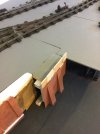
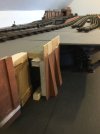
A test fit for the under-construction retaining wall for the projecting section of the high-level base-board:

9C401836-0E4F-4971-A50C-E885F0057C68.jpeg

396112EF-EE14-4A4C-8498-17825F5B5E57.jpeg

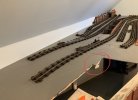
The addition can be seen by comparing with this previous photo:

02127F55-AA54-4A06-8EAC-0C5DC1C2DEEE.jpeg

The turnout connecting the track through platform 2 and the centre road just encroaches on the small additional section of base-board, also the point lever for the turnout giving access to the head-shunt.
 

40057

Western Thunderer
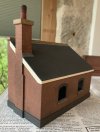
A bit of a set-back with the Cairnie Junction yard office.

Earlier in the construction, I had to correct a serious twist that developed in the structure during the hot weather a few weeks back. When I came to put the supports across the back of the building, I discovered that the front wall had warped so the two ends were no longer aligned. I cut through some of the internal wooden framing, made sure the ends lined up and put in some additional framing to hold the structure square again. Problem solved — or so I thought.

A couple of days ago, I test fitted the fascia boards. It was immediately apparent that the front left-hand corner of the roof was lower than the front right-hand corner. I am annoyed with myself for not noticing this before. It really didn’t show when the boundary was between a grey-brown coloured roof and brown-grey coloured brick-work. But, once laid in place, it was obvious that a narrow strip of wood painted cream wasn’t truly horizontal, and this was going to show.

I put the building aside for 24 h to try to work out a way of addressing the problem. I am very pleased with the paint work and really didn’t want to have to refinish the roof.

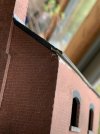
I think I have a solution which will preserve the paintwork with only some minor re-touching. On the front left corner I have cut a slot under the roof, very carefully using a key hole saw:

9088D99D-E993-4F53-BC27-76CC4522E05B.jpeg

The minor damage to brick-work will be covered by the fascia boards, so doesn’t matter. The paint-work on the top of the roof is unharmed.

I shall now force a wood wedge made from a coffee stirrer into the slot cut by the saw, so lifting the front of the roof by c. 0.5 mm. I can adjust the exact lift by varying the size of the wedge. Once the wedge is glued in place (epoxy) the roof will be at least as strong as before, but with the front edge horizontal or very, very nearly so.

Fingers crossed.
 

40057

Western Thunderer
Rescue effected:

240FDE3A-43B8-4EB0-8FEA-C12943C7CA6F.jpeg

I am still not sure of the source of the ‘tilt’ to the bottom edge of the roof, and not sure it has anything to do with the earlier warping of the wooden backing to the front wall. I suspect the problem was due to the plywood sheet forming the roof being very slightly convex on the left side, concave towards the right side. Anyway, any residual departures from straight and horizontal are probably proportionately far less than on a similar real building. Part of giving the model character.

I will of course cover the heads of the three moulding pins. I guess just using glue would be sufficient, but I have seen too many vintage buildings that have fallen apart. So I rarely rely solely on glue for attaching anything to my buildings.
 

40057

Western Thunderer
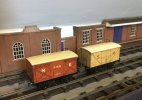
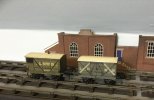
It is very unusual to acquire a piece of vintage rolling stock that needs absolutely nothing done to it. However, today, just a few hours work has completed two wagons ready for use:
2E7A9520-2810-4FA2-9C6C-53478BF886A8.jpeg

The brake van I have had for many years. A previous owner had removed the original couplings and fitted it with smaller more realistic ones. After a long search, I recently acquired a second spare coupling of the type originally fitted — so have returned the brake van to ‘as manufactured’ condition.

The covered goods van I bought a few months ago. It was very dirty, so I have cleaned it. I think the van must have been used on a layout laid on the floor, judging by the amount of hair and carpet fluff wrapped around the axles and lodged between the wheel spokes. One coupling was badly bent, now straightened. One buffer casting was loose on the steel pin used to fasten the buffer to the wagon, sorted with a spot of glue.

I am sure these two wagons are painted the same colour grey. The brake van is more thickly varnished and the yellowing of that varnish has greatly changed the appearance.

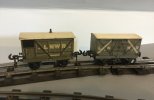
A closer look at the two wagons:
4336C434-A1C4-4943-A47F-EAA11CC36061.jpeg

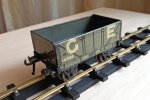
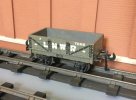
These wagons are from the same series as this one I described in my post #55:
02EB4685-8E75-4573-874C-0431547B3E49.jpeg

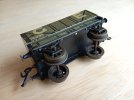
The bodies are wood, hand painted then decorated with large transfers that cover a whole side or end of the wagon body. All three wagons carry the running number ‘1920’ which will be the date of manufacture. On page 140 of ‘The Bassett-Lowke Story’ by Roland Fuller (New Cavendish Books, 1984) there is a ‘works photograph’ of three of these wagons, including the brake van and covered van models illustrated above. The photo reproduced in the book was no doubt taken to mark the introduction of these models, and two of the three wagons have solebar transfers with the number/date 1919. I have also seen solebar transfers for 1921 and wagons with no date — possibly these are of later manufacture.

The eagle-eyed will have spotted that the couplings on the open wagon are a different shape from the couplings on the two vans. The couplings on the open wagon are a kind of half-way house between the shapes of the coupling hooks used by Bing and Carette. These couplings seem to have been briefly made at Northampton just after WW1. The wagons dated 1919 in the photograph reproduced in The Bassett-Lowke Story have these half-way type couplings.

My three wagons suggest the change-over to Carette pattern couplings occurred during 1920. This would indicate that the tooling from the Carette factory in Nuremberg (shut down by the Germans during WW1) arrived at Northampton before the end of 1920. It also puts the manufacture of my open wagon earlier in 1920 than the manufacture of the two vans. Incidentally, my brake van did definitely originally have Carette-pattern couplings because the shape of the inner end of the coupling around the fixing screw had left a tell-tale scar in the paint.

I really am not a person who likes or seeks to collect ‘complete sets’. However, I suppose there is a collecting aspect to a lot of model railways, and these wooden transfer-decorated wagons are an interesting small series. Initially, in 1919, four types were issued, all LNWR. These were the three shown above plus a 10-ton mineral wagon. I have the LNWR mineral wagon too, so that’s a complete set of sorts. Slightly later, two more mineral wagons were added to the range — one GNR, the other MR and branded for loco coal. I have an example of the MR wagon but it needs a replacement W-iron to make it useable.

The six types listed above were the only pre-grouping wagons made in this series in 0 gauge. Many more types were made in Gauge 1.

The range of transfer-decorated wooden wagons was expanded later. In 1924, for sale at the British Empire Exhibition at Wembley, a fictitious private owner ‘Schweppes’ open wagon was produced at the instigation of the drinks manufacturer. I don’t think it was included in any Bassett-Lowke catalogue, but it could be bought from Bassett-Lowke shops. It was slightly cheaper than the standard models. The ‘Lowko Spirit’ tanker (see my post #115) was always listed in catalogues in the same section as the transfer-decorated wooden wagons, though it was dissimilar in many ways. Later in the 1920s, an SR open wagon and covered van were produced. No doubt these wooden SR wagons were introduced in acknowledgement of the complete lack of SR vehicles in the contemporary range of tinplate wagons. Though post-grouping, the dimensions and style of transfers used for the SR wagons were the same as for the pre-grouping types described above. When 0 gauge transfer-decorated, wooden wagons were later made for the LMS, LNER and GWR (see my post #105), the style and dimensions were closely similar to the equivalent contemporary tinplate wagons, and substantially different from the 1920s models.

 

John R Smith

Western Thunderer
Hello Martin

Thank you for your very interesting article about the wooden wagons (which almost look like tinplate at first glance). I have an elderly tinplate wagon which I have never been terribly sure about, so I thought perhaps I could introduce it here and ask for your opinon - I an sure that you will probably know far more about it than I do -

Carette GE Wagon 01.jpg

I think that this must be Carette, but made for Bassett-Lowke, as there is a (very tiny) B-L "Lowko" graphic on the solebar. There is no maker's name on it anywhere. But the couplings do not look like Carette to me, so perhaps they have been replaced? The litho is, as you can see, in very good condition, and I assume the 1913 on the solebar might be the date of manufacture?

Carette GE Wagon 07.jpg

The wheels are spoked cast iron, and very nice true running, but do you think they could be original? It is a tiny little wagon, and quite charming.

Like you, I have become quite a wagon collector in recent years - and now I have far too many for my small layout!

John
 

40057

Western Thunderer
Hello Martin

Thank you for your very interesting article about the wooden wagons (which almost look like tinplate at first glance). I have an elderly tinplate wagon which I have never been terribly sure about, so I thought perhaps I could introduce it here and ask for your opinon - I an sure that you will probably know far more about it than I do -

View attachment 243441

I think that this must be Carette, but made for Bassett-Lowke, as there is a (very tiny) B-L "Lowko" graphic on the solebar. There is no maker's name on it anywhere. But the couplings do not look like Carette to me, so perhaps they have been replaced? The litho is, as you can see, in very good condition, and I assume the 1913 on the solebar might be the date of manufacture?

View attachment 243442

The wheels are spoked cast iron, and very nice true running, but do you think they could be original? It is a tiny little wagon, and quite charming.

Like you, I have become quite a wagon collector in recent years - and now I have far too many for my small layout!

John
Hi John

Yes, it’s Carette. From the range produced exclusively for Bassett-Lowke, designed by Henry Greenly.

I refer you to my post #129 for more information. You can, for example, see the series number included in the lithography — 13446 (one of the last new designs added to the range).

The couplings are replacements — later Bassett-Lowke. Also the wheels — Milbro wagon wheels. The original Carette wheels weren’t a great design and I would say have usually been replaced to improve running.

Nice wagon!

Martin
 

John R Smith

Western Thunderer
Ah. I went back to your post #129 et seq, and found everything I needed to know, including what the "35" meant.

Quite an education!

John
 

40057

Western Thunderer
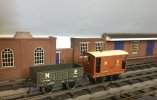
Gracious! Rivermead Central is starting to look like a vintage model railway:

4EC20173-D9B3-4520-8605-EF082C2C7EE1.jpeg

My new Hornby LNE fish van and an SR refrigerator from the same series (No. 0 vans in Hornby-speak). See my post #275 for more information.

Not up to ‘Bassett-Lowke standard’, but undeniably nice looking vans. And quite good models, within the limitations of the method of manufacture and practical/economic necessity of using the same body pressings and under-frame across the range. There were twelve different types of No. 0 van. Less said the better about the 4-wheeled GW siphon. I won’t be getting one of those! The LMS fish van though, in NPCCS red livery, is a really good representation. Likewise, the LMS refrigerator and banana vans. There were no equivalent vehicles to these offered by Bassett-Lowke, so the Hornby vans can add variety to a vintage railway.

It doesn’t really show in the above photograph, but the SR van is fitted with Hornby spoked wagon wheels. These are alloy castings and were sold separately so owners of Hornby railways could upgrade from the tinplate wheels supplied as standard. Fortuitously, the Hornby spoked-wheel sets are dimensionally pretty similar to Bassett-Lowke wheels — so the SR van should behave on my track.

It’s a good illustration of the relative position of the Hornby and Bassett-Lowke ranges. Hornby wagons — sold with tinplate wheels, but owners could get better running and appearance by buying cast alloy spoked wheels as extras. Bassett-Lowke wagons — sold with cast alloy spoked wheels, but owners could get better running and appearance by buying turned, cast-iron spoked wheels as extras.
 

40057

Western Thunderer
On a roll with wagons. Two more sorted and ready for traffic:

E9093717-0D4C-4FDE-9DED-7C09702593E9.jpeg

In truth, very little needed doing to either of these beyond a light clean. I have given the merchandise wagon Bassett-Lowke turned cast-iron wheels, in place of the cast alloy wheels originally fitted. One of the alloy wheels was badly out of true. Possibly it had always been so, or it might have been damaged at some time. Either way, Bassett-Lowke supplied cast iron wheels so customers could upgrade their wagons, so replacing the wheels as I have is entirely appropriate. My general policy for Bassett-Lowke wagons is to keep the original alloy wheels when present and true running. If the original wheels are missing, damaged or badly out of true, I fit Bassett-Lowke cast-iron wheels. The turned cast-iron wheels do run much better. The very broad alloy wheels fitted to Bassett-Lowke wagons through the 1920s and until the late ‘30s are rarely completely true but better in this respect than the wheels fitted to the pre-WW1 Carette-made wagons.

The above wagons date from the 1930s. They are lithographed tinplate constructed using the tab-and-slot method. The merchandise wagon is the older of the two as it has long-link couplings with a hook that is almost identical to the shape used by Bing. The brake van has the later coupling with a smaller, neater hook and a shorter drop link (which doesn’t touch the third rail!). I think the change to the later coupling was in about 1935/6. This series of wagons was introduced in 1929 and by 1931 had replaced all of the previously made tinplate wagon models. There were about twenty-five different wagons offered — so only half the number in the 1914 catalogue. Partly, this was because there were now only four principal railway companies. But types made pre-WW1 such as a rectangular tank wagon, bolster twins, fish trucks and a pitched-roof lime wagon did not feature in the 1930s range. The 1930s wagons included open merchandise wagons and covered goods vans for all four main railway companies, brake vans (LMS, LNER and GWR), a cattle wagon (LMS), a refrigerator (LNER), bogie brick and trolley wagons (LNER), a mineral wagon (PO — Bassett-Lowke, Model Engineers) and four tankers. The LMS merchandise wagon, covered goods van and brake van were updated after 1936 to the new LMS wagon livery. No post-1936 livery versions were made of the other railway companies’ wagons.

Nice though the 1930s wagons are, they generally don’t equal the wagons made for Bassett-Lowke by Carette pre-WW1. The printing is not as fine and well detailed. All the 1930s 4-wheeled wagons share a common underframe. The underframe, including the W-irons, is made from one sheet of metal, lithographed, then pressed into shape. The Carette-made wagons had separate W-irons, soldered on — so wagon length and wheel base could be varied as per prototype. The need to solder on the W-irons meant the basic under-frame couldn’t be lithographed, but was painted after soldering — then separate litho-printed solebars were clipped on. So the Carette construction was much more complex, presumably relatively expensive, but the wagons were dimensionally more accurate.

The common length of all the 1930s 4-wheeled wagons does mar some of the models. To my eyes, the LNER brake van pictured above is a fine representation. I would say it is easily the best of the 1930s goods brake vans, as the proportions of the standard van body are not right for the GWR and LMS versions. Interestingly, post-WW2, the last new lithographed wagon model made was a lengthened version of the LMS brake van, albeit in BR livery. On the plus side, the 1930s wagons do not suffer from corrosion due to residual flux left after soldering — because no solder is used in their construction. And the best of the 1930s wagons are very good indeed. The four tankers (Esso, Pratt’s Spirit, Mobiloil and United Dairies/GWR) and the trolley wagons (empty or with boiler or cable drum) are particularly handsome models and surely amongst the best tinplate wagons ever made.
 
Last edited:

40057

Western Thunderer
Very little progress to report over the last two weeks. Too hot, for a start. Also, asked to help out with something I was involved in before retirement.

However, the fascia boards are fitted to the Cairnie Junction yard office:

D0CC2F20-FC8A-4634-97BF-CF5E9174AEEE.jpeg

Some minor attentions still required to tidy up the paintwork after fitting. Still to go, door and windows.
 
Top