Rivermead Central

40057

Western Thunderer
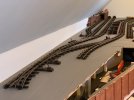
Heartening progress with track laying. I do sometimes wonder if I have set myself too big a task with Rivermead Central, but today two significant milestones were passed. First, the yard at Cairnie Junction is now connected to the main line. Second, track now extends more than half way down the west side of the room:

5B4ACF36-98A3-4246-8777-7DAE6A4BDC9A.jpeg

The two turnouts in the foreground are the newly laid track.

974644A5-29A0-46C8-8AA3-EFBF8C48307F.jpeg

The newly laid turnout further from the camera is the one I have not repaired — because it isn’t broken. I examined it very carefully and there is no sign of any cracking or separation in any of the critical soldered joints. The turnout has been well used; holes drilled in the battens show it to have been previously screwed to a baseboard, and traces of green, brown and grey paint on the sleeper ends suggest it was once part of a railway with scenery. This was actually the first Lowko Track turnout I bought, whilst still a student. I remember it being pressed into service in my hall of residence, laid on the floor, to demonstrate clockwork trains to other members of the university railway society. Of course, I did not realise at the time that a Lowko Track point that is not broken is a very rare thing. I thought I had found the perfect track system …

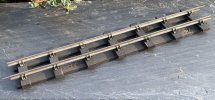
Talking of perfection, the next track I will lay is plain line, the head-shunt for the sidings in the yard behind platform 1. Here’s the track panel I shall use adjacent to the turnout:

96996240-8941-455C-9BC5-C53BFE8C78C8.jpeg

It’s at least ninety years old but looks like it was made last week. Earlier in this thread, someone made a comparison with time travel. It really does feel like that — laying effectively brand new track, which was designed in 1908 and made probably in the 1920s.
 

40057

Western Thunderer
The Cairnie Junction yard office now has a roof:

D72D16A0-2640-4EB7-9F4E-4DBA1AC03960.jpeg

The roof is plywood with impressed ‘slates’, recovered from a wrecked 1950s model building. I made the slate roofs on the Benham’s buildings from the same material.

I’ll make and fit the coping on the back wall (this is a lean-to in its construction) and the chimney stack before weathering the whole building. Then add the fascia boards, windows and door.

Happy with it so far.
 

40057

Western Thunderer
More track laid!

D1A70016-4463-4ADB-9054-EEBCCC60DC06.jpeg

Three track panels forming the rearmost track southwards from Cairnie Junction station. Some track is now in place on the west side high level base-boards for more than three-quarters of the length of the room. That’s an end to track laying for now, until I have further turnouts repaired.

This section of the high level base-boards can accommodate three parallel tracks. The front track has to be the main line circuit. One of the other tracks has to be the start of the Cavendish Goods branch. The third track could be a head-shunt (for the north end sidings), a siding or one side of a loop. My intention had been to use this back track as a head-shunt, but laying the track panels this afternoon has made me realise that won’t work. It’s too much of a stretch to reach the back track, especially at the south end, to be able to easily manipulate the controls of a shunting locomotive. The middle track in this section, nine inches closer to the operator, will have to be used as the head-shunt. I will consider further whether to keep the back track as a siding or make it into a loop with the middle track. A siding would be perfectly practical operationally, trains of wagons being propelled in/pulled out by a locomotive that ventures only into the more reachable north end of the siding.

The practical consideration of reaching locomotives to operate them is also going to limit what I do with the south-west corner of the room. The width of the low-level base-board here means the back of the high level base-board is too far away to be used for trains. I’m thinking some kind of large factory, diagonally across the corner of the room, with three tracks in front would be workable. More thought is required.

As well as needing to repair more turnouts before I can continue track laying southwards, I will have to relocate my stock of Lowko Track. I suppose it was inevitable that over many years the expanse of vacant base-board would get used for storage or as a work surface. The south-west corner has been used to store Lowko Track:

9C5200A3-90A8-4267-9BA9-5C3801644841.jpeg

There’s approximately a hundred track panels in that pile, all straightened, cleaned, repaired etc, and ready to use. Except the points, which are not repaired. Roughly eighty track panels have been laid to date. I think I have enough track to complete the layout, but whether the numbers of straights/curves/electric/non-electric correspond to what I will need I don’t know. In the above photograph, the end of the track I laid this afternoon is on the right, the south-west corner of the room is on the far left.
 

John R Smith

Western Thunderer
Gosh, it is all looking very good, Martin. And I really do envy you your space - I have never had anything approaching twenty feet long to establish my railway empire in. The best that I have now is just twelve feet. I also think that you must have the patience of a saint! I can't imagine waiting so long to get something running, I have always laid the track first and tested it thoroughly with every layout I have built. If it had been me, I would have at least got a complete circuit down before I even thought about buildings or more rolling stock, as long as I had a loco and a few wagons. I do appreciate, of course, that in your case you have to rebuild and repair the track before you can use it!

The problem of your rearmost line is a tricky one. I had assumed from your plan that it would be the headshunt cum reception road for the three road yard with Benhams works at the back, which would work with goods traffic coming in from the north. But as you say, the big problem with clockwork engines is that you have to be able to reach them - on my own layout, nothing is further than 18 inches away (and I am short, which makes this even more important). So if you no longer have this headshunt it is hard to see how you will work the yard, unless you use the Cavendish Branch for this, in which case you are fouling a running line during shunts. As a siding this rearmost track is not terribly useful, because to work it once again you either have to foul a running line or leave one of the yard sidings clear to act as a headshunt. I can think of one excellent potential use, though - as a carriage siding for trains which start or terminate at Cairnie Junction.

Loops are useful, but are very space-hungry. They are big chunks of double track which are running lines and by definition must be kept clear. So you end up with a lot of trackage which cannot be used to park wagons or coaches - I have the same problem on my little layout now that I have introduced a run-round. In many ways, using a pilot engine to shunt stock and release the train engine is rather more space efficient. So at Kingswell Street we have a mixed approach - some trains have their engine run round and set back into the platform, whereas others have the stock shunted clear by our resident pilot. And I have to confess that sometimes the pilot gets parked in the loop!

GWR Local Pass Web.jpg

As you can see, my run-round is very short, so we can just get around the GW sixty-foot A Set brake and a six wheeled van. Even so, it takes up nearly half the layout (but it has added to the operational scope).

Following your progress with great interest!

John
 

Roger Pound

Western Thunderer
Martin,

I really admire your thorough and steady progress with Rivermead. If I may venture an experience of filling an awkward corner, I had a similar situation on my Sumwear-in-England 00 layout where I wished to 'hide' the r2 curve which ran on to the sector plate storage. I solved that by putting a factory complex over it. There was already a raised roadway crossing the track at the commencement of the curve - my little grey cells were on go-slow before that solution became so obvious! As you have no railway equipment to consider, as I understand it, a nice factory complex should not only solve your problems but look good too. The best of luck with whatever you decide !

Roger
 

40057

Western Thunderer
Gosh, it is all looking very good, Martin. And I really do envy you your space - I have never had anything approaching twenty feet long to establish my railway empire in. The best that I have now is just twelve feet. I also think that you must have the patience of a saint! I can't imagine waiting so long to get something running, I have always laid the track first and tested it thoroughly with every layout I have built. If it had been me, I would have at least got a complete circuit down before I even thought about buildings or more rolling stock, as long as I had a loco and a few wagons. I do appreciate, of course, that in your case you have to rebuild and repair the track before you can use it!

The problem of your rearmost line is a tricky one. I had assumed from your plan that it would be the headshunt cum reception road for the three road yard with Benhams works at the back, which would work with goods traffic coming in from the north. But as you say, the big problem with clockwork engines is that you have to be able to reach them - on my own layout, nothing is further than 18 inches away (and I am short, which makes this even more important). So if you no longer have this headshunt it is hard to see how you will work the yard, unless you use the Cavendish Branch for this, in which case you are fouling a running line during shunts. As a siding this rearmost track is not terribly useful, because to work it once again you either have to foul a running line or leave one of the yard sidings clear to act as a headshunt. I can think of one excellent potential use, though - as a carriage siding for trains which start or terminate at Cairnie Junction.

Loops are useful, but are very space-hungry. They are big chunks of double track which are running lines and by definition must be kept clear. So you end up with a lot of trackage which cannot be used to park wagons or coaches - I have the same problem on my little layout now that I have introduced a run-round. In many ways, using a pilot engine to shunt stock and release the train engine is rather more space efficient. So at Kingswell Street we have a mixed approach - some trains have their engine run round and set back into the platform, whereas others have the stock shunted clear by our resident pilot. And I have to confess that sometimes the pilot gets parked in the loop!

View attachment 241773

As you can see, my run-round is very short, so we can just get around the GW sixty-foot A Set brake and a six wheeled van. Even so, it takes up nearly half the layout (but it has added to the operational scope).

Following your progress with great interest!

John
Hi John

Thank you for your comments and interest.

Yes, I am very pleased with how it looks.

Of course, it is very tempting to just lay a circuit of track. But then I would have to lift it, or parts of it, to install scenery. Also, once I knew exactly where they had to go, to put in points. And with track joined with alternating spikes into hollow rail heads, you can’t just take out one piece. Certainly appealing to get a circuit down — but actually I think it would slow progress.

I know I am fortunate to have such a good sized space for the railway. It is still not big enough! By which I mean, compared with a true scale model, the sidings, loops and platforms are much too short, everything is compressed. In terms of the work to build the layout, I wouldn’t want anything larger! Every layout has compromises, visually and operationally. I just have to decide which ones I am prepared to make. Using one track for two functions — running line and head-shunt — might just have to be one of the concessions to lack of space. I won’t be the first to use that work-around.

Just laying the three track panels yesterday highlighted to me how much easier it is to work at the back of the layout first. I have, if you recall, lifted the Lowko Track previously laid on the low level base-boards, forming the yard at Cavendish Goods. I am sure I would have somehow managed to lay the track I put down yesterday if the track on the low level was still there. But it would have been much, much more difficult to work on the rear track. Being able to rest weight on the other hand when stretching over to use the drill, tighten screws etc. really helps. So I do need as far as possible to work on the back of the layout first and work forward, section by section.

Using the rear track as a head-shunt/reception was my intention, but, as of yesterday, I realise it is not practical. I don’t think it shows in any of the photographs I have used, but the low level base-board is narrower, by about a foot, roughly opposite the north and south facing yard accesses at Cairnie Junction. The narrowing is for access to the stairs into the room. So around the area of the Cairnie Junction yard accesses and the point-work at the south end of platforms 1 and 2, the whole width of the high-level base-board is easily reached. North and south of the section with the narrower base-board, where the base-boards are full width, the rearmost track on the high-level is a stretch — too far away for easy operation of clockwork locomotives. In the corners of the room, the back of the high-level base-board is out of reach (at least 4’ from the operator). Practically therefore, I need to use the rearmost track for storage, to park rolling stock. And access needs to be from the centre of the room where I can reach the locomotive pushing in/pulling out the wagons/coaches (the Benham’s siding fits these criteria).

I laid three track panels yesterday forming the rear track to the south of the yard access. The two panels nearest the turnout were easy to reach due to the narrower base-board. The third track panel was a stretch to reach due to the full-width base-board. It would be the same for the next track panel. After that, heading into the corner of the room, to lay a fifth track panel/buffer stop, I will have to stand on a low stool to reach. Track I can’t easily reach can still be used for parking rolling stock — as long as the locomotive at the other end of the train can be reached.

Use of the rear track I was laying yesterday requires further thought. It could be the line to Cavendish Goods, though that has practical difficulties. I need parking space for rolling stock. If I keep it as a siding four track panels long (= 5’), stock can be shunted into it using the track into the three sidings behind the platforms. There are four track lengths before the middle and rear sidings start.

The alternative you suggest — a carriage siding — had occurred to me too. Operationally, it would work well. The biggest downside is that I am already short of space for goods wagons, without making the problem worse.
 

John R Smith

Western Thunderer
I need parking space for rolling stock. If I keep it as a siding four track panels long (= 5’), stock can be shunted into it using the track into the three sidings behind the platforms. There are four track lengths before the middle and rear sidings start.

The alternative you suggest — a carriage siding — had occurred to me too. Operationally, it would work well. The biggest downside is that I am already short of space for goods wagons, without making the problem worse.

Thank you for your thoughtful reply, Martin. And I was only teasing you a bit about slapping some track down - I am a very impatient person! I must admit that if a project drags on for too long, then I lose interest, so I really admire your tenacity.

I understand you need for stock storage, and as you say, as long as the loco is at the right end (and accessible) then you can use the rear track as a storage siding. But it would actually work better for carriages than goods stock in this role, unless you are going to keep your wagons in set rakes, like coaches. Otherwise you are going to have to end up using some of your running lines as a marshalling yard. And ideally, if you had more than one operator (shades of Crewchester!) then you want to be able to do any shunting at Cairnie Junction while through trains pass by on the main.

I have a terrible time with all this. Even though I have five yards of storage sidings off-stage as it were, I still have far too much stock to have it all out at once. So a lot of the carriages and engines live in their boxes on shelving beneath the layout. But then Kingswell Street is not really a layout, it is more like a diorama with some movement!

John
 

40057

Western Thunderer
Thank you for your thoughtful reply, Martin. And I was only teasing you a bit about slapping some track down - I am a very impatient person! I must admit that if a project drags on for too long, then I lose interest, so I really admire your tenacity.

I understand you need for stock storage, and as you say, as long as the loco is at the right end (and accessible) then you can use the rear track as a storage siding. But it would actually work better for carriages than goods stock in this role, unless you are going to keep your wagons in set rakes, like coaches. Otherwise you are going to have to end up using some of your running lines as a marshalling yard. And ideally, if you had more than one operator (shades of Crewchester!) then you want to be able to do any shunting at Cairnie Junction while through trains pass by on the main.

I have a terrible time with all this. Even though I have five yards of storage sidings off-stage as it were, I still have far too much stock to have it all out at once. So a lot of the carriages and engines live in their boxes on shelving beneath the layout. But then Kingswell Street is not really a layout, it is more like a diorama with some movement!

John
Hi John

Undoubtedly, you are right. A carriage siding would be the most appropriate use. Certainly right for Cairnie Junction where the only other stabling for coaching stock is the siding curving north-east accessed from the station centre road.

In the context of the whole layout though, I am very short of space for wagons.

It all comes back to not having enough room. Cairnie Junction really should have three platforms. But those three platforms would have to fit in the space in front of the hidden Cavendish Goods line (or over it, for the rear platform). To get three platforms of reasonable length, all the options required the platforms to be moved further south — further from the 180 degree ‘north end curve’. Which reduced the length of the low-level space for Cavendish Goods, making that yard unworkable. I could manage two through platforms and a bay — but only with the bay facing the wrong way. So I settled for two platforms + centre road at Cairnie Junction — but with a definite plan for a bigger station at Rivermead Central. Which means no space for goods sidings at Rivermead Central. Etc. Etc.

I find I consistently underestimate the space required. In my imagination, I will install four long sidings. Only to find there is actually room for only three quite short ones. I am indeed lucky to have a large room, but that extensive goods yard I imagined building? It’s three sidings and I am struggling to provide a head-shunt for them.
 

John R Smith

Western Thunderer
I find I consistently underestimate the space required. In my imagination, I will install four long sidings. Only to find there is actually room for only three quite short ones. I am indeed lucky to have a large room, but that extensive goods yard I imagined building? It’s three sidings and I am struggling to provide a head-shunt for them.

Martin

I do sympathise. I know it is not much help, but I think that the problems you are struggling with are twofold.

Firstly, there is an inherent tendency for continuous layouts to be overweighted with running lines and to be short of yardage. This is because inevitably the curves in every corner of the room create dead space behind, which it is difficult to use because of reach - a problem made worse of course in the larger scales, and worse still using clockwork. Even if you were electrically propelled, fiddling around with three link couplings is no joke at full stretch. So, ideally one would have all the yards and shunting areas in front, and the running lines behind, but this is rarely practical with a continuous plan, because bringing the sidings to the front makes them very short, as they are now inside the corner curves.

Secondly, both you and I are constrained by using sectional B-L track, and we are bound by the lengths and crossing angles of the Northampton design. Whereas if you were building your own track, you could save considerable amounts of space with custom turnouts and crossings - tandem turnouts, double slips etc. I did this on a fine scale O Gauge layout I built in 1973, where I crammed an amazing amount of track onto a five foot board by building it all myself - it ended up almost all turnouts and very little plain line! But this is not an option for Rivermead Central.

The yard at Cairnie Junction is fine in principle, with three sidings and if we put the rear line back to a role as a headshunt (I know, we can't) for a moment then the design is OK - but - it does not offer as much storage as one might imagine at first glance. The headshunt must be kept clear, especially as it also serves as a goods reception road. Every shunter will tell you that you can shunt a yard with only two sidings, but he would much rather have three. And the third is not for storage, but for dumping the brake van and organising the shunted wagons - beacause of course a lot of the wagons in the yard will be loading/unloading and should not be moved if possible. So now, in reality, of the four roads you only have two for storage (although, of course, you can get away with the odd wagon or two dumped at the ends of a siding).

Have you got plans for Central and Cavendish Goods sorted out yet? If so, it might be a good idea at this stage to sit down and work out your total siding capacity. Then, see how that sits with your carriage and wagon stock lists. Platforms, to a certain extent can serve as carriage and van storage in a terminus. And I guess that you will want a MPD somewhere for your locos - and a turntable (which would be ideally sited in a corner)?

John
 

40057

Western Thunderer
Martin

I do sympathise. I know it is not much help, but I think that the problems you are struggling with are twofold.

Firstly, there is an inherent tendency for continuous layouts to be overweighted with running lines and to be short of yardage. This is because inevitably the curves in every corner of the room create dead space behind, which it is difficult to use because of reach - a problem made worse of course in the larger scales, and worse still using clockwork. Even if you were electrically propelled, fiddling around with three link couplings is no joke at full stretch. So, ideally one would have all the yards and shunting areas in front, and the running lines behind, but this is rarely practical with a continuous plan, because bringing the sidings to the front makes them very short, as they are now inside the corner curves.

Secondly, both you and I are constrained by using sectional B-L track, and we are bound by the lengths and crossing angles of the Northampton design. Whereas if you were building your own track, you could save considerable amounts of space with custom turnouts and crossings - tandem turnouts, double slips etc. I did this on a fine scale O Gauge layout I built in 1973, where I crammed an amazing amount of track onto a five foot board by building it all myself - it ended up almost all turnouts and very little plain line! But this is not an option for Rivermead Central.

The yard at Cairnie Junction is fine in principle, with three sidings and if we put the rear line back to a role as a headshunt (I know, we can't) for a moment then the design is OK - but - it does not offer as much storage as one might imagine at first glance. The headshunt must be kept clear, especially as it also serves as a goods reception road. Every shunter will tell you that you can shunt a yard with only two sidings, but he would much rather have three. And the third is not for storage, but for dumping the brake van and organising the shunted wagons - beacause of course a lot of the wagons in the yard will be loading/unloading and should not be moved if possible. So now, in reality, of the four roads you only have two for storage (although, of course, you can get away with the odd wagon or two dumped at the ends of a siding).

Have you got plans for Central and Cavendish Goods sorted out yet? If so, it might be a good idea at this stage to sit down and work out your total siding capacity. Then, see how that sits with your carriage and wagon stock lists. Platforms, to a certain extent can serve as carriage and van storage in a terminus. And I guess that you will want a MPD somewhere for your locos - and a turntable (which would be ideally sited in a corner)?

John
Hi John

Thank you again for your insights.

Agree about the tendency to too high a proportion of running lines. It’s one reason why I’m sticking with a single track main circuit, though a bit odd for an express headed by a Royal Scot or similar. But double track would take up too much base-board space. Even fewer sidings!

Your second comment about bespoke track to save space. Well, Bassett-Lowke did sell components for home construction of Lowko Track. I have some — including, for example, check-rail chairs not used in factory-made points. I have made a Lowko Track point. I used the sleeper raft from a very rusted and wrecked tinplate point and built a new set of rails, in brass, and added a third rail. In this case, my point is a standard 3’ 2 1/4” radius turnout of the same dimensions as the standard factory product. But I could equally well have built something different. It’s a question of time, but if I needed a different radius or tandem turnout which would make a huge difference to what I could accommodate, I would consider a scratch build using Lowko Track components. There is also the possibility of special order factory made track. A friend has a fan of sidings in Gauge 1 Lowko Track which is clearly factory made and much more compact than a similar formation made up using standard turnouts.

I won’t be attempting a Lowko Track double-slip.

Regarding the ‘yard’ at Cairnie Junction. It is, of course, too small. But it was the largest possible. A couple of helpful aspects. The sidings, though short by the standards of real life, are long in relation to the train length most clockwork locos can manage. So I can easily store four or five wagons at the far end without reducing operational efficiency. The Benham’s siding is six track panels, four of which are on Benham’s land in front of their works. Leaving two track panels in railway ownership adjacent to the turnout. I will have a loading gauge here. But on the basis of one movement per day (maximum) in and out of the Benham’s works, the section in railway ownership can be used to park brake vans etc during shunting operations. There are still three sidings for railway use.

I do have a plan for Cavendish Goods. Very little wagon storage capacity, unfortunately. There has to be a run-round loop, a head-shunt and there are two private sidings. And it’s not a big yard. One siding only where wagons can be left parked.

I am not planning to use all my wagons on the layout at any one time. Apart from anything else, like you I have tinplate wagons and wooden wagons of more scale appearance. To my mind, they don’t look right together. So sometimes I will have a tinplate railway, sometimes a vintage wooden wagon railway.
Martin
 

John R Smith

Western Thunderer
I am not planning to use all my wagons on the layout at any one time. Apart from anything else, like you I have tinplate wagons and wooden wagons of more scale appearance. To my mind, they don’t look right together. So sometimes I will have a tinplate railway, sometimes a vintage wooden wagon railway.

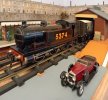
I completely agree with this approach, Martin. Tinplate and wooden wagons just don't work well together, so I don't mix them up either, although I have both. You will laugh, but the total siding capacity on my effort is just nine wagons (not counting the engine shed which sometimes has a loco coal wagon in it). However, as long as the platform road is clear, it is shuntable - just!

Rather than something like the W S Norris seventy foot purpose built hall, I am forced to concentrate on little cameos within the scene -

Pilot 5374 in Goods Shed Web.jpg

Which is quite fun, for photography at least. Your magnum opus will at least be a lot more spacious and offers plenty of scope for mainline running with lengthy trains, so that is what you are gaining with your track plan. Something has always got to give, but I would give a lot to have the option of sitting back and letting a big engine and express train just run through at speed. So you gain in that respect, but lose a bit on yards and sidings. I think that is a reasonable compromise, and I am sure that it will all be very satisfying when it is finished!

John
 

40057

Western Thunderer
I completely agree with this approach, Martin. Tinplate and wooden wagons just don't work well together, so I don't mix them up either, although I have both. You will laugh, but the total siding capacity on my effort is just nine wagons (not counting the engine shed which sometimes has a loco coal wagon in it). However, as long as the platform road is clear, it is shuntable - just!

Rather than something like the W S Norris seventy foot purpose built hall, I am forced to concentrate on little cameos within the scene -

View attachment 241808

Which is quite fun, for photography at least. Your magnum opus will at least be a lot more spacious and offers plenty of scope for mainline running with lengthy trains, so that is what you are gaining with your track plan. Something has always got to give, but I would give a lot to have the option of sitting back and letting a big engine and express train just run through at speed. So you gain in that respect, but lose a bit on yards and sidings. I think that is a reasonable compromise, and I am sure that it will all be very satisfying when it is finished!

John
Good morning, John

In terms of the effort required to build it, I certainly wouldn’t want to attempt a larger layout. That would definitely never get finished. Rivermead Central is quite big enough, thank you.

The section of the yard at Cairnie Junction we have been discussing should ideally include a head-shunt, a loop and at least two storage/shunting sidings — five tracks. There is actually space for three tracks two of which are running lines. It’s not that the layout is too small (see above), the decision is about making the best of use of what is available, reflecting real practice as far as possible and the practical needs of operating the layout.

Regarding the back track, I’m short of storage space for wagons so that would be a good use. Using the start of the Cavendish Goods branch as both a running line and head-shunt is not ideal but not ridiculous. It also makes the shunting locomotive easier to reach and, in effect, lengthens the head-shunt. I don’t need to take a decision now about what to do. Whether I can fit another reachable siding in the south-west corner has a bearing because that could be used for wagon storage instead. Also, when shunting the three sidings in the ‘north yard’, the shunting locomotive would not generally need to use more than the first one or two track panels of the head-shunt — easily reached whichever track is used. (Using the back track as a reception siding is different because the main-line locomotive would need to be stopped where it could not be easily reached).

In addition to the above considerations, I have a different approach in hand. Previous to the current discussions about the tracks to the south, I had already realised operating a locomotive in the sidings behind the station was going to be at least awkward. I decided I need a powerful shunter with variable speed and easy to operate controls, even at arm’s length. So, after discussions with Tom Mallard, the design of just such a locomotive is underway. I’m not sure when we’ll have something we can share on WT, but there is a plan for a purpose-built heavy shunter.

Martin
 

40057

Western Thunderer
I completely agree with this approach, Martin. Tinplate and wooden wagons just don't work well together, so I don't mix them up either, although I have both. You will laugh, but the total siding capacity on my effort is just nine wagons (not counting the engine shed which sometimes has a loco coal wagon in it). However, as long as the platform road is clear, it is shuntable - just!

Rather than something like the W S Norris seventy foot purpose built hall, I am forced to concentrate on little cameos within the scene -

View attachment 241808

Which is quite fun, for photography at least. Your magnum opus will at least be a lot more spacious and offers plenty of scope for mainline running with lengthy trains, so that is what you are gaining with your track plan. Something has always got to give, but I would give a lot to have the option of sitting back and letting a big engine and express train just run through at speed. So you gain in that respect, but lose a bit on yards and sidings. I think that is a reasonable compromise, and I am sure that it will all be very satisfying when it is finished!

John
Hi John

Can I ask, is 5374 your ‘resident pilot’? It looks to have rather finer profile wheels than is usual on those locos?
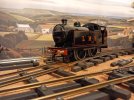
Odd things, those freelance Bassett-Lowke 0-6-0Ts. Quite expensive relative to the other contemporary freelance designs, or even the Compound. But a long production period and quite common to find today, so they must have sold well. I say odd, because they are not typical of 0-6-0Ts having outside cylinders and large diameter wheels. Yet they make a handsome model. I have an LMS one but with disintegrating alloy wheels, so unuseable.

Martin
 

John R Smith

Western Thunderer
Can I ask, is 5374 your ‘resident pilot’? It looks to have rather finer profile wheels than is usual on those locos?
Hello Simon

Indeed, my 5374 (which is one of the first series of these B-L 0-6-0 Tanks) has been the resident pilot for some time. She actually has larger wheels than the later production runs, and even more unusually the wheels are cast iron, not Mazak, which would be normal with a clockwork engine. She has nutted axles, as well, not press fit. Mazak "rot" is sadly very common on many B-L engines (as well as Hornby) - the Hornby 4-4-2 tank in my previous picture has had all new wheels.

Unfortunately 5374 was the station pilot, and was a really nice slow speed shunter - but the governer has malfunctioned, and now she is unuseable as light engine because she dashes off at supersonic speed and is hard to catch. I don't know if you are familiar with B-L governers, but the bob weights are all controlled by a little spring - my spring has broken, and I cannot find a replacement or anybody with the expertise to strip the mechanism and replace it.

So the 0-6-0T is retired, and pilot duties are now in the hands of a B-L 0-4-0 tank which uses the same body pressings (but shortened).

Backscene B-L 0-4-0 Web.jpg

This photo is from many moons ago when we had a rural backscene. The little 0-4-0 no 10 has plenty of grunt, and will haul several heavy Exleys around no trouble, but I did like the 0-6-0 rather better.

John
 

40057

Western Thunderer
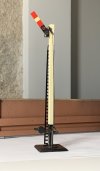
Some conservation work completed on a post-WW2 Bassett-Lowke signal:

21760EC5-99A8-4FBF-8930-0F1AAEC8116E.jpeg

This is from the cheaper — I should probably say ‘less expensive’ — range of signals, made of tinplate. The post is of soldered construction and painted. The ladder is painted and fastened to the post by means of wires inserted into holes. The signal arm is lithographed, assembled using bent over tabs. So quite a complex item to make.

Conservation work was very necessary. The signal was suffering from a common problem affecting Bassett-Lowke tinplate models assembled using solder — inadequate cleaning of the flux before painting. Overall, the signal is in super condition. The top of the ladder where the fastening wires had been soldered in place was heavily rusted. I removed the rust using a phosphoric-acid based rust remover — which revealed the flux/rust had eaten right through the ladder in one place leaving a hole. After treatment, the affected area was painted with anti-rust primer. Then black paint to match the original.

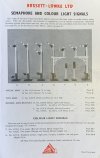
I rather like these tinplate signals. Compared with before WW2, the post-war range included far fewer variations. No 3-way junction signals or gantries, for instance:

CB257C2F-C05E-4D0F-90DC-7398627304D6.jpeg

(Above and below, from the 1956 catalogue).

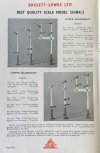
The range of ‘best quality’ signals was more extensive:

03111ABD-5500-4A39-9344-997E853B0E97.jpeg

The superior signals have wooden posts and operate prototypically using wires. But no ladders on the standard production, unlike the tinplate signals.

I expect to use signals from both ranges on Rivermead Central.
 

40057

Western Thunderer
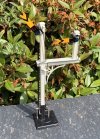
For completeness, here is the only other post-WW2 tinplate signal I have:

96A9EFFA-FCD1-4432-B276-F7B0438EB7C4.jpeg

This one has also been bought within the last year. I have cleaned it and attended to a small amount of flaking paint, but otherwise it is ‘as found’. So it’s ready to use on the layout — if I have somewhere for it. It could be the splitting distant for the approach to the north end of Cairnie Junction station, if I treat platforms 1 and 2 as double track for trains on the main circuit. My intention though is always to use platform 1 (bi-directional) for those trains, unless there is a specific reason to use platform 2. The access track to platform 2 includes 3’ 2 1/4” radius curves (everything on the main circuit proper is a larger radius). Also platform 2 is electrified which some clockwork locos won’t like (the third rail might operate the brake or reversing trip). So it would be better if the right-hand doll were the taller one. But this is the signal I found offered for sale and it’s in good condition, which they usually aren’t.

No rusting at the top of the ladder in this case — because no soldering. The ladder is attached to the doll by a bent over tab pushed through a slot. There must have been some reason why this method of attachment couldn’t be used for the single-post signals.
 

Allen M

Western Thunderer
Hello All
What I always find fascinating is the price and the 'moaned about' high prices today.
I started work at 15 in September 1956. My pay as a trainee electrician was 39/0 for a 44 hour week.

Regards
Allen
 
Top