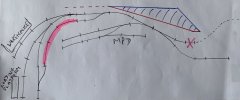
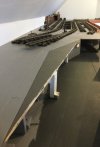
My original plan for Rivermead Central did not involve any provision for electric traction. However, not long after the main base-boards were built (c. 25 years ago), I decided I wanted to electrify the line between Cairnie Junction and Rivermead Central. My intention was to operate the branch using an e.m.u. — ideally, a Bassett-Lowke Euston—Watford set. A friend who has a business dealing in vintage toys and trains had a couple of boxes full of 3-rail brass Lowko Track. I bought all he had. A large quantity of straight 15” track panels — 49 in total, I think — about half in immediately useable condition. The rolled sheet-brass rails used to make 3-rail Lowko Track are very easily bent or dented, unlike the rails made of tinplate. So often individual rails need to be replaced in the brass version of Lowko Track. Nearly all the 49 straight track panels I bought could be repaired if I needed to. Along with the large quantity of straights, there were only four 3’ 2 1/4” radius curves. I later found a couple more. Also three 3’ 2 1/4” radius turnouts, one of which had a completely mangled switch blade. The two turnouts in good condition were fully dismantled, cleaned and rebuilt (as described previously in this thread) and installed on the layout at Cairnie Junction several years ago:
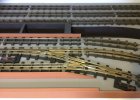
These two turnouts provide the connection between the centre road and the track serving platform 2 at the north end of the platform.
Not much more electric track has been laid since these turnouts were put in place. Apart from the general slow progress with the layout, specifically the problem has been finding more 3-rail Lowko Track — curves and points. After that initial purchase from my friend, I have found hardly any 3-rail Lowko Track in the last twenty years. A bit of a surprise given that tinplate Lowko Track is fairly common. And quite a problem in terms of building my planned layout.
Several things might have contributed to the relative scarcity of 3-rail Lowko Track.
When it was first sold, pre-WW1, most model railways (and many homes) were without electricity.
Electric Lowko Track was really quite expensive. In the early 1930s, Bassett-Lowke had introduced 3’ radius tinplate track, marketed as ‘Sixfut’. Without the third rail, a circle of Sixfut track was 8/4, a 3’ radius point was 4/3. A 3’ 2 1/4” radius circle of tinplate (‘clockwork’) Lowko Track was 22/6, a turnout was 11/-. The Lowko Track was more than twice as expensive as the equivalent in Sixfut tinplate, but much more realistic. For electric track, the circle of Sixfut was 18/4, a turnout cost 7/9. For electric Lowko Track, a 3’ 2 1/4” radius circle was 48/-, a turnout 15/6. Again, the Lowko Track was more than twice the cost of using Sixfut. But, in 0 gauge, a Lowko Track electric turnout also cost more than a tinplate bogie coach, or three to five tinplate wagons, depending on the particular types of wagon. A Lowko Track, electric, double-track cross-over was 50/-. That was more than the price of a whole train of tinplate bogie coaches (14/6 each).
In the early 1930s, Bassett-Lowke introduced a simplified version of its Scale Permanent Way, sold as Popular Permanent Way. Fifteen inch lengths of 3’ radius ‘plain’ (i.e. without a third rail) Popular Permanent Way cost 3/2 (the Lowko Track equivalent cost 1/5). But the electric version of the Popular Permanent Way curve was 3/10 or only 3/- with steel running rails — while the equivalent Lowko Track piece was also 3/-. Popular Permanent Way 3’ radius electric turnouts were 17/6, the electric Lowko Track version only 2/- less. Once the Popular Permanent Way track was offered, electric Lowko Track really doesn’t look like a good buy. The Popular Permanent Way track was clearly superior in strength and appearance, but cost very little more than Lowko Track if third-rail track was required.
After so long without any sign of further electric Lowko Track, I was delighted to buy a quantity a few days ago. The track was offered on a well-known internet auction site. The collection of track I have bought really does look like someone’s ‘train set’. There are sixteen 3’ 2 1/4” radius curves (i.e. a complete circle) one 3’ 2 1/4” radius turnout and two straights. A classic model railway set up on the carpet — a circle or oval and a short siding. Given that Lowko Track was sold until about 1935, it is just possible that the original owner has only recently passed away or gone into a care home. The track I have bought is certainly dirty enough to have been in an attic for seventy years or more.
So this batch of track has solved my shortage of electric curves. And I have another very repairable turnout:
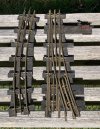
I still need to find another, right-hand, electric Lowko Track turnout. Another couple of electric turnouts after that would be nice, but are not essential. I now have more than enough electric plain line, straights and curves.
I still don’t have an e.m.u or electric locomotive of any kind.



 !
!