Rivermead Central

Roger Pound

Western Thunderer
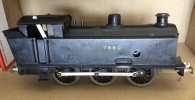
In a perfect world, someone at Bassett-Lowke should have revisited the livery spec. for the CR 112s when production resumed post-WW1. But for what was essentially a free-lance model, who was going to think of that? An understandable oversight, surely.
I agree. This loco was the product of a time when modellers were happy to accept that this, amongst many, was a free-lance model and unlike todays requirements of wanting every last detail possible to be reproduced, they accepted the model for what it was. The free-lance 0-4-0 in 0 gauge was common practice in those days - I had a Hornby No.1 0-4-0 tender locomotive in LMS crimson , carrying the number 5600. It bore absolutely no resemblance to the prototype of that number, but for me - a young lad in the late 1940's, it was an engine and it gave hours of pleasure.
Rivermead Central continues to reflect to av ery high standard the products of those distant days and is, IMHO, doing a splendid job. Keep up the fine work.

Roger.
 

40057

Western Thunderer
Thank you, Roger, for your kind remarks in the previous post.

I have given the Royal Scot’s motor a track test using a circuit (‘oval’) measuring approximately 7’ X 12’.

A track test like this is an indication of the motor’s performance, not conclusive. It’s worth doing because, if it shows the motor definitely needs further attention, it saves the work of fitting up the valve gear etc if the motor is installed in the locomotive for testing. I tested the motor set up as an 0-2-2. The main-spring (i.e. most of the weight) is at the end of the mechanism with the unpowered wheel-set. So slipping on test is inevitable — which will reduce performance compared to the motor when installed in the locomotive. On the other hand, the motor doesn’t have to move the weight of the locomotive body and tender, there is less friction as there are fewer wheels and no dummy valve gear.

As expected, the driven wheels slipped on starting even with no load attached. Light engine (motor?), the run was four circuits of the test track. The maximum load pulled was three coaches — not because the motor wasn’t powerful enough to pull more, but because the wheels were rotating at speed and just slipping without moving the train. The speed control was set at roughly the mid-point for these tests.

The results are good enough for me to install the motor in the locomotive. Exactly what the haulage capacity and length of run will be then, we will have to wait and see. It isn’t possible to accurately establish performance from testing the motor separately. These large Bassett-Lowke motors are impressive pieces of engineering. On one wind, the Royal Scot ought to pull four coaches at least for three circuits of a track similar to the one I used for testing the motor.
 

John R Smith

Western Thunderer
I have given the Royal Scot’s motor a track test using a circuit (‘oval’) measuring approximately 7’ X 12’.

A track test like this is an indication of the motor’s performance, not conclusive.

Martin

Well done, and things are certainly looking hopeful. As you say, it is not a definitive running test, because set up with only one set of driven wheels and no coupling rods adhesion will naturally be a problem. I think Bassett-Lowke reckoned on a 120 feet length of run with a full wind for this engine, which is pretty much the same as Jack Ray got out of his big B-L locos too. The makers also cautioned in the catalogue that three foot radius was the minimum recommended and larger would give better results. If your problem was binding and misalignment, though, the real test is smooth running at very low speed at the tail end of the wind, rather than hesitant fits and starts as the spring winds down.

This six-coupled mechanism is, as I am sure you know, the most sophisticated that B-L ever produced for O Gauge, with its geared winder, remote ratchet, maximum width mainspring, massive reversing gears and adjustable oversize governor. I am very impressed with mine, I must say. On my ridiculously small layout it is completely docile on just a few winds, and ambles around with a coach or two at shunting speeds.

John
 

40057

Western Thunderer
Martin

Well done, and things are certainly looking hopeful. As you say, it is not a definitive running test, because set up with only one set of driven wheels and no coupling rods adhesion will naturally be a problem. I think Bassett-Lowke reckoned on a 120 feet length of run with a full wind for this engine, which is pretty much the same as Jack Ray got out of his big B-L locos too. The makers also cautioned in the catalogue that three foot radius was the minimum recommended and larger would give better results. If your problem was binding and misalignment, though, the real test is smooth running at very low speed at the tail end of the wind, rather than hesitant fits and starts as the spring winds down.

This six-coupled mechanism is, as I am sure you know, the most sophisticated that B-L ever produced for O Gauge, with its geared winder, remote ratchet, maximum width mainspring, massive reversing gears and adjustable oversize governor. I am very impressed with mine, I must say. On my ridiculously small layout it is completely docile on just a few winds, and ambles around with a coach or two at shunting speeds.

John
Clockwork motors have to work very hard on a typical vintage layout. The often apparently poor haulage capacity in terms of ‘number of coaches pulled’ is in large measure due to the weight and rolling resistance of the vehicles and the friction attendant on large flanges on sharp curves. A measure of performance based on number of vehicles pulled doesn’t mean very much unless quoted in connection with the nature of the track, in particular the radius of the curves.

On Rivermead Central, I have kept the gradient of the Cavendish Goods branch to 1 in 66. The curves on the branch (three 90 degree curves, 3’ 2 1/4” radius) are dead level. All of the climb is on the straight track. A train ascending the branch noticeably slows on each curve — the level sections — and then accelerates again as it starts to climb. The friction from the flanges on the tight curves is a bigger drag than the gradient.

Mindful that the radius of curves tends to be a limiting factor for train length, the main circuit on Rivermead Central has (and will have when complete) nothing less than 3’ 6” radius. It’s still a lot tighter than ideal.
 

John R Smith

Western Thunderer
On Rivermead Central, I have kept the gradient of the Cavendish Goods branch to 1 in 66. The curves on the branch (three 90 degree curves, 3’ 2 1/4” radius) are dead level. All of the climb is on the straight track. A train ascending the branch noticeably slows on each curve — the level sections — and then accelerates again as it starts to climb. The friction from the flanges on the tight curves is a bigger drag than the gradient.

Agreed, but with clockwork the problem is not so much going up the hill, but coming down it, surely. With no brakes, and no remote control, will the train make it around the first curve?

John
 

40057

Western Thunderer
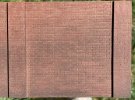
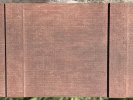
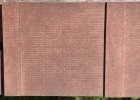
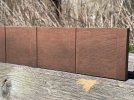
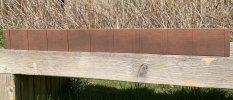
The section of boundary wall for the back of the layout just south of the Benham’s buildings now has its ‘mortar’ added, is weathered and has a coat of matt varnish. It needs coping fitted and I will have to mount it on a strip of thin plywood painted to match the grey base-boards.

I’m pleased with the weathered brickwork:

52BA7E52-8EB9-4005-BA90-CA44F0FF4BC4.jpeg

36204314-8E22-4C6B-80CD-D94C85FEAEFF.jpeg

3F76890F-2A3C-4696-AC3D-9FDF34E23D91.jpeg

1B6297A9-DBE2-4180-AC37-A5FA4D93283C.jpeg

4DBF1C4D-281D-47BA-8427-75C16F3BA554.jpeg

I mixed a new ‘brick colour’ paint for this wall, a slightly lighter more orange shade than the paint used for the brickwork on the Benham’s buildings. The idea being it will help create the background of mixed browns and dull greys I want as a contrast to the colourful trains. Whether the difference in brick colour will really show under the weathering in artificial light I’m not too sure.
 
Last edited:

40057

Western Thunderer
I refer to my posts #195 and #196 from November last year. Work commenced on rebuilding the next Lowko Track turnout but then stalled — first due to a broken 12BA tap, then due a broken electric drill. However, both broken items have now been replaced. Further encouragement to restart work on the turnout comes from installation of the base-board reported in my post #336:
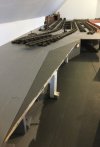
5D95D53B-226B-4BB0-90DA-4591767CDDC4.jpeg

Until a couple of weeks ago, the area behind the new section of base-board (to the left in the above photo) was being used to store track panels. Standard 15” pieces of Lowko Track plain line sorted and stacked — cleaned/repaired mainline quality, ditto for other running lines, ditto for sidings and awaiting cleaning. Now I have an expanse of empty base-board just waiting for track to be laid.

This afternoon I finished the rebuilding of the section of the turnout beyond the crossing. Here all the rails are held in position by being soldered to two long transverse tinplate strips. The work required in this section was to re-make and strengthen soldered joints and to adjust the position of the check rails so they will do their job. The check rail on the curved road in particular was way out of position. In this picture, you can see the as-manufactured position of the check rail from the remnants of the original, now broken, soldered joint:
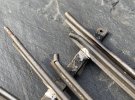
C4F20CCF-23BF-4299-A161-97BAB7DAA64D.jpeg

Also visible is my new fastening, a 12 BA screw upwards through the transverse tinplate strip and foot of the check rail. Once the check rail is correctly positioned and secured by screws, the soldered joints are re-made:
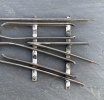
215C7937-1F8D-4978-A3F9-1623027DFE14.jpeg

The new fastenings are invisible from above and will be impossible to detect once the rails are reinstated on the sleeper raft. The new solder of the re-made joints will be covered by black paint as per usual Bassett-Lowke practice.

Note the difference in the width of the flange-ways after moving the check rails. The above turnout should now work reliably with wheel-sets with either a back-to-back of 27.0 mm or 27.5 mm.

It is odd that the check rails on Lowko Track turnouts are often, but not always, too far from the running rails to be effective. It might be a legacy from the early date Lowko Track was designed (1908). However, certainly by 1910, Bassett-Lowke standardised on 27.0 mm as the back-to-back measurement for wheels. The back-to-back measurement was very consistently adhered to. So it is strange that Lowko Track turnouts are generally built to suit coarser wheels.

Regarding the turnout now being rebuilt, I still have to modify the fastenings for the switch blades. One rail chair will need to be replaced. The intended location for this turnout means the position of the operating lever will have to be moved so it is parallel to the running rails, requiring the use of a bell-crank.

 

John R Smith

Western Thunderer
Martin

That is all very nice, neat work. This issue of back-to-back standards has bedevilled me from the beginning of my own project. All of my Bassett-Lowke rolling stock has a B-to-B of 27mm or close to it (sometimes a bit under 27.0 mm). But at some time in the 1950s there seems to have been a move to 28.0 mm, and so Exley in particular are often made to this wider dimension. This applies to the coaches with Exley bogies - but B-L fitted their own bogies to the Exleys they sold, with 27.0 mm B-to-B wheeelsets. And it is not just Exley that has this problem, either - many of the wagons I had purchased in all innocence, despite being advertised as coarse scale, have the "wrong" B-to-B. Until I realised what was going on I had endless problems on my B-L post-war track, with my rolling stock derailing on facing points.

For some reason Jack Ray and John Hart standardised their stock (and locomotives as well?) on 28.0 mm, and when the Gauge O Guild was formed in the 1950s their published coarse scale standards were for 28.0 mm too. Consequently today Slaters coarse scale wheels are at 28.0 mm and we seem to be stuck with it. Now I have learned my lesson, I never purchase an Exley coach with Exley bogies!

John
 

40057

Western Thunderer
Hi John

The whole area of track and wheel standards was (still is, come to that) an absolute minefield.

Bassett-Lowke’s wheels were very consistently 27.0 mm b/b, certainly locos and cast iron wagon/coach wheel-sets. With the coach and wagon wheels made of alloy the b/b is a little less consistent and precise. Over the period of Bassett-Lowke’s production, there was a general trend amongst other ‘serious’ model manufacturers to finer wheel and track standards in pursuit of greater realism. I think Leeds Model Company wheels were set at 27.5 mm b/b even in the ‘20s. Bond’s I think were at 28.0 mm in the 1930s. Bassett-Lowke stuck with 27.0 though wheels were narrowed and flange depth reduced.

In terms of reliable running of vintage trains, the safe option is to stick with one manufacturer. Otherwise, just to be aware and check wheels for compatibility with the track used.

I have a couple of the shorter, simpler pre-war Exley’s and their (original) wheels are 27.0 mm b/b. Post-war scale length Exley’s are ‘too scale’ for me. Also, very heavy for use with clockwork locos and long for my 3’ 2 1/4” radius curves. So I don’t have any. Milbro cast-iron wheels need to be watched. The b/b measurement is not at all consistent, even on the same coach. I retain original Milbro wheels but swap out wheel-sets with wider b/bs for wheel-sets that are within tolerance for Bassett-Lowke track.

It all depends on the item of course, but I replaced the wheels on my Pealling Stephenson Clarke wagon — see various of my posts in early 2024, starting with #57.

I have over the years knowingly bought a few vintage wagons with wheels that are too fine for my track. Replacing the wheels, even if it were possible, would not be appropriate. The fine wheels are very much part of what the wagon is — a serious attempt at accurate modelling at a relatively early date. I shall use these wagons as ‘set dressing’ but can’t run them.

Your contributions to this thread are very, very welcome. I still think you should have your own WT thread too, to show the railway you have built and raise other issues relating to it.

Martin
 

John R Smith

Western Thunderer
Martin

Many thanks for your kind words. I also have one or two wagons with rather too fine wheels, which can run in and out of the station on the main but cannot be shunted into a siding over points. My own experiments with changing wheelsets have not been attended with a great deal of success, despite my having a good selection of coarse scale wheels in the stores. Often the axleguards are too closely set, or the axle length is too short or too long, or the bearing journal size does not match up. Or fine scale brake gear gets in the way.

I do love my Exleys, though, and would find it hard to give them up. Nowadays I can spot Exley bogies and B-L bogies in the seller's photos, and choose accordingly. Just for fun, here is the latest arrival -

Exley TPO 01 Web.jpg

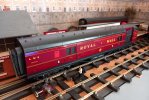
This TPO has B-L bogies with cast-iron wheelsets, and a B-to-B of 27.0 mm. So now I can have my own miniature "Night Mail", the last departure of the day in my timetable, which will arrive at Crewe just after 11 pm and connect with the West Coast Postal Special.

John
 

40057

Western Thunderer
Martin

Many thanks for your kind words. I also have one or two wagons with rather too fine wheels, which can run in and out of the station on the main but cannot be shunted into a siding over points. My own experiments with changing wheelsets have not been attended with a great deal of success, despite my having a good selection of coarse scale wheels in the stores. Often the axleguards are too closely set, or the axle length is too short or too long, or the bearing journal size does not match up. Or fine scale brake gear gets in the way.

I do love my Exleys, though, and would find it hard to give them up. Nowadays I can spot Exley bogies and B-L bogies in the seller's photos, and choose accordingly. Just for fun, here is the latest arrival -

View attachment 239143

This TPO has B-L bogies with cast-iron wheelsets, and a B-to-B of 27.0 mm. So now I can have my own miniature "Night Mail", the last departure of the day in my timetable, which will arrive at Crewe just after 11 pm and connect with the West Coast Postal Special.

John
Hi again

A well chosen name for the station!

Undeniably, those post-WW2 Exley’s are very handsome models with an excellent paint finish.

Martin
 

John R Smith

Western Thunderer
Hi again

A well chosen name for the station!

I now feel my choice of name was perhaps a bit cheeky, but I settled on it at the beginning of the project and it has kind of stuck. I suppose I do have a the excuse of a family connection, because my maternal grandfather, William Oates, worked for Bassett-Lowke at Kingswell Street for a short while before 1914. He was a fitter and turner, and it was his first job after serving an apprenticeship with Allchins, the builders of traction engines.

John
 

40057

Western Thunderer
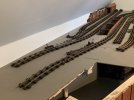
The new section of high-level base-board (see my posts #336 and #370) has now been painted in matching grey. I’ve mixed a whole pot of the grey paint which should keep me going for years. Getting the new section of base-board painted has allowed track laying to commence in a southwards direction from Cairnie Junction station:

BD7D4FBA-0EC8-4BA5-9CDE-F0BD38D208FE.jpeg

None of the track laid today is actually on the new base-board but it is very close to it — too close for this track to have been laid before I installed and painted the base-board.

The track heading towards the lower left-hand corner of the photo is the main line. The next piece of track southwards on the main line is the right-hand turnout currently being rebuilt (see my post #370). The main line continues south as straight track until the start of the 180 degree curve at the south end of the room. The alignment is now set by the current end point of the main line as seen above. The position had to be within a few mm of the position shown. There is room — just — for two tracks behind the main line given the spacing between tracks dictated by the standard 3’ 2 1/4” radius turnouts. There is room in front of the main line for a short head-shunt that will allow a locomotive to run round a train in platform 2 without blocking the main line while it does so. This head-shunt was always a clearly appropriate provision but I needed another left-hand electric point — just obtained and seen in my post #329.

The other track heading southwards seen above next to the wall is part of the goods sidings. The next track piece on this line is also a right-hand turnout. It connects with the right-hand turnout in the centre of the photo — the north-facing entry to/exit from the goods yard. I’ve made a thorough examination this afternoon of the turnout I now think I will use. It’s a rare thing — a Lowko Track turnout that isn’t broken. There are no broken soldered joints and no sign of developing cracks. The turnout is probably well over 100 years old and it appears to have been well used. There are old screw holes in the battens where it was previously fastened down in someone else’s layout. On the basis it ain’t bust, I have decided not to take it apart to fix it. Fortuitously, the check rail spacing on this turnout is also pretty good. Ideally, I’d like the check rail to be about 0.5 mm closer to the running rail on the straight track. I don’t think there is any danger of a flange going the wrong way at the crossing, but there could be flange contact with the crossing nose. I’ll live with that small risk. The turnout needs a thorough clean, but that’s nothing compared with the time involved in dismantling and rebuilding.
 
Last edited:

40057

Western Thunderer
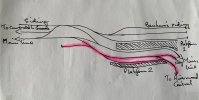
It’s probably worth showing an updated track plan for what I am now building:

44570D9B-9546-48DD-A8EC-2F7ACE143EBF.jpeg

I hope this helps make sense of the track being laid as shown in the photo in the previous post.

All of the track on the diagram is Lowko Track. That highlighted in pink is electrified using the usual Bassett-Lowke system of a raised centre third rail. The head-shunt to the south (left) of platform 2 was something I always wanted to include but I didn’t have a turnout available. Now one has been found (see post #329), it will be repaired and adapted and the head-shunt can be built. The head-shunt is particularly required because there can be no electrified track in the main circuit. Clockwork locomotives often don’t like the raised third rail. It’s OK on plain line but on turnouts where the centre rail is off-centre for both diverging tracks, the raised rail might operate the ‘trip’ to apply the locomotive’s brake. Not all clockwork locomotives are fitted for track operated braking and reversing, but standard Bassett-Lowke motors are so-equipped.

The reverse curves in the main line south of the Cairnie Junction platforms are 4’ radius. I built these using Lowko Track components recovered from beyond-repair track panels. There is another 4’ radius curve to go in the north-facing yard access which compensates for the ‘non standard’ alignment of the main line resulting from the use of the larger radius curves. The long curve in the main line at the north end of platform 1 is 3’ 6” radius which gives a double-track spacing with the standard 3’ 2 1/4” radius curves in the adjacent siding. Again, the 3’ 6” radius curves are home made using Lowko Track components — in this case parts sold as a kit for home track construction. The 3’ 6” radius is (= will be) the tightest radius curve in the main running circuit.

All the other curves and turnouts in the diagram and photo above are 3’ 2 1/4” radius. This was the largest radius offered in 0 gauge Lowko Track after WW1. Pre-WW1, 4’ radius was listed in the catalogues for both plain line and points. I have never seen even a single piece of factory-made 0 gauge Lowko Track in the larger radius. Loose rails curved to 4’ radius and Gauge 1 4’ radius Lowko Track were offered until manufacture of Lowko Track ceased in the mid 1930s. So the components for 4’ radius Lowko Track are/were available. I should say for completeness that 0 gauge double-track crossovers, also listed until production ceased, are, in effect, two 4’ radius turnouts.

There will be just five points in the main line circuit. In each case, the main is the straight road. So although the points are 3’ 2 1/4” radius, a train on the main line will not have to traverse such a sharp curve.
 

Roger Pound

Western Thunderer
I continue to admire the depth of your knowledge about BL and their products. It will be nice to see the completion of the next section of track - may one assume that this will allow the running of services at Rivermead? Keep up the excellent work.

Roger.
 

40057

Western Thunderer
I continue to admire the depth of your knowledge about BL and their products. It will be nice to see the completion of the next section of track - may one assume that this will allow the running of services at Rivermead? Keep up the excellent work.

Roger.
Hi Roger

Thank you for your kind remarks.

We are a way off having a complete circuit, I’m afraid. At the other end of Cairnie Junction station, two points are required — one turnout (left hand, not electric) to complete the passing loop on the main line (the tracks through platforms 1 & 2), the other turnout (right hand, electric) for the Rivermead Central branch diverging from the track into platform 2.

I have several left-hand ‘non-electric’ turnouts available, subject to repair and modification. That’s just a question of choosing a good one and spending the time on dismantling and rebuilding it. Unfortunately, I do not have a right-hand electric turnout. Ideally, I will find one. Until that happens, I have plenty else to be getting on with. Ultimately, if I still haven’t found one and not having the electric turnout becomes a block on making progress, I will scratch build one from Lowko Track components.
 
Top