Rivermead Central

John R Smith

Western Thunderer
Martin

Your shed is looking very good! I have the B-L Coal Office at Kingswell Street, but it cost me a lot more than 5/- I'm afraid.

Footplatemen's Cabin Web.jpg

As you say, the walls are an off-white and the door is green. Mine is missing the sign on the roof. I am using it for a shunter's and footplatemen's cabin, but I didn't have the heart to remove the coal price list. One day, if I ever get a proper goods yard, it can fulfil its intended role.

John
 

40057

Western Thunderer
Martin

Your shed is looking very good! I have the B-L Coal Office at Kingswell Street, but it cost me a lot more than 5/- I'm afraid.

View attachment 250407

As you say, the walls are an off-white and the door is green. Mine is missing the sign on the roof. I am using it for a shunter's and footplatemen's cabin, but I didn't have the heart to remove the coal price list. One day, if I ever get a proper goods yard, it can fulfil its intended role.

John
Hi John

The coal price list is a rare survivor. It was missing on most examples of the between-the-wars coal office I have seen.

I would be looking for a wreck with a roof sign to complete your example, if it were mine!

Martin
 

John R Smith

Western Thunderer
I would be looking for a wreck with a roof sign to complete your example, if it were mine!

Good idea,, but these days people will be asking silly money even for a wreck, I am afraid.

Martin, you will be pleased to know that I have had second (and perhaps even third) thoughts about the "huge" Hornby signals at Kingswell Street. Stung into action by your (and other modeller's) remarks, the offending items have been swept aside, and more diminutive Bassett-Lowke items are being installed in their place -

Advanced Starter 01 Web.jpg

Grudgingly, I have to admit that the B-L items do look somewhat better.

John
 
Last edited:

40057

Western Thunderer
Good idea,, but these days people will be asking silly money even for a wreck, I am afraid.

Martin, you will be pleased to know that I have had second (and perhaps even third) thoughts about the "huge" Hornby signals at Kingswell Street. Stung inro action by your (and other modeller's) remarks, the offending items have been swept aside, and more diminutive Bassett-Lowke items are being installed in their place -

View attachment 250443

Grudgingly, I have to admit that the B-L items do look somewhat better.

John
Much better!

Martin
 

40057

Western Thunderer
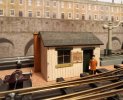
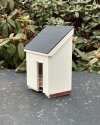
A little more progress with the storage shed:

E801FA02-72D8-4909-B148-4226639E8642.jpeg

The fascia board on the end nearer the camera is glued in place with pilot holes drilled first for a couple of moulding pins. The front board is fixed with the heads of the moulding pins covered. I have not yet made the fascia board for the other end.

The roof is now a darker grey and a close match for the colour used on the roofs of vintage Bassett-Lowke buildings.

Martin
 

40057

Western Thunderer
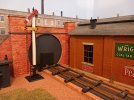
More parts made for the storage shed. Some of them have been attached:

3325DDC0-EFE7-4296-A62B-7C529F08B870.jpeg

I’m building the shed’s plinth from brick-effect MDF. The doorstep and window are the next parts I need to make. The door is finished but won’t be installed until the doorstep is in place.

I’m going to add strips of wood to cover the ends of the slates on either side of the roof. I’ve found many photos of period wood buildings such as signal boxes where the roofs have these wooden edging strips.

I have also started making the length of brick wall against which the shed will sit.
 

40057

Western Thunderer
Back in my post #479, I showed a photo of a couple of Bassett-Lowke’s 1930s production lithographed tinplate wagons. The ‘ordinary’ wagons in this series — particularly the open merchandise wagons and covered goods vans — are easy to find in good condition and typically cost less to buy than a current-manufacture model of a similar prototype. These 1930s models will be the backbone of the tinplate wagon fleet used to operate Rivermead Central.

The 1930s era Bassett-Lowke tinplate wagons are generally not such good models as the pre-WW1 tinplate wagons made for Bassett-Lowke by Carette. The 1930s wagons (especially the vans) are too large, the Carette-made wagons are correct scale size or very close. The litho-printing on the Carette wagons is better. The length and wheel-base of the Carette models varies according to prototype. The 4-wheeled 1930s wagons all share the same underframe. The 1930s wagons do however have axle-boxes which the Carette wagons don’t. There are some practical considerations too in favour of the 1930s models. They don’t suffer from corrosion due to flux residue from soldering as the construction is entirely ‘tab and slot’. The 1930s wagons are generally far easier to find in good condition and much cheaper to buy. For me, for Rivermead Central, a wagon fleet largely based on the Carette-made wagons is not a practical possibility. I have some examples of the Carette series and they’re really nice. But to get an appropriate fleet of wagons to operate Rivermead Central — a variety of types, in sufficient numbers — I need to rely mainly on the 1930s-made wagons.

Amongst the 1930s range of wagons there were some specialist vehicles for particular traffics. An LNER refrigerator, for example, which had the same body as the other 1930s vans but different printing. An LNER bogie brick wagon. An LNER trolley wagon with alternative loads of a boiler or cable drum. The bogie wagons were all very fine models. Even better though were the tank wagons in the 1930s range: a United Dairies milk tank and oil/petrol tankers belonging to the Vacuum Oil Company and the Anglo-American Oil Co.

(While the milk tanker was listed in the Bassett-Lowke catalogues as a wagon, really it was NPCCS. Various of the pre-WW1 Carette-made ‘wagons’ were also actually NPCCS, e.g. an LNWR OCT, LNWR fruit van. For simplicity, I’ll use ‘wagon’ when Bassett-Lowke did.)

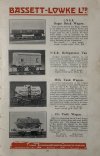
The superiority of the tank wagons was made explicit in the Bassett-Lowke catalogue descriptions:

56F86BF4-C18E-4191-B015-7EE1DAB7DC32.jpeg

The 1930s tank wagons are clearly far better models than the pre-WW1 Anglo-American tank wagon in its 0 gauge version. I don’t have my copy of ‘Paddington to Seagood’ to hand, but my recollection is that when the tinplate wagons on that famous model railway were mostly replaced by more detailed scale models, the tinplate tank wagons were retained. The tank wagons are undeniably especially good. Naturally, this makes them highly desirable today and in excellent or better condition they sell for stupidly high prices. They are undoubtedly much less common than the 1930s merchandise wagons and goods vans — probably because of their originally higher price. But any model made of lithographed tinplate will have been produced in large numbers. Less common, for sure, but not rare.

There is a particular reason why the Pratt’s Spirit tanker shown above is relatively scarce. I have commented before that 1930s and earlier model railways were very much focused on being bang up to date. In 1935, the Anglo-American Oil Co. replaced the ‘Pratt’s’ brand name with ‘Esso’. Within a year, Bassett-Lowke had updated their model. So whilst most of the 1930s series of tinplate wagons were offered for sale for about ten years, the two versions of the Anglo-American Oil Co.’s wagon had much shorter production periods. Both the Pratt’s tanker and the successor Esso tanker were only sold for about five years.

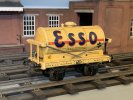
To get examples of the 1930s tank wagons for Rivermead Central, I have had to accept some compromises. One wagon that someone left in the light which has faded on one side. One that has some visible paint restoration. But I do have a really very good Esso tanker:

35D5EA6F-982F-4CB2-B4B1-39C537D42B7B.jpeg

The Esso wagon has side boards (as per the milk tanker) whereas the saddle mountings for the tank were left visible on the Pratt’s version.

The 1930s Bassett-Lowke tank wagons surely have to be the best lithographed tinplate model wagons made after WW1.
 
Last edited:

Fitzroy

Western Thunderer
The tank ends and end beams were suspiciously similar to those on the Hornby Colas and milk wagons, and I wonder if they were from a common source. It would be interesting and instructive for someone who has examples of both to run some calipers over them.
Pieter
 

John R Smith

Western Thunderer
Martin

Your Esso tanker is very nice indeed. It is interesting that the tank wagons were actually more expensive than the bogie brick wagon. As you say, the B-L tanks are all now asking big money if in good condition - well north of £200 is the going rate. So not for me, as I am no collector, certainly not when I could get a very good Exley coach for that sort of sum.

John
 

40057

Western Thunderer
The tank ends and end beams were suspiciously similar to those on the Hornby Colas and milk wagons, and I wonder if they were from a common source. It would be interesting and instructive for someone who has examples of both to run some calipers over them.
Pieter
Hi Pieter

The Hornby end beams are much wider (length across the width of the wagon) and look obviously too long jutting out on each side of the wagon. Otherwise, the elaborate Hornby tanks would be quite good models.

Image found on the web in an auction catalogue:

D21D8077-0E84-4579-85FB-A0E8237A4339.jpeg

Remember, the Bassett-Lowke (Winteringham) wagon is lithographed. All the sheet metal parts will have been printed together on one flat sheet and then stamped out and embossed to shape afterwards. You can’t sensibly make a wagon like that by sourcing some of the sheet metal components from elsewhere.

Martin
 

40057

Western Thunderer
Signalling advice, please!

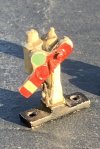
Back in March of this year, as track laying progressed at Cairnie Junction, I started to think about what signalling I would need to install. In particular, shunting signals — since I currently have only a few examples, and you don’t see vintage ground signals for sale very often. So knowing what I needed to look for would, with a bit of luck, give me chance to find what I need. My thinking remains that the model ground signals sold by Mills Bros (Milbro) would be the easiest to find in the sort of quantity required. This is the one I have:

D2C00D6E-F4F7-4D7D-BA23-67427BEF1B18.jpeg

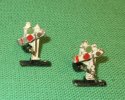
And these are the two a friend has for sale:

F728ECBF-336A-487B-8C3E-200B6D06DFC3.jpeg

OK, they are a bit tatty, but not broken. I can do some limited paint repairs to make them more respectable without changing their character by ‘over restoration’.

But my question is: What is the significance of the reversed paint scheme on the signal arms (i.e. white stripe on a red arm or red stripe on a white arm)? I’m not knowledgeable about signalling and can find no explanation in books or online.

Any information gratefully received! Thank you in advance.

Martin
 

John R Smith

Western Thunderer
Martin

Sadly, I have always lived in an area where disc ground signals were used, and they have always had a red stripe on a white background (except for a very few which had a yellow stripe on a white background). So I am not familiar with the miniature semaphores which you illustrate above.

The reversed paint scheme seems rather unlikely, as the position of the arm is not very clear.

John
 

40057

Western Thunderer
Martin

Your Esso tanker is very nice indeed. It is interesting that the tank wagons were actually more expensive than the bogie brick wagon. As you say, the B-L tanks are all now asking big money if in good condition - well north of £200 is the going rate. So not for me, as I am no collector, certainly not when I could get a very good Exley coach for that sort of sum.

John
Hi John

As you point out, when new, the tank wagons really were expensive relative to other 0 gauge tinplate wagons. However, note the B/L catalogue describes the milk tanker as an inexpensive scale model. Which is reasonable when the same catalogue (July, 1933) also lists a 2” scale Atlantic for £450 (£25 extra if fitted with vacuum brakes). A more meaningful comparison with the 0 gauge tinplate tank wagons would be the price of 0 gauge wooden wagons as described in my post #105. Even the cheapest of the transfer-decorated wooden wagons — the open merchandise wagons — were 6/6 in 1933. The 0 gauge Lowko Spirit tanker (see my post #115) was listed at 10/- in the July 1933 catalogue.

I don’t think my motivation for buying the Esso tank illustrated was principally ‘collecting’. It is, undeniably, a really nice looking wagon. It looks great in the yard at Cairnie Junction. And such tank wagons were part of the real railway scene in the 1930s, albeit as quite a small proportion of the total wagon fleet. I suspect tank wagons formed a rather larger proportion of the stock on contemporary model railways owing to their colourful liveries and visual appeal. So I have to have tank wagons on my vintage tinplate railway for it to be a good representation.

I will concede however that there is a collecting aspect to stock acquisition. As I said in my post on the tinplate tank wagons, for practical reasons of cost and availability, the Bassett-Lowke 1930s-production series of tinplate wagons is going to be the mainstay of freight operations on Rivermead Central. All of the wagons in this series would be suitable for use on my layout. Actually, it would be appropriate to have several of the LMS and LNER merchandise wagons given the vast numbers on the real railways. So in looking for nice, affordable and appropriate vintage wagons, I have — almost accidentally — ‘collected’ examples of most of the 1930s Bassett-Lowke tinplate wagon models. Unsurprisingly, the ones I don’t have are the harder to find and more expensive types like the milk tank and trolley wagon with cable drum. To operate Rivermead Central, what I have will do just fine. If ‘collecting’ was my principal motivation, I guess I would be scouring auction catalogues for the ‘missing’ wagons.

Martin
 

John R Smith

Western Thunderer
If ‘collecting’ was my principal motivation, I guess I would be scouring auction catalogues for the ‘missing’ wagons.

Yes, and that is exactly the difference. I was by no means implying that you were a "collector" - I don't think many collectors in the accepted sense would be building an extensive coarse-scale layout, spending hours refurbishing ancient pointwork, or building very attractive wooden buildings from scratch.

John
 

40057

Western Thunderer
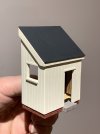
A little more progress today with my storage shed. The plinth brick work is complete and the doorstep has been fixed in place:

336E9DB7-3D7C-4B47-A254-2ADF332F7CA7.jpeg

The doorstep is in my usual ‘speckled concrete’ finish. The plinth brick-work will need to be toned down with a bit of weathering.

Martin
 

40057

Western Thunderer
Over the last couple of years in this thread, I have posted photos of various Bassett-Lowke wagons obtained for use on Rivermead Central. Rather a random selection of wagons I happen to have and often photographed in the order they happen to have been repaired. For those without a particular interest in vintage model railways, this unmethodical approach may have made it difficult to put individual wagons into context within the huge and diverse variety of wagons sold by Bassett-Lowke during more than sixty years of retailing small scale (gauges 0–3) model railways.

So I will try to give a summary of the types made:

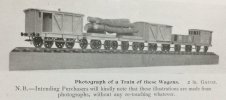
1. Individually hand-built models. Offered almost from the start to almost the end of the Bassett-Lowke retail business. Made of wood with metal fittings and hand painted.
09661A84-5F91-43AC-9FB2-8A0DE26C896C.jpeg

The above illustration is from the 1905/06 season catalogue. At this date, 0 gauge models were not listed but very detailed models in larger gauges were made. I think 0 gauge versions appeared around 1910. The models offered in the mid-1920s were similar or identical to those made prior to WW1. By the mid-1930s, Bassett-Lowke listed fewer types in their catalogues but were ‘always pleased to quote prices for making specially any model not included in our regular stock.’ Up to this time, I think the hand-built wooden wagons were always made at Northampton. However, shortly before WW2, illustrations suggest the wooden wagons then being sold by Bassett-Lowke were made by Mills Bros (Milbro). After WW2, a limited but entirely new range of wooden wagons was offered:
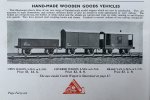
817C00BC-A661-49D9-BA1B-F80E61094601.jpeg

Compared with the 1905 models, the 1950s wagons represent much more modern prototypes. But the level of detail and method of manufacture was essentially the same.

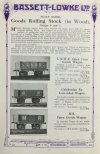
2. Transfer-decorated wooden wagons. An intermediate range (quality and price) between the hand-built wagons and those made of lithographed tinplate. Plain wooden bodies with all detail (planking, framing, lettering etc) provided by transfers. Wagons made in this way were introduced in 1919. They were needed because Bassett-Lowke’s pre-WW1 supplier of lithographed tinplate wagons had ceased trading in 1917. The advantages of the method of manufacture were set out in the description in the Bassett-Lowke catalogues:
A200CAA8-554A-4EEF-A25B-D0090A15B8D6.jpeg

Wooden, transfer-decorated wagons continued in production until c.1937. The range was expanded over time and models of more modern prototypes were introduced. Many more types were made in Gauge 1 than in 0 gauge.

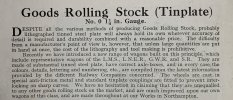
3. Wagons made of lithographed tinplate. Mass-produced and lower priced than the wooden wagons, as explained here in 1933:
EA67924F-58E8-4746-9995-28AC7290FB92.jpeg

Chronologically, Bassett-Lowke tinplate wagons fall into four distinct groups:
i) 1909–1914. Made by Carette. Around 50 different wagons made in Gauge 0 with nearly all also made in Gauge 1 and about half additionally in Gauge 2.
ii) 1921–1930. Wagons made in Northampton using the tooling from the Carette factory. Only six different wagons offered, 0 gauge only, but with corresponding post-grouping versions made after 1923.
iii) 1929–1940. Wagons made at Northampton using new tooling. 0 gauge only. During the production period, including replacement models in updated liveries, around 25 different wagons were made.
iv) 1949–1960. Three LMS wagon models from the pre-WW2 range were reintroduced with small differences. The LMS brake van was replaced c.1951 by a BR version on a longer wheel-base. In the late 1950s, with the main manufacturing facility gone, ‘special load’ wagons were offered made up of a tinplate wagon chassis with various objects (castings, lengths of pipe, sleepers etc.) wired or nailed in place as loads.

I think that will do as a much simplified summary of the wagons made. There were a very few odd wagons that Bassett-Lowke sold at different times that don’t fit neatly into any of the above categories. All the wagons I have described in this thread so far, or am likely to illustrate in future, do fall into one of the ranges listed above.

Martin

 

John R Smith

Western Thunderer
Thank you for that very useful summary, Martin. It is interesting that Bassett-Lowke never seem to have felt that brake gear would be a useful addition to any of their wagons, even the most expensive handbuilt items. Mind you, this seems to have been true of Milbro also.

John
 

40057

Western Thunderer
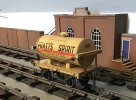
By way of a follow up to my post #588, the predecessor to the Esso tank wagon shown therein.

BB326C31-5538-4A35-9BC8-105D823C3AD6.jpeg

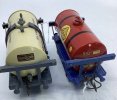
The ‘Pratt’s Spirit’ model was sold between 1931 and 1935 before it was replaced by the ‘Esso’ version. Note the visible saddle-type tank mountings on the earlier model and the fleet number on the tank end. The Pratt’s Spirit tanker has a 10-ton capacity, the Esso tank 14 tons. Bassett-Lowke updated more than just the livery when the branding changed.

The two models also have different couplings. The Pratt’s tanker has the long-link couplings with a hook shape almost identical to the Bing coupling. These couplings were standard on Bassett-Lowke Northampton-made tinplate rolling stock and locomotives from the mid-1920s to c.1935. The Esso tanker has the later short-link type of coupling with the smaller hook.

The above Pratt’s tanker is in respectable but not excellent condition. When I acquired it, some minor restoration was needed. A previous owner had removed all the paint from the buffer faces presumably on the grounds that bare metal was more realistic. To restore the original appearance, I repainted the buffer faces in black matching the finish on the rest of the buffer castings. Also, the cast alloy wheels had been given white rims (tyres) which looked terrible. As the alloy wheels were also very worn and out of true, I replaced them with correct-period Bassett-Lowke cast-iron wagon wheels.

The Pratt’s Spirit tanker is one of my favourite tinplate models. A classic 1930s wagon.

Martin
 
Top