Over the last couple of years in this thread, I have posted photos of various Bassett-Lowke wagons obtained for use on Rivermead Central. Rather a random selection of wagons I happen to have and often photographed in the order they happen to have been repaired. For those without a particular interest in vintage model railways, this unmethodical approach may have made it difficult to put individual wagons into context within the huge and diverse variety of wagons sold by Bassett-Lowke during more than sixty years of retailing small scale (gauges 0–3) model railways.
So I will try to give a summary of the types made:
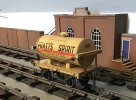
1. Individually hand-built models. Offered almost from the start to almost the end of the Bassett-Lowke retail business. Made of wood with metal fittings and hand painted.
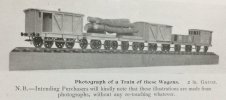
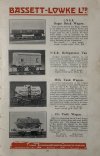
The above illustration is from the 1905/06 season catalogue. At this date, 0 gauge models were not listed but very detailed models in larger gauges were made. I think 0 gauge versions appeared around 1910. The models offered in the mid-1920s were similar or identical to those made prior to WW1. By the mid-1930s, Bassett-Lowke listed fewer types in their catalogues but were ‘always pleased to quote prices for making specially any model not included in our regular stock.’ Up to this time, I think the hand-built wooden wagons were always made at Northampton. However, shortly before WW2, illustrations suggest the wooden wagons then being sold by Bassett-Lowke were made by Mills Bros (Milbro). After WW2, a limited but entirely new range of wooden wagons was offered:
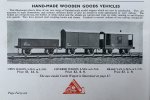
Compared with the 1905 models, the 1950s wagons represent much more modern prototypes. But the level of detail and method of manufacture was essentially the same.
2. Transfer-decorated wooden wagons. An intermediate range (quality and price) between the hand-built wagons and those made of lithographed tinplate. Plain wooden bodies with all detail (planking, framing, lettering etc) provided by transfers. Wagons made in this way were introduced in 1919. They were needed because Bassett-Lowke’s pre-WW1 supplier of lithographed tinplate wagons had ceased trading in 1917. The advantages of the method of manufacture were set out in the description in the Bassett-Lowke catalogues:
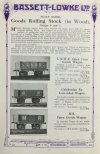
Wooden, transfer-decorated wagons continued in production until c.1937. The range was expanded over time and models of more modern prototypes were introduced. Many more types were made in Gauge 1 than in 0 gauge.
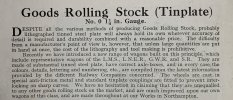
3. Wagons made of lithographed tinplate. Mass-produced and lower priced than the wooden wagons, as explained here in 1933:
Chronologically, Bassett-Lowke tinplate wagons fall into four distinct groups:
i) 1909–1914. Made by Carette. Around 50 different wagons made in Gauge 0 with nearly all also made in Gauge 1 and about half additionally in Gauge 2.
ii) 1921–1930. Wagons made in Northampton using the tooling from the Carette factory. Only six different wagons offered, 0 gauge only, but with corresponding post-grouping versions made after 1923.
iii) 1929–1940. Wagons made at Northampton using new tooling. 0 gauge only. During the production period, including replacement models in updated liveries, around 25 different wagons were made.
iv) 1949–1960. Three LMS wagon models from the pre-WW2 range were reintroduced with small differences. The LMS brake van was replaced c.1951 by a BR version on a longer wheel-base. In the late 1950s, with the main manufacturing facility gone, ‘special load’ wagons were offered made up of a tinplate wagon chassis with various objects (castings, lengths of pipe, sleepers etc.) wired or nailed in place as loads.
I think that will do as a much simplified summary of the wagons made. There were a very few odd wagons that Bassett-Lowke sold at different times that don’t fit neatly into any of the above categories. All the wagons I have described in this thread so far, or am likely to illustrate in future, do fall into one of the ranges listed above.
Martin