Rivermead Central

40057

Western Thunderer
First, thank you, John, for the above comment.

Only a little bit of modelling time today, but I have nailed the horizontal rail (there will only be one) to the sleeper-built fence and painted it:

F03C9FB8-9BA8-45C9-9574-4FAB88DFD92B.jpeg

I will give the fence a light spray of matt black once suitable weather returns. Then glue it to the wall.

I still have some preparation work before attaching the adverts to the wall. A couple of the adverts I expect to use are currently attached to parts of dismantled derelict vintage buildings. It can be time-consuming removing the adverts without damaging them, especially if I also want to re-use the vintage wooden building material, so need to avoid damaging that too if possible.

I certainly now have more adverts than I need for the current build section of wall, having bought three more suitable examples offered for sale on the Internet. So I will try out various arrangements until I get one I like, ideally including adverts in a range of colours for various products that were well-known 70–110 years ago. I will need to be very precise pinning the adverts in place. They will have to go on straight first time, as I really mustn’t damage the painting of the brick-work at this stage.

This is really the first wall/building I have made where the location on the layout makes it appropriate for there to be enamel adverts. These adverts were such a prominent feature at the time and equally so on contemporary scenic model railways. So being able to display a representative selection is excellent. Very much the case that my new build wall is providing a suitable context to appreciate vintage models.

Martin
 

40057

Western Thunderer
Signs of the time:

9535A9D8-463E-4D0F-B38D-4C039B6AD1DD.jpeg

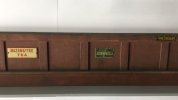
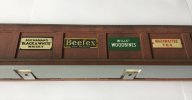
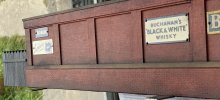
As can be seen, I have started fixing the enamel adverts to my wall. Possibly visible too, I have added extra weathering to the ‘stone’ string course. I realised the coping was much dirtier than the string course — which seemed unlikely IRL. So the string course and the coping are now similar in colour.

I’m using Bassett-Lowke track pins (for fastening down chairs) to fix the adverts. And taking great care to keep the adverts level; putting a nail in the wrong place and having to repair the brick-work at this stage would be a serious nuisance.

The arrangement I have come up with uses eight adverts of various shapes, sizes and colours. The spare adverts will go elsewhere in due course. I decided more adverts just looked too crowded and covered too much of the brick-work I had spent so long painting.

Martin
 

John R Smith

Western Thunderer
As can be seen, I have started fixing the enamel adverts to my wall.

The adverts look great, Martin. And very much in keeping with the vintage "look". We know from pre-1923 photographs that stations of the Victorian and Edwardian eras were in fact liberally festooned with enamel advertising, usually all the way along the platform fencing. But were signal boxes, goods sheds and engine sheds similarly adorned?

Bassett-Lowke and Milbro would certainly have you believe so - as you can see from my B-L engine shed, which has a total of ten enamel signs (four on each side, and two on the back) -

Tunnel Project 07 Web.jpg

As you can see, this picture was taken during the Hornby signal era (all has now changed in the S&T department at Kingswell Street).

John
 

40057

Western Thunderer
The adverts look great, Martin. And very much in keeping with the vintage "look". We know from pre-1923 photographs that stations of the Victorian and Edwardian eras were in fact liberally festooned with enamel advertising, usually all the way along the platform fencing. But were signal boxes, goods sheds and engine sheds similarly adorned?

Bassett-Lowke and Milbro would certainly have you believe so - as you can see from my B-L engine shed, which has a total of ten enamel signs (four on each side, and two on the back) -

View attachment 261641

As you can see, this picture was taken during the Hornby signal era (all has now changed in the S&T department at Kingswell Street).

John
Hi John

I had a look around at historic photographs and my conclusion was that adverts did appear all over the place where they would be seen. So I did find evidence of adverts on retaining walls and buildings visible from trains entering/leaving stations. There must have been some agreement and payment for allowing adverts to be displayed. Which no-one is going to want to do if the adverts would not be seen by the public.

I did test the appropriateness of putting adverts on my wall. Passing trains would be (mostly, anyway) travelling slowly leaving/entering Cairnie Junction station (we’ll ignore the rapid acceleration that can come with clockwork). The wall is 30–35 scale feet from the running line. So plenty close enough for passengers to read the wording on the adverts but far enough away to have time to read them.

Martin
 

40057

Western Thunderer
A brief update on my wall. All the adverts are now nailed in place — without mishap. I must say, I am relieved to have them all fixed as I was very nervous — at this late stage — of a misplaced nail or hammer blow.

The last two to go on:

22D40962-51AE-48C4-9821-0B173E1218DE.jpeg

I’ll get a picture of the whole wall outside in daylight, weather permitting.

Martin
 

40057

Western Thunderer
No outdoors photograph of my wall, I’m afraid. It has been consistently far too windy and if stood the wall up outside it would simply blow over.

However, the remaining tasks to get the wall ready for installation on the layout are well in hand. Specifically, the strip of wood to go in front of the wall that will hold it in place. Just resting in position here:

02D08165-CB3F-4EC8-B927-6E527AA94D29.jpeg

The wooden strip is 4 mm thick pine painted to match the base boards. I have made recesses in the underside that fit over the metal brackets that project from the front of the wall:

A65EF64A-BA9C-4F64-9265-540556D08932.jpeg

The structure will be fixed in place, and held straight and upright, by counter-sunk wood screws through the pine strip and the holes in the metal brackets. The ‘step up’ at the front of the wood strip will be obscured by the track in front, though it wouldn’t matter if it was visible.

As I get close to adding this wall to the layout, I am starting to think about how to cover the wall of the room to the south of where this wall will go. The wall above goes roughly in the position shown in red below, the puzzle is what to put behind the track in the position of the blue line:

FA626983-C1E0-495E-B07F-DB6310BF4067.jpeg

There isn’t much room. Even in low relief, the backs of buildings would be too close to the track. So essentially, it can probably be only a wall or fence. The problem being this section of layout also has a retaining wall between the high and low levels and will need an anti-plunge wall at the front of the base-board. I’m not keen on having part of the layout with nothing but walls as scenery, if I can avoid it.

Martin
 

John R Smith

Western Thunderer
I’m not keen on having part of the layout with nothing but walls as scenery, if I can avoid it.

Martin

In this context, "scenery" has rather a different implication than on today's finescale layouts. Nowadays we expect ballast, trackside verges, point rodding, fencing, and vegetation which is a close representation of full-size flora, all blending seamlessy into a photographic quality backscene. Not so on your (or my own) layout. In the 1920s and '30s the keen railway modeller would probably have put up some Hornby hedgerows, Britains trees and Bassett-Lowke telegraph poles and have been very content with the result.

So you could do the same and stay well within the spirit of a faithful representation of the Golden Era. But I suspect, that having started out with a 3D low-relief backdrop which is all your own work, you will not want to change course now. I solved the problem on my own layout by using a (modern) printed backscene because a) I am lazy and like quick results and b) like you, I literally have no space between the rearmost track and the wall of the room. I originally wanted to keep it all in period and to use the printed backscene as sold in four sections by Bassett-Lowke, and in fact found exactly that (or a repro of it) on eBay, ordered it, and after many weeks had gone by discovered that the seller had gone out of business. So that was the end of that good idea. Just as well, really, because the B-L backscene was only 9 inches tall which is not enough in O Gauge.

Another factor which will, or should, influence your decisions will be the treatment of the other three corners of the room. In other words, what is your new section of wall covering going to be leading into, and how should it blend thereto? The corners of the room are your only chance to build some depth - so far you have Benhams warehouse and works in corner one, which is looking great. What are your plans for corners two, three and four?

John
 

40057

Western Thunderer
Martin

In this context, "scenery" has rather a different implication than on today's finescale layouts. Nowadays we expect ballast, trackside verges, point rodding, fencing, and vegetation which is a close representation of full-size flora, all blending seamlessy into a photographic quality backscene. Not so on your (or my own) layout. In the 1920s and '30s the keen railway modeller would probably have put up some Hornby hedgerows, Britains trees and Bassett-Lowke telegraph poles and have been very content with the result.

So you could do the same and stay well within the spirit of a faithful representation of the Golden Era. But I suspect, that having started out with a 3D low-relief backdrop which is all your own work, you will not want to change course now. I solved the problem on my own layout by using a (modern) printed backscene because a) I am lazy and like quick results and b) like you, I literally have no space between the rearmost track and the wall of the room. I originally wanted to keep it all in period and to use the printed backscene as sold in four sections by Bassett-Lowke, and in fact found exactly that (or a repro of it) on eBay, ordered it, and after many weeks had gone by discovered that the seller had gone out of business. So that was the end of that good idea. Just as well, really, because the B-L backscene was only 9 inches tall which is not enough in O Gauge.

Another factor which will, or should, influence your decisions will be the treatment of the other three corners of the room. In other words, what is your new section of wall covering going to be leading into, and how should it blend thereto? The corners of the room are your only chance to build some depth - so far you have Benhams warehouse and works in corner one, which is looking great. What are your plans for corners two, three and four?

John
Hi John

Thank you for your comments.

Yes, in my/our world, a wall is ‘scenery’. It’s still more than a lot of layouts had.

The relevant corner of the room in the current context is the south-west corner (the Benham’s works is in the north-west corner). This corner is probably the largest area of base-board not covered in railway on the whole layout. Because of the low-level boards (= Cavendish Goods) in front of the high-level tracks, there is a significant area of high-level base-board that is out of reach. So, on the high level, behind the Cavendish Goods branch (which is behind the main line circuit) there is an opportunity for a complete building or buildings. I wouldn’t be bothering to model the out-of-sight side, of course — but the roof could be all there. I probably won’t need a separate low-relief wall covering behind the complete building(s), if I choose wisely.

I will have to decide on the plan for the south-west corner very soon. As you correctly say, the next section of wall covering along the west wall needs to work with whatever goes in the corner.

One option for the south-west corner is to model a building beyond the railway boundary. I rather like the idea of a ‘statement’ Art Deco building and there are some suitable kits available, notably a cinema. The problem I see is the cinema has to be on a street, so there would be a whole lot more modelling required beyond building the kit. Also there probably isn’t room for a street/road and the cinema behind it. A more practical choice would be to model the rear of a building or buildings, backing onto the railway. Which rather rules out a grand statement building. I could have a row of terrace houses diagonally across the corner though, which would look very appropriate.

Decisions will have to be taken quite soon. If I went for a rail-served factory or depot, just in reach, in front of whatever building goes right in the corner, that will also affect my track layout.

Martin
 

Yorkshire Dave

Western Thunderer
One option for the south-west corner is to model a building beyond the railway boundary. I rather like the idea of a ‘statement’ Art Deco building and there are some suitable kits available, notably a cinema. The problem I see is the cinema has to be on a street, so there would be a whole lot more modelling required beyond building the kit. Also there probably isn’t room for a street/road and the cinema behind it. A more practical choice would be to model the rear of a building or buildings, backing onto the railway. Which rather rules out a grand statement building. I could have a row of terrace houses diagonally across the corner though, which would look very appropriate.

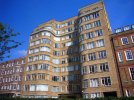
Instead of a factory or terraced houses why not go for something like Florin Court in Charterhouse Square.

Florin_Court_(2).jpg

There are plenty more Art-Deco buildings such as the Daily Express Offices, Shell-Mex House, Senate House, etc, etc. Loads of inspiration here Category:Art Deco architecture in London - Wikipedia

Better still go for one of the Charles Holden Underground Stations such as Sudbury Hill or Chiswick Park among others. You don't have to model what's underneath :).
 

40057

Western Thunderer
Instead of a factory or terraced houses why not go for something like Florin Court in Charterhouse Square.

View attachment 262023

There are plenty more Art-Deco buildings such as the Daily Express Offices, Shell-Mex House, Senate House, etc, etc. Loads of inspiration here Category:Art Deco architecture in London - Wikipedia

Better still go for one of the Charles Holden Underground Stations such as Sudbury Hill or Chiswick Park among others. You don't have to model what's underneath :).
Hi David

Thanks for suggesting the Wikipedia page.

Some great buildings.

I cannot go for a high-rise building because of the sloping ceiling. Maximum two storeys anywhere close to the east or west walls of the room where there is only c.135 mm of vertical wall above the high-level base boards. You can see my problem in this shot of the Benham’s buildings:

4E0E2615-753F-4F53-BFF9-EAD66B08B6B5.jpeg

I designed these buildings to all have their greatest height at the front, away from the wall. So the ‘Benham’s’ roof sign on the factory building, the wall supporting the canopy on the warehouse and the ornate date stone on the office building were all devices to produce buildings that are taller than the height of the vertical wall behind them.

The place where I can have tall buildings is Cavendish Goods. Lower level base-boards and away from the west and east walls. Four storeys or more would be no problem. I plan to have one or two large warehouse/factory buildings at Cavendish Goods, as the reason for the branch existing. One of the industrial buildings at Cavendish Goods could be Art Deco, the other, say, Victorian. Ideally, I will find suitable kits.

I have another option for my Art Deco building. The station hotel at Cairnie Junction. This will be against the north wall of the room a foot or so to the right of the right edge of the above picture. At the moment the best kit option I have identified for the hotel is based on the one adjacent to Boat of Garten station. However, I am not confident I can make a good representation of the stone used in the building. I will use kits where I can simply to save time. Roughly speaking, I have 65’ of 3’ wide base-board to cover with railway and scenery — mostly railway. I need to avoid very time-consuming building projects.

Martin
 

40057

Western Thunderer
Still too windy to stand my wall up outside. But a ‘for the record shot’ taken in our porch. The wall is now complete and ready to be installed on the layout:

5A34662D-CEE1-40FD-9FC4-4A509B4BF568.jpeg

The short section of sleeper-built fence is glued in place:

A6B3BE47-F902-42DD-A926-5BA6C53CE3D9.jpeg

I don’t intend fastening to the wall the grey-painted pine strip that covers the metal brackets. Both the wall and the pine strip will be held in position on the base-boards by the same countersunk screws.

I am pleased with the final appearance of the wall and fence. The wall is new, made of modern MDF overlying a wooden structure. But the adverts are vintage (or actually officially ‘antique’) items contemporary with my rolling stock. The fence is made of Bassett-Lowke sleepers.

Some further thoughts about how to cover the back wall in the area marked in blue:

4BEA3747-3DB1-44A4-A48A-E26EE0BFAE16.jpeg

I think my options are:

1. More sleeper built fence.
2. Another wall.
3. Part fence/part wall.
4. Lift the rearmost track, say, one or two lengths from the turnout. Insert a short curved length so the track diverges from the wall by a few degrees. Possibly then a return to bring it back parallel. Anyway, increase the space behind the track to allow low-relief buildings. The distance between the tracks is generous due to the geometry of Lowko Track standard lengths, so there would be no issue with clearances bringing the rear track forward by, say, an inch or a bit more.

When I think about the amount of construction required to progress the layout, option 4 is a disproportionate amount of work. I just need to cover the wall. Option 1 has the benefit of being the least work and it’s not a wall. Option 2 offers the chance to add some vintage interest with more adverts.

I have noticed when looking at 1920s and ‘30s photos showing advertising that while adverts often appear pretty random, which I have copied, it also seems to have been common to display multiple copies of the same advert along a wall or building. So if I built a wall with eight piers, hence seven sections between piers, I could display four of the same adverts using every other section. I don’t have four copies of the same advert, but a friend has packets of identical adverts in brand new ‘unsold shop stock’ condition. So I could easily buy four copies of a chosen advert and reproduce a common sight in the ‘20s.

Martin
 

John R Smith

Western Thunderer
Hello Martin

The new wall looks very good. My advice for the blue area -

Keep it simple. Keep it quick to build and complete.

The main task ahead of you is to complete all the trackwork, test it thoroughly, and iron out any bugs (there will inevitably be some). Don't get too sidetracked by the picture frame.

Just my twopenn'orth!

John
 

40057

Western Thunderer
Hello Martin

The new wall looks very good. My advice for the blue area -

Keep it simple. Keep it quick to build and complete.

The main task ahead of you is to complete all the trackwork, test it thoroughly, and iron out any bugs (there will inevitably be some). Don't get too sidetracked by the picture frame.

Just my twopenn'orth!

John
100% agree, John.

I am building a model railway.

I need to spend enough time and effort on the ‘scenery’ to make it look as I want it. But not so much I don’t get to build the railway itself or work on the vintage rolling stock.

Martin
 

Yorkshire Dave

Western Thunderer
I have another option for my Art Deco building. The station hotel at Cairnie Junction. This will be against the north wall of the room a foot or so to the right of the right edge of the above picture. At the moment the best kit option I have identified for the hotel is based on the one adjacent to Boat of Garten station. However, I am not confident I can make a good representation of the stone used in the building.

Base the hotel on the Midland Hotel at Morecambe which is rendered - no stonework required. A shell can easily be built from wood or card. Being rendered it will provide a nice contrast to the brick and stone buildings. Photo from Historic England.

midland-hotel.jpg
 

40057

Western Thunderer
The way I am building Rivermead Central means I can go for months without adding anything to the layout itself. All the modelling time is devoted to working on a particular building — effectively a sub-assembly — being constructed remotely. Then, of course, a significant change is made to the layout in just a few hours.

Before I can add the newly completed wall to the layout, I have to fasten in place the storage shed, wall and fence completed in January (post #661). I carried out a test-fitting earlier today. As part of this, I have drilled a small hole in the end of the previously installed length of fence and used a peg fixed in the wall to hold the fence upright (it was slightly leaning forward). I have marked the locations for drilling the pilot holes for the fixing screws, but as yet the storage shed assembly is not fastened in place. But this is how it will look:

EDC8097C-9C1B-45F5-8C17-5721AB55F817.jpeg

28A4834C-8163-48FD-94B3-A195EDEC4A90.jpeg

Between the storage shed and the yard office there will a lamp hut (built from an Intentio kit) and the signal box (Bassett-Lowke, c.1920 or earlier). So a collection of railway buildings all connected with operating the yard. And all these buildings modelled in their entirety.

On reflection, there perhaps is not really much of an issue with more ‘plain boundary wall’ to the south of these buildings. There are enough buildings at the back of the layout, against the west wall of the room, for the overall appearance to look, I think, varied and urban.

Martin
 

40057

Western Thunderer
Base the hotel on the Midland Hotel at Morecambe which is rendered - no stonework required. A shell can easily be built from wood or card. Being rendered it will provide a nice contrast to the brick and stone buildings. Photo from Historic England.

View attachment 262105
A magnificent building. But a very large one!

I might have room for the central tower plus two or three windows-width each side.

I would need advice on how to construct the curved walls! Never attempted anything remotely like this.

The rendered finish is a help. So if I can build it, yes, I can paint it.

Martin
 

40057

Western Thunderer
Some thinking has been done!

First, the next ‘wall covering’ for the back of the layout heading southwards along the west side. My ‘back of an envelope’ concept sketch:

031D29AF-CABF-4679-BDB2-BBB5E8EFB0C5.jpeg

I’ll start by finding the adverts for this one. Three the same — or four if I extend the wall so there are two more piers. Assuming I can find a set of adverts, I’ll then space the piers so the adverts fit between them. The wall to be red brick with some engineering blue bricks in appropriate positions (footings at least). Target length = c. 2 feet.

Next, the overall plan for the south-west corner (subject to change). Unusually, sketched on the front of an envelope:

27C93069-F8A4-4701-B314-9BF77B8D1E50.jpeg

The long (180 degree) curve in the main line at the south end of the room will be a constant 3’ 10” radius. This was a standard radius made by Milbro (Mills Bros of Sheffield) and I have the necessary pieces of track. I will have to make short ‘converter’ lengths to join the drawn Milbro rails to the Lowko Track hollow tinplate rails. That’s still a lot less work than making up ten or eleven bespoke lengths of 3’ 10” radius Lowko Track from recovered components. The radius is the maximum I have room for.

I still have to make the curving retaining wall between the main-line and the low-level yard at Cavendish Goods. The high-level base-board behind the curving section of retaining wall isn't made either. When I got my ‘replica’ vintage brick sheets made by Poppy’s Wood Tech some years ago, I got some made using very thin plywood. This material will bend easily to make a retaining wall of c. 3’ 6” radius. This is the job the thin plywood brick sheets were made for.

In the south-west corner itself, a terrace of houses. Ideally, the back elevation but I haven’t found kits for that which I like. So the houses might have to face the railway and have an access road in front. In front of the houses, a coal merchant’s yard. A source of traffic for the railway. An opportunity to use my post-WW2 Bassett-Lowke coal office, which is as per the illustration in the 1951 catalogue:

3EF621ED-E0F0-4FA1-AF79-CC9A31651CF5.jpeg

Being able to use the coal office would, as with the yard signal box, allow me to mix vintage buildings with my new construction. A downside is the need to rebuild another Lowko Track point.

I have done no measurements for the above scheme at this stage. Past experience suggests I generally over-estimate the amount I can fit in the available space. I could though reduce the houses to half-relief (stopping at the roof ridge tiles) which would save at least 6” in the width of the terrace.

Martin
 

John R Smith

Western Thunderer
Next, the overall plan for the south-west corner (subject to change). Unusually, sketched on the front of an envelope:

Hello Martin

The overall plan looks fine. The coal merchant's siding will be a nice space filler and a useful source of traffic, too. One thing that we both have is a good selection of private owner coal wagons. You are inevitably constrained for backdrops by the location of your layout (in a loft? roof space?) so that you have less than 6 inches vertical height of room wall above the rear of the baseboard. So any conventional printed backscene or even sky paper is ruled out. Hence the wall and fence solution is a very good one, and if you keep your construction standardised it should be fairly quick to build.

I’ll start by finding the adverts for this one. Three the same — or four if I extend the wall so there are two more piers.

I love these enamel adverts - but unfortunately,, they now seem to have become very collectable, and hence somewhat expensive. Like a lot of things in this vintage hobby!

In the south-west corner itself, a terrace of houses. Ideally, the back elevation but I haven’t found kits for that which I like. So the houses might have to face the railway and have an access road in front.

A road in front of a terrace could also be combined with the access road to the coal yard - and be a nice opportunity to display some of your wonderful Minic road vehicles. One thing I might suggest - unlike my fine scale layouts, almost nothing on Kingswell Street is glued or otherwise fixed in place. The only things which are screwed down are the signals (because otherwise it is very difficult to operate them) and a very few screws at critical points on the track (to provide a datum). Otherwise all the buildings are simply popped down and rest in place. This way, if I change my mind about something or want to try out various arrangements I can easily move things around. It also simplifies things when I want to clean the layout - I just lift all the buildings off, give them a brush individually, and run the vacuum cleaner over the track and the bare boards.

John
 

Yorkshire Dave

Western Thunderer
A magnificent building. But a very large one!

I might have room for the central tower plus two or three windows-width each side.

I would need advice on how to construct the curved walls! Never attempted anything remotely like this.

The rendered finish is a help. So if I can build it, yes, I can paint it.

Fortunately there are a large number of surviving Art Deco buildings around in the UK for inspiration so you could easily adapt one to suit the space. The main thing as I see it is to create something with screams Art Deco.
 
Top