7mm Rob's Rolling Stock Workbench

Rob Pulham

Western Thunderer
Hi Rob. Very nice;). As its a tad early for my era and i dont know anything about horse boxes:confused: what livery will it be?

Rob

Thanks Rob, I planned to finish it in lined LMS livery but I have been struggling to get any running numbers for them in LMS days. It seems that the S&D retained it's livery until 1930 so I was resigned to painting it ultramarine blue (now steady on boys, don't get too excited:p) and spending £20 on a sheet of HMRS transfers that I would only ever use a few of.

But by good fortune and timing for your enquiry Rob, I had a reply this morning from a gent in the S&D section of the HMRS who has let me have LMS running numbers for a few of these horseboxes and by coincidence for the one that I have a B&W photo of that I have been using for reference. So LMS lined livery it will be. I need to get my finger out and build the Midland one that I have so I can paint them both together.

You are getting some very nice results Rob :bowdown:...........the Aldi gas torch I showed you has proved a real bargain too :cool:

Cheers Phill, what I like about the microflame is that you can get away with the smallest amount of solder and get it to run into the joint by capillary action, This leaves virtually no solder to clean up, just a bit of discolouration of the brass which cleans up with a plastic pan shiner.
 

Rob Pulham

Western Thunderer
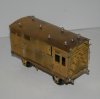
Well here are a few shots of progress on the NER horse box.

NER Horsebox 002.JPG

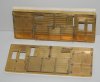
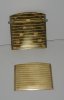
Still some way to go on detailing the sides. I have made the small observation door on either side sliding and I plan to put a basic interior in so that it can be viewed by opening the door. Sad I know but I do love the details.

NER Horsebox 003.JPG

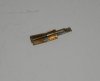
Since there was a lack of castings and I believe by LNER days it would have been dual braled until at least 1930 I have knocked up a semblance of a vacuum cylinder to go with the Westinghouse casting.

NER Horsebox 006.JPG

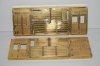
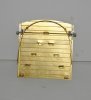
I have also made a partition for the grooms compartment, I still need to make stalls etc.

NER Horsebox interior panel.jpg

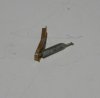
Sadly as I mentioned before there are no etches or castings to represent the quite distinctive door supports - I now describe them as supports as the more I look at different pictures I don't believe they were springs, more like rams that come to s top and support the door when lowered.

nerhorsebox door supports.jpg

Which means that I need to order some brass angle from Eileens to have a go at making them.
 

Rob Pulham

Western Thunderer
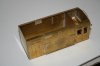
Having had a day off today, I spent it pleasantly scratch building additional details for the NER horse box sides.

Both sides are now fully detailed (the door supports will be fastened to the chassis so I can remove the body for painting - although I may ultimately glue them once they painting is finished) next up is the end with the brake tell tale.

In the style of fellow members I have made the door bolt working - shame the doors are not separate or I would have had a go at making them open too.:p

NER Horsebox sides 001.JPG

NER Horsebox sides 004.JPG
 

Old Buffer

Western Thunderer
That is looking very good so far:thumbs::bowdown:, the detailing is great:drool:. As you say it's a pity the doors are not seperate parts:(. You could have used some of my really bad Yorkshire/Saxon language (as I used tonight:headbang:) whilst trying to get the hinges to work.
Alan
 

Rob Pulham

Western Thunderer
That is looking very good so far:thumbs::bowdown:, the detailing is great:drool:. As you say it's a pity the doors are not seperate parts:(. You could have used some of my really bad Yorkshire/Saxon language (as I used tonight:headbang:) whilst trying to get the hinges to work.
Alan

Thanks Alan, I already did,:mad: when a couple of my hinges flew off into the carpet monster,:shit: never to be seen again until they rattle around in the vacuum:headbang: The new workshop has laminate floor so hopefully I should find the bits that ping off into space!!
 

Rob Pulham

Western Thunderer
Tonight I spent some time detailing the Grooms end with handrail and brake tell tale. I still have the other brake pipe work to add.

I have to confess that I like the tell tale indicators so much I plan to make some for the S&D box. Each indicator is made from 2 x 4mm scale Markits crank pin washers, soldered together to give some depth and a slot cut in them with a piercing saw to accept the end of the brass rod.

NER Horse box Grooms end 001.JPG

NER Horse box Grooms end 002.JPG
 

Buckjumper

Flying Squad
Nice neat work Rob. This is of particular interest as I have one in the 'to do' pile as NER NPCS made it to London, even down onto the Met., and one of that company's out of gauge CCTs once smashed into several girders at Ray Street gridiron near Farringdon. Won't be replicating that incident though.
 

Rob Pulham

Western Thunderer
Thanks Adrian,
Would you do me a small favour - if it's to hand would you mind checking the castings to see if there should have been a vacuum cylinder and a Westinghouse cylinder as opposed to two Westinghouse (sorry but it's nagging at me)?

It seems that D&S kit's do vary in their contents - I took delivery today of a CLC Brake van and a GCR CCT, both eBay spoils and a good price too at £40 each. The CCT look s to have full brake gear including both types of pump and brake yokes etc, while the brake van at first glance (without opening the packaging) seems to be similar to the NER horsebox in that I cannot see any brake yokes.

I can only assume that the CCT is perhaps a newer design of kit (a lot of the parts are number marked and there are 4 x A5 pages of instructions:thumbs:) despite the brake van having what looks like the most recent form of packaging (once again similar to the NER horsebox that I bought new from Halifax show this year).

Anyway despite the omissions I do think it 's a lovely kit and the etches are worlds apart from the MSE based ones on the S&D box.

I really do need to get a current list from Danny, one (among many) that I fancy is a LNER BY120. I saw part built one sell on ebay recently and it looked very nice. I have built a couple of the 4mm Chivers kit's and they are a nice bit of rolling stock.
 

Buckjumper

Flying Squad
Ooh that was lucky I've got kits squirrelled away in so many places it could have been anywhere, but the NER box fell out of the first place I looked. Only one Westo cylinder and no vac cylinder in the bag which leads me to suggest that unlike the later D.196 boxes which did have vac cylinders, these boxes were only piped for foreign lines.

What I do have in there are castings for the door spring/rams.

Danny can supply a fret of etched brake yokes, but even better, Laurie Griffin has some nice cast ones in his range, cat. 37-17 (£6 for a pack of six at 2010 price).
 

Rob Pulham

Western Thunderer
Thanks again Adrian,

That clears that one up. Although I am sure that by my modelling era - firmly into grouping that they would have been dual fitted - both diagram's were according to Tatlow.
 

Buckjumper

Flying Squad
Rob - could you confirm where you got the info that the D.67s were fitted with a vac cylinder? I'm curious as I've not yet seen any evidence for it, and I'd have thought that it would have been a prohibitively expensive and relatively pointless conversion given that many were already over 30 years old at Grouping, and already fitted with vac through pipes.

Compare with the GER (another Westinghouse line) horseboxes. Some were fitted with vac through pipes by the GER, and at Grouping the LNER fitted through pipes to the rest. In the early 1930s the LNER stripped out the Westinghouse gear from all the horseboxes (indeed, all NPCS and carriages except those sets running on the intensive suburban lines) leaving the horseboxes with just vac through pipes and a handbrake.
 

Rob Pulham

Western Thunderer
Rob - could you confirm where you got the info that the D.67s were fitted with a vac cylinder? I'm curious as I've not yet seen any evidence for it, and I'd have thought that it would have been a prohibitively expensive and relatively pointless conversion given that many were already over 30 years old at Grouping, and already fitted with vac through pipes.

Compare with the GER (another Westinghouse line) horseboxes. Some were fitted with vac through pipes by the GER, and at Grouping the LNER fitted through pipes to the rest. In the early 1930s the LNER stripped out the Westinghouse gear from all the horseboxes (indeed, all NPCS and carriages except those sets running on the intensive suburban lines) leaving the horseboxes with just vac through pipes and a handbrake.

Hi Adrian,

The information comes from Tatlow's Historic Carriage Drawings Volume 3 NPCS, page 82 and I quote:

"The vehicles of this and the next design to diagram 196 were dual brake fitted, together with through steam heating pipe and lit by oil lamps"

There are no photographs accompanying the article on these boxes but there are several of D196 boxes. These photos show both sets of equipment but interestingly looking at the D67 drawings (both side and end views). They only show the Westinghouse equipment so that belies the text.

I do agree with your point that, the age of them at grouping would have made conversion expensive and pointless, makes perfect sense.

Do I add the vacuum cylinder or don't I, hmm..... Where's that rubbing chin smiley when you need it?
 

Buckjumper

Flying Squad
Hi Rob - I thought that might be the source, but didn't want to presume. Although the book is useful, there are some areas (particularly those dealing with the GE) which I dispute because the author upon whose articles Peter has based his information, disclosed to me that his articles should now be considered obsolete as new information has come to light in the interim. I hold the same view with Peter's wagon books, particularly the GE section in Vol.1. for the very same reason (same original author!). Don't get me wrong - Peter's books are wonderful resources for modellers, and I wouldn't be without my copies, but if you're keen to build historically accurate models I'd urge you to try and locate primary evidence wherever possible.

In Danny's instructions he mentions a drawing by Ian Sadlers in the NER Assoc. Journal (upon which, I presume, the drawing in the instructions is based - and I see that there are differences between it and the one in the Tatlow book), and also a photograph from the collection of Ken Taylor. It might be worth sending an email enquiry to the NERA Journal editor and/or librarian for further information.

FWIW, the livery information on P.12 of Historic drawings is incomplete for the LNER , and this is something I discussed with Peter Tatlow and Nick Campling a few years ago, so take care not to paint the ends black but the same colour as the sides. The discussion concluded with a number of amendments by Nick:

"I can confirm that NPCS CCT's, Mail Vans, Bogie Milk Vans, and non corridor brakes had black ends certainly from 1928. Horseboxes, prize cattle vans and 6wh Milk Vans (eg NB) had both sides and ends the normal body colour
right through into BR days. Bogie passenger brakes with bow ends were varnished teak and lined right through to 1948."
 

Rob Pulham

Western Thunderer
In Danny's instructions he mentions a drawing by Ian Sadlers in the NER Assoc. Journal (upon which, I presume, the drawing in the instructions is based - and I see that there are differences between it and the one in the Tatlow book), and also a photograph from the collection of Ken Taylor. It might be worth sending an email enquiry to the NERA Journal editor and/or librarian for further information.

Hi Adrian,
Thanks for the the update and insights. Part of my problem is that there are no instructions with the kit - just a couple of basic drawings.

Thankfully even without your further info from Nick, I would have painted them body colour anyway. Not having picked up from anywhere the reference to black ends.

I think that I will stick with just the Westinghouse equipment and save the vacuum cylinder for another day/kit.

Thanks again
 

Buckjumper

Flying Squad
Hi Adrian,
Thanks for the the update and insights. Part of my problem is that there are no instructions with the kit - just a couple of basic drawings.

Blimey, I didn't realise. You probably won't need them now, but a scan of the instructions, brief as they are, have been emailed over.

ATB
 

Rob Pulham

Western Thunderer
Thanks Adrian, I am sure they will be of use as I haven't started the main assembly or underframe yet - just been adding what detail I could while it was flat to make life a little easier.

Thanks again.
 

Rob Pulham

Western Thunderer
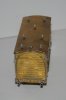
Thanks again Adrian, the instructions that you sent over have been of use already. What isn't clear from either of the drawings that I have is that what I took to be an etched grove representing the end of the planks on the ends is in fact a groove to that the builder is meant to fill with wire to represent the half round beading on the real thing.

Hopefully this shot will give an idea of what I mean.

NER Horse box Grooms end 004.JPG
 

Rob Pulham

Western Thunderer
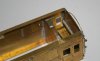
Although I haven't posted updates recently progress has been steady. I made another seat although this one is soldered in so painting will be fun. I also made a false end panel to hide the rear of the outer steps/handrail etc.

NER Horsebox 001.JPG

NER Horsebox 002.JPG

NER Horsebox 003.JPG

I have also added the roof and made some progress on the underframe.

NER Horsebox 001.JPG

NER Horsebox 002.JPG

NER Horsebox 003.JPG

I have had a go at the prominent springs for the drop down doors. I hope that I can solder one part to the sole bar and glue the other to the rod that runs across the bottom of the door after the body is painted.

NER Horsebox 004.JPG

NER Horsebox 006.JPG

NER Horsebox 007.JPG
 

Rob Pulham

Western Thunderer
Since my holiday I have done a little more fitting the brake yokes (Griffin castings), the Westinghouse cylinder and the grooms end steps but I seem to have lost mojo for this build so I have put it aside while I think about scratch building the brake linkages and picked up the A3 again.

Papyrus Brakes 002.JPG
 
Top