
You are using an out of date browser. It may not display this or other websites correctly.
You should upgrade or use an alternative browser.
You should upgrade or use an alternative browser.
Scratch build - LNWR Precursor Tank - Scale7
- Thread starter adrian
- Start date


RichardG
Western Thunderer
Nothing fancy for soldering it all together - no clamps are necessary just a simple wooden block at times is all that is required.

@adrian I have found the block of wood method really helpful when I came to move a skew-whiff frame spacer in a chassis I had already built. If I had known about it I would have used a wooden block for the initial assembly

But do you have an equally straightforward method for getting axle bushes directly opposite each other during a build? I have got myself down to an error of about a quarter of a degree but this is not "opposite" and I found myself running a tapered broach through the bushes to let the axles spin freely. Many kits make this foolproof but a scratchbuilt chassis does not.

Ian@StEnochs
Western Thunderer
Use a decent frame assembly jig. I use a Hobby Holidays one but other makes are available.@adrian I have found the block of wood method really helpful when I came to move a skew-whiff frame spacer in a chassis I had already built. If I had known about it I would have used a wooden block for the initial assembly
But do you have an equally straightforward method for getting axle bushes directly opposite each other during a build? I have got myself down to an error of about a quarter of a degree but this is not "opposite" and I found myself running a tapered broach through the bushes to let the axles spin freely. Many kits make this foolproof but a scratchbuilt chassis does not.

simond
Western Thunderer
Or build on a big sheet of squared or graph paper taped on top of a piece of float glass. Line up the axles and the frames with the lines in the paper. Support the axles on extruded ally angle laid “corner up”, and you’re guaranteed that they’re in the same plane, and by looking at it from all angles, you’ll get the frames straight and perpendicular to the axles. And of course, use the coupling rods to set the spacings.
its probably much more hassle than buying a frame assembly jig, but it is satisfyingly cheap…
its probably much more hassle than buying a frame assembly jig, but it is satisfyingly cheap…

adrian
Flying Squad
But do you have an equally straightforward method for getting axle bushes directly opposite each other during a build? I have got myself down to an error of about a quarter of a degree but this is not "opposite" and I found myself running a tapered broach through the bushes to let the axles spin freely. Many kits make this foolproof but a scratchbuilt chassis does not.
My "high-tech" chassis alignment jig is simply a couple of 12" lengths of silver steel. I thread them through the axle bushes when soldering the chassis together. The length simply amplifies any distortion or twist. For making sure that the bushed are opposite each other then I use a 3" or 4" engineers square against the frames to make sure that the rods are perpendicular to the chassis i.e. opposite each other.

More details here

Jinty chassis build. - Cherry Clan
Building the Scale7 chassis for the Connoisseur Jinty, incorporating springy beam suspension.
 www.cherryclan.com
You can spend lots more money on chassis alignment jigs but I've never found the need to and spent my money on other tools instead.
adrian
Flying Squad
Once I had the ashpan in place it allowed me to work out how the motor and gearbox was going to sit. The ashpan limiting the angle of tilt to the gearbox so I could workout the hole required in the boiler to accommodate it.

Attention then turned to the next "component" being the smoke box. Fortunately on the Precursor Tank the smokebox is a simple wrapper, no multi stepped bands between the smokebox and the boiler. I started by cutting the front and rear plates and a length of strip for the wrapper. The front plate and wrapper then had the appropriate riveting applied.
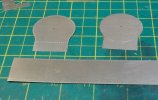
The wrapper was then hand pressed around a large steel bar, a couple of feint lines were scribed across the wrapper using a square, these help to ensure that the wrapper is square to the bar.

I decided to trim the front plate at the bottom so that I could insert the front frame plates behind the wrapper - hopefully it will become clear later on. I also cut a couple of rectangular spacer to solder the front and rear plates together before fitting the wrapper.
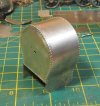
The rear plate was also inset so that there was a lip of wrapper to go around the boiler.
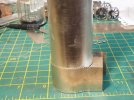
At the side the wrapper is bolted to the frames rather than riveted as there is also the steam chest between the frames, so the bolts have a small but discernible angle inline with the cylinder centre line. Rather than trying to mark out the wrapper I marked it out on a scrap length of nickel silver to use as a drilling jig. I then soldered and trimmed a length of n/s wire in the holes.

A quick clean up finished off one more element for the build.


Attention then turned to the next "component" being the smoke box. Fortunately on the Precursor Tank the smokebox is a simple wrapper, no multi stepped bands between the smokebox and the boiler. I started by cutting the front and rear plates and a length of strip for the wrapper. The front plate and wrapper then had the appropriate riveting applied.
The wrapper was then hand pressed around a large steel bar, a couple of feint lines were scribed across the wrapper using a square, these help to ensure that the wrapper is square to the bar.
I decided to trim the front plate at the bottom so that I could insert the front frame plates behind the wrapper - hopefully it will become clear later on. I also cut a couple of rectangular spacer to solder the front and rear plates together before fitting the wrapper.
The rear plate was also inset so that there was a lip of wrapper to go around the boiler.
At the side the wrapper is bolted to the frames rather than riveted as there is also the steam chest between the frames, so the bolts have a small but discernible angle inline with the cylinder centre line. Rather than trying to mark out the wrapper I marked it out on a scrap length of nickel silver to use as a drilling jig. I then soldered and trimmed a length of n/s wire in the holes.
A quick clean up finished off one more element for the build.
Ian@StEnochs
Western Thunderer
My "high-tech" chassis alignment jig is simply a couple of 12" lengths of silver steel.
Adrian I agree, cheap but not very easy to use.You can spend lots more money on chassis alignment jigs but I've never found the need to and spent my money on other tools instead.
The method works, I have used it, but 3 hands would be better than the two I have. A worthwhile improvement is to turn crankpin size pins on each end of the rod so that the coupling rods can be used to set the wheelbase exactly. However if you are a novice chassis builder you may not have the tools for that.
I don't want to teach folk to suck eggs but building a working chassis from scratch is not a simple task especially if it is your first. There is only ONE position where the frames are straight, free of twist, with the wheels spaced exactly the correct distance apart and the axles square to the frames. Springing, or compensation, can eliminate the effects of twist but a good chassis jig will make achieving the other conditions much simpler.
If your first effort isn't succesful you may never try again.
Ian.
Last edited:
adrian
Flying Squad
I hope we can just agree to disagree - personally I don't find it difficult to use. I do it in 2 stages - in that I fix all the hornblocks to the frames before assembling the chassis. I fix one hornblock to one frame to give me my starting reference. I then clamp the 2 frames together and with a square block to fix the hornblock in the same location on the opposing frame. Then as you suggest I use the coupling rods as spacers to set the wheelbase for all the remaining hornblocks on the frames. Once that is all done the next stage is just soldering the frames together for the chassis. So the steel rods are only needed to check if the chassis is twisted or skewed.Adrian I agree, cheap but not very easy to use.
The method works, I have used it, but 3 hands would be better than the two I have. A worthwhile improvement is to turn crankpin size pins on each end of the rod so that the coupling rods can be used to set the wheelbase exactly. However if you are a novice chassis builder you may not have the tools for that.
Each will do their own, but I am firmly with Adrian on this - I built a dozen or two locos before anyone ever suggested that many tens of pounds spent on an "Alignment jig" was an indispensible necessity. Once I knew what I was doing, I never had a failure: providing you are working from the correct first principles, (as Adrian lists) you won't go wrong. By contrast, I have seen any number of unskilled people use alignment jigs and get poor results - simply because they assumed that the jig will prevent errors. But the reality is that the jigs themselves inevitably involve clearances and tolerances, and in unskilled hands, these will accumulate in an unhelpful way. [a common issue is not getting the rod-centres IDENTICAL on each side- a basic mistake which the jig will not prevent]
Putting that lot another way, if you have the skills you don't need the jig, and if you don't have the skills, a jig will not save you! Practice makes perfect, and I scrapped a fair few before I got good at it!
Excellent thread Adrian - keep up the posts!
Best wishes,
Howard
Putting that lot another way, if you have the skills you don't need the jig, and if you don't have the skills, a jig will not save you! Practice makes perfect, and I scrapped a fair few before I got good at it!
Excellent thread Adrian - keep up the posts!
Best wishes,
Howard

Brian McKenzie
Western Thunderer
More than a 'like' - a BIG tick from me.Each will do their own, but I am firmly with Adrian on this - I built a dozen or two locos before anyone ever suggested that many tens of pounds spent on an "Alignment jig" was an indispensible necessity. Once I knew what I was doing, I never had a failure: providing you are working from the correct first principles, (as Adrian lists) you won't go wrong. By contrast, I have seen any number of unskilled people use alignment jigs and get poor results - simply because they assumed that the jig will prevent errors. But the reality is that the jigs themselves inevitably involve clearances and tolerances, and in unskilled hands, these will accumulate in an unhelpful way. [a common issue is not getting the rod-centres IDENTICAL on each side- a basic mistake which the jig will not prevent]
Putting that lot another way, if you have the skills you don't need the jig, and if you don't have the skills, a jig will not save you! Practice makes perfect, and I scrapped a fair few before I got good at it!
Excellent thread Adrian - keep up the posts!
Best wishes,
Howard
-Brian McK.

CoVianna
Member
You could take the design a bit further by making a small depression in the base of the jacks in which to insert and fix a small flat round button magnet.
Use a non-stick steel baking sheet (or baking tray to catch parts and both cheaply and freely available) as a secondary 'workbench' as this will prevent the jacks and chassis moving around or toppling if you were working on it in this position.
And you could lift the whole ensemble and move it aside as 'one piece' to clear the bench to work on something else.
Brilliant idea!
It’s made me think. Do they make ones that are not non-stick? Then I can use it like you do but also as the ‘ground’ for my resistance soldering kit.
simond
Western Thunderer
You definitely do not want to overheat non-stick as that will release all sorts of nasty smoke, probably including hydrofluoric acid, so do avoid dropping a hot soldering iron on it if it is non-stick.
given the 3DP jacks are non conductive, you’d need an earth wire to the chassis anyway.
just had a look for “steel baking tray” online. They’re all stainless…
given the 3DP jacks are non conductive, you’d need an earth wire to the chassis anyway.
just had a look for “steel baking tray” online. They’re all stainless…

Ian@StEnochs
Western Thunderer
You know you want to Join the grown ups!How have I missed this thread. WONDERFUL machining and modeling here!
That trailing truck setup is genius! I will not give in to scale 7... I will not give in to scale 7...
Amanda
adrian
Flying Squad
Thanks everyone for the feedback it is appreciated.
Next small step was the cab spectacle plate. Using the section drawings from the LNWR Society digital archive it was a simple job to transfer the dimensions to a sheet of nickel-silver. After attacking it with a piercing saw and tidying up with the files it was cut to shape. The windows were quite a tricky shape to get looking correct and to be honest this was the second attempt as I wasn't happy with my first effort.
Whilst it was flat I thought it best point to add the bezels around the windows.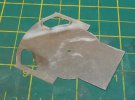
This was done by using the spectacle plate as the template to trace the shape onto a thin sheets of n/s

Against the shape I drew out the extra width for the bezel and cut out a blank.

These were soldered in place on the spectacle plate and then the window was cutout again, and filed flush with the shape in the spectacle plate.

As mentioned elsewhere on WT across the top there is a row of ventilation holes, the "marking out" is done by using a rivet embossing tool. This could then be used as the centre marks for drilling out the ventilation holes.

A quick dry assembly - the boiler fits inside the smokebox wrapper and a twist drill aligns the spectacle plate with the boiler. This was done to check the fitting of the tanks around the boiler, that they would be correct width over tanks, vertical etc. My initial cut was perfect so I spent a little time filing and fetteling to get this fit.
[ The first scrap effort can be seen behind and to the left - if I remember correctly I cut to windows to large and the heights weren't right either ]

Next small step was the cab spectacle plate. Using the section drawings from the LNWR Society digital archive it was a simple job to transfer the dimensions to a sheet of nickel-silver. After attacking it with a piercing saw and tidying up with the files it was cut to shape. The windows were quite a tricky shape to get looking correct and to be honest this was the second attempt as I wasn't happy with my first effort.
Whilst it was flat I thought it best point to add the bezels around the windows.
This was done by using the spectacle plate as the template to trace the shape onto a thin sheets of n/s
Against the shape I drew out the extra width for the bezel and cut out a blank.
These were soldered in place on the spectacle plate and then the window was cutout again, and filed flush with the shape in the spectacle plate.
As mentioned elsewhere on WT across the top there is a row of ventilation holes, the "marking out" is done by using a rivet embossing tool. This could then be used as the centre marks for drilling out the ventilation holes.
A quick dry assembly - the boiler fits inside the smokebox wrapper and a twist drill aligns the spectacle plate with the boiler. This was done to check the fitting of the tanks around the boiler, that they would be correct width over tanks, vertical etc. My initial cut was perfect so I spent a little time filing and fetteling to get this fit.
[ The first scrap effort can be seen behind and to the left - if I remember correctly I cut to windows to large and the heights weren't right either ]

paulc
Western Thunderer
From memory most of the cab fronts are the same, Precursors , George's, 19 " goods etc .Thanks everyone for the feedback it is appreciated.
Next small step was the cab spectacle plate. Using the section drawings from the LNWR Society digital archive it was a simple job to transfer the dimensions to a sheet of nickel-silver. After attacking it with a piercing saw and tidying up with the files it was cut to shape. The windows were quite a tricky shape to get looking correct and to be honest this was the second attempt as I wasn't happy with my first effort.
Whilst it was flat I thought it best point to add the bezels around the windows.View attachment 247525
This was done by using the spectacle plate as the template to trace the shape onto a thin sheets of n/s
View attachment 247524
Against the shape I drew out the extra width for the bezel and cut out a blank.
View attachment 247522
These were soldered in place on the spectacle plate and then the window was cutout again, and filed flush with the shape in the spectacle plate.
View attachment 247521
As mentioned elsewhere on WT across the top there is a row of ventilation holes, the "marking out" is done by using a rivet embossing tool. This could then be used as the centre marks for drilling out the ventilation holes.
View attachment 247520
A quick dry assembly - the boiler fits inside the smokebox wrapper and a twist drill aligns the spectacle plate with the boiler. This was done to check the fitting of the tanks around the boiler, that they would be correct width over tanks, vertical etc. My initial cut was perfect so I spent a little time filing and fetteling to get this fit.
[ The first scrap effort can be seen behind and to the left - if I remember correctly I cut to windows to large and the heights weren't right either ]
View attachment 247519
adrian
Flying Squad
I'm sure you're right, the LNWR seemed very keen on reusing standard components as much as possible. That said the window shape is quite awkward and subtle. Once cutout I did leave it for a couple of days and kept looking at it to decide if I was happy with the shape.From memory most of the cab fronts are the same, Precursors , George's, 19 " goods etc .
I picked up a copy of Tom Mallard's book at the Guild show last weekend. Perhaps I should take a leaf out of his book and draw it up in cad and get it etched next time.
RichardG
Western Thunderer
This is really helpful advice for making custom beading for a window or other opening. I imagine, the stressful part is aligning the blank for the frame behind the cut-out in the spectacle plate. The solder will hide the guide marks very quickly.These were soldered in place on the spectacle plate and then the window was cutout again, and filed flush with the shape in the spectacle plate.
adrian
Flying Squad
Yes - soldering it in was a little bit of heart in mouth moment. With such a thin bezel I suspect that I'd bend it if I tried to file it all to shape prior to soldering to the spectacle plate.This is really helpful advice for making custom beading for a window or other opening. I imagine, the stressful part is aligning the blank for the frame behind the cut-out in the spectacle plate. The solder will hide the guide marks very quickly.