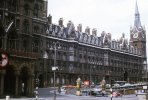
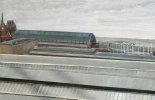
TFW’s workshop & Copenhagen Fields

Tim Watson

Western Thunderer
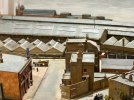
It is amazing in model railways how an object or image can set the hares running in directions which lead to unexpected projects. One such is this painting by Wrenford Thatcher, b 1944, British (print available from Norski Noo’s gallery):

bf7f0b2a-d353-471a-a1b7-079ee3b73b73.jpe
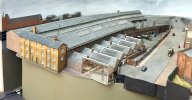
I came across it online, did a double take and then tried to work out what he had painted. The style has a certain naivety and is very busy. Knowing the area rather well, it was clear that he had used a large measure of artistic license in the interpretation of the scene looking over the viaduct at Belle Isle towards Kings Cross and St Pancras. This is the broadly similar view of CF:
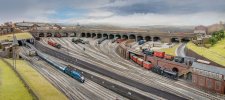
2f3a4ba2-de70-493f-9e67-d1686574144d.jpe

I had always shied away from representing Top Shed in great detail and felt that KX & St P were too far to the left to be included. Behind York Road viaduct CF obviously has phenomenal compression in the scene, with the area broadly modelled (or at least represented) bounded in the red line shown on the map.
53248580-2ae4-424c-8929-b5266d48221b.jpe

The southern end of the layout stops at a building which should actually be four feet further to the left, with models of the early Maiden Lane station buildings that converted into the potato warehouses (after Kings Cross opened) and one wing of the main Goods Warehouse. For the locals, you can usually help them to get orientated by saying that one of the buildings is now a Waitrose…
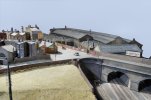
efd9b3cb-191d-410d-b2b7-51015cd568fd.jpe

On Wrenford Thatcher’s painting St Pancras is very conspicuous, making the scene unmistakable. Is it time to reconsider this missing iconic structure and indulge ourselves with a bit more artistic license? As Justin Colson commented, our viewing public are often confused as to what it is they are looking at: St Pancras on the backscene would make it extremely obvious. I then started to trawl for suitable photos of the area to get a feel of what might be in the line of sight (shown by the yellow arrow below). KX would not be, as it is frankly where the operator sits, but the gas holders of the Imperial Gas Light and Coke Co would be along with some other more mundane buildings.
ab204cf3-34de-40a3-9615-c4ef7e3ebf9a.jpe

Above all, towers St Pancras.

170c1a1e-3fa5-41e0-8d26-b4731130f671.jpe

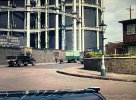
Some of the gas holders still exist, having been converted into wickedly expensive flats, but the good old Ladykillers came to the rescue with a still from the film:
f6527027-f490-4003-8e21-32e2466f7c79.jpe
(courtesy Studio Canal). In later years some of the iron work was painted black and red: I wonder what colour they were prewar?
460906a8-c093-468c-b461-2447a532670d.web

Gary Fletcher is digging out some outline drawings of the station and gas holders for me, but the amount of detail to be included will be minimal. Representing all the cylindrical structures in this area onto the backscene will be somewhat challenging, but if it works…

What do you think?


Tim
 
Last edited:

James Spooner

Western Thunderer
Tim,

I don’t normally (don’t usually feel I have the right to) comment on other people’s projects, especially such amazing feats as Copenhagen Fields. Since you have posed the question, though, looking at the above photo with the current back scene, one might be mistaken for believing Copenhagen Fields is adjacent to Salisbury Plain (for example) as it is very rural and doesn’t give the impression of being a part of a thriving capital city. I think it will be tricky to incorporate the gas holders as you rightly note, but if you can pull it off then it will place the model much better.

Nigel
 

simond

Western Thunderer
Tim,

I guess creating the image of the gasometers as an overlay (even a silhouette) would mean you could try it out without committing yourself.

I do agree with Nigel that they will help set the scene.

Atb
Simon
 

Tim Watson

Western Thunderer
Thank you for the helpful comments. For sure the new backscene additions will be on separate scenic flats as they will need to be used both on the main layout and the YR tube diorama display. The view behind the YR viaduct is a bit flat: there is a hint of the Somers Town goods sheds, but more of a representation of Top Shed is long overdue (but no coaling tower). However, we are looking westward at the low-lying swampy westerly regions of London, so the scene is fairly low rise.

CF is always an iterative process in its building, with incremental improvements as and when the wind blows in the right direction. I am looking forward to playing with this over the next few weeks.

Tim
 

Yorkshire Dave

Western Thunderer
Some of the gas holders still exist, having been converted into wickedly expensive flats,

But not on their original site.

Of the nine gas holders, six were demolished and three were preserved and moved further north to allow for the redevelopment of St. Pancras for Eurostar services and the Thameslink tunnel from the GN main line to the MR widened lines tunnel and the new underground Thameslink St. Pancras station.

Here is an annotated feint NLS OS 1:1,250/1:2,500 1944-74 series map overlaid on a modern image. The blue outlined gas holders were demolished and the magenta ones moved.

Screenshot StPKX.jpg

And the original NLS OS 1:1,250/1:2,500 1944-74 series map extract.
Screenshot StP KX 1.jpg
 

Tim Watson

Western Thunderer
Changing topic somewhat, on another forum, someone asked how our brass strip fiddle yard track was laid. I thought it might be of interest here, also.

The brass strip track is a system greatly developed on CF, originating from Denys Brownlee’s original 2mm scale layout in the 1970s. Peter Clark made a gear-driven horizontal rolling mill with slots in the rollers to locate and restrain the 6x2 mm brass strip so that it can be bent - on the flat - to a prescribed radius (it won a silver medal at a Model Engineer Exhibition in the mid 1980s).

CF has extensive fiddle yards and the brass strip will allow a derailed train to keep running, without falling off into the 6’ way. It is also much easier to put stock on. The baseboard joints are also inherently robust. In short it is pretty bomb proof.

For laying, the inner rail is rolled to the required radius and then predrilled with a Slocombe or BS2 lathe centre drill on a drill press. This gives a countersunk hole to take a 3/8”x2 brass wood screw. The rail is held down and pilot holes drilled in the baseboard through the brass, again using the Slocombe drill. The screws are then placed in sequence along the rail.

The second, outer rail, is then rolled to a slightly larger radius, placed against the inner rail using turned brass gauging discs and the hole positions opposite the inner rail screws indicated with a marker pen. These are then drilled on a drill press and returned to the layout to be held against the inner rail with gauges whilst the holes are re-drilled with the BS2 drill in-situ to pilot drill the plywood track base. The brass screws are then placed and the gauge checked. A coarse, sharp, file can be used to trim away brass if tight to gauge, working on the inner rail. Any errors in the ‘rail top’ can be taken down with a large coarse file and then polished to a good surface finish.

In practice, there is quite a lot of tweaking and hand bending of the brass needed to get it to lay flat and to gauge. Once everything is running well, superglue is run along the outside rail edges to lock it in place. At baseboard joints, the brass strips are laid across the joint, bedded into 24hr-setting epoxy resin. The rail joint is then cut through when the adhesive is hard.

It is far easier to use this brass-strip concept on straight track. 2mm height strip matches 2mm FS track perfectly. The brass can be supplied on-line, this is a recent high quality supplier:
Be very wary of guillotined strip from China - it won’t be good to use. The cost is usually equivalent to commercial
N gauge track and very dependant on brass wholesale prices at the time. We have laid many yards of this track on CF and can cover big distances quite quickly - it is easier if you have two pairs of hands to do it. I don’t think CF would have survived 41 years without this style of track, especially as the fiddle yard boards travel unprotected - so saving van space.

Hope this lengthy, wordy post, gives some insight into the system. I think we had an article in MRJ about it in the early days. With much easier phone photography nowadays perhaps a series of construction photos might be useful, when the next stretch is laid.

Tim
 
Last edited:

2mm Andy

Active Member
I believe one of them ended up at Bill McAlpine’s place named: ‘steel henge’.

Tim
I think "Ironhenge" at McAlpine's Fawley Hill estate was made from the columns removed from St. Pancras station during the CTRL works.

Interesting information regrding the brass strip track on Copenhagen Fields, Tim. The late Ray Fricker's 'Saxted' layout is in storage in my spare room at home, and that has very similar brass strip track in the fiddle yard. I'll try to get a photo over the weekend.

Andy
 

Tim Watson

Western Thunderer
Interesting information regrding the brass strip track on Copenhagen Fields, Tim. The late Ray Fricker's 'Saxted' layout is in storage in my spare room at home, and that has very similar brass strip track in the fiddle yard. I'll try to get a photo over the weekend.

Andy
It would be great to see Saxred back on exhibition. Ray & Denys were both superb modellers. The buildings were mainly Shire Lane Crafts in origin and were made by Brian Dollemore; he made hand carved pear wood master patterns then resin castings. He was responsible for our terraced houses on CF.

Tim
 

Heacham

Active Member
I think "Ironhenge" at McAlpine's Fawley Hill estate was made from the columns removed from St. Pancras station during the CTRL works.

Interesting information regrding the brass strip track on Copenhagen Fields, Tim. The late Ray Fricker's 'Saxted' layout is in storage in my spare room at home, and that has very similar brass strip track in the fiddle yard. I'll try to get a photo over the weekend.

Andy

I thought Ray's layout was superb and his Great Eastern locos beautiful. If I remember correctly it was powered by U2 batteries which made it quite easy to set up. Ray was a member of the Herts 2MM group and so of course was Denys hence the strip fiddle yard. I had the pleasure of meeting both of them in the early 90s at the Herts meetings in Hatfield when the group was building a layout based on Hill End station between St Albans and Hatfield. I am glad to hear the layout is still around.

Simon
 

D869Zest

Active Member
1/4 by 1/16 brass strip back in the day Tim? I recall there being a mix of sizes when I looked around the back of CF.

I did some FY modules with this strip back in the 90s. Remarkably I found a engineering firm willing to order the stuff in 6ft lengths for me literally 2 minutes walk from my front door. Now their premises have been replaced by houses.

I stopped using this method when I could no longer get rolled strip in the same size - it being tricky to mix sizes with the way my modules were done. As you said, guillotined stuff is hopeless - suppliers will tell you it's fine but I don't find banana shaped strip to be a good thing. No doubt rolled metric stuff is fine is the size works.
 

Tim Watson

Western Thunderer
1/4 by 1/16 brass strip back in the day Tim? I recall there being a mix of sizes when I looked around the back of CF.
Indeed it was. The 6x2mm is a perfect height match for 2mm track: 1/6” was a bit of a pain. I simply turned 2mm grooves in the mangle to accommodate the new size.

Tim
 
Last edited:

Tim Watson

Western Thunderer
We can now declare on CF - St George for England & St Pancras for Scotland!

f5577ddf-38ef-4be1-842c-f76fb5aa9821.jpg

I find the easiest way to work out how a back scene is going to work is to cut out bits of coloured paper and try different shapes, sizes and positions. The first stage was to estimate the proportions of the train shed, associated buildings and the gas holders.
ac336618-78c6-4eec-a7b1-2775d4f8ac3e.jpg

When on display with the YR diorama the viewing angle is also from the end.
6c092ce8-a542-42fe-8c91-f9c75ed25b1b.jpg

The coloured paper is for pastels and gives a general idea of colour balance; it was laminated into a thicker material using spray adhesive. After some too-ing and fro-ing I decided to include the train shed frontage and at the same time cut out ellipses to show the tops of the gas holders.
73773beb-ab8c-430b-a039-ca1ad4413166.jpg

A great deal of chopping and changing allowed me to develop the Midland Hotel building and a better understanding of the relationship between the side roofs and the main train shed. Once the shapes were more or less correct, the paper was impregnated with super runny cyanoacrylate adhesive, which stiffens it up no end. There were also twenty or so chimneys along the side to consider. The glazing, pre war, would have been as it is now. Masking tape was used to delineate the roof glazing as well as the tops of the chimneys.
e6673a14-5431-451b-b3bb-4aa17f3ba435.jpg

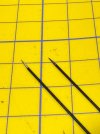
Making the station and gas holders as a scenic flat required that the spires were suitably robust. To that end, some pivot steel was ground up to a fiendishly sharp point and then chemically blacked.
df3ae22c-13a1-4b60-af21-ac50bb7c5ffb.jpg


The rods were then embedded in the card structure, being held with copious amounts of cyanoacrylate adhesive. Some extra background spires were made from PECO track pins.
756688db-439d-409a-beab-cef2844cdb90.jpg

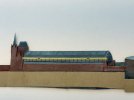
So this is progress so far. I have also added the SW wing of the hotel as it gives the buildings greater mass. I haven’t yet indicated any windows; I’m not sure I will - in the art of modelling it is what you leave out that matters, not what you put in. I did think the building needed to be a bit brighter & lighter, but that is because I have become used to the ‘new’ station.
b16c9c8d-ab98-41eb-912c-f92a932ffc57.jpg

150 years of soot and smoke had made St P very dingy indeed, so the colour is I think about right, also taking into account aerial perspective.
7d2718f0-61b6-4118-afad-e789978562a5.jpg

Modelling the gas holders is another challenge, but I think I have a solution to that. It will be very interesting to see people’s reactions when they see the fifth station on CF.

Tim
 

J_F_S

Western Thunderer
To that end, some pivot steel was ground up to a fiendishly sharp point and then chemically blacked.

Wow! that is one way of ensuring no one catches it with their wrist - certainly not twice!!

Wonderful modelling - I can spend ages just looking at all the little details ...
 

Tim Watson

Western Thunderer
I wasn’t quite happy with the extent of the Euston Road wing of the hotel, so it has been cut back and the porch added at the front. This produces a better lead in to the eye and is more accurate.
a82323a2-de55-4b3e-a78a-b755f8acf776.jpg

I tried it out on the main layout today, albeit without the YR buildings in place and I think it will work out OK.

Tim
 

Tim Watson

Western Thunderer
St Pancras is now accompanied by the Kings Cross Goods Yard Granary Warehouse and two gas holders. More detail is yet to be added to the Goods Shed and there are another four or more gas holders to the north as well as the Western Goods Shed. The hard horizontal horizon will be softened when the gas holders are complete, as it is currently being used for setting out the perpendiculars of the iron henges. The whole scene is 11” long.
1a32d4f5-4c65-4fe6-bb86-f79db66f77f1.jpg
Quite hard work doing this, but I think it will look useful on Copenhagen Fields, next to be seen at the Manchester Christmas Show on 13-14th December.


Tim
 

Yorkshire Dave

Western Thunderer
It is amazing in model railways how an object or image can set the hares running in directions which lead to unexpected projects. One such is this painting by Wrenford Thatcher, b 1944, British (print available from Norski Noo’s gallery):

bf7f0b2a-d353-471a-a1b7-079ee3b73b73.jpe
I came across it online, did a double take and then tried to work out what he had painted. The style has a certain naivety and is very busy. Knowing the area rather well, it was clear that he had used a large measure of artistic license in the interpretation of the scene looking over the viaduct at Belle Isle towards Kings Cross and St Pancras.

What is interesting is the artist has placed an ex-SR W 2-6-4T on the North London Lines viaduct. I would therefore presume a photograph must be in existence depicting this otherwise it's an odd choice - unless the artist knew his locomotives.
 
Top