The Heybridge Railway, 1889 to 1913

paulc

Western Thunderer
I use off-cuts of thick mdf. A few scorch marks are badges of honour.:)1758161874610652246767.jpg

Tim
A few interesting items on here .
I too use MDF to solder on but I've found that the flux soaks in and swells the surface so I'm going to ply next .
Ref using glass , my whole work bench is toughened glass ( ex computer desk ) but I've never tried soldering directly on it figuring the top would act as a heat sink and before someone comments that the whole bench is glass , no it has a steel frame .
 
Last edited:

simond

Western Thunderer
I wouldn’t worry about glass acting as a heat sink. List of thermal conductivities - Wikipedia

Conductivity ~ 1 to 2. cf Brass ~ 100-125 and Copper ~ 300 W/m/K.
interestingly, nickel is only a bit less than brass, at 90. I guess NS may be a bit lower again.

it doesn’t mention fibreboard but most woods are <0.1.

And my workbench, which is 10mm MDF on top of an IKEA desk looks a bit like the surface of the moon. Lots of flat bits, surrounded by craters…
 
. . springs and sandboxes

RichardG

Western Thunderer
I will put off attaching the sandboxes because I want to try for some better springs first. So this post wraps up the assembly of the frames for a short while.

DSC_0735.jpeg
The new springs are from Jim McGeown, he includes them with his re-released J69 and sells them separately as an accessory pack.

DSC_0731.jpeg
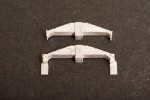
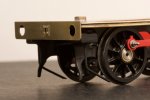
I have shortened the castings so they fit the H2.

DSC_0733.jpeg
I think these are a worthwhile upgrade over the originals, which are etched as part of the frames.

DSC_0739.jpeg
I did the first spring as a test piece but of course having done one I had to do the rest. Then I added the sandboxes.

DSC_0745.jpeg
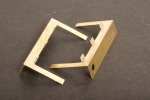
Finally a bracket (two layers of scrap fret) to constrain the motor.

The frames assembly might be finished now. The brakes will have to be added after painting and installing the wheels. I haven't done anything about electrical pickups because I am still undecided whether to go for radio control.
 

RichardG

Western Thunderer
Ignorance is bliss

But it doesn’t last long ;)

How did I get here?

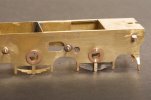
This kit has the running board panelled over behind the smokebox. This hides the lack of inside motion. With no inside motion, it is straightforward to mount a motor with a single-reduction gearbox onto the middle axle. The plating-over also hides the top edges of the frames, which are set up to let the builder use coarse scale wheels.
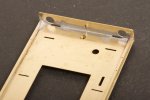
  • I decided, without really thinking things through, that my model would look better without the plating-over. Then I could have more daylight between the frames . . . so I cut out a hole in the running board to suit.
  • Then I realised the tops of the frames would show through the new hole . . . so I made some broader frame spacers, and arranged them so the motor/gearbox could drive the rear axle.
  • Setting the frames further apart meant the distance across the axle bushes was greater than the B2Bs . . . so I turned down the faces of the bushes.
  • The backs of the wheels were now nicely close to the frames, but there was no room for plunger pickups . . . so I blanked off the etched holes for these.
  • The newly opened-up front section of the frames looked bare and empty . . . so I used some spare parts from another kit to represent the inside motion.
  • The gearbox would now be visible through the cut-outs in the frames . . . so I added pieces of dummy ashpan to hide this.
  • I could now confirm that the gearbox would now end up touching the superstructure . . . so I cut notches into the cab front, footplate and boiler backhead to make some space for this.
  • The floating motor/gearbox needed some fore/aft constraint . . . so I added the motor stay.
All because I cut a hole in the running board :rolleyes:

The changes to the brake hangers and the springs are merely cosmetic. This is all enough for me, so painting and reassembling the chassis is now underway.
 

Rob Pulham

Western Thunderer
Having cut the same hole in the running board when I stripped my J79, it wasn't until watching Richard's endeavours that I realised that I would have the same issues.

Although I have stripped the chassis too and was planning a partial rebuild (mainly of the brakes). It seems that it's going to need a bit more than just attention to the brakes.

One step forward and two steps back seems to be the story of my modelling at the minute, so why should this be any different.

At least now when I reassemble it, I won't suddenly discover the frames showing under the boiler. I know that they will be visible and that I need to do something about it before reassembly.

I also have Jim's J71 kit in the stash which upon examination of the etches had the same infill plate between the tank fronts and smokebox so another that will need modifications from the outset.
 
. . rolling chassis

RichardG

Western Thunderer
I also have Jim's J71 kit in the stash which upon examination of the etches had the same infill plate between the tank fronts and smokebox so another that will need modifications from the outset.

DSC_0773.jpeg
I am not convinced that the chassis widening is worth the effort. I hope to be pleased with the finished model, but these frames have taken a huge amount of work with very little to show for it. The open space inside looks large but much of it will be between the side tanks.

A couple of strategically-placed toolboxes beside the original infill plate would look pretty good from most angles.

Still, I am pleased with the colours here - Halfords no. 228 'Volvo Dark Grey' on the frames, with black on the sandboxes and springs to bring a bit of variety. Satin varnish over everything except the axle bushes.
 

RichardG

Western Thunderer
I spent some time looking for photographs of the SG38 gearbox so I could see what I was buying, and found nothing. So here are a couple of photos of the one I have bought for my H2 in case they are useful.

DSC_0779.jpeg

DSC_0785.jpeg
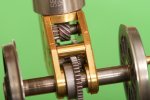
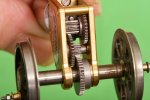
This gearbox has three stages, plus a pair of 1:1 helical gears to turn the drive through 90 degrees. It's satisfying to buy something built to a standard and not to a price, as long as I don't do it too often. The SG38 cost nearly as much as the kit :eek:

DSC_0790.jpeg
Having a floating motor/gearbox is really helpful when tuning a chassis. This one flipped to and fro running forwards until I eased a few tight spots. Which really means, I removed the paint from the holes in the rods.

DSC_0786.jpeg
I shimmed the outer axles to remove all end float, and left the middle axle free to slide sideways. This is the result on my Setrack point with its 1,020 mm radius. This is all somehow rather satisfying.

I am not convinced that the chassis widening is worth the effort.
But now, seeing this chassis running on the track, the effort probably was worthwhile. I am cautious of recommending the work to widen the chassis, but I seem to have got away with it. I am glad I had a go.
 

RichardG

Western Thunderer
I have found the assembly of the running board difficult. Too difficult to be enjoyable to be honest. Everything needs to be flat (so it doesn’t pull the chassis crooked) and also square so it looks half decent.

DSC_0795.jpeg
I have discarded the hanging bars supplied in the kit because they look too tall, and put some 1/16 inch square tube in their place. The tubes give the model some strength here. I drilled the holes for the handrails right through, three are square and one is skewed. This is using a pillar drill, I could despair but no-one else will notice.

DSC_0794.jpeg
I have set the two buffer beams 1 mm above the top surface, not the 1.5 mm suggested in the instructions. Again this is to improve the appearance but now the cylinder cover (to follow) sits higher than the buffer beam at the front.

DSC_0791.jpeg
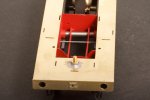
I have my prize so to speak, in that the tops of the frames are underneath the running board. The red paint looks thin but this view will disappear.

DSC_0792.jpeg
When I soldered the front retaining nut into place, the front buffer beam fell off. When I soldered the nut the second time, I kept the buffer beam immersed in water so this didn't happen again.

I could stand some weights on this, connect a battery to the motor and see it move a train, but this sort of activity is a bit fraught on my nine feet of layout. I hope there is a roundy-roundy track at Bury St Edmunds (the Sugar Factory) next Sunday. I want to see the model hurtling through some points and staying on the track before I add the brake gear.
 

RichardG

Western Thunderer
I have set the two buffer beams 1 mm above the top surface, not the 1.5 mm suggested in the instructions. Again this is to improve the appearance but now the cylinder cover (to follow) sits higher than the buffer beam at the front.

I am now looking at a compromise I don’t want to make, but where there isn’t an easy way out.

I have put the buffer beams about 0.5 mm too low. This sets the buffer centres in line with those of my Dapol Terrier, above those of my Minerva Manning Wardle and below those of my Dapol RCH wagon. Usefully, the backs of the buffer stocks will just clear the underneath of the running board too.

1662 front buffer plank.jpeg
Front detail of number 1662 (*)

DSC_0799.jpeg
I think, the depth of model buffer beam extending below the running board looks right; the amount extending above is too small; and the sandbox is the wrong shape.

The back story for this loco has always been tricky. The best I have managed is to pretend the NER built a fourth H2 in 1907, alongside number 1662. This suits the timeline of my railway. This fourth locomotive was declared surplus to requirements by the NER, and finished off by the GER or one of their contractors. This gave it some oversize buffers (to follow) and different sandboxes; and so while it looked like a H2 there were detail variations.

There is a precedent for the sandboxes, because number 1787 received a design different to numbers 407 and 1662. The buffers are easy to explain because they will suit the tight curves and match up with those I put on Nellie the crane tank. I cannot face taking the buffer beams off again, let alone making new ones, so this leaves me to fudge the cylinder cover one way or another.

(*) From a photo of number 1662 in Yeadon's Register of LNER Locomotives, volume 43 part B.
 
. . power and control planning

RichardG

Western Thunderer
I want to see the model hurtling through some points and staying on the track before I add the brake gear.

Hurtling is good, but slower speeds are better especially at home. Also I can see how well the model runs through my own track first.

DSC_0807.jpeg
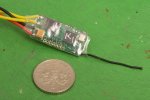
This is a Micron MR601a controller. It arrived today (sooner than expected), and it combines a radio receiver and an electronic speed controller. There are also auxiliary outputs for lights, but the H2 doesn't need these.

DSC_0804.jpeg
Temporary wiring . . .

DSC_0813.jpeg
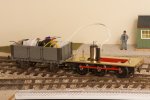
. . . wrapped up to go into a wagon.

DSC_0816.jpeg
DSC_0810.jpeg
This ensemble reaches a maximum speed of 0.6 feet per second, which scales up to around 17 mph. This is with a 7.5 volt supply. The MR601a accepts up to 13 volts; more batteries = faster.

This unloaded chassis can also move six additional wagons before wheelslip begins i.e. seven wagons in all. Adding 200 grams of ballast increases this considerably. I have tried 15 wagons without problems; this is all I can manage on my layout.

I haven't ruled out conventional analogue control from the track, but I do like the convenience of radio control. And the way the models never stall. I used the same MR601a controller in 'Lady Marion' and it has worked well.

Micron Radio Control : Micron MR601a DSM2/DSMX 13V Receiver with 1.2A Bi-Directional ESC
 

simond

Western Thunderer
and a 2S lithium battery will give more or less 7 and a bit Volts and easily fit - my Dapol 48xx runs fine on such a low voltage, certainly quick enough and sufficient haulage for anything it might be asked to pull.

And the battery fits nicely through the smokebox door, which makes removal for charging very simple.
 

RichardG

Western Thunderer
Hello Simon I rather hoped you would find this!

I like the two-cell approach, this is why I chose five AAA batteries for the first test runs.

I have been thinking of two rectangular batteries, one in each side tank. I could easily fit a pair of 400 mAh batteries, 3.7 volts each. This would save the boiler/smokebox space for one of those charger boards with a USB-C socket. Then I could recharge the model using my phone charger.

Have you posted any pics of your 48xx conversion?

This is the battery I was thinking of:
Screenshot 2025-10-01 17.32.41.png
 

simond

Western Thunderer
Hi Richard, no, I don’t think I posted anything, but here you go:

image.jpg

haven’t used it for a while, and that battery looks a bit swollen. If so, it’ll be in the outdoor bin PDQ.

just checked and it looks ok, and is still pretty much fully charged so is unlikely to be a problem.

image.jpg

the receiver is a micron, and the transmitter is one of these

image.jpg

Works well, but I miss the sounds. It seems that sound options are getting better.

I tried it on my Duchess some years back and it was not a great success, though I sold the loco with DCC sounds at a modest profit.
 

RichardG

Western Thunderer
DSC_0820.jpeg
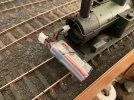
On to more cheerful thoughts . . . I wonder what batteries the loco needs to be useful. This is a test train of five vehicles, weighted up to a total of 1 kg. The additional weight of the Dapol RCH wagon and its load represents the contributions of the finished superstructure and batteries. The lighting rig is useful for holding the meter leads out of the way.

I am quite amazed by the efficiency of the Slater’s SG38 with its coreless motor. Here are some figures for motor current consumption, these are using the 7.5 volt supply from five AAA batteries:
  • 60 mA shunting speed
  • 80 mA sensible layout speed (for Heybridge Basin)
  • 120 mA maximum speed (scale 17 mph)
Two further measurements:
  • 100 mA motor maximum speed no load (loco lifted off the track)
  • 360 mA motor stalled at maximum power
The Micron MR601a controller draws a further 30 mA all the time (at 7.5 volts) to power itself. If I run the loco at my "sensible layout speed" with a 1:4 duty cycle, the average current consumption will be (80 / 4) + 30 = 50 mA.

I think this is incredible for 7 mm scale. I have seen far higher currents drawn by 00 and H0 models with lighter trains . . . full marks to Slater’s for the efficiency of their SG38.

So, I have some numbers: five wagons, 17 mph, 50 mA, 7.5 volts. They suggest, a pair of 400 mAh batteries might just about manage eight hours - a full day at a show. I can start to think about how to fit them and the other r/c parts into the loco.
 
Last edited:

RichardG

Western Thunderer
I have done my thinking and devised a way to install radio control into the model: controller, batteries, power switch and charging socket.
  • 400 mAh seems like a useful battery capacity to aim for.
  • I am not bothered about using lithium batteries to save weight. In fact, heavier is better because it reduces the need for extra ballast.
  • NiMh technology is easier to charge than LiPo, and there are fewer worries about bulging or worse.
  • If I can keep and charge the batteries inside the model, I can have a fixed smokebox door. The detachable door on ‘Lady Marion’ has proved rather a fiddle for me to take off and put back.
Two compact LiPo batteries are possible, one inside each side tank. But I can probably shoehorn eight AAA batteries into the model - four inside the boiler and two inside each side tank. Unfortunately this leaves no reasonable place to put the power switch.
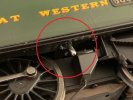
power switch.jpg
This location for the power switch seems really sensible . . . thank you @simond. I would never have thought of this on my own.

I have found a source of two-thirds length AAA batteries with a capacity of 400 mAh. These will fit alongside a power switch below a side tank, so I have ordered some and worked up the model to suit. If these batteries don't work out, I have a get-out in that there will still be room for six full-size ones.

DSC_0829.jpeg
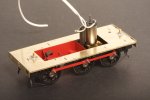
The model has gained a short tube to hold the power switch, and a flat bracket to hold the charging socket. The r/c controller will fit in beside the motor.
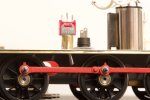
DSC_0836.jpeg
I might need a pen or a house key or similar to reach the switch, but I think this is as neat as I will ever manage. The idea is to secure the switch with epoxy glue after I paint the metalwork.

On the way here, I did try to shorten the dolly on a larger toggle switch. When I came to the end of the cut I discovered the dolly was hollow and contained a compression spring to hold the mechanism together. The switch was ruined.
DSC_0837.jpeg
I have also opened up the inner sides of the tanks to let me insert the switch and the batteries after assembly and painting. There is going to be enough room to manoeuvre the switch into place, but only just.

This probably completes all of the effort to make the model ready for radio control. I'm glad I left the assembly of the superstructure until now.

 

simond

Western Thunderer
Thanks Richard.

I arranged it so that turning it on requires a fingernail, turning it off is easier.

I must put another dab of paint on the toggle, though I’m looking at the loco from my chair as I type this, from about 3 metres away, despite it being chrome, it is not obvious at all.

atb
Simon
 

simond

Western Thunderer
Entirely possible, I recall lots of folks did that for coach lighting in 16mm, but don’t lose your magnet…

It’s usually possible to hide a switch in a locker, coal bunker, water filler, or just in the under-footplate gloom, and I prefer the fixed-in-place solution.

Simon
 

RichardG

Western Thunderer
I must put another dab of paint on the toggle
Perhaps some black heatshrink?

What about a magnetic on/off switch?
I want a changeover switch here. The toggle will be forwards for running; backwards for off and charging. This follows the convention I have set myself for the Y14 and 'Lady Marion'.

Obviously, if the batteries come out for charging then only the on/off function is needed. I do prefer a physical switch, if only so I can confirm the power is switched on when the model is refusing to move . . .
 
Last edited:
Top