Prototype Tim Mills' Photos

Barry37

Western Thunderer
Thank you all for keeping the podger/dodger/todger/jimmy conversation going. This thread badly needs the occasional shot of levity.

This loco was in posts #3572 and #5034. It’s V2 60821 at Kings Cross at some time around 1960 but see the notes about the N2 above. The loco had been New England based since December 1958 where it was withdrawn in December 1962. (SLS). It was scrapped at Doncaster Works in May 1963. (BR Database).

View attachment 241782

Another photo which confirms the date as before mid-1959 rather than 1960 is this one of B2 61614 Castle Hedingham and V2 60821 (details above) at Kings Cross. The B2 was a Cambridge engine from October/November 1956 and was withdrawn in June 1959. (SLS). BR Database proposes it was scrapped in the month of withdrawal but the Railway Observer that it was seen intact at Stratford on 1oth November 1959.

View attachment 241783

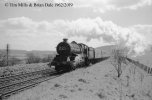
61XX 2-6-2T 6128 on an up trip or pick up freight near Saunderton on 14th April 1962. At the time it was a Slough engine where it had been allocated in March 1962, moving to Gloucester Horton Road in May and Southall in October/November before returning to Gloucester Horton Road in December 1964 being withdrawn in April 1965. (SLS). It was scrapped in August 1965 (BR Database) at Hayes Bridgend (WHTS) where it was observed on 13th June 1965. (RO).

View attachment 241784

WD 2-8-0 90516 on a down freight near Saunderton on 14th April 1962. It was a Woodford Halse loco from February 1958, then Toton in January, Newton Heath in April/May and Aintree in September 1964 followed by Frodingham in April and Doncaster in October/November 1965 where it was withdrawn within the next couple of weeks. (SLS). It was scrapped in June 1966 at Garnham, Harris and Elton, Chesterfield. (BR Database).

View attachment 241785

Brian
The wagon behind 6128 appears to be an LNER 20 ton 8 plank loco coal wagon. These had two pairs of side-hung doors each side, built in the 1930s. They had a steel underframe.
From 1935, a steel-bodied version was also being built, also with side-hung doors.
 

oldravendale

Western Thunderer
More screw missiles, podgers and jimmys or, perhaps, jemmys. Lovely!

Graham @Dog Star - Tim may well have had two cameras on the go. I suspect he was in charge of one and his fiance/wife had the other one. In fact we've seen examples of two photos of the same subject from very nearly the same location previously and assumed that there must be more than one camera involved. Why do you ask?

Then feet firmly back on terra firma your comment about the loco coal wagon is much appreciated, Barry @Barry37 .

King Class 6014 King Henry VII which was previously in post #1824 and here on an up Birmingham train near Saunderton on 14th April 1962. It lived at Stafford Road from March 1954 and was withdrawn from there in the September of the year the photo was taken. (SLS). It was scrapped at Cox & Danks at Oldbury in March 1963. (BR Database).

img150 TM 29 Film ID 53 6014 up Birmingham 14 Apr 62 Nr Saunderton Possible. copyright FINAL.jpg

King 6027 King Richard I on a down Birmingham train near Saunderton on 14th April 1962 as previously seen in post #2609. It was a Stafford Road engine from January 1960 and was withdrawn in September 1962. (SLS). It was scrapped at Cox and Danks, Oldbury, in around July 1963. (BR Database).

img151 TM 30 Film ID 53 6027 down Birmingham 14 Apr 62 Nr Saunderton copyright FINAL.jpg

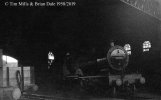
A well under exposed photo of Midland Compound (but built by the LMS in 1927) 40925 in Kentish Town Shed on 27th September 1958. In June 1957 the loco was allocated to Crewe North, loaned to Bourneville in December the same year where it was allocated in the following January, moving to Derby in February 1959 and withdrawal the following November. (SLS). It was despatched to Crewe Works in January 1960 (RO) where it was seen on 14th February 1960 (WHTS) although BR Database report it as scrapped in January.

img180 TM Film ID 7 40925 Kentish Town  27 Sept 58 copyright FINAL.jpg

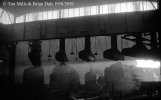
Kentish Town Shed on 27th September 1958. We don’t have specific details of any of the locos but I can see a Britannia, a (probably) Midland 3F 0-6-0T and a 2-6-4 tank.

img181 TM Film ID 7 Kentish Town  27 Sept 58 copyright FINAL.jpg

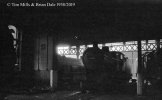
Another Midland Compound built by the LMS, No 41062 in Kentish Town Shed in September 1958. This became one of the Bournville allocation in October 1957, moved to Derby in February 1959 and was withdrawn the following May. (SLS). It was scrapped at D Ward, Woodville near Burton (RO) in October 1960. (BR Database).

img182 TM Film ID 7 41062 Kentish Town  27 Sept 58 copyright FINAL.jpg

Brian
 

AJC

Western Thunderer
The shot of King Henry VII is stunning - good composition, really fine view of the track showing cess, margins, and supereleveation coming out of the curve. Kings are not special favourites of mine, but that image shows their presence beautifully.

Adam
 

Dog Star

Western Thunderer
Brian, re two cameras... something does not seem right in regard to the dates of the photos at Saunderton, or rather the solitary King image which has a disputed date. Let us take up a discussion at Stafford.
 

daifly

Western Thunderer
Not mentioned about the two photos of 6014 is the unusual position of the headcode box. As far as I can tell, it was the only ex-GW loco with it fitted in this position. All of the other locos that had frames fitted had them attached to the smokebox door, usually obscuring the loco numberplate! 6014 was streamlined with, among other horrors, an ugly dome attached to the front of the loco. This was removed by January 1943. The frame at that time was in the low position and was presumably never moved.
6014.jpg
 

Dog Star

Western Thunderer
In regard to the recent posts of Kings at Saunderton, two questions p!ease:-

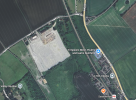
Where is the photo of 6014 on the section between West Wycombe and Saunderton? I ask because I do not recognise the electricity sub-station on the LHS of the photo.
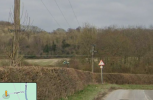
The photo of 6027 carries a "Z25" reporting number... Is this a rail tour? (Not listed by Six Be!!s) or an excursion train? (Not a FA cup final which was 5/5/1962).

Dave @Yorkshire Dave - can you help?

Rgds, Graham
 

simond

Western Thunderer
Presumably the long splashers were a premonition of the Counties. Never thought about that before.

The other”streamlining” features were in my view grim/fanciful/pointless.

Much as I think Churchward was a genius, and Collet had a very sound foundation on which to build, the A4s were much better looking.
 

D1010

Member
Many years ago, I heard a story from a well respected author that the GWR weren't keen on streamlining and that Collett simply placed lumps of plasticene on his paperweight locomotive. And so 6014 and 5005 Manorbier Castle were briefly "streamlined" and the whole sorry saga confined to history. I believe both locomotives retained their angled cab fronts though.
 
Last edited:

AndyB

Western Thunderer
Where is the photo of 6014 on the section between West Wycombe and Saunderton? I ask because I do not recognise the electricity sub-station on the LHS of the photo.
Graham,
I reckon it is by Haw Lane bridge, just north of Saunderton station:
1749635550580.png
It isn't a substation, just a change in direction (90 degrees) - probably a feed off the main line of pylons to the west.
Correction - seems to be a line of power poles that runs south along the railway from Princes Risborough then turns west along Haw Lane, coming to an abrupt stop.
Here's the modern view looking down Haw Lane to the pole with the change in direction:
1749635957826.png

Then it stops where the footpath crosses Haw Lane:
1749636726006.png
Andy
 
Last edited:

Dog Star

Western Thunderer
Andy, thank you.

So much change in the lineside vista from 1962 to what Google satelite view shows today.

If you are correct then that location makes Tim's access easy because Saunderton station remains open. Now if Tim caught a train to Saunderton, did he photograph the local service (likely to be a DMU from Marylebone)?
 

Yorkshire Dave

Western Thunderer
n regard to the recent posts of Kings at Saunderton, two questions p!ease:-

Where is the photo of 6014 on the section between West Wycombe and Saunderton? I ask because I do not recognise the electricity sub-station on the LHS of the photo.

The photo of 6027 carries a "Z25" reporting number... Is this a rail tour? (Not listed by Six Be!!s) or an excursion train? (Not a FA cup final which was 5/5/1962).

Dave @Yorkshire Dave - can you help?
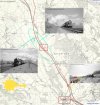
Regarding the photos taken around Saunderton I also have tried to piece together the itenerary and like @AndyB I believe they are taken around this area. Except for the photo of 6026 on the southbound Cambrian Coast Express (post #2597) which I believe is taken just north of West Wycombe before the line crosses the main High Wycombe - Princes Risborough - Aylesbury road. which I have overlaid on an OS map extract with the road in red and the railway line in brown.

Saunderton.jpg

As @Dog Star has alluded to some of the dates are awry and in posts #2597, #2609, #5047, #5121 and #5143 where Tim appeared to do a tour from Paddington to High Wycombe taking in the Marlow branch and to Saunderton these are dated Saturday 14th April 1962 and appear to be from the same negative strips. However according to posts #4226, #4232, #4235 and #4236 Tim was at Tring on the same day where the weather appears to be heavily overcast.

In post #5121 of 46146 and 6026 these appear to be consecutive frames from the same negative strip which would indicate Tim may have begun his day trip via Euston as there is an early low morning sun on 46146.

If you were to extrapolate this, it could well be the photos taken at Tring (posts #4226, #4232, #4235 and #4236) were on the preceding day i.e. Friday 13th April 1962. Which, in turn, would fit the negative sequences.

Coming back to the Paddington, High Wycombe, Marlow, Saunderton, West Ruislip trip - this would have been eminently possible during the day starting early and evidenced by the angle of the sun on the King heading the Inter City Express and the mid to late afternoon sun on the returning Cambrian Coast Express.

The locations of the photos taken nearer Saunderton could also be easily reached by the then half hourly Thames Valley bus from High Wycombe to Aylesbury as the railway and road closely follow the same route. The bus probably being more frequent than the train.
 

Dog Star

Western Thunderer
Good that AndyB and Dave have sorted my question about the electricity pole route, thank you.

Now, how about that excursion running under headcode "Z25"?
 

Martin Shaw

Western Thunderer
I’m a little late to this sub thread, two weeks swanning around Italy and Switzerland by train and eating far too much is the excuse.

I have found a timetable for the CCE dated Jun – Sept 1956, I realise it’s a bit early for the photos in question but the times didn’t vary much.

Down CCE SX

Padd dep 10.10
Wolverhampton LL arr 12.37 engine change
dep 12.44
Shrewsbury arr 1.19 engine change
dep 1.23
Machynlleth arr 3.17 split
dep 3.22 dep 3.40
Aberystwyth arr 4.5
Barmouth arr 4.57

By 1958 the coast section was subsequently extended to terminate at Pwllheli.

The Saturday service departed Padd 40 mins later and arrived more or less an hour later at both destinations.

At the time Kings were barred west of Wolverhampton so a Stafford Road Castle did the 30 odd miles to Shrewsbury, rather wastefully of engine utilisation so in 1958 after gauging runs Kings were permitted to Shrewsbury.

The down CCE carried reporting number 183, the corresponding up train 365. The WR changed to the 4 character headcodes at the commencement of the summer 1960 time table so whilst the lamps indicated the class of train and hence the first digit of the hcode, the remaining three digits utilised the frames from the former 3 digit numeric code and repurposed them so 183 became J17 and 365 became A70. The J signifies a train for the Shrewsbury district and A obviously enough Paddington.

Up CCE SX

Barmouth Junc dep 8.45 Aberystwyth dep 9.25
Dovey Junc arr 9.50 arr 10.00 couple together
dep 10.08
Wolverhampton LL arr 1.11 engine change
dep 1.18
Paddington arr 4.10

The Saturday service departed Aber nearly two hours later and Barmouth itself at 10.55 with a call at Shrewsbury from 2.37 to 2.41 where presumably an engine change occurred and an arrival in London at 6.10.

I have found an interesting snippet,

“Be warned, as with the 3 number system, care needs to be used in interpreting trains in photographs, as sometimes, a loco might retain the number of its previous working on its smokebox door, thus misleading fans into believing that it had been changed. The most common example of this was the down Cambrian Coast Express, where a turn-round time at Shrewsbury for much of the 1950s hardly allowed any time for such niceties, as filling the tender was the priority. The same loco that hauled the train ex Paddington was used to take the up train back, so the titled train name-board and the Reporting number were left where they were.”

Some of the above info is at variance with my established details so care needs be taken.

The Intercity was introduced in 1950, and by 1960 was just one of an hourly service to the west midlands to cater for express traffic removed from the WCML to allow for modernisation of that route.

The down service departed Paddington at 9.00, headcode 181 and later H06, the up service departed Wolverhampton at 4.35 with headcode 365 and later A05.

In theory its perfectly possible for the engine from the down Intercity to power the Up CCE from Wolverhampton to London but I expect it probably didn’t happen, although there does seem to be some possibility from the photos.

The V headcode was for inter regional trains so V03 was the 07.35 weekdays Birkenhead to Paddington, 11.00 am ex Birmingham Snow Hill.

The Z headcode was for specials, one offs etc, so Z25 is I suspect a mystery forever.

Martin
 
Last edited:

John Palmer

Western Thunderer
Down CCE SX

Padd dep 10.10
Wolverhampton LL arr 12.37 engine change
dep 12.44
Shrewsbury arr 1.19 engine change
dep 1.23
Machynlleth arr 3.17 split
dep 3.22 dep 3.40
Aberystwyth arr 4.5
Barmouth arr 4.57
That four minute allowance for an engine change at Shrewsbury looks very challenging! What's the routeing through Shrewsbury - is there a platform call + reversal or is it a direct run from Wolverhampton to Welshpool via Abbey Foregate curve? If the latter then the Castle has to come off before the Cambrian section locomotive attaches, further increasing time required for the change, but if there's a reversal at a Shrewsbury platform the new engine can come on whilst the Castle detaches from what has now become the rear end. But what with hooking on, joining the vacuum bags and the brake test, smart working still required.

I'm also a bit puzzled about the reference in the snippet to filling the tender at Shrewsbury - surely the replacement engine will have dealt with this before being joined? And since the snippet is referring to "the same loco that hauled the train ex Paddington", presumably it must be describing the practice during the period when Kings were taking the CCE all the way to Shrewsbury?
 

Martin Shaw

Western Thunderer
John

My understanding is that the train arrived from Wolverhampton in the platform. The Castle detached as a Manor or Dukedog attached itself at the other end. I would whole heartedly agree with you that to achieve the necessary in four minutes is smart working. My further understanding is that even if the Abbey Foregate curve was used, precluding a stop at Shrewsbury for passengers, an engine change must have been necessary somewhere, presumably the Cambrian section loco(s) could have been attached at Wolverhampton.

I have found a number of conflicting pieces of evidence regarding the CCE that I'm not sure which might be correct. I think the refrence to tender filling is in regard of the loco of the down CCE arriving in Shrewsbury at 1.17 and departing with the up CCE at 2.37. 80 mins to clean the fire and take water is not too long really especially on a big engine.

Martin
 

Yorkshire Dave

Western Thunderer
I have found a number of conflicting pieces of evidence regarding the CCE that I'm not sure which might be correct. I think the refrence to tender filling is in regard of the loco of the down CCE arriving in Shrewsbury at 1.17 and departing with the up CCE at 2.37. 80 mins to clean the fire and take water is not too long really especially on a big engine.

With roughly 80 minutes to service a large loco and with reference to the photo of 6026 King John seen on 14th April 1962 at Paddington in post #5121 it would therefore be conceivable for 6026 King John to haul the 09.00 Inter City Express to Wolverhampton to arrive around 11.30 (where it terminated); then be serviced and prepared to haul the Cambrian Coast Express 13.00 - 13.30 ish departure from Wolverhampton to London only be photographed later in the afternoon on the same day near West Wycombe heading south arriving at Paddington around 16.00.
 
Top