Prototype Tim Mills' Photos

AJC

Western Thunderer
There’s a feast of background details in that lot. The small figure dashing behind the Castle tender, and the superannuated brake van draped with a tarp, for starters.

What's with what appears to be a rail bender hooked on the pair of posts in the second to last image?

Nice selection on minerals on the coal stage in that shot, too - one quite battered steel 16 tonner, a very fresh looking minfit, and ex-PO 7 plank (no paint), and a quite tidy steel 16 tonner.

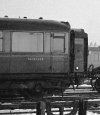
The Scottish allocated Gresley coach (SC16732E) at Willesden is quite interesting - I think it's maroon, but until I noticed that the lining was in the wrong place, I'd suspected that it was a late survivor in carmine and cream...

Adam
 

Dave F.

Western Thunderer
Quote:- The Scottish allocated Gresley coach (SC16732E) at Willesden is quite interesting - I think it's maroon, but until I noticed that the lining was in the wrong place, I'd suspected that it was a late survivor in carmine and cream...

Yes it is maroon and the Scottish Region put the lining below the beading so it lined up with Mark 1s. plenty photos in Scottish books. This is what I was told many years ago by an old fella who had connections with the railways. It also helped us young guys when painting Ian Kirk coach kits, putting lining transfers on over the beading was next to impossible....
 

Rob R

Western Thunderer
The upper panels and beading on the Gresley both look lighter than the lower panels.
It might just be the lighting but...
Gresley crop.jpg
 

AJC

Western Thunderer
The upper panels and beading on the Gresley both look lighter than the lower panels.
It might just be the lighting but...
View attachment 241261

I'd expect the cream to start immediately above the line (which it doesn't seem to, might be wrong), but the change does happen to coincide with the top of the tumblehome/turnunder. Not conclusive, but suggestive, to me, anyhow.

Adam

EDIT - Steve Banks suggests that lining in this position was a quirk of Scottish Region Gresleys. Since I know almost nothing about these coaches (wrong region!), I'm just guessing: LNER teak coaches and livery - Steve Banks (scroll to the bottom of the page).
 

oldravendale

Western Thunderer
Hi Heather @Heather Kay - I'd not noticed the person trying to hide from the camera although that brake van was in the same position at Old Oak for as many years as I can remember. In fact I remember it before it had the tarp draped over it. I always meant to take a photo... As for the "rail bender" are you commenting on this?

img070 TM 4 No Film ID 46472 prob Willesden Shed Pictures Detail. FINAL.jpg

I put it down to another piece of shed detritus and not worthy of comment, but now you draw attention to it... Graham @Dog Star has tried to be helpful by explaining it as a "Jim Crow" but I don't know what that is either. Somewhere in the memory is a reference to a "Jim Crow" as a means of unofficially adjusting the exhaust in the firebox but I may be and most likely am incorrect. Hopefully explanations will follow and we'll have another exciting rabbit hole to investigate.

Thanks again, Adam @AJC for your comments about the rolling stock, followed by Dave @Dave F, and Rob @Rob R with additional info by Martin @Martin Shaw .

And so pleased to be back, Dave @Genghis !

Inside Old Oak Common Shed in April 1963 with four locos we’ve seen previously. Modified Hall 6990 Witherslack Hall (#2243, #3641 and #5002), 2884 2-8-0 3860 (#4995) , Castle 5056 Earl of Powis (#4996) and 7018 Drysllwyn Castle (#1218 and #2208).

Modified Hall 6990 Witherslack Hall was allocated to Old Oak Common in December 1951 and didn't move to St Philips Marsh until November 1963. In June 1964 it went to Bristol Barrow Road where it was withdrawn in December 1965. (SLS). It is currently working on the GCR at Loughborough where it arrived by way of Woodhams, Barry. See: 6990 Witherslack Hall

3860 was an Aberdare loco from September 1962, then Neath Court Sart in May 1964 before withdrawal in the following August. (SLS). It was scrapped at Cashmore’s, Newport in November 1964. (BR Database).

The Castle 5056 Earl of Powis was allocated to Old Oak on 4th November 1950 (BR Database), Cardiff East Dock in July1963, Hereford in April 1964 and Oxley in June the same year where it was withdrawn in the following November. (SLS). It then moved to Cashmore’s, Great Bridge, where it was scrapped in February 1965. (BR Database).

7018 Drysllwyn Castle. The Drysllwyn Castle name persists at Didcot but not on 7018 which was allocated to Old Oak Common at the time of the photo and withdrawn from there in September 1963. (SLS). It went to Cashmore's Great Bridge where it was scrapped in June 1964. (BR Database).

img072 TM 6 No Film ID 6990, 3860, 5056, 7018 Shed Pictures copyright FINAL.jpg

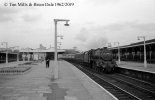
Black 5 44771 was seen previously in post #3835 but here it’s on the down Northern Irishman from Euston to Stranraer at Willesden Junction in April 1962. It was allocated to Rugby in July 1959, Nuneaton in June 1965, Holyhead a year later and Chester at the end of the same year. It was withdrawn in March 1967. (SLS). It was scrapped at Cohen's, Morriston, in October 1967. (BR Database).
img136 TM 9A Film ID 53 44771 down Northern Irishman Euston - Stranraer Willesden Jnctn 13 Apr...jpg

Princess Coronation 46225 Duchess of Gloucester, previously in post #3789 on a down Inverness Sleeper at at Willesden Junction on 13th April 1962. 46225 had been on Carlisle Upperby’s allocation from July 1959 until withdrawn in September 1964. (SLS). It was scrapped at Arnott Young, Troon in December the same year. (BR Database).

img137 TM 10A Film ID 53 46225 down Inverness Sleeper Willesden Jnctn 13 Apr 62 copyright FINAL.jpg

Brian
 

Dog Star

Western Thunderer
Brian,

A "Jim Crow" is used by PW men to change a curve in a piece of rail.

Your memory of a device to sharpen the exhaust is a reference to a "Jimmy" which was a bar across / within the cap of the blast pipe. Use of such a device on the GWR was said to be a summonable offence leading to looking at the carpet in the shed master's office.
 

Barry37

Western Thunderer
Brian,

A "Jim Crow" is used by PW men to change a curve in a piece of rail.

Your memory of a device to sharpen the exhaust is a reference to a "Jimmy" which was a bar across / within the cap of the blast pipe. Use of such a device on the GWR was said to be a summonable offence leading to looking at the carpet in the shed master's office.
Indeed it is a Jim Crow. I used one like that on Sunday morning maintenance at the Milky Way railway, near Clovelly. At the time (late 1990s) it was being operated by the Lynton & Barnstaple Railway Co. to raise money – the income stream was used to convince the bank to lend money to buy Woody Bay station.
 

hrmspaul

Western Thunderer

img069 TM 3 No Film ID 47501 prob Willesden Shed Pictures copyright FINAL.jpg​

Behind it is what appears to be an LMR built Diag 2173 milk tank. According to Jenkinson and Essery volume 1 this was the only diagram with the filler at one extreme end and all 62 built 1950. So filthy I wouldn't be surprised if already in engineers use. For example LMS Milk tank wagons | W44546_LMR__m_

Paul
 

Barry37

Western Thunderer

img069 TM 3 No Film ID 47501 prob Willesden Shed Pictures copyright FINAL.jpg​

Behind it is what appears to be an LMR built Diag 2173 milk tank. According to Jenkinson and Essery volume 1 this was the only diagram with the filler at one extreme end and all 62 built 1950. So filthy I wouldn't be surprised if already in engineers use. For example LMS Milk tank wagons | W44546_LMR__m_

Paul
Seems to be some variation in the positioning of the wagon numbers on these wagon. From your photos, it can be at the left or right hand end of the solebar. The one in this image has it at the RH end – appears to be M 4456x (last number might be a 2).
 

John Palmer

Western Thunderer
The tarp-draped brake in img068 seems to have the correct proportions for a Diagram AA12 brake measuring 20' over headstocks.

"Jimmies" were also referred to as "choppers" or "razors"; no doubt the latter gave rise to the expression "cutting her throat" for an engine so fitted.
 

hrmspaul

Western Thunderer
Seems to be some variation in the positioning of the wagon numbers on these wagon. From your photos, it can be at the left or right hand end of the solebar. The one in this image has it at the RH end – appears to be M 4456x (last number might be a 2).
I don't believe 44562 existed, the number series finished at 44561 if my reading of the book is correct.

BR changed the end that the numbers of coaching stock would be. These instructions http://www.barrowmoremrg.co.uk/BRBDocuments/CS/BR_Coach_Lettering_web.pdf seem to have been ignored sometimes and are confusing about data panels on NPCCS. That position and size follows page 60.

Paul
 

Tim Birch

Western Thunderer
Your memory of a device to sharpen the exhaust is a reference to a "Jimmy" which was a bar across / within the cap of the blast pipe. Use of such a device on the GWR was said to be a summonable offence leading to looking at the carpet in the shed master's office.
And not just on the GWR. My grandmother told me that around 1910-15 , as a young girl, she used to pack her father's lunch box. He was a driver on the LNWR and she always had to make sure that the jimmy was in the lunchbox, carefully placed out of sight at the bottom.
 

Barry37

Western Thunderer
I don't believe 44562 existed, the number series finished at 44561 if my reading of the book is correct.

BR changed the end that the numbers of coaching stock would be. These instructions http://www.barrowmoremrg.co.uk/BRBDocuments/CS/BR_Coach_Lettering_web.pdf seem to have been ignored sometimes and are confusing about data panels on NPCCS. That position and size follows page 60.

Paul
Thanks for clarification. Confusion possibly brought about by a milk tanker looking more like a wagon than a coach/NPCS.
The last number could be a 1 – that and the number before it are less clear than the first three,
 

hrmspaul

Western Thunderer
Thanks for clarification. Confusion possibly brought about by a milk tanker looking more like a wagon than a coach/NPCS.
The last number could be a 1 – that and the number before it are less clear than the first three,
Like fish vans they are not wagons. Milk tanks are also confusing as the frame is owned by the railway company but the tank is privately owned so variations in colour, lettering and where they were repaired, which is why I was able to photograph some at Staines, the tanks taken to Poyle trading estate. A modelable feature any layout could have
 
Top