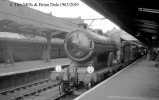
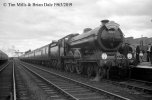
Prototype Tim Mills' Photos

76043

Western Thunderer
The movement of surplus brake vans like this is something I've not seen before, I assume it's redistribution but I'd like to know more.

There's plenty of us on here that appreciate wagons and the publications that @hrmspaul and his colleagues have produced over the years. No idea where I'd be without these books.

@oldravendale Brian, please continue to publish the oddities.

I thought I'd comment on this photo, standard late LNER wagon with interesting chalk markings of Smithfield and Brentford markets?

V2 60975 on a down train at Holloway...

View attachment 249508
 

Yorkshire Dave

Western Thunderer
I simply don't have the knowledge of these pre my history ferry wagons and life is in the way of searching through reams of diagram books. As some of you will realise the number of different diagrams and diagram series used for the continental traffic was simply amazing. That the railways of Europe could be bothered to find so many wagons capable of fitting in our loading gauge and have the other necessities of sitting on the deck of ferry for hours across the North Sea or Channel is simply unbelievable.

Thank-you for your historical context Paul.

The cross channel rail vehicles we are seeing in Tim's (and some of my dad's) photos of the 1950-60s are either pre- or immediate post-war designs.

Just to add a bit more. The European railway companies DB, SNCF, SNCB (Société Belgo-Anglaise des Ferry Boats subsidiary), FS and the private companies; Transfesa (Spain), Interfrigo (Switzerland), Transthermos (Germany)) including their respective predecessors redesigned some of their standard rail vehicles to gabarit Anglais (English loading gauge) specifically for cross channel traffic.

Of the companies:
Société Belgo-Anglaise des Ferry Boats - merged in 1998 to become IFB which is the maritime freight division of SNCB.
Transfesa - still extant, Spain.
Transthermos - now part of the Nagel Group, Germany.
Interfrigo (Switzerland) was a rail logistics company wound up in 2010 and the freight devolved to the rail companies - not to be confused with today's Interfrigo Ltd, Northern Ireland; InterFrigo srl, Italy and Interfrigo AG, Switzerland.

Cross channel railway freight operations is a subject in its own right and very interesting. The challenge I personally like is searching for the information on German, Belgian and French websites in their respective languages.


As for railway modelling you are quite correct about the lack of 4mm (and 7mm) cross channel vehicles given how relatively common they were seen (since 1924?) in the UK given the number of daily train ferry sailings over the Harwich-Zeebrugge and Dover-Dunkerque passages. It's a different matter in HO scale where models of cross channel vehicles are available.
 

Yorkshire Dave

Western Thunderer
This is one of those "do I include this photo or not" but it gives a clue to the origin of the following photo so it's here. It's inside an unidentified Kings Cross to Potters Bar DMU on 6th February 1963.

img821 TM 2A Film IDL DMU Kings X - Potters Bar 6 Feb 63 copyright FINAL.jpg

This will be a Cravens DMU (twin front windows - Met Cam, Derby, BRCW and Pressed Steel units generally had three). These were also used on the KX and Hatfield to Dunstable North services.

Also in the days before the drivers pulled down the internal cab blinds so the passengers could no longer enjoy the 'drivers' view.
 

Roger Pound

Western Thunderer
Also in the days before the drivers pulled down the internal cab blinds so the passengers could no longer enjoy the 'drivers' view.

Not directly connected to the Potters Bar locale, but I remember enjoying the view from the seat directly behind the driving section on a dmu from Birmigham New Street to Leicester (London Road). This was many, many years ago and the type of dmu is long forgotten, I'm afraid, but it made my otherwise routine trip much more interesting!

Roger.
 

Martin Shaw

Western Thunderer
Brian
img#826 is at Newton on Ayr, #825 might well be Ayr itself, there is what looks like a Swindon Class 126 DMU in the shed on the left.
Martin
 

Ian@StEnochs

Western Thunderer
Hello Paul @hrmspaul and thank you for some more really useful info. We're really blessed to have such a fount of knowledge and a collection of wagon photos which are second to none. As Adam @AJC says, if you don't know the nature of those wagons there's no hope for the rest of us.

This is one of those "do I include this photo or not" but it gives a clue to the origin of the following photo so it's here. It's inside an unidentified Kings Cross to Potters Bar DMU on 6th February 1963.

View attachment 249814

Seen previously in posts #1954 and #4083 A1 60131 Osprey at an unknown location but probably from the DMU above in 1963. It was an Ardsley engine since May 1962, moving to Neville Hill in August and being withdrawn from there at the beginning of October 1965. (SLS). It went to TW Ward at Killamarsh for disposal which was complete at the end of November 1965. (Rail UK).

View attachment 249815

9F 2-10-0 92143 and here on a train of mineral wagons at Potters Bar on 6th February 1963. Home for the loco was New England when new on 31st August 1957 (BR Database), went in to store in January 1965 and was withdrawn in February. It was scrapped the following May at Cohen’s, Kettering. (BR Database).

View attachment 249816

Sister 9F 2-10-0 92142 moving brake vans brake vans at Potters Bar on 6th February 1963. It was a New England loco when new on 31st July 1957 (BR Database), and was withdrawn in February 1965. It was scrapped in February 1966 at Cohen’s, Kettering. (BR Database).

View attachment 249817

Crab 2-6-0 42882 believed to be at Ayr on 14th September 1961. It was allocated to Carlisle Kingmoor from as early as January 1948 (BR Database) and was withdrawn at the end of December 1962. (SLS). It was scrapped in November 1963 (BR Database) at McWilliams, Shettleston. (RO).

View attachment 249818

Believed to be at Ayr this is Fairburn 2-6-4T 42122 on 14th September 1961. The loco was on Ayr’s allocation from 21st November 1959 and withdrawn on 29th December 1962. (SLS). It was scrapped in September 1963 (BR Database) at Campbell’s, Airdrie or Shieldhall. (RO).

View attachment 249819

Brian

Brian,

Yes that is Ayr with the locomotive sheds on the left of Mogul 42882, they were never ‘Crabs’ in Ayrshire! The cheap looking structure was the 60’s extension of three roads of the red sandstone shed building to provide space for dmu maintenance. There was a similar extension on the other end.

The Mogul is on the up line and the picture would have been taken from inside the shed yard. Ayr shed was relatively easy to access, I went there a lot as a boy and never got thrown out. There was a footbridge over the main line at the far end which gave easy access and there was a footpaths almost all the way from Ayr station

The Fairburn is taking the harbour branch at Newton on Ayr. The bridge in the background is Tams Brig with the loco depot behind. The line seen curving off to the left is towards Mauchline and the central Ayrshire coalfields and was very heavily used. Ayr was a major centre for coal traffic much being exported through the harbour.

The train of vans is probably on its way to Ayr goods depot which was on the site of the original 1839 Ayr passenger station.

Ian.
 
Last edited:

oldravendale

Western Thunderer
Thanks for yours, Simon @simond and I remember the view from the DMUs, Roger @Roger Pound . The less good shots always seem to generate interest and Dave @Yorkshire Dave has given us more and better info to go with the photo. Thank you Dave.

I also thought the train of brake vans was interesting and I've not seen the like previously either @76043 . I noted those chalk markings myself and we've certainly seen these recreated on certain models. I also fully endorse your comments about the prototype info available from Paul @hrmspaul and others. The info which follows from Dave @Yorkshire Dave about the continental connections is really helpful as well.

Martin @Martin Shaw and Ian @Ian@StEnochs - it's wonderful to have the location so firmly pinned down. Much appreciated and incorporated in the data which accompanies the photos.

The next few posts will be of single subjects as there are multiple images of single subjects but are nonetheless interesting for all that.

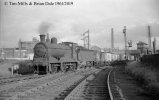
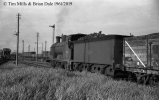
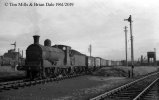
Hopefully these four photos will bring back some more memories, Ian. From the same series as these but seen previously in post #1710 this is 812 Class 0-6-0 57614 on a coal train in sidings at Ayr Yards on 14th September 1961. The new order in the shape of a diesel shunter is on the extreme left of the third pf these photos. 57614 was shedded at Ayr at the time and had been since at least 1948 (BR Database) and was withdrawn from there at the beginning of October 1962. (SLS). It was scrapped at Arnott Young, Troon, during February 1964. (BR Database and Rail UK). WHTS also records it being sighted in store at Ayr on several occasions through 1963 and also at Arnott Young in January 1964.

img827 TM 21A Film ID43 57614 Coal Train Ayr 14 Sep 61 Freight Traffic. copyright FINAL. Appro...jpg

img828 TM 22A Film ID43 57614 Coal Train Ayr 14 Sep 61 copyright FINAL.jpg

img829 TM 23A Film ID43 57614 Coal Train Ayr 14 Sep 61 copyright FINAL.jpg

img830 TM 24A Film ID43 57614 Coal Train Ayr 14 Sep 61 copyright FINAL.jpg

Brian
 

RonnieS

Western Thunderer
The movement of surplus brake vans like this is something I've not seen before, I assume it's redistribution but I'd like to know more.
It maybe something like the "round up" on WR in the 60s. This was a Q (occasional working) on some Sundays in the Wolverhampton area. A memo or list went out to collect odd wagons (mainly brake vans) that had been left in sidings and goods yards in the locality. My dad was a Head Shunter and passed Goods Guard and I accompanied him on a couple of trips. This was, of course, before Health and Safety was invented as I would have been 11 or 12 at the time.
 

Ian@StEnochs

Western Thunderer
Thanks for yours, Simon @simond and I remember the view from the DMUs, Roger @Roger Pound . The less good shots always seem to generate interest and Dave @Yorkshire Dave has given us more and better info to go with the photo. Thank you Dave.

I also thought the train of brake vans was interesting and I've not seen the like previously either @76043 . I noted those chalk markings myself and we've certainly seen these recreated on certain models. I also fully endorse your comments about the prototype info available from Paul @hrmspaul and others. The info which follows from Dave @Yorkshire Dave about the continental connections is really helpful as well.

Martin @Martin Shaw and Ian @Ian@StEnochs - it's wonderful to have the location so firmly pinned down. Much appreciated and incorporated in the data which accompanies the photos.

The next few posts will be of single subjects as there are multiple images of single subjects but are nonetheless interesting for all that.

Hopefully these four photos will bring back some more memories, Ian. From the same series as these but seen previously in post #1710 this is 812 Class 0-6-0 57614 on a coal train in sidings at Ayr Yards on 14th September 1961. The new order in the shape of a diesel shunter is on the extreme left of the third pf these photos. 57614 was shedded at Ayr at the time and had been since at least 1948 (BR Database) and was withdrawn from there at the beginning of October 1962. (SLS). It was scrapped at Arnott Young, Troon, during February 1964. (BR Database and Rail UK). WHTS also records it being sighted in store at Ayr on several occasions through 1963 and also at Arnott Young in January 1964.

View attachment 249869

View attachment 249870

View attachment 249871

View attachment 249872
Brian,

Excellent Views of 57614. The first is of her having just turned off the main line onto the harbour branch at Newton on Ayr where the Fairburn tank was. You can see the back of the station platforms and beyond that a caravan in the small sales area which is now an undertakers yard. This station was just a two platform job with no goods facilities and served the Newton are between Ayr and Prestwick. It's sectional wooden G&SWR building were replaced with nice modern 'Art Deco' style brick facilities. The main building is still there out of railway use but with it's windows bricked up. The train has taken the lead into Falkland yard, the other two lines continue to the harbour. It is interesting to see a couple of ex PO wagons at the head of the train.

The rest of the sequence is within Falkland yard which had extensive sorting and storage sidings mostly for coal wagons. The van train earlier would be sorted here and probably shunted down to the goods depot by the Barclay shunter. Driver and fireman are clearly interested in the photographer

Incidently Falkland yard still exists with almost all of its sidings intact but hardly used now. It had been the major storage area for coal wagons and EWS had a maintenance facility, in Ayr loco shed, where once the DMUs were maintained. However the collapse of the coal trade led to it's disuse and decline and it is a sorry rusty and overgrown mess.

Ian
 

hrmspaul

Western Thunderer
This will be a Cravens DMU (twin front windows - Met Cam, Derby, BRCW and Pressed Steel units generally had three). These were also used on the KX and Hatfield to Dunstable North services.

Also in the days before the drivers pulled down the internal cab blinds so the passengers could no longer enjoy the 'drivers' view.
Also reminds me of a journey I made with Dad when he was counting passengers, checking up on Guards counts returns for Dr. B.

We did a triangular day trip, Staines to Reading and then Newport. There we transferred to the front of a DMU to Worcester. Several abiding memories, not least the trap points that I hadn't seen before which came at irregular intervals. Numerous Granges (I think!). But more regular was the ringing of the bell on the ATC telling the driver he had a green to proceed signal. It really did become quite irritating. We returned from Worcester and the other memory is no one got on or off this "express" at Kingham but it remains open.

Paul
 

oldravendale

Western Thunderer
Thank you for the DMU thoughts and memories, Alan @Alan and Paul @hrmspaul . It's turned out that putting that photo up was quite a good idea!

Thanks too to @RonnieS . Your suggestion about the train of brake vans may well be and in view of your first hand knowledge probably is correct. Much appreciated.

Providing the precise location of those photos is so valuable, Ian @Ian@StEnochs. Thanks again.

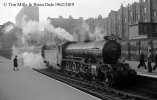
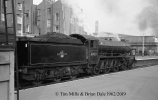
Again several photos of the same subject in this post The last of these was printed for Tim in his series "Special Trains" and used in an exhibition of his work at Loughborough Station. From the same series as post #3516 and photos img2835-2838 we also saw a single frame of this B16, 61438, at Marylebone in post #3449 (img2786). Here are six more of the loco on the LCGB Railtour, The Midland Limited on 14th October 1962, not 30th September as previously recorded. See The Railtour Files The B16s were very rare birds anywhere near London so this must have created quite a lot of interest at the time. 61438 was allocated to York North in March 1943 (BR Database). It moved to Hull Dairycoates in December 1962 and was withdrawn from there in June 1964. (SLS). It was sold for scrap to Draper’s, Hull, in September 1964 and cut up there at the beginning of October 1964. (BR Database).

img831 TM 9 Film ID77 61438 Marylebone 30 Sept 62 copyright FINAL.jpg

img832 TM 10 Film ID77 61438 Marylebone 30 Sept 62 copyright FINAL.jpg

img833 TM 11 Film ID77 61438 Marylebone 30 Sept 62 copyright FINAL.jpg

img834 TM 12 Film ID77 61438 Marylebone 30 Sept 62 copyright FINAL.jpg

img835 TM 13 Film ID77 61438 Marylebone 30 Sept 62 copyright FINAL.jpg

img836 TM 14 Film ID77 61438 The Midland Limited LCGB Railtour  Marylebone Special Trains. cop...jpg

Brian
 
Last edited:

Heather Kay

Western Thunderer
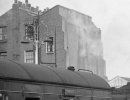
While images of "just another steam engine at a station", there’s so much going on.

Leaving aside the people in the distance walking across the tracks without not a care in the world, just look at this building backing in to the station.

IMG_4689.jpeg

I know it’s a cliche, but if you built a model like that, with literally half a block sliced away, with random brick buttresses and all rendered over, you’d be laughed at. I wonder what the story is there: bomb damage, or just the railway shouldering its way through?
 

Roger Pound

Western Thunderer
The B16 reminded me of the regular 'York Goods' as we called an evening fitted freight turn through Leicester going south on the old GC. in the early 1950's. B16's, both original and rebuilt, were the regular performers although very occasionally a V2 would be in charge. I understood that the B16 came off at Banbury and a Western Region loco took the train on to Swindon - but that was just lads gossip so these days one could not really state it as a fact. Never mind, in all events they were happier days in many ways, regrettably long gone.

Roger.
 

Pete_S

Western Thunderer
While images of "just another steam engine at a station", there’s so much going on.

Leaving aside the people in the distance walking across the tracks without not a care in the world, just look at this building backing in to the station.

View attachment 249913

I know it’s a cliche, but if you built a model like that, with literally half a block sliced away, with random brick buttresses and all rendered over, you’d be laughed at. I wonder what the story is there: bomb damage, or just the railway shouldering its way through?

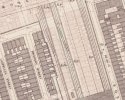
The latter it seems:—

Marylebone.jpg

Pinkish layer is 1893/95 with 1937/38 overlaying it.
 

AJC

Western Thunderer
The latter it seems:—

View attachment 249983

Pinkish layer is 1893/95 with 1937/38 overlaying it.

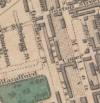
Well, it is Marylebone, the latest (I think?), of the London termini, which intruded into a well-established neighbourhood, so it's not that surprising - none of the earlier ones were on greenfield sites, and each required massive clearance work one way or another.

Here's the same area in the 1820s:

1760993966959.png

From C. & J. Greenwood's survey available here: Layers of London (twenty years earlier it was an open field - Thomas Lord's first - I think - cricket ground).

Adam
 
Last edited:

Gadgie

Western Thunderer
While images of "just another steam engine at a station", there’s so much going on.

Leaving aside the people in the distance walking across the tracks without not a care in the world, just look at this building backing in to the station.

View attachment 249913

I know it’s a cliche, but if you built a model like that, with literally half a block sliced away, with random brick buttresses and all rendered over, you’d be laughed at. I wonder what the story is there: bomb damage, or just the railway shouldering its way through?
Thanks for drawing attention to this unusual building. I can’t quite get over the delightful jumble of chimney pots — is it one flue per fireplace, or what?

Richard
 

oldravendale

Western Thunderer
Prime bit of observation there, Heather @Heather Kay and the subsequent posts from @Pete_S and Adam @AJC show how the station was shoehorned in to quite a small space, even allowing for the demolition of properties. Even now Marylebone has the feeling of a less overpowering structure than the other main line stations. We're lucky to still have it when we realise how close it came to total demolition with the closure of the GCR main line. I believe, Richard @Gadgie that each of those chimney pots was probably for more than a single fireplace. I think you can follow the chimney breasts up the rendered side of the building. Certainly in our current house and in previous ones the fireplaces on one side of the house all joined to a single flue.

Thanks for yours about the B16s, Roger. Regrettably I never saw one...

Another LCGB Special, The Eastern Counties Limited - The Railtour Files - of 12th July 1959 used 4-4-0 D16/3 62613 among other motive power (see below). This first shot is at Fenchurch Street Station. 62613 was allocated to Spital Bridge from April 1959, then March in February 1960 where it was withdrawn in October the same year. (SLS). It was scrapped in December 1960 (BR Database), having been seen at Stratford on 30th October (RO) and again on 28th December in the Foundry (SLS) so the suggestion of scrapping in that month may be a bit optimistic.

img837 TM 32A Film IDERMay63 62613 on LCGB Special Fenchurch St Jul 60 Eastern Countis Ltd 12 ...jpg

The train is here being held at signals on Channel Sea Curve, Stratford en route to Cambridge.

img838 TM 33A Film IDERMay63 62613 Halted at Signals on Channel Sea Curve Stratford en route t...jpg

Finally for this stint the train is stationary at Cambridge Station.

img839 TM 34A Film IDERMay63 62613 Cambridge Eastern Countis Ltd 12 Jul 59  copyright FINAL.jpg

From Cambridge the train was taken forward by B12 61577. This loco was seen previously as long ago as post #158 (at the end of October 2020!) and more recently in #4637 at Cambridge Shed. BR Database says that this loco was at Ipswich from at least 1948 until August 1958 when it moved to Norwich Thorpe. (BR Database and SLS). It was withdrawn from Cambridge in September 1959 where it was allocated from April the same year. (SLS). According to the Railway Observer it went to Stratford Works and WHTS records it as being noted there on 4th October 1959. The Railway Observer further advises that it was seen being cut up on 10th November 1959.

img840 TM 35A Film IDERMay63 61577 Cambridge Eastern Countis Ltd 12 Jul 59  copyright FINAL.jpg

Brian
 

Martin Shaw

Western Thunderer
D16/3 62613 wdn 25/10/60, B12/3 61577 wdn 28/9/59, both dates according to Yeadon. A thought about these and scrapping dates.

The withdrawal date is an important accounting date is it was then the departmental ownership and hence capital asset recording changed, from traffic to regional stores. Subsequent cutting up dates, apart from a matter of historical record are irrelevant from the railways point of view as the scrap material was either reused or sold for onward use. The point is that whilst withdrawal dates needed to be accurately reported internally and are largely reliable, subsequent events have relied upon enthusiast sightings with somewhat less veracity as is rather often shown. Personally I'm not too bothered about what happened after withdrawal or when.

Martin
 
Last edited:
Top