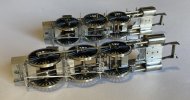
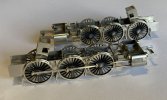
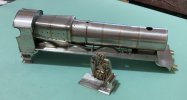
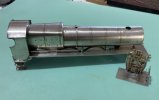
Tom Mallard’s Workbench - Bradwell K1 - Clockwork LNER Q1

Tom Mallard

Western Thunderer
IMG_5619.JPGIMG_5620.JPGHampton Court 270325.JPGIvanhoe 270325.JPGIvanhoe backhead 270325.JPGHampton Court backhead 270325.JPG

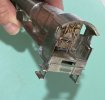
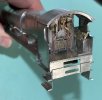
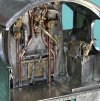
Progress made on the backheads for Ivanhoe and Hampton Court. This illustrates one of the main visual differences between the different batches these engines came from - one has screw reverse, the other lever. I think it worth mentioning that all of the rivet detail is embossed - not etched. The backheads, built up with castings from Brassmasters/Martin Finney/Malcolm Mitchell are somewhat simplified compared to the prototype, but I think will be acceptable once painted and with a crew in there.

The brakegear is not at all convenient to make, but thankfully has the necessary clearance...

Not too much more to do now, though the top feed, safety valves and bonnet will require care.

Tom
 

Tom Mallard

Western Thunderer
IMG_5878.JPGIMG_5874.JPGIMG_E5859.JPG

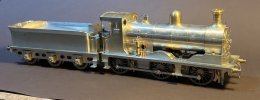
Finally I have got Caledonian Railway 828 together. There are some nice touches I was asked to incorporate, chief among these is that this clockwork model is controlled via the actual regulator for on/off, and the reversing lever controls forward/reverse travel.

As a clockwork model, the construction is necessarily more robust than my usual efforts and with careful editing of the detail level to tie in with the clients existing locomotive stud, whilst also adhering to the proportions of the prototype. It has been a most enjoyable learning opportunity, with a very different kind of outcome.

I like the way I have been allowed to include 21st century approaches such as the tender axlebox castings being from 3D printed waxes juxtaposed with the antique clockwork mechanism and handmade construction.

Best regards

Tom
 

Tom Mallard

Western Thunderer
They are all just fantastic Tom! With the Caledonian loco, what clockwork mechanism did you use?
Thanks for the kind remark. According to my client, it’s a small size Bing motor rebuilt with a ‘Teleguv’ i.e. the governor from a telephone dial in place of the original Bing governor.
I further modified the installation of the Teleguv for improved packaging of the backhead.
 

40057

Western Thunderer
Tom has done a tremendous job building 828. I am pleased to say, once painted, it will be coming to work on my layout, Rivermead Central. It’s been very interesting working with Tom on this project. Not something I would normally do, but I got a small lump sum when I retired a couple of years ago. Not a fortune, but enough to commission Tom to build 828. You can’t take it with you, 828 (the real one) is a very favourite locomotive, I wasn’t going to find an existing 0 gauge clockwork model of a CR 812 class loco. I used to read the articles by Norman Eagles about the Sherwood Section locomotives and how various contrivances (tilted motors, stub axles) had been used to squeeze clockwork mechanisms into models of small prototypes. Eagles worked with Leslie Forrest (Windsor Models) and commissioned Forrest to build many locomotives for the Sherwood railway.

So I’m regarding 828 as part of, for me, the whole vintage-clockwork-model-railway experience. A continuation of a tradition of commissioning unusual clockwork locos. A type that was never going to be made in numbers by one of the major manufacturers, a challenge to make in clockwork, but achievable on a one-off basis.

To get reasonable haulage capacity and a good length of run out of a clockwork loco, you need a large main-spring. Always, with clockwork, put the largest possible motor into any loco. So prototypes with large-diameter, high-pitched boilers, Belpaire fire-boxes, small-diameter driving wheels are ideal for clockwork — lots of headroom above the axles for a really large motor. Side-tanks are helpful as they disguise that there is no daylight under the boiler.

So a small 0-6-0 tender-engine, with a small boiler, largish wheels and, in real life, lots of daylight under the boiler is inherently an extremely difficult thing to build in clockwork. At least, if the model is to look anything like the real loco. The fire-box just isn’t big enough even for a very small clockwork mechanism. Whichever axle is powered, the motor won’t fit in the gap between axles, meaning stub axles to accommodate the main-spring.

On the face of it, there is nothing about Tom’s model of 828 that marks it out as built in 2025, as opposed to, say, 1955. Actually, I think there is. Tom has done a remarkable job at hiding the motor. To achieve that, the motor has been sharply tilted downwards to the rear and reduced in size by trimming the side plates. The tilt on the motor has allowed the middle wheels to be mounted on a conventional (through) axle — though the axle had to be reduced in diameter to just clear the main-spring. I am of the view that the position of the motor is the exact and only position which would avoid stub axles and hide the motor so effectively. I doubt if that unique solution would have been found by conventional means — lying the motor on an outline drawing and moving it about. It was only through Tom’s use of CAD drawings to test options that we were able to find a solution for the motor that didn’t appear possible — but the testing process showed would work. In his post about 828 above, Tom referred to use of 3-D printed waxes to produce exceptionally good castings. Again, couldn’t have been done seventy years ago. So I think 828 has advanced what is possible with clockwork in a small engine, by deploying new technology to do better with an old one.

The other area where 828 has pushed the envelope for a clockwork model is in the matter of control. Conventionally, two or three large levers sticking out of the back of the cab. However, with 828, once wound up — using the keyhole nicely disguised by the Westinghouse pump — making the engine go requires the regulator to be opened. A quarter turn anti-clockwise will set the loco in motion. Just like the real loco. Similarly, the operation of the scale reversing lever to effect a change of direction. Both controls have been cleverly arranged by Tom so they operate, superficially, in the same way as on the real 828.

I haven’t seen 828 in its finished state. I saw it and was able to give it a test run last December. It’s got a good motor, powerful for its size. I am delighted with how it has turned out. My thanks to Tom for an outstanding clockwork locomotive.

Martin

 
Last edited:

Ian@StEnochs

Western Thunderer
As a schoolboy trainspotter I saw a lot of 812 class 0-6-0s. 57577 was a frequent performer on the coal from Kirconnel to Hurlford mineral sidings. She coasted down through Cumnock with around 20 wagons almost every lunch time and we got kind of fed up with seeing her every day.
They also made up the 'twins',two 812s up from Ayr to Littlemill colliery with emptys. One stayed at the pit and shunted while the other took a rake of fulls to Ayr harbour. Returning later and then the pair took a big load back to the harbour. Imortalised as Donald and Dougal by rev Audrey.
Happy days. Your clockwork engine captures the look well. I hope you paint her black.
Ian
 

40057

Western Thunderer
As a schoolboy trainspotter I saw a lot of 812 class 0-6-0s. 57577 was a frequent performer on the coal from Kirconnel to Hurlford mineral sidings. She coasted down through Cumnock with around 20 wagons almost every lunch time and we got kind of fed up with seeing her every day.
They also made up the 'twins',two 812s up from Ayr to Littlemill colliery with emptys. One stayed at the pit and shunted while the other took a rake of fulls to Ayr harbour. Returning later and then the pair took a big load back to the harbour. Imortalised as Donald and Dougal by rev Audrey.
Happy days. Your clockwork engine captures the look well. I hope you paint her black.
Ian
Modelled in late CR condition. No lamp brackets above the front buffer beam, Westinghouse brake, steam heat connection on the tender only, CR boiler (not the LMS-built one 828 got c.1925). Has to be blue.
 

Tom Mallard

Western Thunderer
Saints 2 290525.jpgSaints 3 290525.jpg

The Saints are creeping toward completion now all the large sub assemblies are done. Small nuances between the models may be visible, such as a larger diameter chimney on Ivanhoe, different splashers and different front footplate rivetting arrangement. The brackets that hold the exhaust ejector pipe and handrail stanchion are cut from brass plate after drilling holes at the correct centres. The profile is then refined with files and burrs before mounting on the backing plate.

Choosing to have proper copper caps on these GWR chimneys meant a separate cap. This is a sleeved fit on the chimney base which is soldered on before final profiling and boring operations

The keeper plate and cosmetic spring assembly is a very useful feature for mounting the pickups to, but quite an involved task to do nicely. Plus the springs are of course largely hidden... The keeper plate is to be held in place with 14BA screws.

I hope they are done soon - its mostly just the small details now.

Best regards

Tom
 

Tom Mallard

Western Thunderer
Chassis 7 010725.jpgChassis Ivanhoe 010725.jpg
Chassis 4 010725.jpg

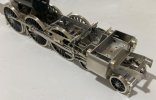
The Saints are almost really definitely nearly finished. I've somehow made the inside valvegear workable and removable but I'm happy to have only put it into one model. The cylinder assembly looks good with the oil pots and valve rods in situ.

The keeper plates are quite an involved thing to make, but make chassis assembly and setup that much more straight forward. There are more pipes down there than I expected.

The most tricky parts of assembly are now done, bar the pickups, and we're onto final detailing of the body and a few little bits and pieces to make.

Best regards

Tom
 
Top