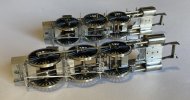
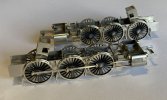
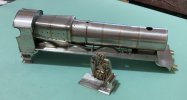
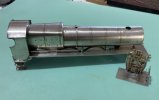
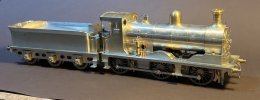
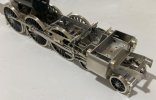
Tom has done a tremendous job building 828. I am pleased to say, once painted, it will be coming to work on my layout, Rivermead Central. It’s been very interesting working with Tom on this project. Not something I would normally do, but I got a small lump sum when I retired a couple of years ago. Not a fortune, but enough to commission Tom to build 828. You can’t take it with you, 828 (the real one) is a very favourite locomotive, I wasn’t going to find an existing 0 gauge clockwork model of a CR 812 class loco. I used to read the articles by Norman Eagles about the Sherwood Section locomotives and how various contrivances (tilted motors, stub axles) had been used to squeeze clockwork mechanisms into models of small prototypes. Eagles worked with Leslie Forrest (Windsor Models) and commissioned Forrest to build many locomotives for the Sherwood railway.
So I’m regarding 828 as part of, for me, the whole vintage-clockwork-model-railway experience. A continuation of a tradition of commissioning unusual clockwork locos. A type that was never going to be made in numbers by one of the major manufacturers, a challenge to make in clockwork, but achievable on a one-off basis.
To get reasonable haulage capacity and a good length of run out of a clockwork loco, you need a large main-spring. Always, with clockwork, put the largest possible motor into any loco. So prototypes with large-diameter, high-pitched boilers, Belpaire fire-boxes, small-diameter driving wheels are ideal for clockwork — lots of headroom above the axles for a really large motor. Side-tanks are helpful as they disguise that there is no daylight under the boiler.
So a small 0-6-0 tender-engine, with a small boiler, largish wheels and, in real life, lots of daylight under the boiler is inherently an extremely difficult thing to build in clockwork. At least, if the model is to look anything like the real loco. The fire-box just isn’t big enough even for a very small clockwork mechanism. Whichever axle is powered, the motor won’t fit in the gap between axles, meaning stub axles to accommodate the main-spring.
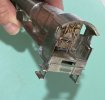
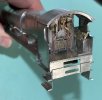
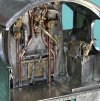
On the face of it, there is nothing about Tom’s model of 828 that marks it out as built in 2025, as opposed to, say, 1955. Actually, I think there is. Tom has done a remarkable job at hiding the motor. To achieve that, the motor has been sharply tilted downwards to the rear and reduced in size by trimming the side plates. The tilt on the motor has allowed the middle wheels to be mounted on a conventional (through) axle — though the axle had to be reduced in diameter to just clear the main-spring. I am of the view that the position of the motor is the exact and only position which would avoid stub axles and hide the motor so effectively. I doubt if that unique solution would have been found by conventional means — lying the motor on an outline drawing and moving it about. It was only through Tom’s use of CAD drawings to test options that we were able to find a solution for the motor that didn’t appear possible — but the testing process showed would work. In his post about 828 above, Tom referred to use of 3-D printed waxes to produce exceptionally good castings. Again, couldn’t have been done seventy years ago. So I think 828 has advanced what is possible with clockwork in a small engine, by deploying new technology to do better with an old one.
The other area where 828 has pushed the envelope for a clockwork model is in the matter of control. Conventionally, two or three large levers sticking out of the back of the cab. However, with 828, once wound up — using the keyhole nicely disguised by the Westinghouse pump — making the engine go requires the regulator to be opened. A quarter turn anti-clockwise will set the loco in motion. Just like the real loco. Similarly, the operation of the scale reversing lever to effect a change of direction. Both controls have been cleverly arranged by Tom so they operate, superficially, in the same way as on the real 828.
I haven’t seen 828 in its finished state. I saw it and was able to give it a test run last December. It’s got a good motor, powerful for its size. I am delighted with how it has turned out. My thanks to Tom for an outstanding clockwork locomotive.
Martin