Prototype Tim Mills' Photos

John Palmer

Western Thunderer
Looking at the Siphon J pictured at Stranraer, I was struck by the distance between the wheelsets in each bogie. The Diagram O31 Siphons J were produced with seven foot wheelbase bogies, and it seemed to me that the one pictured was carried on bogies of greater length. A bit more research required...

I don't have either Jack Slinn's original work on the Siphon family or John Lewis' more recent treatise on the subject. The information available to me does, however, indicate that a further ten Siphons J were built to a different diagram, O40, and completed in 1934. There appears to have been a six inch difference between the two diagrams' wheelbases, which suggests to me that the O40s were fitted with a different design of bogie, presumably one of the nine foot wheelbase types – which is what I think I can see beneath the one at Stranraer. This also appears to be confirmed by the data in Longworth, in which the O40 design is illustrated with a 9' 0" wheelbase plate bogie.

Incidentally, I was wrong about the number of O31s built: one lot of 8 and one lot of 27, making 35 in total not 32.

No doubt someone having more than my rudimentary knowledge of GW Brown vehicles will correct me if I've got this wrong.
 

oldravendale

Western Thunderer
Regarding Stranraer... Thank you for kicking off the discussion about the bogie van, Paul @hrmspaul . Then Tim @timbowales , Adam @AJC , John @John Palmer and Ben @readingtype for endeavouring to make a definite description. We're possibly not there yet but I sense circling the answer.

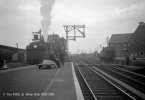
This is an unidentified Brush Type 2 loco, possibly better known as a Class 31 clearly in green with body side bands at base and middle and yellow front end assisting what I believe to be a B1 but the location and date are unknown. I guess the "interim" livery on the diesel may help to refine the date a bit.

img4216 TM No Info copyright Final.jpg

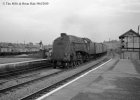
I believe this to be at Harringay and shows an unidentified A1 pacific and at an unknown date.

img4217 TM poss Harringay Rd No Info copyright Final.jpg

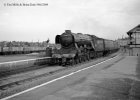
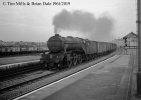
A4 60034 Lord Farringdon last seen in post #2445 here at Harringay but with no date. Considering the location and the allocation record we can at least have a stab at the latest date which we may be able to attribute to this photo. The loco was allocated to Kings Cross from April 1948 and moved to New England in June 1963 before going to St Margarets in November the same year. According to SLS it was at Darlington Works for a Heavy Intermediate from 11th January - 24th April 1965. and was allocated to Aberdeen Ferryhill in June 1964 as its final shed for use on the Aberdeen - Glasgow trains and withdrawn in August 1966. (SLS). However the SLS also says it was scrapped at Hughes Bolckows, North Blyth, in October 1965. I think this is a typo and should read October 1966.

img4218 TM 60034 poss Haringay Rd No Info copyright Final.jpg

That photo of Lord Farringdon completes the publication on WT of very nearly four thousand images, mostly of railway subjects but a few diversions in to cars, traction engines and ships. For a file described as “mostly rubbish” it’s been an eye opener. I’ve noted where I printed a few of these images for Tim although most I printed are in the photos yet to come up – an out of sequence series of negatives which Tim removed from complete sets. I know these have never been properly recorded until now which is one reason I am so delighted with all the extra information which flows from the WT brains. We have together built up a mine of information for which I am eternally grateful.

Brian
 

Eastsidepilot

Western Thunderer
B17 61652 Darlington at Kings Cross in November 1957. The SLS report the loco as allocated to Colwick at least from October 1946. BR Database then show it as allocated to Cambridge in December 1950 and withdrawn in September 1959. Yeadons advise it was scrapped at Doncaster Works and WHTS that it was seen there in November 1959 although BR Database give a scrapping date of September 1959.

View attachment 237402


Brian
The RCTS green book says 61652 was 'withdrawn' 9/59, so maybe BR Database has it wrong way round, this fits with Yeadon's sighting 10/59 at Doncaster ?
Col.
 

timbowales

Western Thunderer
Looking at the Siphon J pictured at Stranraer, I was struck by the distance between the wheelsets in each bogie. The Diagram O31 Siphons J were produced with seven foot wheelbase bogies, and it seemed to me that the one pictured was carried on bogies of greater length. A bit more research required...

I don't have either Jack Slinn's original work on the Siphon family or John Lewis' more recent treatise on the subject. The information available to me does, however, indicate that a further ten Siphons J were built to a different diagram, O40, and completed in 1934. There appears to have been a six inch difference between the two diagrams' wheelbases, which suggests to me that the O40s were fitted with a different design of bogie, presumably one of the nine foot wheelbase types – which is what I think I can see beneath the one at Stranraer. This also appears to be confirmed by the data in Longworth, in which the O40 design is illustrated with a 9' 0" wheelbase plate bogie.

Incidentally, I was wrong about the number of O31s built: one lot of 8 and one lot of 27, making 35 in total not 32.

No doubt someone having more than my rudimentary knowledge of GW Brown vehicles will correct me if I've got this wrong.
Right then, I've got Slinn & Clarke open as I type this.
9' American bogies were used under Dia O31 Lot 1409 when built but all had 7' bogies by the end of 1932
9' pressed steel bogies were fitted under Dia O40 when built. There were only 10 of these so one turning up in SW Scotland is very rare.
I wonder, given that these were heavily insulated and provided with ice boxes, could it have been being used for some kind of dairy product coming over fron Ireland?
 

Dave Holt

Western Thunderer
Another possibility is that the B1 is providing steam heat for a diesel with a faulty boiler? Not uncommon in the early days of dieselisation. The track looks frosty and the trees bare, so presumably the photo was taken in the winter months.
Dave.
 

76043

Western Thunderer
Thank you Brian for four thousand images so far. I had no idea it was that many, bringing to light lots of information about about the workings of BR in this period. My memorable favourite is the shot of the one in a half a million Wagons that BR built, the standard van that was unique.

Thanks again!
Tony
 

Rob R

Western Thunderer
Right then, I've got Slinn & Clarke open as I type this.
9' American bogies were used under Dia O31 Lot 1409 when built but all had 7' bogies by the end of 1932
9' pressed steel bogies were fitted under Dia O40 when built. There were only 10 of these so one turning up in SW Scotland is very rare.
I wonder, given that these were heavily insulated and provided with ice boxes, could it have been being used for some kind of dairy product coming over fron Ireland?
There was a large dairy on the Portpatrick branch which kept a short stub open until quite late and is now home to the Seriously Strong Cheddar, but relocated to the edge of Stranraer, though still adjacent to the remains of the Portpatrick branch.
More cheese Gromit?
 

John Palmer

Western Thunderer
Right then, I've got Slinn & Clarke open as I type this.
9' American bogies were used under Dia O31 Lot 1409 when built but all had 7' bogies by the end of 1932
9' pressed steel bogies were fitted under Dia O40 when built. There were only 10 of these so one turning up in SW Scotland is very rare.
I wonder, given that these were heavily insulated and provided with ice boxes, could it have been being used for some kind of dairy product coming over fron Ireland?
Interesting and a little surprising!

Use of both the 7' 0” wheelbase and 9' 0” wheelbase 'heavy plate' type bogies seems to have been well established from before the 1929-30 period in which the Lot 1409 Siphons J were built, so I'm a bit puzzled as to why this first batch were initially constructed with 'American' equalised bogies, only for these to be replaced with seven footers within the first three years of their life.

I had thought it likely that the O40s would have received the 'heavy plate' type bogies when built between October 1932 and April 1934, so their mounting from the outset on the 9' 0” wheelbase pressed steel design of bogie came as a surprise. In “Great Western Coaches : 1890-1954” Michael Harris wrote that “After 1932” the pressed steel design “was standardised for virtually all new construction”, but on the same page has a drawing of bogie types annotated to the effect that the pressed steel type shown was employed from “1935-54”, which rather clouds the issue as to its introduction date.

However one looks at it, it seems that O40 Siphons J must have been amongst the very first vehicles to have been mounted on the then-new pressed steel design of bogie.
 

LarryG

Western Thunderer
Regarding GWR bogies, the GWR went through phases. Fishbelly, 8' and 9' American, and 9' Plate bogies were the norm before until 7' 0" bogies took over around 1925 on whatever was being built. 9' Plate were then reserved for heavier coaches until the Pressed Steel bogie came into fashion. Within each type (excluding Fishbelly and American) were deep frame, shallow frame, short spring, long spring, short step, long step variants. All good fun for the modeller. :thumbs:
 

Pete_S

Western Thunderer
Michael Harris wrote that “After 1932” the pressed steel design “was standardised for virtually all new construction”, but on the same page has a drawing of bogie types annotated to the effect that the pressed steel type shown was employed from “1935-54”, which rather clouds the issue as to its introduction date.

094175B_Crop.jpg

And

105415A_Crop.jpg
There's also 101426 for a Heavy Single Bolster version dated September 1933.

Swindon Standardisation strikes again!
 

ovener

Western Thunderer
Thank you Brian for your labours. I can only imagine how much time it's taken especially with post-processing and adding the information. Tim had a good eye for a pleasing photo, and the incredible hive mind of WT adds so much extra detail. I don't remember any steam from my childhood as we didn't live near a railway and were overseas when I would have been old enough to remember at least the very end of it. Very much appreciated.
Richard
 

oldravendale

Western Thunderer
That's a useful bit of info, Col @Eastsidepilot . Now added to the file so many thanks.

Also Tim @timbowales, Rob @Rob R, John @John Palmer, Larry @LarryG and Pete @Pete_S. Thank you all for so much information stimulated by that wagon at Stranraer.

Then Dave @Dave Holt - you are, of course quite correcr and that's something I'd not considered, but it's a worthwhile comment to add to the photo.

Then Tony @76043, Roger @Roger Pound and so many others who have expressed their interest at various exhibitions. Your enthusiasm for the continuation of the thread is much appreciated but, as far as I'm concerned, it remains a labour of love.

There will follow around 500 (actually 485) more black and white photos which include the majority of the pictures Tim asked me to print for him before he died. I was, of course, happy to do so. Against some of the original brief descriptions upon which the commentary is based you’ll find the magic word “Approved” or “Printing Copy”. Tim was a hard task master and wouldn’t accept anything other than perfect – in his opinion – and most went through three or four iterations. However I have very limited information about most of them. The negatives inevitably include many which are less than perfect but this series probably includes the finest of Tim’s work as well as the inevitable failures. It will be quite obvious where I have limited data so help to fill the gaps will always be appreciated and acknowledged. Neither is this the end of Tim’s photos. We’ve not even started the colour images and I’ve not calculated how many of those there are...

Condensing 57XX 0-6-0PT 9710 possibly at Acton on 4th October 1962. The home shed was probably always Old Oak Common – it had certainly been allocated there since at least 1947. (BR Database). Withdrawal followed in October 1964 (SLS) and it was seen on 19th November 1964 at Cox and Danks, Park Royal (WHTS) and was scrapped in January 1965 (BR Database). Of interest is that the SLS report the loco at Caerphilly Works Erecting Shop on 29th October 1961. Other small engines which could be considered “local” to Old Oak and unlikely to travel so far yet present at Caerphilly at the same time were 6115 of Slough and 6145 and 9420 of Old Oak.

img001 TM5A Film ID76 9710 poss Acton 4 Oct 62 copyright FINAL Remasked.jpg

Another showing 9710 but here with an unidentified 94XX pannier tank at Acton on 4th October 1962.

img003 TM7A Film ID76 9710 and 94XX poss Acton 4 Oct 62 copyright FINAL Remasked.jpg

A3 60110 Robert the Devil at Hornsey in July 1961. It had been allocated to Kings Cross in July 1957 and was withdrawn in May 1963. (SLS). It entered Doncaster Works on 11th June 1963 where it was cut up in the same month. (Yeadons and WHTS). This loco was previously in posts #3022 and #4052.

img004 TM Large Format 60110 Hornsey July 61 copyright FINAL Remasked Printing copy.jpg

Brian
 
Last edited:

Arun Sharma

Western Thunderer
9710 has previously been reported as being overhauled at Caerphilly -Page 58 of Brian Haresnape's "Collett & Hawkesworth Locomotives" has a pic of 9710 at Cardiff Canton after having been overhauled at Caerphilly in Feb 1962. Having produced the condensing kit conversion for the Minerva 8750 I have a soft spot for this sub-class of engines!
 

Yorkshire Dave

Western Thunderer
Another showing 9710 but here with an unidentified 94XX pannier tank at Acton on 4th October 1962.

img003 TM7A Film ID76 9710 and 94XX poss Acton 4 Oct 62 copyright FINAL Remasked.jpg

Not forgetting the 1959 or 1962 (as they are both similar) tube stock - which is only at the most two years old or new at the time of the photo - approaching North Acton station beyond the second bridge in the distance. It was the first to be in unpainted aluminium and note it is carrying an oil tail lamp, which was the practice until two red rear/stabling lights were installed next to the headlights during the 1970s.

The 1959 tube stock was intended for the Piccadilly Line but after delivery of seven sets, subsequent sets were diverted to the Central Line to replace the 1924 et seq Standard Stock. The Central Line 1959 stock was transferred back to the Piccadilly Line when the 1962 stock was delivered to the Central Line. The 1962 stock remained on the Central Line until it was replaced by the 1992 Central Line stock, with the former being cascaded to the Northern Line until withdrawal in 2000. This was the last stock on the Underground where the guard operated the doors.

1960 Central Line tube stock was a small batch used on the Hainault-Woodford services, from which it never strayed, testing and developing Automatic Train Operation.

When the 1973 Piccadilly Line tube stock was delivered after the opening of the Heathrow extension the 1959 Piccadilly Line stock was cascaded to the Bakerloo and Northern Lines replacing the 1938 tube stock.
 

oldravendale

Western Thunderer
Thanks for the info about the condensing tank at Caerphilly, Arun. That's extremely useful confirmation.

Dave @Yorkshire Dave . Once again you've come up trumps with the info about the tube stock. That's a very concise and complete history in very few words for which I'm grateful.

A3 60060 The Tetrach at Hornsey in July 1961. The loco was allocated to Darlington in December 1960, Gateshead in July 1961, Heaton in October 1962 and Gateshead again in July 1963 where it was withdrawn in September the same year. It went in to Darlington Works for cutting up on 11th October 1963.

img005 TM Large Format 60060 Hornsey July 61.  Query Special Trains.  REMASKED copyright FINAL...jpg

This atmospheric shot is one of the very earliest of Tim’s photos and of what I believe to be J69 0-6-0 tanks on the Witham Branch in July 1954. Tim recorded them to be Maldon and Braintree locos.

img006 TM Large Format. poss J69s Witham Branch. Maldon & Braintree Locos. July 54.  copyright...jpg

A4 60005 Sir Charles Newton at Hornsey in July 1961. The loco had been allocated to Gateshead when new in June 1938 (BR Database) then moved to St Margarets in November 1963 and Aberdeen Ferryhill by December the same year (SLS) for use on the 3 hour expresses from Aberdeen to Glasgow. It was withdrawn from Ferryhill in March 1964 (SLS) and was scrapped at Campbells, Airdrie, in June 1964. (BR Database)

img007 TM Large Format 60005 Hornsey July 61 copyright FINAL Remasked.jpg

Hornsey in July 1961 and this is V2 60956. It was based at New England from July 1960 and was withdrawn in September 1962. (SLS). It went in to Doncaster Works for scrapping on 11th December 1962. (BR Database).

img008 TM Large Format 60956 Hornsey July 61.  Query Special Trains.  REVISED MASKING. copyrig...jpg

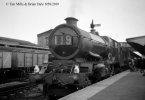
King 6022 King Edward III at Swindon complete with admiring observers in May 1958 as seen previously in post #3995. 6022 was allocated to Old Oak Common in October 1955 and is carrying the appropriate 81A shed plate in the photo. It next went to Stafford Road from July 1959 and was withdrawn in September 1962. (SLS). It was sold for scrap to Cox and Danks at Oldbury in early June 1963. (BR Database).

img009 TM Large Format poss 6022 Swindon May 58. Remasked. B copyright Final.jpg

Brian
 
Last edited:

Martin Shaw

Western Thunderer
Brian
Re #006, I don't think either of the engines pictured is a J69, the arched rectangular windows in the cab side and back sheet dictate otherwise. The Braintree engine on the left could be either a J68 or an F6, most likely the latter I think. The Maldon engine on the right has eight wheels and can only be an F6, 67227/30/37 are all known to have worked over the branch so I suspect one of that trio. Officially they were barred from Witham - Maldon services but pragmatism inevitably won, although they were some 14 tons heavier than a J68.
Martin
 

timbowales

Western Thunderer
Thanks for the info about the condensing tank at Caerphilly, Arun. That's extremely useful confirmation.

Dave @Yorkshire Dave . Once again you've come up trumps with the info about the tube stock. That's a very concise and complete history in very few words for which I'm grateful.

A3 60060 The Tetrach at Hornsey in July 1961. The loco was allocated to Darlington in December 1960, Gateshead in July 1961, Heaton in October 1962 and Gateshead again in July 1963 where it was withdrawn in September the same year. It went in to Darlington Works for cutting up on 11th October 1963.

View attachment 237633

This atmospheric shot is one of the very earliest of Tim’s photos and of what I believe to be J69 0-6-0 tanks on the Witham Branch in July 1954. Tim recorded them to be Maldon and Braintree locos.

View attachment 237634

A4 Sir Charles Newton at Hornsey in July 1961. The loco had been allocated to Gateshead when new in June 1938 (BR Database) then moved to St Margarets in November 1963 and Aberdeen Ferryhill by December the same year (SLS) for use on the 3 hour expresses from Aberdeen to Glasgow. It was withdrawn from Ferryhill in March 1964 (SLS) and was scrapped at Campbells, Airdrie, in June 1964. (BR Database)

View attachment 237635

Hornsey in July 1961 and this is V2 60956. It was based at New England from July 1960 and was withdrawn in September 1962. (SLS). It went in to Doncaster Works for scrapping on 11th December 1962. (BR Database).

View attachment 237636

King 6022 King Edward III at Swindon complete with admiring observers in May 1958 as seen previously in post #3995. 6022 was allocated to Old Oak Common in October 1955 and is carrying the appropriate 81A shed plate in the photo. It next went to Stafford Road from July 1959 and was withdrawn in September 1962. (SLS). It was sold for scrap to Cox and Danks at Oldbury in early June 1963. (BR Database).

View attachment 237637

Brian
Once again the interesting stuff (to some of us!) is not the King but the 20T Loco Coal wagon on the through road :)
 

John Palmer

Western Thunderer
The loco coal wagon in img009 appears to be one of the LMS D1973 variety, judging by the steelwork added to the corners and T stanchions – I've always assumed these were intended to provide some bodywork protection when the wagon was on a mechanical coal tippler, but can anybody confirm this?

Although I thought of the 'Castles' as being better proportioned, what an impressive machine was a 'King'! The subject of this photograph, 6022 King Edward III, was in 1947-48 the trials locomotive for the four row superheater subsequently fitted to other class members. I understand that this venture into high degree superheating was to assure satisfactory perfomance in the absence of Welsh coal, the availability of which was no longer a 'given' in the post-war world. Increased steam temperature called for better control over cylinder lubrication arrangements, as reflected in the mechanical lubricator that can be seen in the photograph adjaent to the smokebox on the driver's side. This, too, was a development first trialled on 6022.
 
Top