Hi Martin,
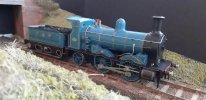
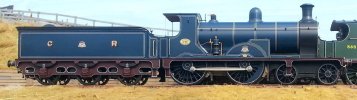
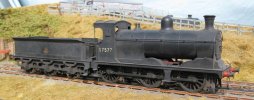
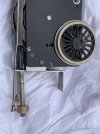
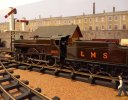
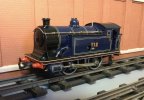
Thanks for your kind words, the three locos are S7, first two are scratch built and the 812 started from a Meteor models kit.
When I hold my IPad against the Dunalistair the model is much darker than the image on the screen but I have a lot more pictures of the same engine and they vary in shade. Photographs and screens do not always portray colours accurately
At the time that Basset Lowke we’re producing their models there were virtually no colour pictures around, the Railway Magazine did colour plates, and few of their customers would have seen the real thing. As all 5 of the BL Caley locos were commissioned I would expect that they would specify the finish and probably supply colour swatches and possibly the paint. Whether or not they had consulted the Caledonian as to accuracy we will never know but consistency of colour across BLs range would be important. I am of the opinion that most buyers would be happy to accept the colour as supplied, they did after all accept a lot of compromises in outline and details which modellers now are much less likely to.
Jim MacIntosh in his book is very careful not to specify an exact shade but places lots of information, both descriptive and pictorially, to the reader to let them make up their own mind. At this advanced date who can say we didn’t get it right?
Most of my own model production is of G&SWR subjects of which there is very little source material, especially on colours. We do know that dark Green predominated with Crimson lake valances. I long ago decided on a shade of green which appeared to me to fit with what descriptions I have found. Not everyone agrees with me but in recent years I haven’t met anyone who actually saw an engine in G&SWR livery and knows better! I do however take pains to ensure that the appropriate parts get green or red or whatever but l don’t loose sleep over it.
I suggest you do the same and choose the paint colour you are happy with.
Ian
Hi again Ian
Ultimately of course you are correct. There are no eye-witnesses left. Establishing the colour with absolute certainty would require either finding the paint recipe or an unambiguously authentic paint sample. Neither seems likely.
For 828, like many models of pre-grouping locomotives, Tom and I have had to rely on ‘most likely’ or ‘probable’ for some details on the model. Features that changed on the real locos c.1915–23, for example. In the absence of a photograph of 828 from a particular angle at the relevant period, some things had to be inferred from photos of other class members or from different times. No doubt you have often had to do this yourself. We have tried very hard, using the best available evidence, to be as accurate as possible.
The colour of the loco is clearly one of its most obvious characteristics. It’s not like putting a rivet in the wrong place — you can’t miss it. So, in the absence of unambiguous fact, best available evidence is the best we have. We need to use that.
I’ve read/consulted Jim MacIntosh’s book. As you say, a huge amount of information is presented. None of it definitive. But there is a complete blind spot regarding contemporary mass-market railway models. I think they are actually the best evidence we have.
You comment that Bassett-Lowke may not have been too careful to get the colour right as there were a lot of other compromises in the outline and details of their models which wouldn’t be accepted now. Of course, standards have improved enormously over the last 100 years. But assessing a pre-WW1 model on current criteria is like judging the conduct of a mediaeval king according to modern day morality and behavioural norms. The king is not going to look good even if he was very enlightened for the time, and striving to do right.
Bassett-Lowke was a business that needed to trade profitably. It was selling sophisticated toys for adults to the well-educated, better-off members of society. People who were interested in real railways and who used them. The firm could only manufacture using the technologies of the time. Electricity was often not available so power was usually clockwork or steam. Both these methods of propulsion introduced unavoidable compromises into the appearance and proportions of models. Since permanent model railways were rare, models had to be able to run on temporary tracks laid on a table or floor. So sharp radius curves — more compromises. Uneven floors — so big flanges, more compromises. The departures from true scale in the models made should not be viewed as incompetent mistakes or indifference to accuracy. That would be to interpret the models against present day expectations and circumstances. The compromises were there for a reason, one in the pre-1914 world — whether that was the track, the method of propulsion or production at a price the market would bear. Within the envelope of what was practically and economically possible, the pre-WW1 models sold by Bassett-Lowke (especially those designed by Greenly and made by Bing) were as accurate as they could be. That mattered to Bassett-Lowke and to the company’s customers. It was what distinguished the scale models in Bassett-Lowke’s catalogues from the toys sold by others.
Colour and livery were one area where models could be very true to reality — so they were. For well known liveries such GNR, Midland, NER, SECR etc etc etc, the Bassett-Lowke models of the time are generally acknowledged to be in correct colours. Having got the others right, why would the Caledonian models, uniquely, be painted in some random shade? I’m sure they weren’t.
So what was Caledonian blue? As it happens, I was able to examine a Bing made CR model today. A Gauge 1 model of CR no.142 belonging to a fellow enthusiast. The model was made between 1910 and 1914. It was an expensive model for adults (most children would not be strong enough to wind it up). To make something this good and not bother to get the colour right seems utterly implausible.
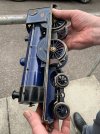
The model is quite thinly varnished. Where the varnish is thicker, such as around the base of the dome, the colour has darkened more.
The underside is not varnished, and is a lighter/brighter shade:
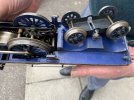
I think the photo shows the colour accurately.
My 112 tank (post WW1) is a closely similar colour underneath but much darker on top as it has a very thick coat of varnish.
Even in the photographs above, where the light has fallen differently on the different surfaces, the colour looks different. Looking at the underside of no.142, ‘sky blue’ does seem a reasonable description. The model of no.142 today was sat next to a model of GER 0-6-0. That really was
dark blue.
I do note that the number plate has a red background — which other evidence suggests is wrong or was not usual with the lighter blue. Could the above engine be in the darker blue livery, i.e. correct but out of date? I don’t think so, but can’t 100 per cent rule that out. Bassett-Lowke’s range of scale models did not really get going until after the CR livery change. The colour shown above was still being used on models made in the 1920s. If just shown the colour in isolation, I think I would call it a mid-blue.
In terms of interpreting contemporary photographs, which often make CR locos look a really pale colour, there is a good check on the website of the Brighton Toy and Model Museum here:
www.brightontoymuseum.co.uk
Look at the colour of the model of Cardean as we see it today, the colour it really is. Then look at how it appears in the 1910 photograph of the same model. Not the same shade at all, but much, much paler. So the evidence there is clear too. In a proper controlled test, the pre-WW1 photograph compared to reality, the photograph has significantly misrepresented the colour. We can’t make that comparison with a real locomotive but the model is a good substitute.
So, I think there is a very strong case — best available evidence — for the colour on the underside of no.142 shown above to be post-1906 Caledonian blue.