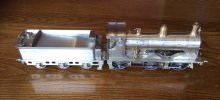
I referred above to a short break from doing any actual modelling. One reason was a visit to the North-west to see 828:
View attachment 240142
Also, to discuss with Tom Mallard a future project.
828 is indeed wonderful but there is no point in repeating comments and information already posted in Tom Mallard’s workbench thread. What I would add is that the process of building a new clockwork model using a pre-WW1 motor is akin to experimental archeology — an approach to understanding how people did things in the past by trying to replicate what they did to see what works.
I have previously described the various 0 gauge scale-model tank engines designed by Henry Greenly, made by Bing and retailed by Bassett-Lowke in the years just before the First World War (see my post #92). There were also tank locos made in gauges 1 and 2, including prototypes not offered in 0 gauge. In the same range of models, in 0 gauge, there were five express locos made with clockwork or electric motors; a Midland Railway ‘999’, GWR ‘City’, LNWR ‘George the Fifth’ (also available as ‘Queen Mary’), Caledonian Railway ‘140 Class’ and GNR large-boilered Atlantic. Two further 0 gauge 4-4-0s were available, but in live-steam — Midland Railway ‘Compound’ no.1000 and LNWR ‘Jubilee’ no.1902 ‘Black Prince’. Most of the 0 gauge models were similarly made in Gauge 1, but not the GWR City and MR 999. In Gauge 1 only, the MR Compound no.1000 was produced in live-steam and clockwork versions. A live-steam version of the GNR Atlantic was offered in Gauge 1, also in live steam a Claughton, LTSR 4-4-2T and GWR ‘County’. Clockwork and electric models offered in the larger gauges (but not made in 0 gauge) included a GNR 0-6-2T, LNWR 4-6-2T, L&YR ‘Dreadnought’ and GCR ‘Sir Sam Fay’. One clockwork 0-6-0 tender loco was offered in 0 gauge (LNWR), two in Gauge 1 (LNWR and MR).
It’s easy to look at surviving examples of the models listed above and just admire the wonderful workmanship and artistic portrayal of the prototype. The models were necessarily simplified and lack many details, but generally capture the overall proportions and essential character of the real locomotive. Comparing these models with modern manufacture is perhaps like the difference between a painting of something and a photograph. What I have not previously understood well was
how these Greenly designs managed to be so successful at capturing the look of the real locomotives. Which is where the experimental archeology comes in.
At a time before many homes had electricity, most model railways relied on clockwork for their operation. Fitting a clockwork motor with a large spring into a model locomotive is not easy. It was a huge challenge with 828. The spring has to fit in the space between the driving wheels and the top of the boiler/firebox. Prototypes with high-pitched, large-diameter boilers and/or Belpaire fireboxes are therefore preferable. Small-diameter driving wheels give more headroom above the axles for the spring. Side-tanks are good too because they disguise the lack of daylight under the boiler. For a planned future project, when trying to work out what would make a suitable prototype for a really powerful shunting locomotive, I ended up searching for something with all the ‘helpful’ characteristics just mentioned. The thought process of trying to work out how to accommodate A REALLY BIG SPRING in a realistic, accurately proportioned model highlighted that prototype selection was all-important. Once you start to think about how to build one, it is very clear that only some prototypes are suitable for a clockwork model.
Another difficulty with model railways in the pre-WW1 era was the extremely tight radius of curves then generally available. To be of any practical use, an 0 gauge model, for example, had to readily run on 2’ radius track. So the lateral displacement of bogies and pony trucks on model locomotives was enormously greater than in real life. Again, this requirement makes an accurately proportioned model an impossibility for many prototypes — for instance, many locomotives with leading bogies and outside cylinders and valve gear.
The design of 828, working out how to fit the motor into a previous ‘new build’ clockwork locomotive and planning for a future construction have all contributed to my understanding what makes a good prototype for a clockwork model. If I apply what I have learnt from those projects to the pre-WW1 range of locomotives sold by Bassett-Lowke, I think I can see a similar thought process at work. The models were good because the prototypes were chosen so the models could be good. With just two exceptions, all the clockwork/electric locomotives with leading bogies had inside cylinders — so the bogie wheels could be of close to scale diameter despite the requirement to traverse very small radius curves. The exception in 0 gauge — Ivatt Atlantic no.1442 — was a celebrity locomotive, the GNR royal train engine that was exhibited at the Imperial International Exhibition at White City in 1909; presumably, the commercial desirability of offering a model of this engine outweighed the compromises required to produce a working model. By contrast, out of practical necessity, all of the live-steam models were of prototypes with two outside cylinders. For these models, to be useable on tinplate track, the bogie wheels were unavoidably under-size. Bassett-Lowke acknowledged this in catalogue descriptions and could supply scale-sized bogie wheels in Gauge 1 for customers using only larger radius curves. Of course, starting with the 0 gauge ‘Royal Scot’ in 1929 and through the 1930s, when outside cylinders and generally outside valve gear became the norm for large, modern express locomotives, Bassett-Lowke sold many models with undersized wheels on the leading bogie. But pre-WW1, when modern express locomotives could have either inside or outside cylinders, Bassett-Lowke (or perhaps Henry Greenly) chose types with inside cylinders for their clockwork/electric models with leading bogies, types with outside cylinders generally only for live-steam models. With the benefit of having had to puzzle about how I could potentially fit a clockwork motor into various possible prototypes, I think I can see that the same considerations contributed to the choices made by Bassett-Lowke pre-WW1. Sure, models had to sell, so they had to be up-to-date and be of prototypes belonging to major railway companies, but they also had to have enough room in the boiler/firebox for the motor. Of the 0 gauge express locomotives offered, two had Belpaire fire-boxes, the other three had large diameter (for the time), high-pitched boilers.
Maybe I have been rather slow here and should have realised sooner just how much careful thought was given to prototype selection for the range of Greenly-designed locomotives Bing made for Bassett-Lowke. For me, understanding has come from the process of trying to work out for myself how to make an accurately proportioned clockwork model to run on tinplate track. A realisation that when I was dismissing potential prototypes as unsuitable, because a realistic model was not possible due, for example, to insufficient room for the spring in the small boiler, or the track curvature, this had been done before. A similar process of choosing what to make, for the same reasons, must have taken place at Bassett-Lowke’s when their pre-WW1 range of scale model-railway locomotives was decided.