
daifly
Western Thunderer
How does one proint?Nice to see someone else prointing the hooks on the brake block for the wheel flange....
Dave

How does one proint?Nice to see someone else prointing the hooks on the brake block for the wheel flange....

I'm glad some one has asked.How does one proint?
Dave

I you want to proint them matching to Slaters wheels, you can take these from the resources library.I prointed my brake blocks with the hooks, but ended up removing them as the clearances were just too tight, and they caused binding.

I should have credited @michael080 as I cheated by using the blocks he's uploaded to the resource area, I practiced my 3D modelling skills on the centre yoke which includes a small amount of twist in the outer bushes so the push rods have a little dihedral when fitted rather than being completely flat.Nice to see someone else printing the hooks on the brake block for the wheel flange....

Thanks Michael,I you want to proint them matching to Slaters wheels, you can take these from the resources library.
RCH brake blocks

I'm at a similar stage on my Macaw build, converting a rather flat etched brake and rods into something more 3dimensional and insulating.
View attachment 255978
my Serpent has no suspension.
I'm sorry, this made me giggle.

Our council has just spent some money repainting bus stop signs and road lines.
On a route that has been closed for at least five years…


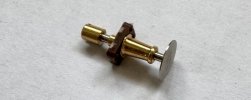
I can see this is a devil of a kit to build - being polite here.I've been feeling guilty about not reporting progress on my model of the Serpent - the original idea between Richard and me was for a 'parallel build', but Richard's model is close to finished and mine is still a pile of pieces on the work bench.
I can see this is a devil of a kit to build - being polite here.


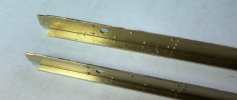
Keep going Nick, keep fighting the dragon, you'll get there in the end.So - the bullet has been bitten. I‘ve filed off the tabs that locate the solebars on the floor, so I can reposition them about a millimetre further inboard. I have also reduced the depth of the bottom flange on the solebars.
I won’t be the first to point out that often the hardest part of a particular operation to shape material is working out how to hold it. In this case, I had that problem, and the question of how to file an equal amount off the flange along the length of the solebar. I solved both these problems with this - a piece of aluminium sheet screwed to a piece of wood:
View attachment 256120
The solebar was trapped between the aluminium and the wood, as you can just see along the far edge. The second solebar is sitting loose on top so you can see the orientation.
The wood was clamped to the bench, so the piece was solidly supported for filing. The thickness of the aluminium was just right so I could file the solebar flange down to the level of the aluminium and get a consistent flange thickness:
View attachment 256121
And here we are - you can see how over-sized the flanges were originally:
View attachment 256122
I suspect the kit designer deliberately made the flanges over-sized, to make them easier to fold. Even with bending bars, scale flanges would be very tricky to fold.
Onwards and upwards…
Nick.
Keep going Nick, keep fighting the dragon, you'll get there in the end.

Rather like the content of the book / movie "How to tame a dragon".Keep going Nick, keep fighting the dragon, you'll get there in the end.