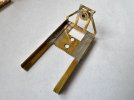
A Tale of Two Serpents

Wheelsets (Nick)
  • magmouse

    Western Thunderer
    I've started by a good look at the instructions and the kit components, to see how the kit is supposed to go together. I've also spent a bit of time looking at prototype photos and the GA drawing (sourced from the National Railway Museum, drawing 8209W of 1889, when these wagons were built). I always find it helpful to understand how the prototype was constructed. In this case, the drawing reveals how the floor of the kit has been simplified, so there is an opportunity to make the model more accurate - more on that when we get to it.

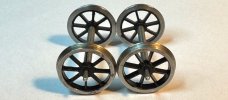
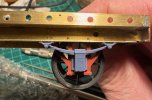
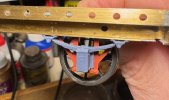
    I've also started preparing the wheels. These are Slaters 8-spoke wagon wheels to S7 standards. With these, I use a sharp scalpel to chamfer the back edges of the spokes and rim of the wheel. This helps give a more delicate silhouette to the wheel - the effect is subtle, but worth it in my opinion.

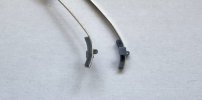
    Here is the back of the wheels, modified on the left and unmodified on the right:

    IMG_6704.jpeg

    And this is what it looks like from the front - again, modified on the left. The rear wheels are unmodified in this picture.

    IMG_6702.jpeg

    Thanks to Mike Osbourne (@Airnimal on RMweb) for this tip.

    Nick.
     
    Preparations, especially corrected curb rails (Nick)
  • magmouse

    Western Thunderer
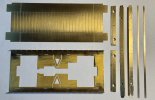
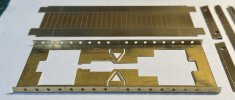
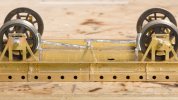
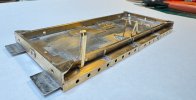
    Over the last couple of days I've spend a bit of time preparing some of the main etched parts of the kit - removing the tags, cleaning up the etch cusp, pressing out the rivets using my rivet press, and doing some of the main folds on solebars, headstocks and sides:

    IMG_6710.jpeg

    Now, if I were committed to building the kit as designed, I'd be pretty happy. With a bit of fettling the main parts look like they'll fit together, and everything is neat and tidy.

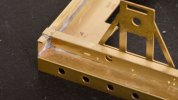
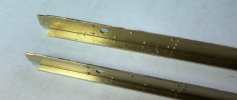
    However... as I've worked through the various parts and examined the GA drawing further, a number of issues have emerged. Firstly, the holes along the side rail are quite a bit too small, so I drilled them out to a scale 3 1/2 inches. I did this with a drill in a pin chuck, as I was concerned using the pillar drill might shift the holes off centre. Doing it by hand meant I could make sure the drill was centring itself in the existing hole. I drilled in from both sides to avoid tear-out as the drill came through. You can see the size difference here - half the top holes are done in this picture:

    IMG_6707.jpeg

    As you can see, it makes a significant difference.

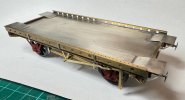
    The next issue relates to the floor. The prototype has iron plates at the sides of the wagon, and a wooden floor in the middle. Both ramp up slightly at the ends to get over the buffer heads. The drawing shows that the plates sit on the under frame, and the wooden boards sit on top of that. The kit uses a single piece of brass for the floor, so you don't get the height difference. My initial plan was to make the planks from plasticard and attached that on top - nice and simple.

    Further study showed other inaccuracies. The etched outlines of the planks are too wide, so new correct-width planks wouldn't cover the etched lines. Also, the length of the projections over the buffers and the ramped section are incorrect. On the prototype, the flat section of plate work goes all the way to the end, with the ramp a separate piece on top, so there should be a visible edge (but not fasteners - the drawing shows countersunk rivets).

    The upshot of all this is that I will use the floor component upside down to make a flat floor, and built up the ramps on top, so I can get the sizes correct and a visible edge where the ramp meets the flat part of the floor. The planking will be done in plasticard. The drawing shows an interesting feature with the planking - it has a small gap (about 1/2 inch) between planks, through which daylight should be visible, as there is no metal plate down the centre of the wagon. I've decided to draw the line at achieving the daylight...

    Along the top of the side rails are a series of holes, used to locate the bars that go across the wagon to chock the wheels of the load. The kit has etched holes, which need drilling out to clear them properly - easy enough. However, the kit has holes almost the full length of the wagon, whereas the drawing has not holes in the centre, only at either end. However, the holes don't go far enough to the ends of the wagon.

    I have added three holes at either end, and only drilled out a total of 16 holes at either end of the wagon. The undrilled holes will need filling with solder and making good when this part is assembled - see the parts on the right of the first picture in this post. Even with this change, the holes will be wrong, as the kit has them too far apart (2.5mm, when it should be 2mm).

    Finally (for now!), The headstocks have a horizontal etched line. I assume the kit designer believed the prototype had a 9 inch deep headstock (the same as the solebars) and then another component on top to make the 12 inch height needed. The drawing shows this is a single C-section part, 12 inches deep, providing the 3" projection above the top of the solebars, so there should be no line there. I plan to fill this etched grove with filler after assembly.

    This has all been a bit frustrating, because what is a good kit in terms of the accuracy of the parts and a logical way of building up the wagon from etches has turned out to be inaccurate in various ways. It seems like every time I look at the drawing, I find something else that will add to the total amount of work to be done. I can only assume the designer didn't have the GA drawing I am looking at.

    Anyway - onwards and upwards!

    Nick.

    PS - there won't be much progress next week as I am away for a few days. It'll give time for Richard to ponder whether he wants to make the very rational decision to build the kit as designed and get a model that captures the prototype overall, or follow me down my rabbit hole of lunacy...
     
    Introducing the lower and upper floors (Nick)
  • magmouse

    Western Thunderer
    might the answer be to make a new floor?

    No, because the kit has in effect two ‘floors’. The upper one has the etched lines denoting the planks and intended to form the ramps at either end. This could be replaced. However, the lower floor is internal with the sides (the parts pierced with multiple holes) - this bit:

    IMG_6712.jpeg
    This lower floor has slots into which the solebars fit. Of course, one could cut the sides off and attach it to a new structure….

    At this point, it’s a question of how much of the kit I’m prepared to throw away to be replaced with a scratch build. And is daylight through scale 1/2 inch gaps in 2” thick planking worth it???


    What thickness is the wood for the planks? I have some birch ply at 0.8mm and at 1.5mm thickness if that helps.

    2 inches. Thanks - I’ll bear that in mind and let you know when I have a plan…

    Nick.
     
    Lower floor (Richard)
  • RichardG

    Western Thunderer
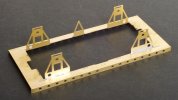
    My first impression is, this kit has been designed carefully and presented well. The etching process has left very little cusp to be removed from the edges. At a glance, the tabs and slots for the solebars seem to line up and so I am optimistic the parts will go together without too much butchery. The half-etching goes quite deep and it is easy to bend parts too far. The numbering of parts is peculiar, I haven’t found ‘1’ yet and the lower floor (which forms the core of the whole model) is ’12’.

    I could set out a list of objectives here. But really, I am building this to simply make myself another foreign wagon for my layout. So for now, I will say simply that my model will be for finescale 0 gauge, with a rigid chassis. My NER Lomac L (Connoisseur Models) has a longer wheelbase and it runs fine, so I see no need to over-complicate things here. I want to represent a wagon running from 1906 through to 1912, so there will be brake gear on one side and oil axle boxes. I have started with part 12.

    DSC_1691.jpeg
    I have opened out all of the holes along the sides. Doing this alone is going to make for a much better-looking model. I took the precaution of using a brand-new 2 mm bit, and then set to work using the pillar drill. Like Nick, I worked at the holes from both sides, and I didn’t get any tearing either. Then I lopped out most of the middle section, just in case I can arrange for some daylight between the planks. This will be easier with no compensation units to block the view.

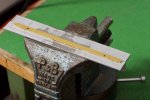
    I don’t have any folding bars so I improvised using two lengths of aluminium L section clamped in the vice to help me to form the sides.

    All four W irons are the same height, so there is a chance of the model ending up flat, and I won’t be breaking them off and re-attaching them as with the Meteor mobile crane.
     
    Solebars (Richard)
  • RichardG

    Western Thunderer
    our increasingly poisonous-looking Serpent

    On the bright side, the solebars seem to fit really neatly. The half-etched marks for the bolts and rivets are nicely small, so the punch is a snug fit inside them and a row of three indentations comes out in a straight line even for me.

    DSC_1696.jpeg
    Improvised folding bars. I also used these to fold up the sides of the lower floor.

    DSC_1699.jpeg
    For the side of the wagon without brake gear, there are two tiny slots in the solebar to be filled in. I struggle with parts this size so I solder in something overlength, then cut and file flush on the inside.

    DSC_1704.jpeg
    For the side with brake gear, I used the unwanted vee hanger to double up the thickness of the one retained.

    Having put the solebars into place, I find it much easier to comprehend what the headstocks ought to look like, how they might attach to the model, and why the kit parts are wrong.
     
    Headstocks (Richard)
  • RichardG

    Western Thunderer
    DSC_1711.jpeg
    The kit headstocks are not completely wrong. The three holes are in the right place, so I used one of them as a drilling template. My new headstocks are from 6.35 mm (“1/4 inch”) strip, with a bottom flange 0.5 mm thick. The lack of the top flange will never show after the upper floor is in place. (yes it will! - 17 Jan)

    DSC_1726.jpeg
    The two rebates in the ends of the solebars are unwanted. A horizontal slot to accept the flange on the headstock would be better but we don't have one of these. So I have patched things up with scrap brass. This is my better corner.

    The new headstock sits higher than the kit one, but the floor still does not obstruct the access for the buffer stocks or the coupling. Maybe I can find a brass washer to fill the gap between solebar and W iron :rolleyes:
     
    Last edited:
    Upper floor and access ramps (Richard)
  • RichardG

    Western Thunderer
    I am making progress, but not without quite a lot new parts.

    For my purposes,
    • The upper floor panel is unsuitable because the planks are too long.
    • The four ramps (on the corners of the upper floor) are unsuitable because they are too narrow.
    • The strips for the tops of the curb rails are unsuitable because they have too many holes and the holes are at the wrong pitch.

    DSC_1765.jpeg
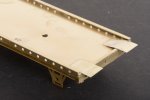
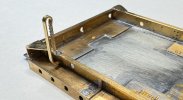
    I have worked up the deck of the model using most of the upper floor panel (this installed upside-down) and new parts made from brass. The hole is for a M4 bolt to connect the RSU.

    The top surface of the upper floor is about 0.5 mm higher than it ought to be, but I cannot see a way around this without rebuilding the entire underframe and the curb rails. I know that two wrongs don’t make a right, but I have added some shim strip to make the headstocks about 0.4 mm too tall, so the end ramps have something to climb over.

    The ramps are from 0.3 mm brass sheet, this is the thinnest I have to hand.

    The tops of the curb rails are plain strips because I would rather have no detail than wrong detail.

    DSC_1755.jpeg
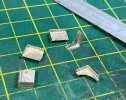
    The half-etched bolt detail on the ramp brackets is on the wrong side, and so the parts will not fold up into shape with the embossed detail on the outside.

    DSC_1757.jpeg
    So I am adding the brackets in pieces.

    DSC_1758.jpeg
    This is a temporary piece of 1.6 mm plywood. The individual planks are too broad but the photo shows the general appearance.

    The plywood is close to the scale thickness of the planks and so, like the upper floor, its top surface is about 0.5 mm too high. If I look through the holes in the curb rails, I can see the top of the ply is just above the centres of the holes, while the GA shows it to be just below them. But the three-dimension shape is about right.

    Right now, my model contains six brass parts from the kit (four of them modified) and 16 new parts I have made myself.
     
    Headstocks and buffers (Nick)
  • magmouse

    Western Thunderer
    I've been feeling guilty about not reporting progress on my model of the Serpent - the original idea between Richard and me was for a 'parallel build', but Richard's model is close to finished and mine is still a pile of pieces on the work bench.

    This is party because I was away the week before last for work, and I've been busy with other things, but also... every time I decide to do a bit of this kit, I find something else wrong with it. This morning's irritation is the discover that the solebars are too far apart, and the flange on the bottom of the solebars is too deep. The result is the overhang of the sides of the wagon relative to the solebars is visually too little.

    It gets worse - the Slaters axle guard units I was planning to use turn out to be too narrow. Combined with the solebars being too far apart, this would leave a huge gap between the back of the solebar and the front of the axle guard, which in turn would make it impossible to get the axle boxes and springs to sit correctly. You will appreciate that there has been quite a lot of dark mutterings to be heard at Chateau Magmouse...

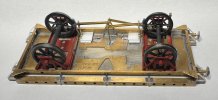
    So, right now, I am reviewing various options to resolve these issues. A small amount of progress has been made in the shape of two new headstocks, to replace the kit ones which have an unwanted etched line down the middle, the buffers and couplings at the wrong height and no top flange:

    IMG_6793.jpeg

    The small holes are for 0.6mm wire to represent the rivets that attach the corner plate connecting the headstock to the solebar on the prototype.

    One curiosity that has emerged from studying the photos and the drawing relates to the buffers. At first glance, these seem to be standard wagon buffers of the period. However, the drawing shows the cast guides have a packing piece between them and the headstock. The overall length of the buffer is still the usual 1'6", but the guide is effectively longer, with less of the head protruding out. The drawing shows why - with its packing piece, the guide sticks out a tiny bit beyond the ramp extensions that go over the buffers to allow a road vehicle to be end loaded. This means that if the buffer is fully compressed - say in a rough shunt - the back of the head hits the guide before it hits the ramp extension. Without the packing piece, a full compression of the buffer would result in damage to the ramp.

    Happily, all this can be nicely represented with a combination of Peco GWR sprung buffers, and plastic moulded buffer bases from Slaters, left over from one of their GWR wagon kits:

    IMG_6792.jpeg

    That's progress of a kind, I suppose...

    Nick.
     
    Solebars (Nick)
  • magmouse

    Western Thunderer
    So - the bullet has been bitten. I‘ve filed off the tabs that locate the solebars on the floor, so I can reposition them about a millimetre further inboard. I have also reduced the depth of the bottom flange on the solebars.

    I won’t be the first to point out that often the hardest part of a particular operation to shape material is working out how to hold it. In this case, I had that problem, and the question of how to file an equal amount off the flange along the length of the solebar. I solved both these problems with this - a piece of aluminium sheet screwed to a piece of wood:

    IMG_6800.jpeg

    The solebar was trapped between the aluminium and the wood, as you can just see along the far edge. The second solebar is sitting loose on top so you can see the orientation.

    The wood was clamped to the bench, so the piece was solidly supported for filing. The thickness of the aluminium was just right so I could file the solebar flange down to the level of the aluminium and get a consistent flange thickness:

    IMG_6805.jpeg

    And here we are - you can see how over-sized the flanges were originally:

    IMG_6802.jpeg

    I suspect the kit designer deliberately made the flanges over-sized, to make them easier to fold. Even with bending bars, scale flanges would be very tricky to fold.

    Onwards and upwards…

    Nick.
     
    Brake gear (Richard)
  • RichardG

    Western Thunderer
    . . .

    View attachment 255949
    Infuriatingly, the lack of refinement continues to the end. The castings for the brake gear are too shallow and too short. I want brake gear on only one side so I can try for a cut and shut job.

    I have written to Ennis75 to see if they can supply a better casting.

    DSC_1794.jpeg
    I have received a reply from Ennis75 along the lines of "we will look into this" so I have built a set of brake gear using a cut and shut job on the two castings supplied in the kit.

    The brake shoes are filed down to resemble the profile of the ones shown on the GA. They looked a bit undernourished afterwards so I padded them out with styrene. This means the curvature is slightly wrong, but the fit is better than seeing daylight here! The brake hangers no longer line up with their fixings on the solebar either but this is a consequence of making the most out of the parts supplied in the kit.

    I have straightened up the dodgy bracing struts seen in my post this morning. This leaves me to glue on the spring/axlebox castings and sit back and watch Nick's model take shape. What a game this kit is turning out to be!
     
    Final useful photo before abandonement (Richard) New
  • RichardG

    Western Thunderer
    DSC_1797.jpeg
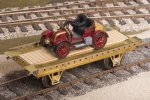
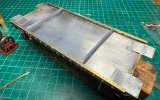
    Anthony Garten (Poppy's Woodtech) has made me this plywood panel to represent the planked part of the deck. The Renault is just about wide enough to straddle the scale 3ft 6in boards.

    To recap slightly, the top surface of the upper deck (the brass sheet here) is about 0.5 mm higher than it ought to be. I have made new headstocks, which sit close to the right place relative to the solebars but not relative to the deck. And so, I have added some 0.4 mm shims on top of the headstocks so the ramps have something suitable to climb over and look the right shape.

    On the prototype, the GA shows the planks were about 51 mm thick. This scales to 1.2 mm. The boards at each end were wedge-shaped so they climbed to finish level with the tops of the headstocks. I am simplifying things by using a piece of 1.5 mm ply, which finishes level with the tops of the headstocks without needing to climb at the ends.

    The excess thickness (0.3 mm) will be harder to see when the edges of the ply are coloured to match the top and indeed when the wagon is carrying a vehicle.
     
    New axleguards (Nick)
  • magmouse

    Western Thunderer
    Well, the fight taming continues...

    As mentioned in an earlier post, the prototype appears to use axle guards of a type intended for 3'7" wheels, thereby reducing the distance from axle centre to solebar. This in turn lowers the floor by an inch and a half, gaining a little height for the load.

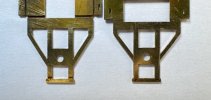
    I also mentioned that I had decided to use a set of etched axle guards from Slaters - originally intended I think for MR fitted vans, I think. As @Overseer pointed out, these might not be quite right, and sure enough, a check against the drawing shows that the angled parts were at the wrong angle. So, I cut through the angled part at the bottom, parallel with the vertical, filed a bit off the end, bent it to a less steep angle, and soldered it back into place.

    Here, on the right, the cut, and on the left, bent to the correct angle, ready for filing:

    IMG_6837.jpeg

    This comparison shows the difference - a noticeable and worthwhile change, I feel:
    IMG_6833.jpeg

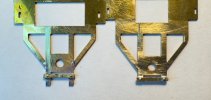
    Once filed, the joint was soldered. The keeper also needed moving up, so these were cut off the etch and soldered back in the right place - seen here before and after cleaning up:
    IMG_6840.jpeg

    The next problem was that the Slaters units, if folded up as intended, would be too narrow. As well as the visual impact of this, it would mess up the relationship between solebar, axle guard , axle box and spring. I therefore decided to widen both the fixed and the rocking unit by cutting them up and soldering sections of brass angle to hold them together at the right width. The rocking unit had to be cut into three, to keep the slots for the attachment plate centred.

    IMG_6846.jpeg

    I will paint these before final assembly, and not attach them to the wagon until that is painted, so I don't have to worry about masking the wheels.

    Having widened the axle guard units, I needed to pack out the bearings using 5BA washers:

    IMG_6848.jpeg

    Naturally, the amount needed wasn't an exact number of washers, so I made some half thickness ones by soldering them to a bit of spare fret and filing them thinner - you can see that in the picture above, where the left hand one of the three is half thickness.

    A couple more pictures:

    IMG_6849.jpeg

    IMG_6850.jpeg

    At this point I was feeling I had just spent several hours sorting out issues with both the kit itself, and the Slaters parts... The modelling gods then decided I was complaining too much about the shortcomings of other people's work, and perhaps too self satisfied about my own. They soon found a way of putting me in my place. You may recall I had added a new nickel silver floor on top of the kit sub floor. I had removed the axle guards from the sub floor, thinking this would make space for the new Slaters units to attach directly to the underside of my new floor.

    Turns out - the Slaters units are too wide for the space left by the kit axle guards. After some wailing and gnashing of teeth, I considered my options:

    1. fill the space with some packing, and attach the Slaters units to that, raising the height of the wagon by 0.5mm. Sounds innocuous, right? However, the distance from the centre of the axle to the underside of the solebar was already 8.5mm against a prototype equivalent to 7.875. Worse, the kit solebars are about 0.5mm too deep, and of course the floor is 0.5mm too thick. All these half millimetres were adding up - and a defining feature of the prototype is the way it is designed to maximise the available load height.

    2. File some metal off the edges of the Slaters units - the amount needed wasn't much. The risk here was filing through the metal where the fold is, such that the strengthening ribs that run the width of the unit came away. Not a problem where I had already soldered the L section, but the side yet to be soldered has little metal to remove and still stay in one piece. I could of course file the corner off after final assembly, but at that point, there's a risk of damaging paintwork, and filling the bearings with brass filings. Possible, but unattractive...

    3. Mill out the unwanted material of the sub floor. Sounds easy - two problems. One - I don't have a mill. Two, on inspection, it turned out the floor had taken on a slight curve across its width, higher in the middle (when the right way up). I have no idea how or when in the process that happened, but there it was. So - the option was to use a small mill bit on my Proton pillar drill, with the wagon attached to the X-Y table, thus making a crude mill. With no very accurate vertical control, the risk was cutting into the 8 thou nickel silver floor, and leaving a witness mark on the other side - this compounded by the curve in the floor.

    Reviewing these options, I rejected (1) - if I was going to do that, I might as well build the kit as intended, and call it done. While the model will have compromises, I want to catch that 'like an ordinary wagon, but somehow a bit lower' character if I possibly can.

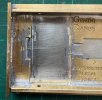
    That left 2 and 3. I opted for 3, with 2 as a fall-back. After some anxious moments, I was able to carve out enough space for the fixed axleguard unit (the rocking one doesn't need the clearance:
    IMG_6856.jpeg

    It is NOT pretty, and in one place there is the slightest of witness marks on the top face of the floor, but it will disappear with paint and dirt, I think. A useful reminder to me to think a bit harder before committing to soldering the top floor on - it would have been so simple to sort this issue while I could file the holes in the sub floor out bigger.

    So, the beast is still fighting back, but step by step it is coming under control....

    Nick.

     
    New axleboxes, springs, brake shoes, wheel chocks and floor panel (Nick) New
  • magmouse

    Western Thunderer
    Not enough actual progress on the model to be worth reporting (just preparing one of the detail parts), but two big steps forwards in the form of 3D printed bearing springs, axle boxes, brake shoes and wheel chocks courtesy of Chris @ChrisBr, and a set of laser-cut parts for the planked central section of the floor courtesy of Ian @ICH60.

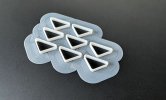
    The 3DP parts:

    IMG_6867.jpeg

    And a quick trial run of the axle boxes and springs - not fixed in place yet, so no need to worry about the off-centre spring.

    IMG_6869.jpeg

    IMG_6870.jpeg

    Because the final plank at each end has to slope up to meet the headstock, those are cut out separately, so they can be packed up 10thou or so and filed to a slope. Several end planks were cut of very slightly different widths, to allow the total length to be adjusted to be a perfect fit:

    IMG_6864.jpeg

    The laser cuts an approximately 0.3mm slit, just right for the 1/2" gap there should be between the planks. The material is 1mm basswood.

    The dark strip down each side is where a groove about 0.2mm deep has been cut, to accommodate a nickel silver strip to represent the iron strip of the prototype.

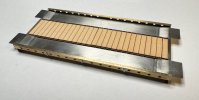
    The floor is in two parts, due to the material being too narrow to do it in one. Here are the parts roughly placed on the wagon, so you can see how it goes:

    IMG_6865.jpeg

    Nick.
     
    New ramp extensions (Nick) New
  • magmouse

    Western Thunderer
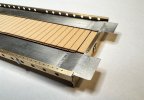
    I've been away for a few days, so not much progress on my Serpent. I have though made and fitted the ramps extensions - seen here with the laser cut wooden floor loosely laid in place to check the fit:

    IMG_6908.jpeg

    IMG_6905.jpeg

    IMG_6906.jpeg

    The ramp extensions were made of the same 8 thou nickel silver as the new floor - pretty much the correct scale thickness.

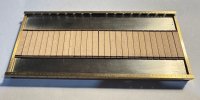
    I was going to fit the triangular brackets that support the extensions, but I found as Richard did that the parts supplied in the kit couldn't be folded up to actually make a right-angle triangle. I have been prepared to forgive the fact the material they are made from is a bit too wide (2mm, when it should be about 1.5mm), but since they can only be fitted but cutting them into parts and soldering back together (see Richard's post some way up-thread), I'll make new ones. This will give me the opportunity to use a correctly sized brass section, and hopefully get the slightly rounded bends shown in the drawing. I'm going to try 3D printing a jig. More work...

    Talking of more work - I had previously thought the triangular reinforcement plates that go where the solebar and headstock meets, and which the kit provides, were not needed. I couldn't see them in early-period photos or on the drawing, though they are visible in a later photo. However, closer examination of the drawing shows they are there, so I'll need to add them. The jury is still out whether I'll use the kit ones, or make my own from something closer to the correct thickness (the 0.5mm brass of the kit is far too thick). Tune in for the next exciting episode...

    Nick.
     
    New brackets for ramp extensions (Nick) New
  • magmouse

    Western Thunderer
    What Chris has said is the nub of the matter, you are going to have a fine-looking wagon although you and most of WT are going to be aware of deficiencies.... and at what cost? Just thinking here:-

    * how long would you take the second time around for that time difference represents the price of experience;
    * how long would you take to build the model from scratch?

    Rgds, Graham

    Second time round would be quicker, of course, but there is still a lot of process work that would need doing, even if I knew exactly what to do. A scratch built wagon could of course rectify many of the deficiencies this one will have - though the best thing if one were determined to get a really good model would be to create one's own etching. That could limit the errors in the overall height to 12 thou (the difference between the floor thickness of the prototype and the kit material, assuming 0.5mm brass) and fix the issues with headstocks, axle guards, size of holes in the sides, position of holes in the top of the sides, etc. Combined with 3D parts and a laser cut floor, this could result in a truly excellent model, and easier than a traditional scratch build. Anyone want a dozen of these???

    And in related news, talking of it being quicker second time round - I looked at the brass brackets I made over the weekend and decided they were too chunky and the corner radius was too much. It took me less than an hour to draw and print some -

    IMG_6918.jpeg

    You know what they say - hindsight is a wonderful thing...

    Nick.
     
    ( examples of silver soldered brackets for future reference ) New
  • adrian

    Flying Squad
    I haven't yet fitted the brackets - I'm nervous that if I try soldering them, the joint in the bracket will come undone, and they will spring open slightly. I used 188 solder on the brackets, so I could use 145 to attach them, which might work, but the headstock and everything attached to it make for a substantial heatsink. The alternative is to glue them on with epoxy once all the soldering work is done.
    For future reference another option would have been to silver solder the brackets - so no problem soft soldering them to the body. These are the footplate brackets I've been making for my Precursor tank. All silver soldered so I can spend as long as I want geting the positioning correct when soldering onto the chassis.
    silverSolder - 1.jpeg
     
    New brake gear (Nick) New
  • magmouse

    Western Thunderer
    So - what's happened since I last posted about the build process itself?

    The vee-hanger, cross shaft and tumbler assembly has been made up and soldered in place. The vee hanger is the kit's, the cross shaft is a couple of pieces of tube with 0.9mm wire through, and the tumbler is an Ambis part:

    IMG_6924.jpeg

    The inner end of the wire represents the single vertical support of the prototype.

    Next, the brake lever guard - this is from the kit:

    IMG_6925.jpeg

    IMG_6928.jpeg

    It fits nicely into the slots etched into the solebar, and makes up to a nice solid part. The ratchet isn't correct, as it should a flat section, not a T, but making these as per the prototype is rather tricky, as the metalwork has to have two 90-degree twists in it, above and below the ratchet. Anyway, this is all good, right?

    Well, no. The Curse of the Serpent struck again - turns out, the lever guard is in the wrong place, and would foul with the bearing spring shoe. Of course, I realised this after I had done it and was doing a quick check of how the springs fit with the axle guard units. So, the old guard had to be removed, the holes filled, new slots drilled and hacked out with the end of a sharp needle file, and a new guard made up and fitted, a few mm closer to the centre of the wagon. Luckily, I am modelling the wagon in earlier condition with single-sided brakes, and the kit provided for independent either side brakes, so I had a second set of etches for the lever guard.

    After that, I turned my attention to the brake gear itself. Chris @ChrisBr 's very lovely brake shoes were glued to strips of nickel silver. I filed a notch in the strip to accommodate the lug on the shoes where the push rods attach:

    IMG_6930.jpeg

    At this stage, the axle guards were not specifically located, which I needed to position the shoes. I used epoxy glue to attach the base of the rocking unit - glued rather than soldered as I needed the axle guard unit itself on the base in order to position it accurately relative to the solebars.

    I then used a Brassmasters axle spacing gauge to temporarily locate the second axle guard unit:

    IMG_6935.jpeg

    With this arrangement I could solder the brake shoes in place relative to the wheels, without the axle guard units being permanently attached - I want to keep them separate until the painting is done.

    I'm afraid I was rather remiss and didn't take pictures during the rest of the brake gear assembly, so this is a picture from later on that shows it:

    IMG_6953.jpeg

    Here you can see the metal strip of the brake shoes soldered in place, then plasticard built up over it to provide a flat surface to attach the safety loops, also folded up from nickel silver strip. The push rods are Ambis etches, attached at both ends with 0.45mm wire through the shoe lugs and the tumbler. Sounds simple when you say it like that, but it was actually a couple of hour's work at least.

    The brake lever is the kit component, so nice and easy. Well not quite - for some reason it is far too long. I cut it down and folded the loop for the handle myself, rather than using etched guide lines. I made a mess of the first one, so again it was fortunate I only need one when the kit provides two. I won't fix the brake lever until after painting and lettering, as there is lettering on the solebar and the lever would rather get in the way.

    IMG_6947.jpeg

    Also in the above picture you can see I have glued the triangular supports for the projecting ramps in place. I used the 3D printed jig discussed earlier to position them, and dropped a bit of thin CA in place on the end of some fine wire, allowing capillary action to draw it into the joint.

    IMG_6948.jpeg

    The buffers here are not yet fixed, which is why they look a bit droopy. Again, I'll leave these until after painting, as they'll get in the way of paint reaching the underside of the ramp extensions and the top of the buffer guides.

    Next, a little refinement especially for Adam @AJC - the top flanges of the solebars, represented by some 10x60 thou plastic strip glued on. Pretty much invisible from normal viewpoints, but I (and Adam) will know it's there...

    IMG_6952.jpeg

    So that's where I've go to. Next the wooden floor and the 'chocks' that sit across the wagon between the sides and restrain the load. Here's a couple more views:

    IMG_6949.jpeg

    IMG_6950.jpeg

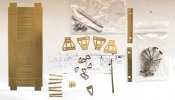
    And finally for now, a review of some of the free extra materials and components provided in the kit that you don't need for this build but which might be useful for something else:

    IMG_6941.jpeg

    Actually, to be fair, some of these are things that are serviceable but I chose not to use - the cast buffer guides and chocks, and the brass cast buffer heads and couplings.

    Nick.
     

    Attachments

    • IMG_6946.jpeg
      IMG_6946.jpeg
      276.2 KB · Views: 4
    New wheel chocks (Nick) New
  • magmouse

    Western Thunderer
    A little more progress - the chocks are done, made with cores representing the oak parts of the prototype that @ChrisBr kindly printed, and nickel silver strip. I cut the strip over length, bent the ends to shape, glued the "sandwich" together with thin CA glue, drilled the holes, and finally trimmed the ends to the correct length. You can just about see that Chris included the wagon running number and "GW" incised into the wood - hopefully this will survive painting!

    IMG_6959.jpeg

    IMG_6957.jpeg

    The chocks won't be fixed until I've made the load (a pantechnicon), as they have to be positioned to fit the load's wheels. I wanted to get them to this point, so they can be given a coat of etch primer, along with everything else - hopefully at the weekend.

    Nick.
     
    New bump stops (Nick) New
  • magmouse

    Western Thunderer
    Blackening the chain and shackle assemblies was mostly successful. I dunked them in some MEK, followed by an hour in Carr's Acid Dip. After a wash and dry, they went into Carr's Brass Black. The chain wanted to blacken more slowly than the cast brass parts, and by the time it was dark enough, the cast brass was a bit 'over cooked' and has flaked off a bit in places. It's good enough, though - once the load is attached and the chains are in position, I can touch up the odd glint of metal with paint.

    I printed some bump stops for the bearing springs (is there a proper name for those?) with the Bambu A1 Mini printer, using the 0.2mm nozzle:

    IMG_6975.jpeg

    Fitted and painted:

    IMG_6979.jpeg

    With this level of magnification, a resin printed part would look slightly more refined, but they're fine with normal human vision!

    The floor is attached - stuck down with a smear of epoxy resin. I did an initial weathering job on this with a wash of Indian ink, diluted in IPA. Some grey weathering powder will tone this down a little when the general weathering is done later. The two metal strips that protect the floor edge are 1mm x 0.2mm nickel silver strip, pre-painted and stuck on with 'tacky glue' - a white glue that is stickier than PVA, as its name implies. I wanted something that wouldn't set too fast, and which I stood a reasonable change of cleaning up if I made a hash of it. I've since added a spot of thin cyano at each end to add strength.

    IMG_6978.jpeg

    IMG_6980.jpeg

    Next up - lettering. I've done a preparatory coat of acrylic satin varnish, just on the face of the solebars - hopefully enough to prevent any silvering.

    Nick.
     
    Lettering (Nick) New
  • magmouse

    Western Thunderer
    Lettering done:

    IMG_6999.jpeg

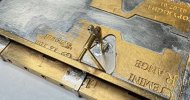
    All from Slaters waterslide, from their GWR wagon range that used to be Coopercraft. There are a couple of compromises - on the left end, it should go "To [hole] Carry 12 Tons", but even on the prototype the word "tons" is pretty squashed up, so I had no chance using the available transfers. The other thing is the tare weight should have a third digit, representing quarters of a hundredweight. Again, there isn't room.

    If anyone can enlighten me as to the significance of the white line near the centre, I'd be grateful - I've just copied the photo, using a piece of an "L" from "LMS" - never going to need that! And before you suggest it - it doesn't show the centre line, because it's not in the centre...

    Nick.
     
    Top