3D Printing - whether to buy, what to buy and how to use it?

simond

Western Thunderer
Simon,

Doing the screws up seems to be like tightening down a cylinder head.
Well, I guess that’s what I did, for the same reasons, I don’t want it to leak!

It doesn’t mention it on the instructions but it seemed a sensible method to me.

The last cylinder heads I did were the Guzzi, and being a V-twin, they’re a single cylinder per head, so it doesn’t quite feel the same. The last multi-cylinder head I did must be forty-some years ago? Was probably a Mini.

And the print was fine!

image.jpg

atb
Simon
 

Easterner

Western Thunderer
Good Evening All,

I hope to revisit and digest this thread over the next few evenings.

Having previously worked with Autocad and other drawing packages, and recently seeing the developments and progress others have made with 3D printing and resources people are making available to download, I’m slowly being tempted into making a purchase myself!

At this stage, I’m primarily looking to print smaller items, such as detailing components, though I may eventually explore larger 0 gauge or possibly gauge 1 items. For most of what I’m envisioning, I suspect a resin-based printer might be the best fit. However, seeing the advancements in 3D printing with Templot, I can also see how an FDM printer could have its uses.

Having followed posts over the last five years of this thread, I wondered if people could share their current updates and advice - knowing what you know now and how 3D printing has evolved.

I’d also appreciate pointers to other threads, blogs, or resources that showcase the differences between resin and FDM printers, and guidance on what might be the best purchase for a nominal 0 gauge modeller - In particular the sort of size printers people are working with.

Thanks in advance for any advice or experiences you can share!

Best Regards
Josh
 

simond

Western Thunderer
Josh, welcome to the discussion!

I wonder whether we should start a separate thread for FDM, or simply keep it all together here. What does the congregation think?

I guess we also have lasers - CO2 Diode and Fibre, CNC milling and turning, other types of printing including SLS, DMLS etc.
It’s all CAM, Computer Aided Modelling.

best
Simon
 

simond

Western Thunderer
A bit of background to 3DP


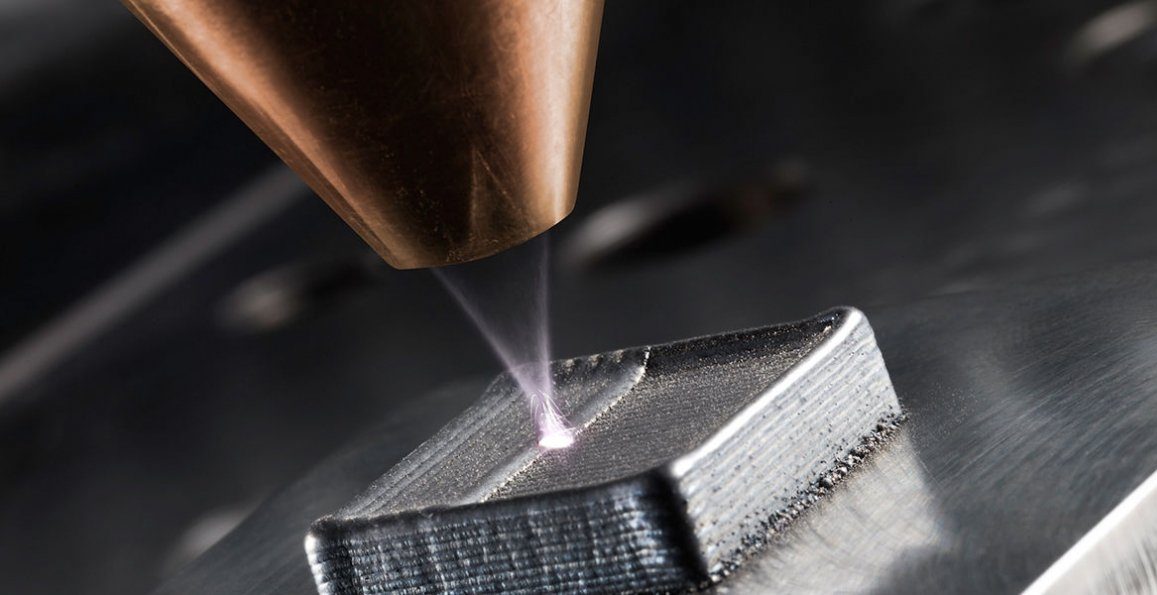
the key technologies used by most modellers are FDM, Fused Deposition Modelling, and SLA (Masked) Stereolithography,

FDM machines like this Bambu: Bambu Lab A1 mini 3D Printer

IMG_2901.jpeg

This is their entry level model, a cracking bit of kit. The top end printers are north of £2 grand.

SLA machines like this Saturn; ELEGOO Saturn 4 Ultra 12K - Best Resin Fast 3D Printer 2024

1771270965000.png
This is a significant upgrade from the machine I purchased some 4 years back, and relatively speaking, cheaper.

There are lots of competing models, and I’m not sure what I’d purchase in the resin (SLA) range now. My very positive experience with the Bambu printers at work has entirely sold them to me, and I will buy one for home at some point.
 

Ian N

Western Thunderer
I got "into" 3d printing after a Bambu A1Mini arrived as a Christmas present. So these comments are best considered very much as a absolute novice view.
For my own drawings, I'm using Freecad. The first four letters explain why! It is a fairly steep learning curve from 2d drawing software and took a couple of weeks before it finally started to click. There are some ( at least I found them to be) very good videos on YouTube by 'Mango Jelly', and anyone intending to use the software I'd certainly recommend combining the videos with a play designing basic things before investing in a printer.

The A1 Mini is extremely capable FDM printer when used with a 0.2mm hot end. However, 2 months on, I can foresee the day when the bed size 180mm x 180 mm will limit what I want to do. But not yet.
It does have limits, I think I may have found one in very fine detail, but it depends where you're willing to compromise. It occasionally struggles, or it's my inexperience, when printing wagon files intended for resin printers. However, the end results are good enough for 'train' wagons rather than 'showcase' wagons.
Why did I go for FDM - primarily cost - if i couldn't get on with it and the software, it wasn't a great financial lost, and secondly environmental - resin had a reputation for being smelly and needing a fairly specific environment for best results . Not something Mrs N would allow in the house!
Some examples...
IMG_3681.jpeg
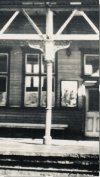
An out of focus gantry post for the ScRSG model of Larbert. The left post has 20 flutes in the base section of the post - possibly more than prototype. They can be seen in the photo, however, to my naked eye, and fingernail, they are undetectable. The number of them had the side effect of causing the overall diameter to be reduced slightly. Each recess iirc, is 0.05mm deep. On the right is it's more practical prototype- approximately 2.2mm dia across 8 flutes. It is likely this could be reduced to somewhere between the two if necessary.
IMG_8096.jpeg
Compared to A one pence coin. The "ornate" brackets are a fudge as I don't yet have a clear photo of their actual design beyond the overall shap. This is 0.7mm thick placed in a slot in the top section. From normal viewing distance it's passable. The fact it's hidden below the canopy is a bonus!
IMG_8097.jpeg
 

Paul_H

Western Thunderer
If you've used Autocad you'll be a step up the learning curve of 3D design. Of the free options Fusion 360 and FreeCad are often liked for railway modelling with lots of peer support and online tutorials, but there are several other packages around and each has their fans.
There'll be a bit of a learning curve getting used to how best to design parts for your printer and understanding slicer settings to get the best results

Another vote for the Bambu FDM printers from here. Very easy to use and reliable straight out of the box.
The A1 Mini is extremely capable FDM printer when used with a 0.2mm hot end. However, 2 months on, I can foresee the day when the bed size 180mm x 180 mm will limit what I want to do. But not yet.
I'd recommend buying the standard A1 as the increased bed size compared to the mini will be useful if you're considering printing track or anything long.
Results with the 0.2mm nozzle can get close to resin printer results for fine detailed models, but can take a long time. More utilitarian parts can be printed fast with the standard 0.4mm nozzle.

Resin printers are likely to give more detailed results than FDM, sometimes faster, sometimes without the design constraints of FDM. The downside is needing to use hazardous toxic resins at controlled temperatures, needing to wash prints after printing, carefully deal with the residues then cure in UV light.
In my opinion not particularly suitable for domestic use, but certainly doable if you have somewhere like a garage to set them up in.
 

simond

Western Thunderer
image.jpg

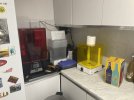
You can do it in a domestic environment - this is my utility room, the big white thing with fridge magnets on is the fridge :D

The red thing is the Saturn, the white thing is the wash tank, contains a gallon of IPA, the blue Tupperware box is the first wash tank, about a cupful of IPA, and the yellow thing is the UV cure tank. You can see the resin bottles behind the cure tank. They’re sitting on a reptile heat mat powered by a USB charger, and they keep a couple of bottles of resin at around 20-25C.

There’s an Elegoo fan heater fitted inside the red cover of the Saturn, which reaches 25C in a few minutes. The utility room is not heated, but the gas boiler is in there.

Vital supplies, bogroll, rubber gloves, filters, live on top of the fridge. The silver thing lower centre is the bin. You’ll need a bin. You’ll also want something like a table protector to keep resin drips off the work surfaces. And an old yoghurt pot for the funnel and filter to drip into.

The resin does have a smell, but it doesn’t linger, and is only created when clearing up. The IPA is pungent, but doesn’t bother me or Madame, and I just open the window if it’s a bit strong. There are water-washable resins, but I have no experience of them.

Of course, what bothers me might not bother you, and vice versa. I’d certainly avoid skin contact with resin, and wear glasses which will protect my eyes from splashes. And whilst I do keep the beer in there, we don’t do food prep anywhere near.


best
Simon
 

Chris Veitch

Western Thunderer
This is their entry level model, a cracking bit of kit. The top end printers are north of £2 grand.
I did ignore FDM printers for a long time as not really relevant to me, but I've recently spent time watching James Clough's excellent YouTube channel Clough24 (an intriguing engineering rabbit hole in many other ways) and he spends a lot of time both using and reviewing some of the larger Bambu Labs machines - he acknowledges that they provide him with machines and he earns commission. They produce some incredible results for larger items, mainly for workshop aids and storage. Well worth a watch.
You can do it in a domestic environment - this is my utility room, the big white thing with fridge magnets on is the fridge
Thanks for sharing this Simon - it's an interesting look at a similar setup to my own but successfully adapted to avoid the low temperature problems which I currently have. It's also interesting (for someone with a neurosis about resin printer safety, which I've rambled on about here previously) to see the mitigation measures taken by someone who knows what he's doing!
 
Last edited:

Paul_H

Western Thunderer
Of course, what bothers me might not bother you, and vice versa. I’d certainly avoid skin contact with resin, and wear glasses which will protect my eyes from splashes. And whilst I do keep the beer in there, we don’t do food prep anywhere near.
Just google "how toxic are 3D printing resins" and you'll get pages of horror stories.

Some things to consider;
Just because you can't smell anything it doesn't mean it's safe to breathe.
You won't let it on your skin, but will breathe it's vapours ?????
These are comparatively new products and the long term health risks are still not really known, but what we do know isn't reassuring.

I've known too many people for whom cigarette smoke 'didn't bother them' until they died of cancer or emphysema.
 

simond

Western Thunderer
Just google "how toxic are 3D printing resins" and you'll get pages of horror stories.

Some things to consider;
Just because you can't smell anything it doesn't mean it's safe to breathe.
You won't let it on your skin, but will breathe it's vapours ?????
These are comparatively new products and the long term health risks are still not really known, but what we do know isn't reassuring.

I've known too many people for whom cigarette smoke 'didn't bother them' until they died of cancer or emphysema.
Fair point, though I recall @mickoo did a VOC (volatile organics) test in his print area and found the resins were much less evident than the IPA.

Whether that should give me reason to be cheerful or not is obviously open to question.

I have to say I was far more worried about the smoke from the laser, particularly cutting mdf, and installed a whopping great fan to exhaust that outside.
 

Paul_H

Western Thunderer
I have to say I was far more worried about the smoke from the laser, particularly cutting mdf, and installed a whopping great fan to exhaust that outside.
Quite right. MDF is really nasty stuff when being worked. The fumes are dangerous and the fine dust it produces when being machined is seriously harmful and can persist hanging in the air for far longer than most people realise. Another example of something you can't see or smell, but can do you harm. I always use dust extraction at source when working MDF and wear a powered respirator, not only when machining, but whenever I return to the workshop for the rest of the day.
 

simond

Western Thunderer
thanks Paul,

If I'm cutting MDF with power tools, it'll be outdoors. The laser obviously isn't but it does extract, that said, the goo that condenses inside the machine is really not very nice at all, cleaning with acetone gets it off, but IPA won't touch it. Presumably the resin binder that is used to make the MDF itself.

I have just looked at the MSDS for the ABS-like resin. There are hazard statements concerning both titanium dioxide and carbon black, and inhalation. I would not wish to be blasé, but these chemicals are very hazardous in powder form and much less so when mixed in a resin. The MSDS is not wildly helpful but gives long term Workplace Exposure Limits of 10mg/m3 for TiO2 and 3.5mg/m3 for Carbon, and indicates1.5% and 0.5% respectively (presumably by weight) but no indication of how much of these chemicals might be expected to be inhalable from opening and pouring a cupful of resin. My guess is "not very much if at all", but of course that might not be a good guess.

I would certainly dig further if it were at work, and the staff exposure risk was 8 hours a day, 40 hours per week.

I guess a mask would not hurt, but at this point, I am not concerned by the exposure risk based on the MSDS and my exposure which is intermittent and limited - I expect a print run involves no more that 2 minutes to put resin in the tank, and less than 10 to clear up afterwards. Maybe once a week, maybe twice, maybe not at all. The rest of the time the resin bottle is closed, and there is a lid on the printer.

I will have a further look at the Volatile Organics.

For clarity, this is in no way a recommendation for anyone else - it's what I am doing at my own risk.

best
Simon
 

michael080

Western Thunderer
Vital supplies, bogroll, rubber gloves, filters, live on top of the fridge. The silver thing lower centre is the bin. You’ll need a bin. You’ll also want something like a table protector to keep resin drips off the work surfaces. And an old yoghurt pot for the funnel and filter to drip into.
Good summary, but you forgot some painters fleece on the floor. I am always generously distributing contaminated IPA on the floor that leaves a sticky residue if not absorbed in the fleece.

Michael
 

richard carr

Western Thunderer
Funny that Simon, I had to do just the same thing on Sunday evening, it's surprisingly easy, although it takes a while and it certainly cured the problem of a tiny leak in the FEP.
I think I need to make this part of the routine maintenance and change it every couple of months, the first couple of prints looked that bit sharper than with the old FEP.

Richard
 

martin_wynne

Western Thunderer
Just google "how toxic are 3D printing resins" and you'll get pages of horror stories.

Some things to consider;
Just because you can't smell anything it doesn't mean it's safe to breathe.
You won't let it on your skin, but will breathe it's vapours ?????
These are comparatively new products and the long term health risks are still not really known, but what we do know isn't reassuring.

I've known too many people for whom cigarette smoke 'didn't bother them' until they died of cancer or emphysema.

FDM printing is much more user-friendly than resin. And less expensive. With a 0.2mm nozzle you can get close to resin quality. Admittedly it then takes a fortnight to print -- but it runs unattended while you build the layout, and when it bleeps finished that's it. Ready to use. No after processing needed.

For an idea of what's possible in 7mm scale with a Bambu FDM printer, PLA filament and a 0.2mm nozzle, see:

https://85a.uk/templot/club/posts/22412

Martin.
 

simond

Western Thunderer
That Minnow is an excellent piece of work, and following the two-coach rule would pass muster pretty much on any layout - you do have to look for the layering. Bit more obvious on the solebars but the grey is really good.

Now if only we could get an affordable, domestic-sized CNC printer that can do legible, fractional-millimeter-font italic writing on the side of wagon bodies in white ink....
 

David Halfpenny

Western Thunderer
That Minnow is an excellent piece of work, and following the two-coach rule would pass muster pretty much on any layout - you do have to look for the layering. Bit more obvious on the solebars but the grey is really good.

Now if only we could get an affordable, domestic-sized CNC printer that can do legible, fractional-millimeter-font italic writing on the side of wagon bodies in white ink....
I've been working on that for some years, Simon, and have looked at dozens of potential processes.

At the moment, my money is on Pad Printing, as used by the trade, with the intriguing possible alternative of White Laser Toner.
Not necessarily a CMYBW printer (who wants to pay for 5 cartridges, let alone a 5 cartridge printer, just for white?) but subsititing a white-toner for the black on in an ordinary domestic laser printer.​
Just to keep you hungry for it, here are:
  • a G1 wagon lettered for a G1MRA founder member, including his membership number and home address - I only wish I knew who did it,
  • a Slaters G1 kit lettered with what I believe to be commercial water-slide decals,
  • a San Cheng 14ton tank wagon lettered by Mark Wood,
  • a wagon I suspect to be one of your own:
 

Attachments

  • PH%20Wagon%20II.jpg
    PH%20Wagon%20II.jpg
    140.3 KB · Views: 15
  • 03.jpg
    03.jpg
    285.6 KB · Views: 13
  • !cid_A63BF9754F0145699B8DF82F0CC59875@markfa28b2e16a.jpg
    !cid_A63BF9754F0145699B8DF82F0CC59875@markfa28b2e16a.jpg
    162.7 KB · Views: 15
  • SD Diorama.jpg
    SD Diorama.jpg
    326.3 KB · Views: 15
Top