3D Printing - whether to buy, what to buy and how to use it?

David Halfpenny

Western Thunderer
If I'm cutting MDF with power tools, it'll be outdoors. The laser obviously isn't but it does extract, that said, the goo that condenses inside the machine is really not very nice at all,
Simon, it's well worth shelling out for 'laserable' MDF that doesn't have as much goo in the glue.
I can get a stack of A3 sheets - near as dammit the bed size of my enclosed (and extracted) indoor laser - for a very reasonable price.
On the other hand, I'll carry on using ordinary DIY-shed sheets for my big open-frame laser, that I intend only ever to use outdoors.​
Similar considerations for plywood of course.
Having hunted down - and driven all the way to - a specialist timber yard advertising 1/32" birch ply, I was disappointed to find big variations between sheets. One especially gooey sheet reduced me to using the laser purely for marking outlines, that I then sawed and sanded to size by mediaeval means. Next time, I'll pay the extra for a delivery of Laser Ply.​

Incidentally, anyone who wants laser-accuracy woodwork without the bother can get pretty close with an ordinary ink-jet printer.
Stick a paper print to the material, using peelable spray-mount to avoid wet glue stretching the paper.​
Or:​
  • Print a fine high-contrast Reversed outline onto a Laser transparency sheet (not an inkjet sheet ! ).
  • Swiftly but carefully, lay the still-wet sheet ink-down onto the material.​
  • Rub / roller down the ink without slipping or smudging.​
  • Peel off the sheet and cut round the outline.​
 

simond

Western Thunderer
I've been working on that for some years, Simon, and have looked at dozens of potential processes.

At the moment, my money is on Pad Printing, as used by the trade, with the intriguing possible alternative of White Laser Toner.
Not necessarily a CMYBW printer (who wants to pay for 5 cartridges, let alone a 5 cartridge printer, just for white?) but subsititing a white-toner for the black on in an ordinary domestic laser printer.​
Just to keep you hungry for it, here are:
  • a G1 wagon lettered for a G1MRA founder member, including his membership number and home address - I only wish I knew who did it,
  • a Slaters G1 kit lettered with what I believe to be commercial water-slide decals,
  • a San Cheng 14ton tank wagon lettered by Mark Wood,
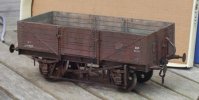
  • a wagon I suspect to be one of your own:
David, thank you for the implied compliment but your suspicions are misplaced. Another SD!
 
Last edited:

Paul_H

Western Thunderer
FDM printing is much more user-friendly than resin. And less expensive. With a 0.2mm nozzle you can get close to resin quality. Admittedly it then takes a fortnight to print -- but it runs unattended while you build the layout, and when it bleeps finished that's it. Ready to use. No after processing needed.
Sorry, but that's not really helpful.
FDM can deliver ready to use parts, but only for some designs.

There's equally a lot of designs that won't print acceptably with FDM that could be done on a resin printer.
A good example might be the thread in RMweb at the moment of a set of pipework for a 7mm scale wagon.
Trying to produce that level of fine suspended detail is just about impossible with FDM.
 

smgee

Western Thunderer
Sorry, but that's not really helpful.
FDM can deliver ready to use parts, but only for some designs.

There's equally a lot of designs that won't print acceptably with FDM that could be done on a resin printer.
A good example might be the thread in RMweb at the moment of a set of pipework for a 7mm scale wagon.
Trying to produce that level of fine suspended detail is just about impossible with FDM.
I found Martin’s post helpful, Paul. As he said, you CAN get CLOSE to resin.

Obviously there will be many examples where that is not true, such as the pipework in your link. Equally, there will be occasions where FDM is more appropriate, especially from a robustness perspective.

Martin’s wagon example shows a marked improvement on the Skog FDM kit I built a year or two ago. I can’t help wondering if it’ll be possible to improve FDM quality any further?
 

David Halfpenny

Western Thunderer
David, thank you for the implied compliment but your suspicions are misplaced. Another SD!
My apologies, Simon!
SDs are especially favoured with talent :)

The 5 plank wagon is Simon Dunkley's, shown displayed on his 'pointless' Microrama - barely longer than the wagon itself.

Here's a thumbnail from Simon Castens's website page titled "Weathering the Wagon".
1/32nd scale railway modelling David

Dunkwag1.jpg
 

Paul_H

Western Thunderer
I can’t help wondering if it’ll be possible to improve FDM quality any further?
There's a potentially helpful addition to slicing technology by using anti-aliasing technology that's currently in beta and could be mainstream later this year. That ought to improve slopes and curves.
There's also some clever 4 axis tech around, I can't see that being very widely adopted anytime soon.
The stumbling block that is pretty much impossible to resolve with FDM is getting good suspended surfaces.
 

David Halfpenny

Western Thunderer
There's a potentially helpful addition to slicing technology by using anti-aliasing technology that's currently in beta and could be mainstream later this year. That ought to improve slopes and curves.
There's also some clever 4 axis tech around, I can't see that being very widely adopted anytime soon.
The stumbling block that is pretty much impossible to resolve with FDM is getting good suspended surfaces.
There's a lot of advice about bridging online.

Here's the 'Indian rope trick' we're trying to do:

Screenshot 2026-02-19 at 11.45.43.png

here's a very basic introduction to the options:

and here's a 3 minute video of a guy working it though for a specific part:
 

Paul_H

Western Thunderer
There's a lot of advice about bridging online.
There is, and I've spent too long trying out some of the ideas, usually without much or consistent results.

But nothing I've seen has ever got remotely near the quality of resin printed overhang structures, or even the upper surfaces of FDM prints.
 

simond

Western Thunderer
There's a potentially helpful addition to slicing technology by using anti-aliasing technology that's currently in beta and could be mainstream later this year. That ought to improve slopes and curves.
There's also some clever 4 axis tech around, I can't see that being very widely adopted anytime soon.
The stumbling block that is pretty much impossible to resolve with FDM is getting good suspended surfaces.
Suspended surfaces in resin can also be tricky, as you might find that the resin pools on them and then sort-of sets off, and you get a lumpy surface. Sufficient warmth, and supporting the part so any suspended surfaces have a decent angle (say 15 degrees or more) seems to address this.
 

Paul_H

Western Thunderer
Sufficient warmth, and supporting the part so any suspended surfaces have a decent angle (say 15 degrees or more) seems to address this.
Indeed, my point is this can be addressed and resolved with good technique with resin prints. I've seen lots of great results. With FDM less so.
 

David Halfpenny

Western Thunderer
Indeed, my point is this can be addressed and resolved with good technique with resin prints. I've seen lots of great results. With FDM less so.
Totally fair comment Paul.
I've seen and handled absolutely jaw-dropping resin prints, including G1 bodyshells so smooth and accurate - bridges and all - that they need no fettling of any kind before painting.​
(And painted they need to be - carelessly, I left a white casting in a translucent box for a few winter weeks, and now it has shadow-prints on it.)
 

Ian N

Western Thunderer
Does anyone have any first hand experience of uncoloured "transparent " PETG they'd care to share?
 

simond

Western Thunderer
I printed some lamp lenses using clear transparent resin - quite successful but be careful to wash them only in really clean ipa and the transparency can be enhanced by painting the parts in clear varnish once cured.

I cannot imagine an FDM printer doing truly clear prints but would be delighted to be wrong!
 
Last edited:

magmouse

Western Thunderer
Does anyone have any first hand experience of uncoloured "transparent " PETG they'd care to share?

Yes - as Simon imagines, you can't print something that is clear in the sense you can see through it like a piece of glass. I've used it to created diffusers for LED lighting on a back scene, and I'm planing to use it to make diffusers for LEDs in carriage lighting, to represent incandescent gas lights (GWR auto trailer).

Nick.
 

Chris Veitch

Western Thunderer
Yes - as Simon imagines, you can't print something that is clear in the sense you can see through it like a piece of glass. I've used it to created diffusers for LED lighting on a back scene, and I'm planing to use it to make diffusers for LEDs in carriage lighting, to represent incandescent gas lights (GWR auto trailer).

Nick.
It’s not 3D printing, but some of the best such effects I’ve seen have been from using UV setting resin to form navigation lights on plastic aircraft kits. It’s set with a simple UV torch and can be polished to the transparency of glass or Perspex.
 

simond

Western Thunderer
Chris,

that gives me an idea or several, thank you.

it would be fairly easy to print a former for, eg, a large multi-facet gas-lit lamp, polish it, make a mould from it, and then cast the actual lens in the mould.

At some point, I will try that.

of course, if I can successfully 3DP the former from the resin, and can polish that to a presentable state, I won’t have to bother with the mould!

cheers
Simon
 

michael080

Western Thunderer
We got a nice new Bambulab H2C at work which gave a lot of problems from the beginning. I couldn't get the right nozzle to run properly. Disassembling the print head for the first time, I found some filamet pieces that were removed but didn't solve the problem. Disassembling it the second time, I found these tiny pieces. The black one sat sat on top of one of the guide pipe., the silver one was blocking the automatic cutting mechanism.

PXL_20260305_131012975.jpg

Problem resolved after some 4 hours.

Bottom line: This machine is a very nice tool if it works properly, but it becomes a nightmare if something doesn't go according to plan.
As a German mechanical engineer, I must say: "Dear chinese engineers, this is overengineered."

Michael
 
Top