Tom Mallard’s Workbench - P4 K1 - Clockwork LNER Q1 and Van Riemsdijk motor

John R Smith

Western Thunderer
Having the winder hole visible has never bothered me, I must admit. In fact, the more visible and accessible it is, the better. On my very small layout, I do a lot of winding in small amounts to keep speeds low - and lifting the engine off the track to do it is certainly not allowed! So we have to plan ahead, and make sure that the engine is in a suitable position when it runs out of puff - not behind the goods shed or the far side of the platform, for example. At Crewchester Jack Ray always insisted on the use of a yellow duster to hold the engine steady whilst winding was being done - no greasy fingerprints allowed on his engines! So, in this tradition, the "Crewchester Duster" is always used on my operating sessions.

John
 

40057

Western Thunderer
Having the winder hole visible has never bothered me, I must admit. In fact, the more visible and accessible it is, the better.

John

Having the winder hole visible has never bothered me either, or the control levers sticking out of the cab. On a vintage model. It’s the way model locos were in 1910, or in 1950. Those features are part of what it is and contribute to its charm and historic interest.

However, I return to the comments I made in my Rivermead Central thread (post #722) about ‘clockwork new builds’ and the comparison with full-size, new-build, steam locomotives. Two different approaches are possible, both for models and full-size new builds. One philosophy is to copy the original as closely as possible and build a replica. I believe this is the aim of the group building the new LMS Patriot 4-6-0. The Ludlow’s of Bolton copies of rare Bassett-Lowke models, produced c. 20 years ago, were replicas — and very good ones. Superficially, the Ludlow’s reproductions looked almost exactly like the Bassett-Lowke models they imitated.

The alternative approach is perhaps best exemplified by new A1, 60163 Tornado. 60163 is NOT a replica. It’s the fiftieth member of the A1 class. It differs from the first forty-nine A1s in all sorts of ways — welded boiler, air brakes, a tender with increased water capacity etc etc.

60163 is still a 1940s-design steam locomotive, still an A1, but modernised, updated for present day conditions, improved. I very much admire this approach which I think the A1 Trust has executed brilliantly.

So for a new build clockwork loco. If I look at a 1910- or 1950-built clockwork model, it will have certain characteristics, such as a visible key-hole. As an historic artefact, that’s fine. The key-hole is one of the characteristics that defines it as a clockwork model locomotive. But judging the model by how accurately it portrayed a real locomotive leads to a different conclusion. Having a hole in the side of the boiler or what is supposed to be a tank for water is clearly absurd.

If I was a modeller in 1910, or 1950, striving for greater accuracy, what improvements would I have most wanted to see in clockwork locomotives to make them more realistic? Getting rid of the visible key-hole would definitely be on my wish list. And those massive controls sticking out of the cab. Plus, I’d like some daylight under the boiler, please, if the prototype had it. And a better performing motor. So, if clockwork hadn’t been abandoned by the quality model manufactures in the 1950s, might any or all of those improvements been introduced?

Continuing the analogy with 60163 as a modernised and improved 1940s-type steam locomotive, Tom’s model of 828 (see above) is a modernised and improved 1920s-type clockwork locomotive. 828’s key-hole is hidden behind the Westinghouse pump. The traditional cab control levers have gone. There is daylight under the boiler. The motor has a much improved governor giving increased haulage capacity and length of run. 828 is still essentially a traditional clockwork locomotive. But, judged objectively as a model, a much better one than anything produced when clockwork was the norm for model locomotives.

It’s a personal view, of course — but I am not much attracted to the idea of replicas of period models. I would rather have an original or go without. Using clockwork new builds to explore, develop and improve what can be done with clockwork seems to me to be much more worthwhile and interesting than making copies.

Which gets us back to the Q1 …

Martin

 
Last edited:

adrian

Flying Squad
Ah! I never thought of that, having always pulled a loco off the track to wind it. But thinking about it, yes. However in that case, how about a geartrain ending in a bevel gear and a vertical key shaft out of the top. Then it could be accessed by the tank filler. Oops, was that the cunning plan?
I always remember Clarry Edward's live steam J70 tram engine. One of the roof "vents" was actually a little button that popped open the side panel with the windows. He could then insert a little tommy bar to operate the little hand water pump.

I dare say you don't need the bevel gears - if you pop open the tank filler cap to insert a tommy bar which you simply push up and down to operate on a ratchet system to wind up the spring.

?u=https%3A%2F%2Ftse3.mm.bing.net%2Fth%2Fid%2FOIP.jpg
 

John R Smith

Western Thunderer
It’s a personal view, of course — but I am not much attracted to the idea of replicas of period models. I would rather have an original or go without. Using clockwork new builds to explore, develop and improve what can be done with clockwork seems to me to be much more worthwhile and interesting than making copies.

Martin

I do completely agree with you, and of course I would not change a thing about 828, which is wonderful. My comments were, as usual, not entirely serious, and a little bit tongue-in cheek.

But still, when there is a lot of shunting to be done, or you need to stop something quickly before it totals a rake of coaches, there is a lot to be said for having accessible, big controls. So I do tend to curse Bassett-Lowke for having inflicted on their big engine six-coupled mechanism a brake lever that works the opposite way round from all their previous engines, and all those of Hornby and Bing too. This has caught me out more times than I care to remember . . .

John
 

76043

Western Thunderer
Tom, Martin, looking at the CAD drawing, I think I see the square winding hole is oh so very near to the tank access panel? So looking forward to seeing how this is dealt with.
Tony
 

40057

Western Thunderer
Hi all

Re-reading my post #402 above, I feel I owe at least some of the pre-WW2 manufacturers of 0 gauge an apology. The key-holes of their clockwork locomotives were generally in full view. However, mostly, very prominent positions were avoided. The key-hole might be at the base of the firebox, for instance, or between driving wheel splashers. Not hidden, but unobtrusive — presumably deliberately so.

A minority did actually hide the key hole. I believe the very earliest Leeds Model Company tank engines had vertical winders positioned under the cab roof ventilator. Slide open the ventilator, wind the loco, push the ventilator back shut. I have never seen one of these and would be very interested to understand how it was done. Much better known is the ‘Bonzone’. Bond’s (= Bond’s o’ Euston Road) were major retailers of models, including trains, made by a wide variety of manufacturers. In the late 1920s they introduced a small tank engine they made themselves. Since this was of their own manufacture, they called the loco ‘Bonzone’ as a homophone for ‘Bond’s own’:

092208E4-313E-4B8E-A372-6FBCCC87CFCF.jpeg

A Peckett 0-6-0 saddle tank, obviously. The key hole is hidden in the tool box in front of the cab. The tool-box lid lifts up to reveal the winder. In adverts for the Bonzone, Bond’s particularly highlighted the ‘unique feature’ of the tool box claiming the Bonzone to be ‘the first model in which the unsightly key winder is out of sight’. Rather charmingly, Bond’s advertising also described the Bonzone as ‘almost a showcase model’.

I’ve seen a few Windsor Models locos with concealed key holes. This is the very distressed body of a Windsor Bowen-Cooke tank, as it would be if running:

73BCE91F-4E10-4BC8-ADBE-4DF715B4B6E4.jpeg

And ready for winding:

D0AFFD22-2E94-455D-A221-23503AAD0ACB.jpeg

So, when clockwork was in general use, concealed key-holes were not usual but not unknown. Very best practice would be a fair comment, I think.

Martin
 
Last edited:

Tom Mallard

Western Thunderer
K1 62015 complete 5.JPG

K1 62015 complete 15.JPG

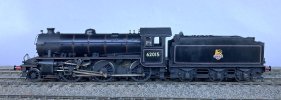
The K1 got its paint and weathering. The base coat of black is cellulose on top of two part etch primer. For expediency, I volunteered to line the model myself using Fox BR mixed traffic lining packs, and although there isn't a specific one available for the K1, I used the B1 set and the K4 set, cutting and splicing as required for the cab side and valence lining.

The cabside numbers are from Railtec, these being quite a lot thinner (and more delicate) than the Fox product.

for the purposes of weathering the model, my objective was to start with ex-works condition or near enough with a shiny finish to the paint using 50/50 gloss to satin Phoenix Precision enamel varnish which sealed the transfers over.

For weathering I mixed Humbrol 29 matt earth with Humbrol 85 instead of the usual matt black Humbrol 33. This was slightly inadvertent but once the mixture was removed with thinners on the better-cleaned areas produced a sheen that I actually prefered to the dead flat 33/29 mix. The rods are painted with 85 mixed with Humbrol 80 gloss Tan substituting for much of 29. I varied the proportions here and there for the brakeblocks (lighter) and smokebox, boiler top, cab roof and tender upper surfaces (adding matt coal black) and spraying instead for a uniform flatness.

The model has a DCC chip installed for use on the owners model railway.

Now 62015 is done, I can pay full attention to an O gauge Q1! This is really coming on now with many of the sheet metal templates resolved, further detail refinement and resolution completed and Mickoo of this parish performing a wonderful service printing a couple of patterns from my CAD models - one for the wheel and one for the brake hanger.

I will update shortly on progress with the Q1

Screenshot Q1 040326.png


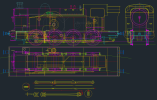
The 12mm scale 2D CAD drawing shows much of the current state of affairs, though there is a 7mm scale drawing which is used to work around the clockwork motor and the functional and aesthetic requirements this imposes on the model. The winding is proposed to take place via a flip-up tank filler and gear train to the motor, which is both discrete and for this shunting engine, a functional improvement over the usual practise of winding from the side.

The chassis is configured to negotiate 3' radius curves leaving clearances very close for a clockwork model. This is the benefit of using the CAD model - various ideas can be investigated and even if the assumptions made aren't fully accurate they do really help inform decisions and the compromises made that should ensure a successful outcome. Though the drawing doesn't show it yet, I will have looked at or considered which parts will need relieving or modifying to suit the running requirements.

Best regards

Tom
 
Last edited:

John R Smith

Western Thunderer
But can someone explain why they want clockwork models in 2026? Is there any other reasons than nostalgia?

I expect that Martin will be along very soon with an extremely well thought-through explanation. As for myself, I think that nostalgia probably has a lot to do with it, although we have to remember that three-rail electric drive can be equally nostalgic, going back as it does to before WWI. All I can say is that when I was prompted by nostalgia to purchase a Bassett-Lowke coarse-scale locomotive some three years ago now (when I had been working in fine-scale 7mm for a long time), it never occurred to me to find an electric one. Clockwork was my first choice.

I think that I wanted to return to a kind of model railway that would be a total contrast to my fine-scale efforts. No DCC, no tiny plastic details (which fall off when you pick things up), instead the idea of running trains, lots of trains, for fun again. And clockwork, strangely enough, is more fun than just sitting back and turning a knob (or pressing little buttons). You have to drive a clockwork engine - set the direction, wind it up, release the brake, and watch over it until it is time to use the brake again. If it gets away from you it can be trouble. It may seem odd, but in some ways clockwork seems more suited to a model of a steam engine than an electric motor. It is entirely self-contained, and as I said you have to drive it just like a live-steam model. Each engine is different, and you have to get to know them to get the best out of them.

So there we go - nothing too rational, but I have got eleven engines now and there is no going back!

Royal Scot 04 Web.jpg

P.S. I should have captioned this. Here we have a clockwork Bassett-Lowke Royal Scot, 1948 -1953. A superb smooth runner, spot the winder hole (it is on this side of the engine . . .)

John
 
Last edited:

40057

Western Thunderer
Perfectly reasonable question, Hawkeye.

Tom is building the Q1 for my vintage layout, Rivermead Central.

The glib answer is in the absence of electrical power in my 100 year old track, an electric model wouldn’t be much use.

John has given other, proper, reasons in his response above.

If you go back in this thread to Tom’s post #365 and the following discussion, you will see other aspects being discussed. I refer you also to my Layout Progress thread Rivermead Central, and especially discussions starting at posts #203, #299 and #742.

Martin
 

Hawkeye

Member
Thanks for the replies, John and Martin! I have never seen and heard a clockwork model in operation but I guess it has a certain feel that might be part of the attraction. There is very little that is rational about model railways, and it is all the little idiosyncrasies that makes things interesting. How boring it would be if we all modeled the same prototypes in the same scale with the same techniques!
 

40057

Western Thunderer
How boring it would be if we all modeled the same prototypes in the same scale with the same techniques!

Absolutely!

I have very broad tastes in model railways, and I much admire the wonderful fine-scale models and layouts that are described on WT. I always read the EM Gauge 70s monthly update from cover to cover, for instance. But none of us has unlimited space, time or money, so what to model is a choice. I have chosen vintage trains, but it might easily have been something else. Probably it’s the age of my trains as much as anything else. On WT, there are lots of layouts featuring skilful representations, for instance, of 100-year-old track. My track is not a skilful representation of 100-year-old track. It is 100-year-old track. Similarly, most of my rolling stock is contemporary with the loco/wagon/coach it represents. They are models of historic objects but also historic objects in their own right.

Since many homes lacked electricity, clockwork was the usual method of propulsion for indoor model railways pre-WW1. So, by default, my vintage layout uses clockwork locomotives.

For the new builds, the approach is to produce essentially the kind of model being made 100 years ago. But not a replica. For 828, which Tom built last year, the clockwork motor is 100 years old. But it was re-engineered for use in 828 with a much improved governor repurposed from its intended use in a 1950s telephone. Thus 828 has significantly improved performance compared with a loco from 100 years ago. So part of the philosophy being applied to 828 and now the Q1 is to develop clockwork beyond the stage it had reached when the manufacture of clockwork powered scale models ceased in the 1950s. For 828, a motor positioned so there is daylight under the boiler, a better governor for a longer run per wind and more haulage capacity, no large control levers sticking out of the cab. For the Q1, a loco designed for shunting. Controls discreet but easy to operate even at arm’s length. Variable speed motor. A concealed key hole. These are traditional clockwork locomotives. But better.

Finally, it’s not like experiencing the real thing, but here is a clockwork train:


Martin
 

John R Smith

Western Thunderer
Finally, it’s not like experiencing the real thing, but here is a clockwork train:

Nice one, Martin. Those Bing six-coupled mechs are amazing. But every time I watch him winding that one I am bracing myself for the spring to break, even though I know it won't . . . .

John
 

Mike W

Western Thunderer
When I discovered 0 Gauge in 1969 there was quite a bit of clockwork which didn't interest me at all. I was aware of John L Ray, but when I was invited to see Norman Eagles' railway I could see the point. You set the train off and it was then completely out of your control until it arrived at its destination - just like the real thing. It was all about running the railway and less about running the engine and fine detail, though some of his locos were very nice. Still a form of model railways, but different.

I've modelled Gauge 3 for 20+ years now and would love to try a G3 clockwork loco, just to see what it was like. The late Barry Lane built one, his LNWR Chopper 2-4-0T, but the small Hornby mechs he used were not powerful enough, so he converted it to electricP1060518 (1).JPG.

Mike
 

40057

Western Thunderer
When I discovered 0 Gauge in 1969 there was quite a bit of clockwork which didn't interest me at all. I was aware of John L Ray, but when I was invited to see Norman Eagles' railway I could see the point. You set the train off and it was then completely out of your control until it arrived at its destination - just like the real thing. It was all about running the railway and less about running the engine and fine detail, though some of his locos were very nice. Still a form of model railways, but different.

I've modelled Gauge 3 for 20+ years now and would love to try a G3 clockwork loco, just to see what it was like. The late Barry Lane built one, his LNWR Chopper 2-4-0T, but the small Hornby mechs he used were not powerful enough, so he converted it to electricView attachment 259166.

Mike
Hi Mike

You would need a pretty substantial spring to produce a loco with respectable power in Gauge 3.

There were some very early clockwork Gauge 3 model/toy locos, but otherwise I can think of only one commercially made 2.5” gauge clockwork model. By Jubb, c.1920, an 0-4-0 saddle tank with chain drive from an enormous spring. There were several clockwork Gauge 2 models made by Bing exclusively for Bassett-Lowke. Again, enormous powerful springs. Finding a spare Gauge 2 mechanism in good order might be a challenge, but would be a good starting point for a Gauge 3 scratch build project. Plenty of Gauge 1 mechanisms available which would probably be sufficient for a small Gauge 3 loco.

Martin
 

John R Smith

Western Thunderer
In some respects, Gauge 1 is already reaching the limits of practical design for spring drive model railway engines. Theoretically, one could build a mechanism with a large enough spring to haul a decent number of Gauge 3 coaches around over a suitable length of run. The problem then is one of being able to wind it up with reasonable ease - you would need a geared ratchet for certain, as the late period Bassett-Lowke six-coupled motors do. But, taken to extremes, the engine would now require a very large number of winds, which could be equally impractical.

John
 

40057

Western Thunderer
In some respects, Gauge 1 is already reaching the limits of practical design for spring drive model railway engines. Theoretically, one could build a mechanism with a large enough spring to haul a decent number of Gauge 3 coaches around over a suitable length of run. The problem then is one of being able to wind it up with reasonable ease - you would need a geared ratchet for certain, as the late period Bassett-Lowke six-coupled motors do. But, taken to extremes, the engine would now require a very large number of winds, which could be equally impractical.

John
Someone with a better knowledge/understanding of physics and engineering than I have could probably explain what the scale limits of clockwork are and why. Clockwork is certainly possible in gauges 00, 0, 1 and 2. John van Riemsdyk maintained 00 was the ideal size for clockwork, claiming prodigious feats of haulage for his 00 tank locos. He certainly had genuine expert knowledge and experience, and manufactured clockwork powered models in both 4 and 7 mm scales. The small number of 00 clockwork locos I have tried myself hauled similar loads in terms of numbers of wagons/coaches to equivalent 0 gauge models. But my sample is too small for safe generalisation.

Martin
 
Top