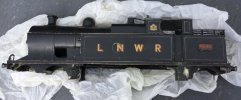
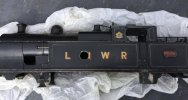
Having the winder hole visible has never bothered me, I must admit. In fact, the more visible and accessible it is, the better.
John
Having the winder hole visible has never bothered me either, or the control levers sticking out of the cab.
On a vintage model. It’s the way model locos were in 1910, or in 1950. Those features are part of what it is and contribute to its charm and historic interest.
However, I return to the comments I made in my Rivermead Central thread (post #722) about ‘clockwork new builds’ and the comparison with full-size, new-build, steam locomotives. Two different approaches are possible, both for models and full-size new builds. One philosophy is to copy the original as closely as possible and build a replica. I believe this is the aim of the group building the new LMS Patriot 4-6-0. The Ludlow’s of Bolton copies of rare Bassett-Lowke models, produced c. 20 years ago, were replicas — and very good ones. Superficially, the Ludlow’s reproductions looked almost exactly like the Bassett-Lowke models they imitated.
The alternative approach is perhaps best exemplified by new A1, 60163
Tornado. 60163 is NOT a replica. It’s the fiftieth member of the A1 class. It differs from the first forty-nine A1s in all sorts of ways — welded boiler, air brakes, a tender with increased water capacity etc etc.
60163 is still a 1940s-design steam locomotive, still an A1, but modernised, updated for present day conditions, improved. I very much admire this approach which I think the A1 Trust has executed brilliantly.
So for a new build clockwork loco. If I look at a 1910- or 1950-built clockwork model, it will have certain characteristics, such as a visible key-hole. As an historic artefact, that’s fine. The key-hole is one of the characteristics that defines it as a clockwork model locomotive. But judging the model by how accurately it portrayed a real locomotive leads to a different conclusion. Having a hole in the side of the boiler or what is supposed to be a tank for water is clearly absurd.
If I was a modeller in 1910, or 1950, striving for greater accuracy, what improvements would I have most wanted to see in clockwork locomotives to make them more realistic? Getting rid of the visible key-hole would definitely be on my wish list. And those massive controls sticking out of the cab. Plus, I’d like some daylight under the boiler, please, if the prototype had it. And a better performing motor. So, if clockwork hadn’t been abandoned by the quality model manufactures in the 1950s, might any or all of those improvements been introduced?
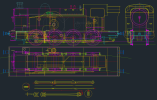
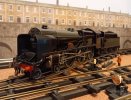
Continuing the analogy with 60163 as a modernised and improved 1940s-type steam locomotive, Tom’s model of 828 (see above) is a modernised and improved 1920s-type clockwork locomotive. 828’s key-hole is hidden behind the Westinghouse pump. The traditional cab control levers have gone. There is daylight under the boiler. The motor has a much improved governor giving increased haulage capacity and length of run. 828 is still essentially a traditional clockwork locomotive. But, judged objectively as a model, a much better one than anything produced when clockwork was the norm for model locomotives.
It’s a personal view, of course — but I am not much attracted to the idea of replicas of period models. I would rather have an original or go without. Using clockwork new builds to explore, develop and improve what can be done with clockwork seems to me to be much more worthwhile and interesting than making copies.
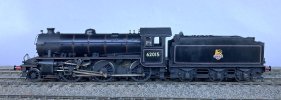
Which gets us back to the Q1 …
Martin