Tom Mallard’s Workbench - P4 K1 - Clockwork LNER Q1 and Van Riemsdijk motor

Solebay

Member
> Until I looked at your photo, I had not realised that these LSW locos looked almost exactly the same as a Caledonian Railway 294 class 0-6-0. Just green instead of black or blue.

Drummond (in fact, the Drummond brothers) carried the same features across different companies. When I was building the LSW 700 class, I took a trip to the Riverside Museum in Glasgow to measure up details from the cab on CR single no. 123.
 

Solebay

Member
>Thanks for taking the time to talk! What is the origin of your model?
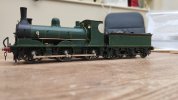
Scratchbuilt, in P4. The tender is from Brassmasters (Martin Finney) although for reasons that now escape me, I replaced the tender body. The 700 class was followed by an 0395 class, also scratchbuilt, and shown below. I'm thinking of completing the set with a double framed Beyer goods, in late condition. But I'll probably get part of that etched.
 

Attachments

  • IMG_20260405_120815.jpg
    IMG_20260405_120815.jpg
    180 KB · Views: 22

Tom Mallard

Western Thunderer
IMG_7541.JPGIMG_E7499.JPG

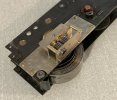
The Q1 motor has grown an appendage to reorientate the winding action through 90 degrees. I sourced a pair of 2:1 crown and pinion bevel gears from Phil at Hobby Holidays, and some steel 0.4 module gears from HPC that closely positioned the centre of one on the centre line of the tank filler. The female winding hole was machined using a 1mm slot drill, then finessed with hand files to improve the corners to fit the finding key. Similarly the square spigot on the crown wheel is machined and hand finished to match the winding hole in the motor. The arbor with this square section is soldered and pinned to the crown wheel. The pinion bevel gear has an adapted 0.4 module gear bored out to slip over the boss which is fixed with Loctite 638.

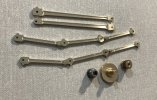
Much entertainment was also had machining the coupling and connecting rods from 2mm nickel silver NS101 plate sourced from Metal Smith Leeds. These start with a profile machined blank with the relief and fluting machined in as secondary and tertiary operations. I've not decided on the crankpin size yet, so these holes will be opened up at a later date.

Enjoy your modelling

Tom
 

John R Smith

Western Thunderer
The Q1 motor has grown an appendage to reorientate the winding action through 90 degrees.

Very nice work, Tom. I can't imagine that there is anybody else working on a precision rebuild (and redesign) of a clockwork mechanism thses days (at least, not for a model railway engine. For horology, of course there will be). The coupling rods are a work of art too - all jointed, for an eight coupled loco.

John
 

Tom Mallard

Western Thunderer
The appropriate description for the mechanism now should probably be a ‘Mallard-Riemsdyk’, by analogy with the original branding of the motors and r-t-r 0-6-0Ts, which were sold as ‘Walker-Riemsdyk’ (see post #427 above).

Martin
That's a generous idea Martin, which makes me feel both proud and awkward at the same time...
 

40057

Western Thunderer
That's a generous idea Martin, which makes me feel both proud and awkward at the same time...

To describe the Q1 motor as a ‘van Riemsdijk’ is still true, but no longer the whole truth.

It is fair to point out that commercial clockwork mechanisms are nearly always altered to some extent when incorporated into scratch built models. Either to make the mechanism fit, or to improve the appearance of the model, corners may be trimmed off the side-plates, new axle holes drilled etc. Only rarely is it possible to find a ready-made mechanism that is perfectly suited to the desired prototype.

But a Hornby motor with the corners trimmed off is still a Hornby motor. The alterations and additions to the Q1 motor go well beyond ‘normal’ modifications to facilitate incorporation into an accurate model. Moving pillars to accommodate the correct axle spacing, for example. A less satisfactory, but traditional, solution would have been stub axles.

The Q1 motor, as it is emerging, is a very sophisticated clockwork mechanism perfectly arranged for the particular model. The excellent speed control system, and compact and unconventional reversing device, as designed and built by John van Riemsdijk. The repositioned winder and internal pillars to allow closer axle spacing, as designed and built by Tom.

I should also say the Q1, as a dedicated heavy shunting locomotive, really is only feasible by virtue of the van Riemsdijk motor. Principally, of course, because of the fine speed control and the preservation of good haulage capacity even at very slow speeds. But also any ‘normal’ clockwork mechanism with a ‘pivoted plate’ reversing device would have required stub axles given the closeness of the wheel spacing on the Q1.

Martin

 
Top