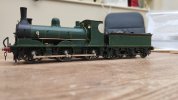
That's a generous idea Martin, which makes me feel both proud and awkward at the same time...
To describe the Q1 motor as a ‘van Riemsdijk’ is still true, but no longer the whole truth.
It is fair to point out that commercial clockwork mechanisms are nearly always altered to some extent when incorporated into scratch built models. Either to make the mechanism fit, or to improve the appearance of the model, corners may be trimmed off the side-plates, new axle holes drilled etc. Only rarely is it possible to find a ready-made mechanism that is perfectly suited to the desired prototype.
But a Hornby motor with the corners trimmed off is still a Hornby motor. The alterations
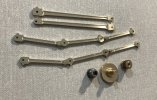
and additions to the Q1 motor go well beyond ‘normal’ modifications to facilitate incorporation into an accurate model. Moving pillars to accommodate the correct axle spacing, for example. A less satisfactory, but traditional, solution would have been stub axles.
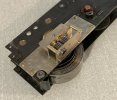
The Q1 motor, as it is emerging, is a very sophisticated clockwork mechanism perfectly arranged for the particular model. The excellent speed control system, and compact and unconventional reversing device, as designed and built by John van Riemsdijk. The repositioned winder and internal pillars to allow closer axle spacing, as designed and built by Tom.
I should also say the Q1, as a dedicated heavy shunting locomotive, really is only feasible by virtue of the van Riemsdijk motor. Principally, of course, because of the fine speed control and the preservation of good haulage capacity even at very slow speeds. But also any ‘normal’ clockwork mechanism with a ‘pivoted plate’ reversing device would have required stub axles given the closeness of the wheel spacing on the Q1.
Martin