4mm An EM Workbench - Any Old Oil

BR Ferry Open, diagram 1/055
  • AJC

    Western Thunderer
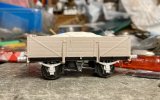
    A quick bit of fettling. On the evidence of this, there’s no way these fittings will survive to the standard I want on the unsheeted version so that can wait until I next put an order into Rumney Models, but just peeking out from under a sheet will be fine.

    IMG_0425.jpeg

    In contrast, I think the brake levers ought to be ok, though I did break one. Thankfully that’s the one without the lifting link so is easier to resolve using bits in stock.

    Adam
     
    BR Ferry Open, diagram 1/055
  • AJC

    Western Thunderer
    By one of those happy coincidences, here's a shot of one in a train (the first I've seen in 'traffic' as opposed to engineers' use:


    Thanks to Jon Hall for the link. The other wagons, from the camera, seem to be a Belgian ferry van (you can see the 'B' logo on the door), a modern (for the time), monbloc tanker, a pair of vans with wide opening sliding doors and planks - not sure what these are - two chemical tanks, not clear what type; another Belgian van and then a BR shoc high. Destination or origin almost certainly Harwich (well, Dovercourt, really).

    Adam
     
    Last edited:
    BR Ferry Open, diagram 1/055
  • hrmspaul

    Western Thunderer
    By one of those happy coincidences, here's a shot of one in a train (the first I've seen in 'traffic' as opposed to engineers' use:


    Thanks to Jon Hall for the link. The other wagons, from the camera, seem to be a Belgian ferry van (you can see the 'B' logo on the door), a modern (for the time), monbloc tanker, a pair of vans with wide opening sliding doors and planks - not sure what these are - two chemical tanks, not clear what type; another Belgian van and then a BR shoc high. Destination or origin almost certainly Harwich (well, Dovercourt, really).

    Adam
    The Chemical tanks are Octels. A common ferry tank working to Harwich from Lostock Gralam or Stanlow Associated Octel tank wagons - international registered

    Paul
     
    Last edited:
    The Yeovil Coupling
  • AJC

    Western Thunderer
    Finescale Archaeology, or near forgotten innovations: the Yeovil Coupling.

    Dad has supplied me with an item of relatively ancient history, a Wills tender by Bob Alderman (for a 4F, I think), with rather nice wheels by Ultrascale. I think this was part of an early YMRG layout based on Radstock - dad may remember, @Stevers may well be too young, the '70s anyway, don't ask me which end of the decade, but I assume the tender is roughly the same age as me, so mid-40s.

    So what have we? Typical early '80s finescale. The side sheets have been thinned a little, separate handrails, with slightly overfed knobs. The inner chassis may be home brewed, centre axle lightly sprung, wheels rather posher than the upper works which are actually perfectly ok, if I were to add some beading strip. Anyway, the Alderman 4F I think I remember was Airfix, probably with a Portescap, slightly later ‘80s finescale.
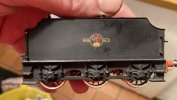
    IMG_0476.jpeg

    Underneath and to the rear we have evidence of a failed innovation, the Yeovil Coupling.
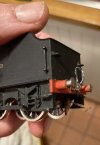
    IMG_0474.jpeg

    It's fairly obviously a form of Jackson, the least obtrusive auto coupling yet devised and generally a Good Thing, made from etched brass. And the latter was its failing, the brass being rather soft and, as is the way of Jackson's, prone to alignment issues. This one pivots, the etch of the things that we had knocking around somewhere suggests that that might have been the intention. Very DIY in ethos, invisibility guaranteed by etch resist, like the old PC etched couplings. I *think* Bob might have been responsible for the artwork for the couplings, but don't quote me on this!

    IMG_0475.jpeg

    Anyway, it's out of the box for remedial work, removing the brakes masquerading as pick ups. And adding actual brakes to the frames. Sadly, perhaps, the etched Jackson’s are probably not long for this world, a reminder that much archaeological investigation is destructive.


    Adam

     
    Last edited:
    The Yeovil Coupling
  • Stevers

    Western Thunderer
    I think this was part of an early YMRG layout based on Radstock - dad may remember, @Stevers may well be too young, the '70s anyway, don't ask me which end of the decade, but I assume the tender is roughly the same age as me, so mid-40s.
    It was of Templecombe I believe, some remains of it were in one of the other attic rooms of the 'Big House' when I joined in 1985. One of the reasons it foundered was that it was 18mm gauge not 18.2.

    The coupling is of 'Yeovil' pattern developed by Bob Alderman. It works on a similar principle to the AJ, but I reckon looks easier to fit. It's documented in Section 9.1.1 (3) of my EMGS manual, which states that Doug Fairhurst has the manufacturing and marketing rights for all 'Yeovil' products.
     
    The Yeovil Coupling
  • AJC

    Western Thunderer
    It was of Templecombe I believe, some remains of it were in one of the other attic rooms of the 'Big House' when I joined in 1985. One of the reasons it foundered was that it was 18mm gauge not 18.2.

    The coupling is of 'Yeovil' pattern developed by Bob Alderman. It works on a similar principle to the AJ, but I reckon looks easier to fit. It's documented in Section 9.1.1 (3) of my EMGS manual, which states that Doug Fairhurst has the manufacturing and marketing rights for all 'Yeovil' products.

    I should have thought to look at the YMRG website. There’s a picture: YMRG – the First Decade

    I don’t remember an EM Dublo CO-BO, but I do remember Bob, and the smell of his pipe, and Brian (who died far too young), and his Princess Coronation saga.

    file0592.jpg

    Adam
     
    Last edited:
    The Yeovil Coupling
  • David Mylchreest

    Western Thunderer
    It was of Templecombe I believe, some remains of it were in one of the other attic rooms of the 'Big House' when I joined in 1985. One of the reasons it foundered was that it was 18mm gauge not 18.2.

    The coupling is of 'Yeovil' pattern developed by Bob Alderman. It works on a similar principle to the AJ, but I reckon looks easier to fit. It's documented in Section 9.1.1 (3) of my EMGS manual, which states that Doug Fairhurst has the manufacturing and marketing rights for all 'Yeovil' products.
    Is the coupling available anywhere?
     
    The Yeovil Coupling
  • AJC

    Western Thunderer
    Is the coupling available anywhere?

    If it is - which I doubt - it would be (as implied by the EMGS manual - Doug Fairhurst was the stores officer for years), via the EMGS. Bob died in 2020, and had been in 7mm for decades at that point. In better material, phosphor bronze, maybe(?), the idea was sound enough. I'm not sure what the other 'Yeovil' products were.

    Adam
     
    Last edited:
    The Yeovil Coupling
  • James Spooner

    Western Thunderer
    I have just had a scoot through the EMGS stores on the website and, whilst in the couplings section there are components for the traditional AJ coupling and plenty for three link and screw couplings there is no reference to the Yeovil (or anything similar).

    Nigel
     
    • Like
    Reactions: AJC
    The Yeovil Coupling
  • David Mylchreest

    Western Thunderer
    If it is - which I doubt - it would be (as implied by the EMGS manual - Doug Fairhurst was the stores officer for years), via the EMGS. Bob died in 2020, and had been in 7mm for decades at that point. In better material, phosphor bronze, maybe(?), the idea was sound enough. I'm not sure what the other 'Yeovil' products were.

    Adam
    A quick Internet search shows that nickel silver has a greater tensile strength than phosphor bronze.
    I experimented with AJs a while ago now and came to the usual conclusion that yes they are cheap but they are the very devil to set up correctly and to maintain in that set-up.
    These couplings might be the solution if they were available (and in nickel silver). But I imagine that the etching around the hooks would need polishing.
    Still a thought for the EMGS.
     
    The Yeovil Coupling
  • David Mylchreest

    Western Thunderer
    Stainless Steel might be even better, same sort of cost as N/S or P/B.

    I'd be interested in using them for Verwood goods stock as I can't bring myself to use Kadees for those. If one could be sent to me I could draw up suitable artwork.
    Best to bear in mind that the hooks do have to be bent to shape and that if they are too long and slender you would get the same issues as making them out of spring steel wire
     
    The Yeovil Coupling
  • Dave F.

    Western Thunderer
    I used Yeovil couplings for a number of years and still have a few wagons fitted with them, they are very strong and can take a bit of tension hauling long trains. Yes they can be damaged with rough handling like most other etched or wire coupling, the only bending needed was to twist the shaft to the required head angle and a slight tweek of the tail of the head so the hook was more or less the same as a Jackson. Another thing I did to improve was to open the oval hole in the mount to round so that the ears of the moveable arm sat in the bottom of the round hole and that centred the head better but still allowed coupling and uncoupling, I also added a dollop of solder to the balance to improve the weight slightly.
    I liked them and I only started with Jacksons when the Yeovil became unavailable. As I say I still have a few and they work okay with the Jacksons.
    I met an old fella from Carlisle at a show and he noticed the Yeovil and said he was involved with the development years before, unfortunately I can't remember his name.

    Dave F.
     
    Last edited:
    The Yeovil Coupling
  • MervB

    New Member
    Good morning all. I thought I'd join WT so I could post on this. As I recall the 4F was one of Bob's locos built for his 'Nine Barrows' S&D EM layout. I bought the layout from Bob in 1984 (funded as an 18th birthday present!). I also acquired some of his etchings, including a Yeovil Coupling pack, and the goods shed windows. I've attached a quick photo. Some of the windows are in my part finished model of Midsomer Norton goods shed, intended for 9B. Please excuse the patina on the etchings. They've been in store since the 80's. I'm not a great AJ fan, but might try them on a future diorama project. I've got a feeling that somewhere lurking in my 'stash' there's also a set of Bob's Braithwaite water tank panels. I don't think his range extended beyond that. Nine Barrows had a short exhibition history and was never written up fully in the model press, but Bob did various articles in the RM. I'm still compiling a definitive list but the main one was one the engine shed, based on Radstock (RM Sept 1980 p316-8), including a great set of drawings by Bob, and photos by Dave Sapp.

    Those were the days,

    MervynIMG_20260210_172436_resized_20260210_052702039.jpg
     
    The Yeovil Coupling
  • AJC

    Western Thunderer
    Thanks Mervyn (and nice to see you here! Welcome). I wonder whether dad still have the front end of the 4F? Interesting to note that a great many of the club stalwarts lived within a street or two of each other at that time. Anyway, I suppose I should actually get on and build something else...

    Adam
     
    Last edited:
    Heljan AC Cars railbus to EM
  • AJC

    Western Thunderer
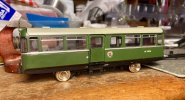
    A bit of run of the mill modern finescale now. What was sold - quite wrongly, it turned out - as a non-running Heljan AC Cars railbus, rewheeled to EM. Anyone familiar with Yeovil's railways will probably be aware of the short workings between Town, Junction, and Pen Mill stations which were handled by various forms of auto or push pull stock with Brighton D1s, LSWR O2s, M7s, a range of panniers and 14xx before latterly these railbuses, made redundant by the closure of the line from Cirencester to Kemble turned up and served until the withdrawal of the services and the closure of Town station. We have an Anbrico one, but I rather wanted my own, it'll serve the limited demands of Ilchester's passengers perfectly well.

    IMG_0550.jpeg

    Conversion was relatively simple - thanks dad (and the EMGS for the instructions) - and just a matter of resolving sideplay and sorting out clearances. Naturally, this meant taking all the underframe detail off. That sounds more conscious than it was: most of it fell off.

    Anyway, here we are. It runs, and I have bagged up all the bits. The next thing to do is to paint the wheels before the frames go back on and adding better mechanical fixings to the bits that have come off.

    IMG_0559.jpeg


    Adam
     
    Rapido Iron Ore Hopper to EM
  • AJC

    Western Thunderer
    A little retail therapy in time for the 11 o’clock coffee.

    Rapido’s latest, the LMS iron ore hopper, in this case branded for limestone. For non-finescale types, or simply those wedded to 00, pop it on the track off you go. It's a lovely model.

    In EM, the NEM pockets are secured by screws and can be discarded (if you like - the screws are nice to have). Wheels are a little trickier, but taking a sharp scalpel to the backs of the brake shoes makes space to clear EM flanges. I found that there was still some resistance and it transpired that the ends of the hinges for the hopper doors were fouling. Out with the scalpel again. You can see how much was removed below. Before:

    IMG_0572.jpeg

    After:

    IMG_0575.jpeg

    And now, ready for couplings and weathering:

    IMG_0576.jpeg

    Adam
     
    BR Ferry Open, diagram 1/055
  • AJC

    Western Thunderer
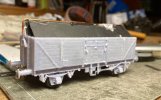
    Both Ferry opens on their wheels now. This side shows up the removal process for the printing supports and the rough, tent-like structure, that will support the sheets. I've made the couplings extra long to allow for the buffer length and my suspicions about the sheet support were accurate: the unsheeted one will have the Rumney Models alternative. Brake gear next and yes, those wheels are actually too small.

    IMG_0581.jpeg


    Adam
     
    Last edited:
    Ratio Clayhood
  • AJC

    Western Thunderer
    A quickie. For a fiver at the Tonbridge show the other week, a Ratio Clayhood. As a simple Morton braked four wheel open this won’t take long, especially as this one will be loaded.

    IMG_0601.jpeg

    At this point, everything from the yellow box that I will use has gone together, and now it’s time to detail the chassis before painting, sheeting and the obligatory coating of clay dust.

    Adam
     
    Top