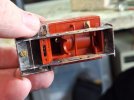
Giles' misc. Work bench.

James Spooner

Western Thunderer
Simon,

That would be a perfectly practical way but not so good on the realistic operation front.

I have just been watching a few Youtube videos of operations on the Welsh Highland and on a lot of them the Garretts are seen slipping one engine while the other plods on! Not always the same one either. The ash train story, where they shunted half the train into a siding at Bedgellert, has slips alternating front and back in the same movement!

In model form a motor to each bogie would recreate that with a bit of deft finger control. But what about the plume of steam from the chimney?

Ian.
Yes, one difference between a Garratt and a Fairlie is in the regulators. A Fairlie has a regulator for each end, which enables the driver to minimise slip at each end, whereas a Garratt only has one regulator to serve both bogies. That means, when one end slips on a Garratt, the majority of the steam is directed to the slipping end and the non slipping end tends to get less steam. Probably difficult to emulate in model form…

Nigel
 

jc2001

Western Thunderer
My 7mm K1 Garrett was fitted with two CT Elektronik decoders - one for each bogie mapped to the same address. Sometimes this used to give erratic behaviour where one bogie ran faster than the other. It's now fitted with Zimos with better stay-alives and this is far less common.

John
 

simond

Western Thunderer
Given the availability of pickups I’m surprised you bothered with KAs? Presumably the pickups on the two bogies are linked?
 

jc2001

Western Thunderer
Yes the pickups are linked. The stay-alives are more belt and braces than anything else. It certainly is the most reliable runner of my NG engines.
 

Giles

Western Thunderer
My 7mm Garratt likewise has two decoders (one with sound) but otherwise identical, and of course identical motors. Even with identical settings, the front and rear engines don't share identical characteristics, leading to one sometimes slipping going up the bank! I previously tried a single decoder driving both engines, but that was much worse.....
 

Giles

Western Thunderer
Some time ago, someone asked if I would build them a 7mm scale Decauville, to which I replied 'absolutely not' - as I knew just about enough about them to realise how frighteningly small they were, and how impossible they would be to motorise etc.etc.....
Having completed the 16mm one, I started looking round for another project, since I can't start on the 7mm NG layout that I would like to, owing to the fact that I haven't managed to get rid of Denton Brook yet. I do like a challenge, so I hypothetically started looking at a 7mm Decauville since I know it a lot better now, and I had drawn up the boiler unit plus many components - and if I was to build it in 7mm, 14mm gauge, then printing would have to play a major part!
Back to the computer, I carried on drawing up tanks and built up and assembly which would give a practical void for a battery a receiver. Why Radio Control on something so small? Because I couldn't find a sensible and decent solution for a conventional motor gearbox that would fit, and I could  just squeeze an 8mm dia gearmotor in..... I know the 2mm wizards would have had no problem, and do such things and more without thinking, but that is why i look, at their works with awe and wonder....

Anyway - having found possible solutions, and put off all thoughts of valve gear, and ever worse, the dreadful motion brackets, to another day (month or year...) work could start. Frames first - nickel silver, silver soldered. Three pairs. Did I mention I decided to build three of the loco's?


Smokebox door latch


Giles

Western Thunderer
I'll tell you what Matt - I'll print you a body, and I'll watch you do the chassis!

The footplate valance and support bracket are silver soldered on (to the footplate) and will form part of the body assembly, not the chassis. The angle on the rear of the footplate allows the fixing of the cab backsheet.

20250408_1333051744116603448.gif

The view from the underside showing the cradles for the gearmotor, the slot for the on/off switch and the three holes for the switch wiring. The charging socket will fit in one side of the smokebox saddle. All three locos are at this stage.

20250408_1332321744116603476.gif
 

Giles

Western Thunderer
3 little maids progressing. Note the handrails are silver-soldered in, and provide a nice location for the body. The handbrake stanchions were turned up on the Unimat 3. Eventually the cab floor unit will be epoxied to the boiler/tank print.

Although I have made Walschearts in this scale before, it is teeny on this loco, and there are three sets.... I have ordered a ComMarker B4 50W fibre laser. I also haven't mentioned this to Di yet..... it was a bargain......
This (once I have mastered it) should make short work of cutting out (and drilling the holes in) all the valve gear and any other bits and pieces.


Giles

Western Thunderer
It should be no problem with the right technique. A lady managed to cut a disc in 4mm aluminium, and though it took a ridiculous time to do that, and frankly wasn't usable enough in our terms is surprisingly good. 1mm nickel silver shouldn't present too much trouble, and more if needed. The benefit is one isn't limited by the tool radius, one can drill very small holes, notches etc. Like etching on steroids.... its one of those things that when one finally masters it, one may be able to do all sorts of tricks...
There is of course a size limitation to the work piece. The bigger you go (lens wise) the less power you have available. It comes with a 100mm and 200mm lens, so you get full whack with the 100 (x100mm work area) lens, but only 25% with the 200 (x 200mm work area) lens. I have also ordered a 150 lens which should give me a 50% rating, which should be perfectly adequate to cut stuff out.

I expect it to be a significant learning curve!
 

Fitzroy

Western Thunderer
From the youtube videos I've seen the etching depth is very impressive. I'm curious to see if it's possible to etch a 3D shape and then use it as an electrode to spark erode tool steel.
 

Giles

Western Thunderer
Doubtless I shall post all the trials and tribulations....! I am also in luck, as I duly confessed my misdeed, but Di was very enthusiastic when I showed her a couple of videos showing the kind of things this type of laser could do, as her first question was 'does it work on silver?'
 

Giles

Western Thunderer
Most unexpectedly the laser arrived more than a week early! The box was of extremely sturdy cardboard with excellent corner protection, and nothing was in anyway damaged (ive not powered it up yet). Assembly took around ten minutes, and although a third hand would have been quite useful, was quite easily accomplished.
I now have to build a simple but effective enclosure so as not to get my eyes zapped by the unpleasant 1064nm light. I shall monitor work in progress via a camera.

 
Top