Giles' misc. Work bench.

Fitzroy

Western Thunderer
By off-setting the cutting line by 0.5mm, and cutting the "fill", I had no problem in cutting through 2mm brass, and doubtless it would cut through thicker, though I think it would be necessary to widen the off-set line. However, this technique has implications for cutting fine detail, as acute angles would start to have issues the thicker you get. I am also using a 110mm lens at the moment, which gives me maximum power. The drawback is that the laser head is set lower for this lens, so the angle of the kerf deteriorates quickly as you increase the size. This may not be a significant problem on thin sheet, but would be cutting large components out of thicker materials. A 200mm lense is included, and is set somewhat higher which greatly helps, but reduces the power output to 25% by area. This simply means you need a lot more passes to do the same job..... I also bought (but have not yet received) a 150mm lens as a halfway house.

The 2mm brass

Having satisfied myself that this wasn't a fluke and the principle behind it was a good one (and recorded the settings!) I then left that, and cut the reverser quadrants for the little 7mm Decauvilles. These are out of 0.28mm NS, and cut in about 30 seconds. I really wanted the notches, and they came out fine, but they're very small to handle!

At that level of accuracy functional gears are a reality, even if you have to run them in on a lathe or similar. It’s looking pretty exciting!
 

Giles

Western Thunderer
Indeed..... previously I have laser cut gears out if Trotec on my diode laser, which were fine for slow speed running - fitted to two cranes and the traction engine. For some time I've not been able to cut Trotec since they changed the formula. The ComMarker will make a very much better job of it, in brass, nickel silver or steel!
 

Fitzroy

Western Thunderer
If you were super cunning you could potentially use a large kerf angle to your advantage when doing things like contrate gears. I’ve made replica Bassett Lowke contrate gears with virtually no kerf angle using a commercial laser cutter to cut the blanks and then pressed them and run them in against a pinion on a lathe, but looking at this I was thinking you could practically make a 7mmv scale Austin 7 diff with straight cut pinions around M0.2 for the differential part and a pressed crown and pinion. Having a large kerf angle would be useful, whether you were making a pure contrate or an attempt at a bevel.
 

simond

Western Thunderer
i rather think that unless the centre of the gear were directly below the lens centre the kerf would be uneven around the gear, which would rather kibosh that, unfortunately
 

Fitzroy

Western Thunderer
Yes but if you are pressing the gears to give them a bevel any help in kerf will make this more effective, also with contrates a few degrees makes a huge difference in the amount of running in required. This is only a theory at this point, I fully intend to try it out if/when I get my own laser. Given this working theory is currently my major justification for buying a laser, even if unsuccessful it might well serve it's purpose! For a 36 tooth gear 5 degrees of kerf angle would be perfect which for something like 48 dp (eg a bassett lowke contrate) is in the broad region of what I'm after but you are right- tiny gears wouldn't offer much advantage at all.
 

Giles

Western Thunderer
As an aside, last weekend we went to the EM show, and I finally got the chance to pick up some wheels to convert a Bachmann Dukedog that I obtained from an Honourable WT member a while back to EM. I was aware that converting it wasn't quite going to be a picnic, but it sure wasn't.... it was one of those jobs that just fights all the way..... about the only easy bits were the pony truck and actually fitting the drivers and cranks (I had lasered a pair of quartering plates, so that job was dead easy with no hassle. I ended up having to laser twenty odd washers from brass, because I hadn't got any (it felt a bit silly using that sort of technology just to make washers....!). But the biggest headache turned out to be the keeper plate binding, which took me ages to work out... Meanwhilst I lost one brake hangers, and had to make another.... it was like 'The Gas Mas Cometh".
Anyway, it runs reasonably, although I was quite close to just making a new chassis for it. I still have to fir new brake rods, make new number plates and fit screw links etc... but I always had a soft spot for these.....


timbowales

Western Thunderer
Having a soft spot for the Cambrian Coast lines a Dukedog is on my to do list. I was saving up for a Bachmann one but having read this maybe I had better keep an eye on ebay for a K's one instead :(
 

Giles

Western Thunderer
Well - I'm glad I persevered, as the body is really nice, and captures the Dukedogs very well. If I were doing it a second time it would take half the time.... as I wouldn't go up various blind alleys..... I ended up making back to back gauges from tube, whereas some nice ones from angle would have been easier. A couple of the Gibson wheels gave me a little grief, but it's not easy pressing any wheels on square.
 

Mike Garwood

Western Thunderer
but it's not easy pressing any wheels on square.
No it's not, unless you have a lathe. It's always been a source of amazement that there isn't something else available to push wheels on with. GW wheel press excluding. Or if you're the late Steffan Lewis who used to put press on wheels on axles with a toffee hammer - no, not kidding.

Lovely work on your thread, always inspirational.

Mike
 

Pete_S

Western Thunderer
Two trial numberplates for the Dukedog. It was only when I was halfway through the second when I realised that the first 9 should be offset to the left... so new ones to be made. This loco carried Red plates. The black is undercoat.
Laser etched and cut on the ComMarker.
I feel uncomfortable saying this, but
Proof of Concept = 10/10
Fidelity to Prototype = 3/10. The plate corners are too square & the numbers are at best 'similar'.

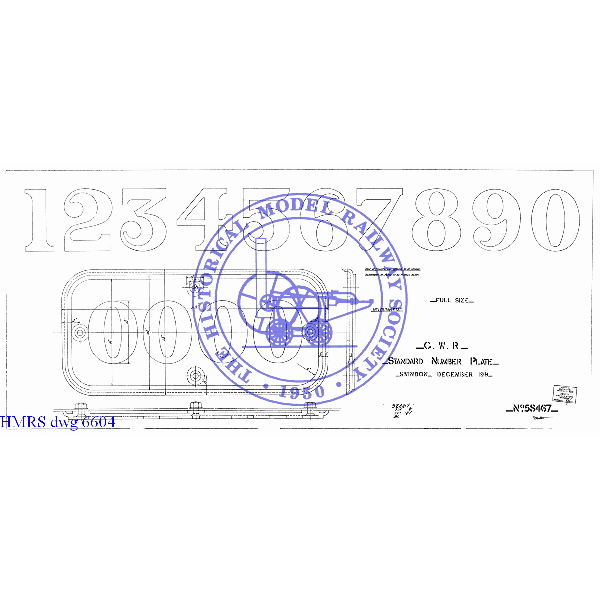
There are works-derived drawings in GW Way and the HMRS have digitised Swindon drawing 58467 dated 12/1919

One of 9018's original cabsides was auctioned by GC Railwayana in 2022:

This test was a combination of my diode laser to burn off the resist, followed by about 45 mins in Ferric Chloride - artwork derived from similar sources as above.

1423 Plates 04.jpg

Pete S.
 

Giles

Western Thunderer
Thanks Pete! I had already twigged the corners and made the alteration - and also that the plate is actually too big.... do you have readable overall dimensions on that drawing? I can't make them out.... I may be able to find an improvement on the letters, but I'm a little limited on that front. Still, I should like to get as close as I can....
 

Giles

Western Thunderer
Its really good to have genuinely constructive comments like the above. It helps one see things through slightly different lenses. I've managed to find a GWR workshop drawing of plate and number font, and spent a couple of hours drawing them up accurately 1:1, so in principle i can do any number (for my one GWR loco......) in any scale (within reason!). I now have to persuade the laser to work between the correct sets of lines....
 
Top
