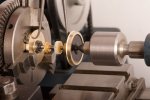
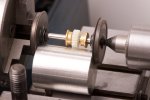
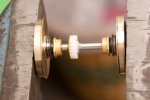
Heljan class 45/0, conversion to S7

Foreword New
  • RichardG

    Western Thunderer
    I'll post my foreword tomorrow. I think I will find the thread easier to handle if people are able to comment on what I have written.

    Foreword.

    This is an account of my first conversion of a loco to ScaleSeven. I am concentrating on details I have not seen written up elsewhere. The account is not intended to be definitive or prescriptive; but is rather an opportunity for me to share some of my own methods and mistakes. When I use the imperative tense, this is for brevity not as a directive.

    This entire model, bought brand new after the takeover of Heljan by Accurascale, cost barely more than eight axles of wheels from Slater’s. The design and manufacturing processes have made obvious economies.

    DSC_2620.jpeg
    In particular, the tyres are plated and carry marks from the factory tooling. Underneath the plating the wheels are solid brass, and a very hard grade of brass at that, and they are horrible to turn. This exercise isn’t as much fun as it might appear.

    Nevertheless, the model runs as a 1-A-1-A + A-1-A-1, with the powered wheels supporting the model and the rest simply going along for the ride. With only four powered axles, the task is less daunting than it might appear; really the model is a Bo-Bo with extra carrying wheels. The only really fiendish thing I have found is refitting the two outermost axles.

    For 0-MF modellers:

    Experience and received wisdom tells me, a wagon with S7 wheels can run happily on 0-MF track. My deviation from the standards has been to set the B2Bs to around 29.8 mm, being 0.5 mm greater than the usual 29.3 mm for FS. The Heljan wheels here are held on their axles by friction, so it seems perfectly possible to do this conversion for an 0-MF layout instead of S7; or indeed later to convert my finished model to the narrower gauge. The constraint being how many times the axle bushes will survive being moved.

    For 0-F modellers:

    The Heljan wheels have flanges around 1.6 mm deep; deeper than GOG coarse scale as well as GOG fine scale. I am using the profile tool from the ScaleSeven Group; but I am pretty sure the same methods would convert the wheels to true 0-FS. Just use the applicable profile tool and leave the wheels at their original thickness.

    For all:

    I will pause here, to let me respond to fresh questions before I post about the special tools.
     
    Special Tools New
  • RichardG

    Western Thunderer
    Special Tools.

    DSC_2657.jpeg
    These are the special tools I obtained and made to do the conversion.

    Clockwise from the back:
    • A loco servicing cradle, improvised from a length of Nomapack U 60-80. I don’t know what this channel is made for, but to me it looks like protective packing for a uPVC window. From the ScaleSeven Group at Albury.
    • A wheel puller, improvised from a small G cramp.
    • A nail punch, with the business end turned down to be a loose fit inside the bush of a Heljan wheel.
    • A wheel profiling tool, from the ScaleSeven stores.
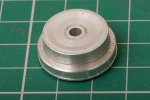
    • Two mandrels and a pressure pad, turned up on the lathe.
    • A back-to-back gauge, also turned up on the lathe (commercial equivalents are available).

    DSC_2718.jpeg
    Two slightly tired mandrels.
    • There are two mandrels, one for each size of wheel. Each mandrel is turned from aluminium bar, with a steel axle from a child’s metal construction set.
    • The reduced end of the axle is a light press fit into the bush of a Heljan wheel. By light press fit, I mean that I can feel friction but no resistance; and there is no discernible free play.
    • The axle is an interference fit into the mandrel, assembled in the lathe as a permanent fixture. For me, the lathe has sufficient strength to do this, the drill press does not.

    DSC_2719.jpeg
    Pressure pad.
    • The pressure pad is small enough to let a cutting tool skim the front of the tyre.
    • The “wheel” side (shown here) is concave to clear the hub of the wheel.

    DSC_2642.jpeg
    Example arrangement of mandrel, wheel and pressure pad.

    When the second bogie was underway, I started to use a couple of 1/4 inch drive sockets in place of the pressure pad. They clamped the wheel more effectively than the pad I had made myself, and so a mixture appears in the photos.

    Your wheels are indeed looking very good, but I know from experience that the most difficult task with this is getting the wheels back on the axles without a wobble.
    To begin, I am using only one back-to-back gauge.
    • My gauge is as close as I can make it to 31.25 mm, certainly somewhere between the limits of 31.2 and 31.3 mm allowed for ScaleSeven.
    • The limits of the allowable back to back dimension (+/- 0.05 mm) emphasise the importance of not having wobbly wheels.
    If the rebuilt locomotive does not negotiate pointwork correctly, I can revisit this gauge and maybe make a second one, so I have a go / no-go pair.
     
    Dismantling and Inspection New
  • RichardG

    Western Thunderer
    Dismantling and Inspection.

    With the model supported upside down, it would be good to run the motors and look for any wobble in the factory wheels. This approach doesn’t work because there is so much side play on the axles, and the wheels just oscillate from left to right. Most on this play disappears after the conversion.

    So I suggest, the best test is to run the model on an 0 gauge layout, and make sure it runs properly before starting. I ran mine at NEEGOG for 20 minutes.

    DSC_2630.jpeg
    Remove all four wheel sets from one bogie.

    The three sets of driving wheels are easy, just remove the keeper plate and lift them out (photo above). Place each wheel in turn over the jaws of the vice and use the modified punch to knock each axle out of its bush. Most bushes stay put in the wheels, a few stick to the axle. If they stick to the axle, they pull off with fingers or a small open-ended spanner.

    (no photo)
    The axle of carrying wheels is more awkward. The pony truck is trapped between the two castings which form the bogie chassis, and so it has to stay put. There is no benefit in removing the compression spring, so don’t ;). Remove the two screws below the buffer beam, and pull off the two plastic side frames. Then use the wheel puller to remove one wheel from the axle, and withdraw the axle.
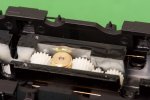
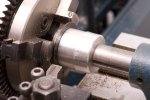
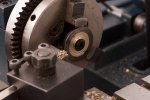
    The wheel puller seems to be a necessity for the carrying wheels, the nail punch is quicker for the driving wheels.

    I worked up one bogie at a time. This way, I could evolve a more efficient approach for the second bogie. I also had an assembled bogie in front of me, in case I forgot how to put things back together.

    DSC_2624.jpeg
    When I opened up my model I found factory grease most everywhere inside the bogies except on the gears. It would be worth checking similar models from Heljan before running them extensively on a layout, even if you are not altering anything. I wiped away the surplus grease and deferred relubrication until later.

    Now is as good a time as any to blacken the axle from the carrying wheels. I used hot bluing, with a microflame torch and a pot of vegetable oil. This gets rid of the shiny finish on the axle ends which is so obvious in the original model.
     
    Tyre Width New
  • RichardG

    Western Thunderer
    Tyre Width.

    The Heljan wheel is about 0.5 mm too thick for ScaleSeven. I remove about half of the excess from the back and the remainder from the front. This leaves enough of the original flange to form the new flange without having to cut into the tread.

    The most important action must surely be, to arrange the wheel to not wobble. The wheel must be flat; and perpendicular to its axle hole. I know the ends of the mandrel are flat and parallel. I also know the front of the tailstock spindle is true; and so is the drill plate (not shown here). What I do not know, is whether the factory hole for the wheel bush is orthogonal; though after subsequently putting the wheel back onto its axle, most likely it is.

    DSC_2638.jpeg
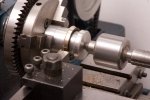
    I press the front of the wheel onto the mandrel, and use the tailstock spindle to move the wheel into the chuck. Then nip up the jaws of the chuck. Placing the the lathe tool lightly against the wheel and rotating the chuck by hand will show whether the wheel is held true.

    I am using ordinary hard jaws in the three-jaw chuck. They haven’t left marks on the finished wheels.

    I tried mounting the plain drill plate into the tailstock, but it didn't seem to improve anything so I put it away.

    DSC_2665.jpeg
    As supplied, the backs of some wheels are convex. Furthermore, although the brass is very hard, the lathe tool can easily deform the flange, pushing it over towards the tread of the tyre.

    Therefore, it seems sensible to start the cut part-way across the back, and to then work inwards and outwards. The light score marks near the periphery of the wheel help to confirm it is true in the chuck.

    DSC_2658.jpeg
    I remove about 0.22 mm in a few passes . . .

    DSC_2663.jpeg
    . . . and finish with a skim of around 0.03 mm to impart a reasonably smooth finish.

    Do this for the other seven wheels.

    DSC_2692.jpeg
    Some deformation of the flange seems inevitable, however hard I try. This is easier to see when the profile tool is against the wheel (later). The factory plating on the tread is so thin it is translucent.

    There is now a choice as to what to do next. For the first bogie, I formed the flange and tyre; and for the second bogie, I faced off the front of the wheel. The second method keeps the same tool in the toolpost for longer. I illustrate the second method here.

    Secure the large mandrel into the chuck and install the live centre into the tailstock spindle.

    DSC_2673.jpeg
    I turned a pressure plate from aluminium but the 1/4 inch socket works better. It grips better and it lets the tailstock sit further away. The live centre fits very happily into the square hole in the socket.

    Now, I don’t want to state the blindingly obvious, but do remove any grease sitting on the mandrel or wheel. This has caught me out a couple of times. The clue is when the tailstock hand wheel feels like an impossible stop cock.

    Reduce the front of the tyre to give the desired thickness.

    Some of the specifications for ScaleSeven quote hundredths of a millimetre. I am thinking especially of the tyre width, 3.21 mm. The micrometer is more believable than the digital caliper, and I used the micrometer to check the tyre width. I took each wheel down to around 3.22 mm.

    DSC_2675.jpeg
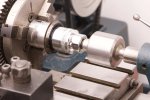
    The same mandrel and a smaller socket hold the smaller wheel for the same process.

    Do this for all eight wheels.

    (next: tyre profile)
     
    Last edited:
    Tyre Profile. New
  • RichardG

    Western Thunderer
    Tyre Profile.

    Measure the diameters of all the wheels, and put the smallest one back onto the mandrel.

    DSC_2696.jpeg
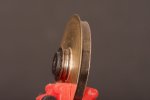
    The deformation of the flange I mentioned earlier becomes more obvious when seen beside the profile tool.

    DSC_2635.jpeg
    The profile tool ought to remove the plating across the width of the tread in one go. If some plating remains, the tool is not orthogonal to the lathe spindle and needs to be squared up.

    DSC_2705.jpeg
    As the profile tool reduces the height of the flange, it cuts away the distorted metal.

    DSC_2701.jpegI use the profile tool to remove all of the plating, and then a further 0.08 mm of metal. Just enough to make sure the wheel is concentric on its mandrel.

    DSC_2700.jpeg
    Then mark the setting of the hand wheel on the cross slide.

    It is then straightforward to leave the mandrel, leadscrew and cross slide untouched, and use the cross slide to form the treads of five more driving wheels.

    DSC_2709.jpeg
    Put a tiny bevel on the outer edge of the tyre. I make this about 60 degrees, and about 0.015 mm deep front to back.

    The bevel removes any tiny pieces of metal pushed over the edge during the profiling operation. The bevel also represents a feature present here on a prototype wheel, though I haven’t checked the detail on a real class 45.

    Guess what - do this for the other five driving wheels.

    It is now time to finally remove the faithful mandrel, set up the smaller mandrel and complete the two smaller wheels. Maybe it is me but I found the smaller wheels even more difficult to turn. The grade of brass grabs and chips and I was on the verge of stopping to buy four new disc wheels. But I persevered.

    DSC_2715.jpeg
    The wheels are now ready to be cleaned, blackened and put back into their bogie.
     
    Last edited:
    Top