Tyre Width.
The Heljan wheel is about 0.5 mm too thick for ScaleSeven. I remove about half of the excess from the back and the remainder from the front. This leaves enough of the original flange to form the new flange without having to cut into the tread.
The most important action must surely be, to arrange the wheel to not wobble. The wheel must be flat; and perpendicular to its axle hole. I know the ends of the mandrel are flat and parallel. I also know the front of the tailstock spindle is true; and so is the drill plate (not shown here). What I do not know, is whether the factory hole for the wheel bush is orthogonal; though after subsequently putting the wheel back onto its axle, most likely it is.
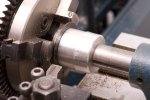
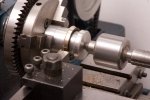
I press the front of the wheel onto the mandrel, and use the tailstock spindle to move the wheel into the chuck. Then nip up the jaws of the chuck. Placing the the lathe tool lightly against the wheel and rotating the chuck by hand will show whether the wheel is held true.
I am using ordinary hard jaws in the three-jaw chuck. They haven’t left marks on the finished wheels.
I tried mounting the plain drill plate into the tailstock, but it didn't seem to improve anything so I put it away.
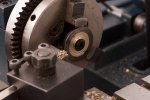
As supplied, the backs of some wheels are convex. Furthermore, although the brass is very hard, the lathe tool can easily deform the flange, pushing it over towards the tread of the tyre.
Therefore, it seems sensible to start the cut part-way across the back, and to then work inwards and outwards. The light score marks near the periphery of the wheel help to confirm it is true in the chuck.

I remove about 0.22 mm in a few passes . . .

. . . and finish with a skim of around 0.03 mm to impart a reasonably smooth finish.
Do this for the other seven wheels.
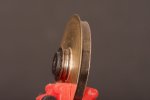
Some deformation of the flange seems inevitable, however hard I try. This is easier to see when the profile tool is against the wheel (later). The factory plating on the tread is so thin it is translucent.
There is now a choice as to what to do next. For the first bogie, I formed the flange and tyre; and for the second bogie, I faced off the front of the wheel. The second method keeps the same tool in the toolpost for longer. I illustrate the second method here.
Secure the large mandrel into the chuck and install the live centre into the tailstock spindle.
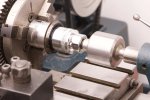
I turned a pressure plate from aluminium but the 1/4 inch socket works better. It grips better and it lets the tailstock sit further away. The live centre fits very happily into the square hole in the socket.
Now, I don’t want to state the blindingly obvious, but do remove any grease sitting on the mandrel or wheel. This has caught me out a couple of times. The clue is when the tailstock hand wheel feels like an impossible stop cock.
Reduce the front of the tyre to give the desired thickness.
Some of the specifications for ScaleSeven quote hundredths of a millimetre. I am thinking especially of the tyre width, 3.21 mm. The micrometer is more believable than the digital caliper, and I used the micrometer to check the tyre width. I took each wheel down to around 3.22 mm.
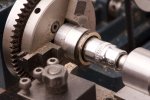
The same mandrel and a smaller socket hold the smaller wheel for the same process.
Do this for all eight wheels.
(next: tyre profile)


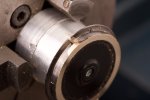


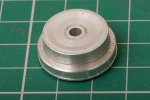


 And sourcing steel tyres, if a thick-walled tube is not available of the correct size, can be a bit of a pain, usually requiring the making of blanks from rod and trepanning the centre out.


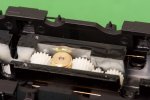
 . Remove the two screws below the buffer beam, and pull off the two plastic side frames. Then use the wheel puller to remove one wheel from the axle, and withdraw the axle.