7mm On Heather's Workbench - North Eastern interlude

BG steps complete
  • Heather Kay

    Western Thunderer
    EC04140A-2D2D-4BB7-830C-980828B19E64.jpeg

    1A4192D6-4839-4E52-B649-E8EE6E549233.jpeg

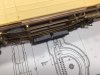
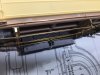
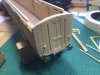
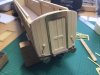
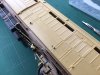
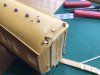
    Well, that’s steps and vac pipe sorted. Again, the Bits Box provided for the extra steps under the guard's doors. The brackets are a bit too far apart, but I’m not telling anyone, and neither should you! ;) The second cell box came off eventually, after some careful prising with blunt instruments. Apart from the glue joint of several decades, nothing got broken.

    I need to sort the vac connections to the cylinders, then I can think about making the steam pipe, vapour trap and the extra electrical box. Thanks to Mike - again - for pointers in that direction. My only worry is whether vans still had their original electrical gear at the end of their lives. It strikes me such things may have been ripe for replacement with the current (ha!) standard equipment at various times. Clear images, though, seem to be few and far between.

    I have been giving a little thought to representative cabling for the dynamos. Just something to give the right impression, and to add to my favourite busyness in the gloom. Thinks are also being directed to the headstock detailing. I’m going to need to make up some buffer saddle stowage blocks, though I could just glue the saddles on the ends of the headstocks and be done. The dropped end of the BG will need dummy stowage blocks, though.
     
    BG frame detailing
  • Heather Kay

    Western Thunderer
    That was, surprisingly, quite a lot of fun.

    5AD537B0-2D85-43D1-8B68-7C084E4FC2E0.jpeg

    Can you see it?

    536B1239-232E-4277-AE72-B80B9C14ED56.jpeg

    How about now?

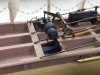
    The steam pipe is 0.9mm brass rod, wrapped in masking tape to simulate the asbestos lagging. The steam trap is a reasonably close approximation to size and shape, filed from some 1mm black styrene with added brass wire to give the impression of the various nuts and bolts.

    Now, time to tackle the box.
     
    Dynamo wiring loom
  • Heather Kay

    Western Thunderer
    On reflection, and a quick scan through photos, I’ve decided not to fit the extra electrical cabinet. One reason is the dynamo setup on the models is different. I think it represents the more common Stones system, and doesn’t have the tension spring. Well, actually, the kit dynamos have very little detail at all, but quite sufficient for dangling in the dark under a model coach.

    0A19CC10-43DC-4490-9916-3BF4A27679BB.jpeg

    What I have done is twist up a quick loop of copper wire and glue it approximately in place to sort of give an impression of the wiring loom from the dynamo up into the frames and thence to the switchgear and battery boxes.

    With that, and still no sign of anything coming from Kemilway (I spoke to an answerphone earlier, and I will charitably assume Mr D is away on a holiday rather than avoiding my calls), I’m calling the underframes finished. Time to get on with headstock and drawgear fitting.

    Monday, I think. When I shall also call Mr D again. Plan B is to acquire the suitable 8ft bogie kit from MM1, and then claim my money back from the other party. It’s gone on long enough now, even allowing for all the usual hiccups we’ve been through this past 18 months and more.
     
    BG end detailing
  • Heather Kay

    Western Thunderer
    Just to show I’m actually doing something, rather than fretting about missing bogie kits…

    43E3EE5D-63FE-480A-B683-E704FD93B1C1.jpeg

    A Kadee has been installed in one end of the BG. Obviously this entailed excising a portion of the headstock, but that wasn’t very hard. As I mentioned a while back, when doing a quick overview of the kit underframes, the moulding was designed with Kadees in mind.

    9429A23D-1544-46C2-B018-A594D0602557.jpeg

    The other end has been furnished with a JLTRT dropped buckeye assembly. The next job is to fit some dangly bits, install the cast buffers and make them a bit bouncy. It should look nice and busy when I’m done - if I can find my energy and an extra bucket of enthusiasm.
     
    Lighting connectors and gangways
  • Heather Kay

    Western Thunderer
    Today, attention turned to further detailing the body ends.

    A7B3C56F-09A2-4523-AA73-5D56A01A6FAE.jpeg

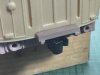
    First, I dealt with the carriage lighting connectors. The basics were moulded on, but the wire was missing. Some careful drilling, and a short length of thin copper wire and that looks better.

    While we are here, note the area for the gangway fittings. Two slots and an 'ole at the top.

    826BC5A2-1888-4B2D-8BF0-0D24C2FD478B.jpeg

    8B58989C-C8BA-4166-84ED-1B1294A8E767.jpeg

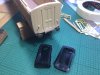
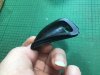
    This floppy wotsit, moulded in some very soft rubber material, was provided. There’s a peg at the top, meant to go in the hole, and two raised parts along the sides to fit in the slots. You can sort of see why I decided to go with the Slater's Pullman gangway kits.

    They, however, are not without their problems.

    AA1950C7-9E47-42E8-B55D-6C0B57038BBF.jpeg

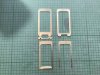
    On the left, the etch parts as they come; on the right after I’ve been at 'em.

    Sadly, the Slater's parts are not a straight drop-in replacement. First, the bottom of the gangway is moulded into the floor of the coach. That meant the bottom of the etched rear panel has to be chopped out. A short amount also needs trimming from the bottom.

    C9A62527-8FA0-47EE-8D59-43EAB8E76245.jpeg

    Once done, the rear plate fits like this. I can still see the slots behind it, and I’m in a couple of minds about what to do about it. I can ignore the slight gap, which probably won’t be visible when it’s all black and grungy, or I can fill or cover the slots. Thinking on that.

    CF998511-5405-4CE9-94E6-30F660C4F252.jpeg

    Mods to the front plates is limited to chopping out the folded down floor plate. Oh, and adding a lamp bracket. A cursory check on photos and drawings shows a variety of positions and numbers, but for sanity's sake I added one low down to the left side.

    I need to blacken the brass parts, and make up the paper bellows parts, and assemble the gangways. It’s Friday, and I’ve run out of puff. Have a good weekend everyone!

    *wave*
     
    BG bogie substitution
  • Heather Kay

    Western Thunderer
    4F6A5709-4EA3-411B-BCEB-2BEE36BFDBC8.jpeg

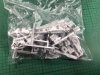
    From the Austin Princess (the old coach-built one) to the Austin 1100 (the one in baby poop brown). Here's a bag of whitemetal bits for a pair of 8ft Gresley bogies from MM1, née JLTRT. Laurie Lynch admitted the mould is getting tired, and I will certainly be increasing my lead intake after this lot.

    Still nothing heard from Kemilway, though I haven’t chased. First thoughts were to write a letter, requesting a refund on the missing bits. I thought to wait for actual money to appear in my account, then to return the various parts I have. Best Beloved thought it might be wise to simply write off the loss, and keep the brass parts as they may come in handy. You know, I think he might be right. I may well attempt to use the brake parts to upgrade the cast kits.

    This is a way off as yet, but not too far. Just some other odds and ends that need sorting out before I get back to this North Eastern odyssey.
     
    The state of play
  • Heather Kay

    Western Thunderer
    Nothing much to show, but I’m working on bodies. My aim is to bring things up to a point where painting might begin.
    • Holes are marked/part-cast for the various grab handles and door handles. I’ve been reviewing drawings and photos to work out the variations on guard door handrails.
    • Handling over the past few years has had the tendency to knock off the long lower door hinges, so I’m working on replacing those.
    • The moulded slots on the ends, intended for the original gangways, need to be filled flush to the bodywork.
    • Late in their life, as these models will represent, many coaches had been converted to rail-level WC tank fillers. I wonder if the various grab handles associated with filling from the roof remained in situ. I do like a bit of clutter on roofs.
    • I am considering how to modify the cast passcom detail to more accurately represent the real thing, or whether to scrap the valve boxes and replace with better versions.
    That ought to keep me busy for a while.
     
    Hinges and handrails
  • Heather Kay

    Western Thunderer
    First job today was chopping short lengths of NS strip, as the nearest thing to the right size for the replacement hinges.

    325FAFD4-E614-4069-BBB3-9051A7DF7AA6.jpeg

    As is prudent under such circumstances, I made far more than I needed. Lucky, really, because my chopping wasn’t consistent and some were too long.

    789DA04D-9952-453B-BD34-0F0B452F54B4.jpeg

    Here are two bottom hinges in place on the BTK. Running a straight edge along the upper hinges, the bottom ones appeared too long. However, comparison with the original undamaged cast hinges showed them to be not far off. Under a coat of paint…

    8141198B-BB5B-4A83-963C-5AE72E912181.jpeg

    Still trying to work out the luggage door arrangements. My confusion is demonstrated quite well here. You can just see small arrows I’ve pencilled in to show holes. At the top, the full brake, with the brake third below. Note a single hole in the right hand door on the BG. Photos - and a works drawing - show a large lever lock handle in this location. On the brake third, however, I have two holes. This implies - borne out by drawings - a grab handle but no lever lock handle. In both cases, the left hand door has a standard tee-handle.

    As for the standard passenger doors, just a relatively simple commode handle is required. I can cope with that. In fact, they were supplied with the models already formed up. I shall need to check the wire used isn’t too thin. My usual recourse is 0.7mm wire, but something thinner seems more appropriate for the Gresley style. I’ve found a couple of lengths of 0.6mm wire which seems ideal.
     
    Filler pipes and things
  • Heather Kay

    Western Thunderer
    Work has been progressing very slowly here.

    My main focus has been working out piping runs up the ends. As built, the WC header tanks were filled from the roof. Later, pipes were fitted to allow rail-level filling. The pipes for this are quite visible, but I’ve been struggling to find how things were handled once the pipes reached roof level.

    The obvious thing is they must have been routed to the filler cap along the roof, like most other companies and BR did. Do you think I can locate any images to illustrate this? Of course I can’t! So, some further interweb rummaging ensued.

    Several preserved examples show the filler pipes ducking into the body below the end of the roof. This makes a lot of sense, since the roof ends curve down, and making plumbing fit neatly - as well as routing among the passcom gear - would have been messy. I am going to follow this example, as I can’t find anything that shows otherwise, and it will make life so much simpler for construction.
     
    Roof detailing
  • Heather Kay

    Western Thunderer
    Butterfly making today.

    6B91BF0B-3ED8-4F4C-AB17-549ECFEE7CF7.jpeg

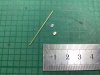
    From Mike's drawings and photos of the LNER drawings, I gauged the size of the "wing" to be about 5in by 2.5in. Rummaging in my scrap box found some nickel silver etch that was about thin enough to withstand my mauling. I solder laminated four pieces together, marked out the shape, and set to with files. Amazingly, it looked about right. You can see two in the photo, plus a length of brass wire for the main rod.

    3E7F9728-0E20-4958-B13A-CC0C51C3FDC4.jpeg

    The hardest part, frankly, was filing a tiny flat aligned at each end of the rod so the "wings" ended up in the right place. The blob of solder is sufficient to represent the fixing - the butterfly was screwed onto the end of the rod. Happy with that. A drop of superglue will hold the rod in place.

    Now, to those roof handrails… the tank filler caps on the all third coach are offset 9in from the centreline, with a ventilator the same the other side. I shall go with the 2ft offset for handrails there. The brake coach has a centreline filler, so 1ft 10in sounds right. Variety is the spice of life.
     
    Door cornices
  • Heather Kay

    Western Thunderer
    757F70CE-1CCA-4CEA-8DB5-2FE54B5F9D95.jpeg

    219D763F-81C3-489E-AA70-EC3FE9949BC6.jpeg

    Can you see them? I’ve managed to simulate the door cornices (that’s the word I couldn’t find yesterday). They’re basically a slight extension of the gutter rail to encourage water away from door openings. I’ve used some very thin styrene strip and managed to attach it along its edge to the gutter ledge using cyanoacrylate.

    Now I think the roofs are finished. Time to think about the insides.
     
    Guard's accommodation
  • Heather Kay

    Western Thunderer
    3406C395-8613-4250-A18E-78F02DC375FF.jpeg

    I wasn’t planning on going overboard with the guard's fittings. However, I was surprised at how much would visible through at least the door windows. I’ve raided the spares for the heater and vacuum brake control, handbrake stand with styrene box addition, and the secure locker/desk. The rest has been knocked up from styrene strip and scrap. The fire shelf will have extinguishers and buckets, of course. The only thing I can’t make from scratch is the letter rack. It’s a wire mesh affair, which might have to be quietly ignored, save for the back sheet visible through the top light over the desk.

    This is the problem when kind folk supply really useful drawings and photos.
     
    A primer coat
  • Heather Kay

    Western Thunderer
    After some more fussing about with interior bits and pieces, I’ve bitten the bullet.

    60787A50-7797-4CDA-8BC1-9C51FD52CFDA.jpeg

    FE3EFE1F-2A4A-4543-85A0-16772C731280.jpeg

    5F3C67CA-EC71-46FE-BA0C-B46EEBA5DA9A.jpeg

    Primer on the bodies and roofs. It’ll make a nice change not seeing the Milky Bar cream any more. I need to set up for primer on the various internal parts, and then I can begin to seriously think about livery paintwork.

    My problem with painting is having to set up the gear on the bench. It sort of hogs things, and it makes sense if I can arrange for several models to be going through the process.
     
    Undersides painted
  • Heather Kay

    Western Thunderer
    5B3C2A44-36AE-4305-A96D-0EA7EF1246A8.jpeg

    I need to order more paint. A rough mix of matt black and matt brown enamels made a batch for three underframes and two pairs of bogies.

    No, really. I need to order more paint! I’ve cleaned out the black and brown enamels in my colouring box!

    Anyway, I’ll inspect that lot in daylight tomorrow. If I’m happy, I’ll leave well alone so it all hardens nicely. Then, getting the main livery colour on the sides will be next.

    Exciting times.
     
    Interior painting starts
  • Heather Kay

    Western Thunderer
    That was a half decent weekend. Being self-employed, I tend to work when the muse is upon me, and after a rocky week where my brain went on a go-slow I felt I needed to try and catch up.

    2C246760-CAA4-4BF6-A5D0-FFB2B0211EF7.jpeg

    So, what did I do. I brush-painted the roofs in a dark grey. It’s not as matt as I’d like, but a good basis for weathering and matt varnish later. The main interior parts were given a base coat of something sand coloured. I’m still poking around for good colour images to show the interior woodwork, but this is a good start.

    8BF74767-5B13-4DDA-A5FC-027703327B28.jpeg

    The same sand colour went on the brake compartment details. I’ll leave these this base colour, and just varnish.

    E97595E9-233B-469E-ADE6-E3883225510B.jpeg

    All three bodies got the sand treatment, too. I rather think I’ll get the interior colours done before painting the outsides. This is partly because blobbing paint through windows won’t matter so much, and it’s easier to handle things as they are at the moment. Although they’ll barely be seen, I will mark out where the door shuts go, and quite possibly paint the door insides a different colour. Photos seem to show dark stain or varnish on doors, particularly in the brake compartments.

    So, now the brain cell's industrial inaction seems to have passed for now, I look forward to a productive week.
     
    Seat patterns
  • Peter Insole

    Western Thunderer
    Heather, the Eastern region seem to have been quite content to continue with several of the earlier LNER patterns - presumably on the principal that only spanking new stock would carry the new fabrics designed especially for them?!

    LNER C5b on time 8-94 - this coach GE16631E - is still rotting, now at Ongar - 2014.jpg

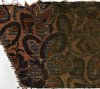
    Many years ago, when I did the sketches for this pic, the coach was quietly rotting in a siding, and although most of the interior had been ripped out, four complete seats remained in situ - complete with the extremely badly damaged and faded fabric that was clearly still fitted when the coach (in lined Maroon) was withdrawn! I was able to remove a small fragment that included a protected section from underneath a squab.

    LNER Tollerton 1.jpg

    Further extensive research - including at the NRM - revealed that this pattern; "Tollerton", was very widely used across the LNER and Eastern Region. Oddly, none of the carriage restoration groups have ever mentioned it - or indeed seem to have even heard of it?!

    I produced some deliberately simplified artwork - by tracing off the surviving section, and filling in the gaps from photographs, for a Love Lane project.

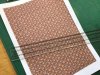
    LNER Tollerton 6 This pattern repeat is 19 x 12.75 inches.jpg

    The colour will need mucking about with and bumping up quite a bit for a workable print off - I think ours came out far too light as it happened, but never mind!

    The section drawn is the repeat pattern, times four - the total scale size of the above image is 19 inches by 12 and three quarter inches.

    I do hope you might find this useful, if not for the current commission, but any others that might come your way?

    If anyone else would like to have a go with it as well, then please feel free!...

    Pete.
     
    Interior small parts detailing
  • Heather Kay

    Western Thunderer
    169AE5E0-483B-454F-9F88-10D8F803C46A.jpeg

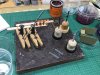
    Small parts painting under way. Right at the back you can see four label clips, which really should have been attached to the brakes before they got painted. Never mind. I’m always doing silly things like that.

    I have also checked my transfer stash and I’m pleased to report I have sufficient branding for the guard doors without needing to order any more! A bit later, I’ll confirm the coach numbers I plan to use.

    As well as printing seat coverings, I’m considering doing the same for the compartment dividing walls. A suitable image of varnished teak veneer will look okay, and I could even include the picture frames. I shall think further on this.
     
    Brake compartment details getting there
  • Heather Kay

    Western Thunderer
    You’ll be wanting a coffee stirrer then…

    Old paintbrush handle. ;)

    D8C51F03-A468-411F-9EC5-83A482A90125.jpeg

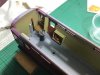
    I have begun to fit brake compartment parts. Here is the brake third. The seat and ducket will be treated to a suitable moquette in time. Of course, I couldn’t resist fitting the roof to see how much of my hard work remains at all visible.

    0DAFAFF6-391B-4916-8D5C-46DFF7113A44.jpeg

    I think the answer is, along the lines of Rolls-Royce salesmen when asked how much power the car might have, sufficient.
     
    Top