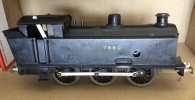
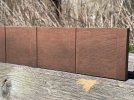
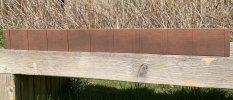
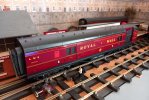
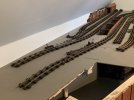
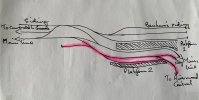
I refer to my posts #195 and #196 from November last year. Work commenced on rebuilding the next Lowko Track turnout but then stalled — first due to a broken 12BA tap, then due a broken electric drill. However, both broken items have now been replaced. Further encouragement to restart work on the turnout comes from installation of the base-board reported in my post #336:
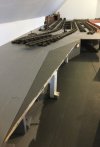
Until a couple of weeks ago, the area behind the new section of base-board (to the left in the above photo) was being used to store track panels. Standard 15” pieces of Lowko Track plain line sorted and stacked — cleaned/repaired mainline quality, ditto for other running lines, ditto for sidings and awaiting cleaning. Now I have an expanse of empty base-board just waiting for track to be laid.
This afternoon I finished the rebuilding of the section of the turnout beyond the crossing. Here all the rails are held in position by being soldered to two long transverse tinplate strips. The work required in this section was to re-make and strengthen soldered joints and to adjust the position of the check rails so they will do their job. The check rail on the curved road in particular was way out of position. In this picture, you can see the as-manufactured position of the check rail from the remnants of the original, now broken, soldered joint:
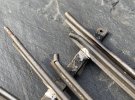
Also visible is my new fastening, a 12 BA screw upwards through the transverse tinplate strip and foot of the check rail. Once the check rail is correctly positioned and secured by screws, the soldered joints are re-made:
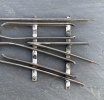
The new fastenings are invisible from above and will be impossible to detect once the rails are reinstated on the sleeper raft. The new solder of the re-made joints will be covered by black paint as per usual Bassett-Lowke practice.
Note the difference in the width of the flange-ways after moving the check rails. The above turnout should now work reliably with wheel-sets with either a back-to-back of 27.0 mm or 27.5 mm.
It is odd that the check rails on Lowko Track turnouts are often, but not always, too far from the running rails to be effective. It might be a legacy from the early date Lowko Track was designed (1908). However, certainly by 1910, Bassett-Lowke standardised on 27.0 mm as the back-to-back measurement for wheels. The back-to-back measurement was very consistently adhered to. So it is strange that Lowko Track turnouts are generally built to suit coarser wheels.
Regarding the turnout now being rebuilt, I still have to modify the fastenings for the switch blades. One rail chair will need to be replaced. The intended location for this turnout means the position of the operating lever will have to be moved so it is parallel to the running rails, requiring the use of a bell-crank.