So you could have bought a 3-arm bracket signal. And you would have had 6d left to live on for the rest of the week.Hello All
What I always find fascinating is the price and the 'moaned about' high prices today.
I started work at 15 in September 1956. My pay as a trainee electrician was 39/0 for a 44 hour week.
Regards
Allen

You are using an out of date browser. It may not display this or other websites correctly.
You should upgrade or use an alternative browser.
You should upgrade or use an alternative browser.
Rivermead Central
- Thread starter 40057
- Start date
By way of a PS on the splitting distant, having got it outdoors in bright light to be photographed, I now notice there is actually a nasty patch of rust on one corner of the base. Nothing to do with residual flux this time — no soldered joint nearby. This will most likely have been caused by being in contact with a cardboard box during decades of storage. Anyway, the rust is bad enough that I will remove it to prevent further spread/deterioration. I also realise, of course I can use the signal! There is no hidden storage or fiddle yard in an off-scene area on Rivermead Central. I do plan however, to obscure the view of the main running circuit using buildings (some removable for access) in the south-east corner of the room. So the splitting distant can be installed close to where the main line goes out of sight. There won’t actually be a junction in the area you can’t see (don’t tell anybody) but the signal will add to the impression of a complex system. And look nice too.For completeness, here is the only other post-WW2 tinplate signal I have:
View attachment 241888
This one has also been bought within the last year. I have cleaned it and attended to a small amount of flaking paint, but otherwise it is ‘as found’. So it’s ready to use on the layout — if I have somewhere for it. It could be the splitting distant for the approach to the north end of Cairnie Junction station, if I treat platforms 1 and 2 as double track for trains on the main circuit. My intention though is always to use platform 1 (bi-directional) for those trains, unless there is a specific reason to use platform 2. The access track to platform 2 includes 3’ 2 1/4” radius curves (everything on the main circuit proper is a larger radius). Also platform 2 is electrified which some clockwork locos won’t like (the third rail might operate the brake or reversing trip). So it would be better if the right-hand doll were the taller one. But this is the signal I found offered for sale and it’s in good condition, which they usually aren’t.
No rusting at the top of the ladder in this case — because no soldering. The ladder is attached to the doll by a bent over tab pushed through a slot. There must have been some reason why this method of attachment couldn’t be used for the single-post signals.
The Cairnie Junction yard office now has a chimney stack:
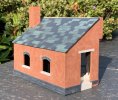
Still to add are the capping and chimney pot. Also ‘lead’ flashing at the base. I have picked out some slates in a different grey. The contrast between the colours of the slates will be reduced by the weathering still to be applied to the roof.
Still to add are the capping and chimney pot. Also ‘lead’ flashing at the base. I have picked out some slates in a different grey. The contrast between the colours of the slates will be reduced by the weathering still to be applied to the roof.
I refer to the recently installed section of high-level base board — see my post #336. However, some additions are required to this part in the darker grey:
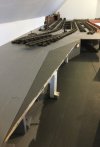
The already-built adjoining section of retaining wall has a narrow strip of high-level base-board included in its construction, which will add an extra couple of inches to the width of the higher level. This provides the space for the head-shunt for the centre road and platform 2. One small further addition is required to the high-level base-board in this section, at the position shown ringed in red here:
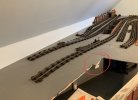
A small forward extension to the high-level base-board is necessary at the position shown to accommodate the alignment of the track connecting platform 2 to the main running circuit and the point lever for the turnout giving access to the head-shunt. Having looked at various real railway retaining walls, often any repairs, alterations or extensions are in a different style to the original wall.
All of the wall made to date is of the same pattern, as seen here:
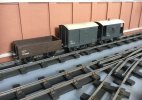
I shall make the retaining wall for the forward extension in a different style:
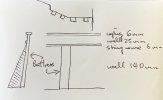
The retaining wall built so far is made of recovered vintage material with over-scale impressed bricks. It will look odd if the new section I am about to build has much smaller (= scale) bricks. So I will use material made for me some years ago by Poppy’s Wood Tech. This is plywood with a laser-cut brick pattern, but with bricks of the same dimensions as used by Milbro in the 1930s.
I have started making the buttresses I will require:
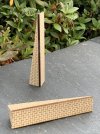
Generally, it will be easier to lay the track on the high-level base-boards behind Cavendish Goods before fixing the retaining wall in place. However, this small forward extension has to be built and installed before I can lay the track connecting platform 2 to the main running line. Hence, I have started the work needed or track laying on the high-level will be held up.
The already-built adjoining section of retaining wall has a narrow strip of high-level base-board included in its construction, which will add an extra couple of inches to the width of the higher level. This provides the space for the head-shunt for the centre road and platform 2. One small further addition is required to the high-level base-board in this section, at the position shown ringed in red here:
A small forward extension to the high-level base-board is necessary at the position shown to accommodate the alignment of the track connecting platform 2 to the main running circuit and the point lever for the turnout giving access to the head-shunt. Having looked at various real railway retaining walls, often any repairs, alterations or extensions are in a different style to the original wall.
All of the wall made to date is of the same pattern, as seen here:
I shall make the retaining wall for the forward extension in a different style:
The retaining wall built so far is made of recovered vintage material with over-scale impressed bricks. It will look odd if the new section I am about to build has much smaller (= scale) bricks. So I will use material made for me some years ago by Poppy’s Wood Tech. This is plywood with a laser-cut brick pattern, but with bricks of the same dimensions as used by Milbro in the 1930s.
I have started making the buttresses I will require:
Generally, it will be easier to lay the track on the high-level base-boards behind Cavendish Goods before fixing the retaining wall in place. However, this small forward extension has to be built and installed before I can lay the track connecting platform 2 to the main running line. Hence, I have started the work needed or track laying on the high-level will be held up.

James
Western Thunderer
By way of a PS on the splitting distant, having got it outdoors in bright light to be photographed, I now notice there is actually a nasty patch of rust on one corner of the base.
Rust can be quite prototypical, just look at Stranraer's signals!
Hi James
From the point of view of realism, rust might be fine — helpful even. But from the point of view of preserving historic artifacts, rust is THE ENEMY. Certainly, when the rust is due to acid flux residue, if that isn’t addressed the object will continue to deteriorate even if stored in perfect conditions. I will generally treat bad corrosion for reasons of preservation. I also clean objects (very carefully) as accumulations of dust and especially soot (also acidic) can also be damaging. So, overall, Rivermead Central might look a bit too clean — but many model railways represent a slightly idealised world.
Martin
From the point of view of realism, rust might be fine — helpful even. But from the point of view of preserving historic artifacts, rust is THE ENEMY. Certainly, when the rust is due to acid flux residue, if that isn’t addressed the object will continue to deteriorate even if stored in perfect conditions. I will generally treat bad corrosion for reasons of preservation. I also clean objects (very carefully) as accumulations of dust and especially soot (also acidic) can also be damaging. So, overall, Rivermead Central might look a bit too clean — but many model railways represent a slightly idealised world.
Martin
The Cairnie Junction yard office now has coping on the back wall:
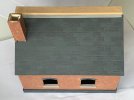
I have also toned down the contrast between the colour of different slates.
A view showing the chimney stack with the join to the brickwork below now disguised by some extra paint:
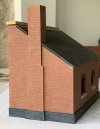
The next job is the flashing around the base of the chimney stack and the capping and pot.
Then weather the building before adding the woodwork — fascia boards, windows and door.
I have also toned down the contrast between the colour of different slates.
A view showing the chimney stack with the join to the brickwork below now disguised by some extra paint:
The next job is the flashing around the base of the chimney stack and the capping and pot.
Then weather the building before adding the woodwork — fascia boards, windows and door.
James
Western Thunderer
The project is about conserving objects as much as anything else?Hi James
From the point of view of realism, rust might be fine — helpful even. But from the point of view of preserving historic artifacts, rust is THE ENEMY. Certainly, when the rust is due to acid flux residue, if that isn’t addressed the object will continue to deteriorate even if stored in perfect conditions. I will generally treat bad corrosion for reasons of preservation. I also clean objects (very carefully) as accumulations of dust and especially soot (also acidic) can also be damaging. So, overall, Rivermead Central might look a bit too clean — but many model railways represent a slightly idealised world.
Martin
The best comparison I can think of is railway preservation — for models.The project is about conserving objects as much as anything else?
Though I would aim to look after vintage vehicles a lot better than is often the case on preserved railways.
The analogy works quite well, I think. In real life, there are preserved historic vehicles that are not used (much or at all) to avoid wear and tear to original components/paint. Others where many examples exist or condition (in terms of originality) is poor, so use is fine. Likewise for me. Preserved railways often have to construct new buildings, but in an historic style using traditional techniques. Me too. I even have a couple of ‘new build’ projects!
The Cairnie Junction yard office now has a chimney pot:
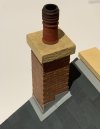
Sorry about the poor quality photo taken in artificial light this evening.
Flashing added around the base of the chimney stack too.
The capping stone on the chimney stack is a block of wood. The chimney pot is a white-metal casting from Wizard Models. Rather a posh chimney pot for such a humble building, but overall, to me, the chimney looks fine.
I will need to add some filler to the join between the capping stone and the brickwork, but tomorrow when the glue is properly dry. Then I will apply weathering to the whole structure and put on a thin spray coat of matt varnish before adding the fascia boards, windows and door.
Sorry about the poor quality photo taken in artificial light this evening.
Flashing added around the base of the chimney stack too.
The capping stone on the chimney stack is a block of wood. The chimney pot is a white-metal casting from Wizard Models. Rather a posh chimney pot for such a humble building, but overall, to me, the chimney looks fine.
I will need to add some filler to the join between the capping stone and the brickwork, but tomorrow when the glue is properly dry. Then I will apply weathering to the whole structure and put on a thin spray coat of matt varnish before adding the fascia boards, windows and door.
John R Smith
Western Thunderer
Very nice, Martin.
I just wonder if it is not a bit too good for coarse scale?
Just kidding . . .
John
I just wonder if it is not a bit too good for coarse scale?
Just kidding . . .
John
A proper picture of the Cairnie Junction yard office and its complete chimney:
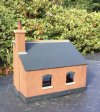
A nice warm day today, so I have sprayed on a couple of light coats of matt varnish. Also brushed and sprayed on the first weathering. In the bright sunlight, the weathering hardly shows on the paler colours — but it is definitely there and easily seen IRL.
I can proceed now with making and adding the fascia boards and door. I’ll then put another coat of varnish on before installing the windows.
As with the Benham’s buildings, I’ll just paint the inside black. Of course, the Benham’s buildings were all just facades (in both senses of the word) so an interior would have been impossible. With the yard office, the whole building is modelled. However, a modelled interior would not be seen so is a waste of effort.
A nice warm day today, so I have sprayed on a couple of light coats of matt varnish. Also brushed and sprayed on the first weathering. In the bright sunlight, the weathering hardly shows on the paler colours — but it is definitely there and easily seen IRL.
I can proceed now with making and adding the fascia boards and door. I’ll then put another coat of varnish on before installing the windows.
As with the Benham’s buildings, I’ll just paint the inside black. Of course, the Benham’s buildings were all just facades (in both senses of the word) so an interior would have been impossible. With the yard office, the whole building is modelled. However, a modelled interior would not be seen so is a waste of effort.
John R Smith
Western Thunderer
With the yard office, the whole building is modelled. However, a modelled interior would not be seen so is a waste of effort.
Something that was so much part of the character of the traditional steam railway was the proliferation of cabins and offices and huts - shunter's cabins, footplatemen's mess rooms, toilet blocks, lamp huts, per-way and S&T stores. I spent many hours in these various places, and the cabins, mess rooms and PW huts had two things in common - a fire place or stove, and a means of making tea. Oh, and one other thing, a table and chairs for playing cards. It would be wonderful to model these cosy interiors, but as you say, sadly they would never be seen.

The shunter's cabin at Drinnick, 1983
John
Last edited:
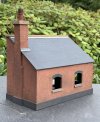
I have applied additional weathering and another coat of matt varnish to the Cairnie Junction yard office. I am happy with how it looks, so I’ll stop there. I might have to apply a small amount of further weathering around the doors and windows to cover glue or make them blend in, but the general painting of the brick-work and roof is now finished:
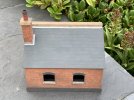
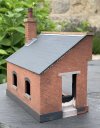
I have just selected some small sized strip wood (walnut, red cedar) for making the fascia boards and door frame and applied primer. I have chosen a green and cream colour scheme for the woodwork.
As with previous buildings, there will be no guttering, drain pipes or other fine detail. That’s not the idea. I go back to principles set out in my first post in this thread:
— buildings to be correctly proportioned but not highly detailed, impressionistic not photographic.
— use of a muted palette, predominantly browns and greys.
— the purpose of the buildings being to provide context for and contrast to the much more brightly coloured vintage trains.
Once the latest construction (wall plus the above office) is on the layout, I will have the wall covering at the back of the layout in place for almost half the western side. It will soon be possible to get a good idea how the concept for the layout will look IRL.
I have just selected some small sized strip wood (walnut, red cedar) for making the fascia boards and door frame and applied primer. I have chosen a green and cream colour scheme for the woodwork.
As with previous buildings, there will be no guttering, drain pipes or other fine detail. That’s not the idea. I go back to principles set out in my first post in this thread:
— buildings to be correctly proportioned but not highly detailed, impressionistic not photographic.
— use of a muted palette, predominantly browns and greys.
— the purpose of the buildings being to provide context for and contrast to the much more brightly coloured vintage trains.
Once the latest construction (wall plus the above office) is on the layout, I will have the wall covering at the back of the layout in place for almost half the western side. It will soon be possible to get a good idea how the concept for the layout will look IRL.
John R Smith
Western Thunderer
I am happy with how it looks, so I’ll stop there.
Very nice indeed, Martin, and I do like your methods and the result. It seems to me that you have studied the style and detail of this genre of building rather well, and I wonder if you have had a professional involvement in the past? My own career included conservation work on many historic industrial buildings down here in Cornwall, so the way you have dealt with the look and treatment of things like the door, windows and chimney seems familiar and authentic to me.
John
Hi JohnVery nice indeed, Martin, and I do like your methods and the result. It seems to me that you have studied the style and detail of this genre of building rather well, and I wonder if you have had a professional involvement in the past? My own career included conservation work on many historic industrial buildings down here in Cornwall, so the way you have dealt with the look and treatment of things like the door, windows and chimney seems familiar and authentic to me.
John
Thank you — that’s very kind and very flattering.
I have no professional background in buildings or architecture.
I start each construction project by looking at numerous photographs of examples of the sort of building I have in mind, in books and on the web. Then I draw a sketch of the design I want to build — which has not so far been a particular real building, just a representation of the type. If in doubt (e.g. how tall should the chimney be?), I go back and check photographs for guidance. The approach has worked in that I am content that my constructions are ‘in keeping’ with real practice, yet adapted to fit within the space constraints and general approach of my layout.
Martin
I have never set out in any detail my plans for the eastern side of Rivermead Central. I don’t yet have a fully worked out scheme, but the overall use of the space and relative positions of the different elements is decided:
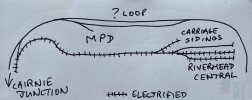
A few points worth mentioning. There is no loco servicing facility and only one siding for carriage stabling at Cairnie Junction (the western high-level base-board), so these deficiencies have to be made good on the eastern side. I would like one goods siding at Rivermead Central (e.g. for a coal merchant) though I doubt if I will have space. If I can’t manage that facility, there will be no freight on the Rivermead Central branch. I want a minimum of three platforms at Rivermead Central to get the ‘important station’ look.
The end of the platform 1/platform 2 passing loop for Cairnie Junction station is in the north-east corner of the room. Curving round the north end base-boards as it does, Cairnie Junction is getting on for 30’ long between the last turnouts at each end.
I would like a long loop against the east wall, but I am not sure there is space. The MPD turntable has to fit between the main running circuit and the branch to Rivermead Central and a loop on the main line may leave too little room for the MPD. A loop would be really useful — the nearest I am going to get to a fiddle yard or off-scene storage. For example, a goods train could be held in the loop for a passenger train to pass or to await a path through congestion in Cairnie Junction station. It would mean any train departing from Cairnie Junction doesn’t have to also be the next train to arrive (from the opposite direction). The only downside to a loop (apart from reducing the space for the MPD) is it puts an additional turnout into the main running circuit (six instead of five). All the turnouts in the main line are arranged so the running line is the straight road, so derailment risk is minimised. Nevertheless, the fewer turnouts, the better.
I am quite some way off building the eastern half of the layout. I need to rebuild further Lowko Track turnouts to get the track-work completed through Cairnie Junction. Then construct the high-level base-boards and a bridge against the southern wall (when I have established the exact division of space between the low-level (Cavendish Goods and factories) and high-level against the southern wall. Thereafter though, the main running circuit on the eastern base-board has only one or at most two turnouts, so should be quick to put in place. I can then start to run trains. As the rest of the track-work on the eastern base-board is laid, it can be used as a fiddle yard and gradually converted to scenic model railway.
A few points worth mentioning. There is no loco servicing facility and only one siding for carriage stabling at Cairnie Junction (the western high-level base-board), so these deficiencies have to be made good on the eastern side. I would like one goods siding at Rivermead Central (e.g. for a coal merchant) though I doubt if I will have space. If I can’t manage that facility, there will be no freight on the Rivermead Central branch. I want a minimum of three platforms at Rivermead Central to get the ‘important station’ look.
The end of the platform 1/platform 2 passing loop for Cairnie Junction station is in the north-east corner of the room. Curving round the north end base-boards as it does, Cairnie Junction is getting on for 30’ long between the last turnouts at each end.
I would like a long loop against the east wall, but I am not sure there is space. The MPD turntable has to fit between the main running circuit and the branch to Rivermead Central and a loop on the main line may leave too little room for the MPD. A loop would be really useful — the nearest I am going to get to a fiddle yard or off-scene storage. For example, a goods train could be held in the loop for a passenger train to pass or to await a path through congestion in Cairnie Junction station. It would mean any train departing from Cairnie Junction doesn’t have to also be the next train to arrive (from the opposite direction). The only downside to a loop (apart from reducing the space for the MPD) is it puts an additional turnout into the main running circuit (six instead of five). All the turnouts in the main line are arranged so the running line is the straight road, so derailment risk is minimised. Nevertheless, the fewer turnouts, the better.
I am quite some way off building the eastern half of the layout. I need to rebuild further Lowko Track turnouts to get the track-work completed through Cairnie Junction. Then construct the high-level base-boards and a bridge against the southern wall (when I have established the exact division of space between the low-level (Cavendish Goods and factories) and high-level against the southern wall. Thereafter though, the main running circuit on the eastern base-board has only one or at most two turnouts, so should be quick to put in place. I can then start to run trains. As the rest of the track-work on the eastern base-board is laid, it can be used as a fiddle yard and gradually converted to scenic model railway.
John R Smith
Western Thunderer
Martin
Turntables are very space-hungry things. As we know that you have a B-L Royal Scot, you are going to need at least an 18 inch table. Unless of course you have ambitions for a Princess or a Britannia, when a 22 inch will be required. My rough calculation says that if you have a double track loop at the rear, then the MPD and turntable, and then the approach road in and out of Central at the front the total width is going to be close to three feet. That is a long stretch to the back roads - I know that you won't be shunting or messing about with couplings there, but they will be clockwork engines which have to be manually started and stopped. And quite likely wound as well, at times.
If it was all electric I would suggest putting the t/table into one of the corners, but you are going to need to be able to physically drive your engines on and off that one too. Even on my little layout, I get plenty of exercise during a running session as you can't just sit back and turn a knob (or these days, press some buttons!).
John
Turntables are very space-hungry things. As we know that you have a B-L Royal Scot, you are going to need at least an 18 inch table. Unless of course you have ambitions for a Princess or a Britannia, when a 22 inch will be required. My rough calculation says that if you have a double track loop at the rear, then the MPD and turntable, and then the approach road in and out of Central at the front the total width is going to be close to three feet. That is a long stretch to the back roads - I know that you won't be shunting or messing about with couplings there, but they will be clockwork engines which have to be manually started and stopped. And quite likely wound as well, at times.
If it was all electric I would suggest putting the t/table into one of the corners, but you are going to need to be able to physically drive your engines on and off that one too. Even on my little layout, I get plenty of exercise during a running session as you can't just sit back and turn a knob (or these days, press some buttons!).
John
I refer back to my post #444. I have spent the afternoon starting to assemble the first section of retaining wall for the projecting area of the high-level base-board:

As usual, I have used both glue and moulding pins. The plywood backing has been cut into strips and alternate strips flipped over. If the plywood backing does have any tendency to warp, the adjacent strips will fight each other and the wall should stay approximately straight.
Next above the brick-effect plywood panels/buttresses will be a string course painted to represent stone. This is ‘ground level’ for the high-level section. Then a brick wall with coping on top.
As usual, I have used both glue and moulding pins. The plywood backing has been cut into strips and alternate strips flipped over. If the plywood backing does have any tendency to warp, the adjacent strips will fight each other and the wall should stay approximately straight.
Next above the brick-effect plywood panels/buttresses will be a string course painted to represent stone. This is ‘ground level’ for the high-level section. Then a brick wall with coping on top.

Roger Pound
Western Thunderer
Having just laid (and subsequently lifted) a scheme which I originally had thought filled all my requirements on my upcoming 2mm layout, I have become acutely aware of space constrictions relative to operational requirements. You seem to have got all your problems identified and the best solution now would appear to be accepting the best possible compromise. I wouldn't personally worry about a further point on the main line especially if it improved achievement of one's aims.. Having seen and admired your workmanship in rejuvenating your track I would not think it would cause too much of a problem. I will follow your resolutions to the problems with interest.
Roger.
Roger.