SimonD’s workbench

Yorkshire Dave

Western Thunderer
Seriously, downloadable 3D printed cows would be really useful! I cast mine in resin but don't have the experience to get all the details - like legs and tails! - out every time.

I did find a couple of cows, but only one that was useable, the other looked like a bovine version of Kryten from Red Dwarf.

I’ve found some sheep too, and a couple of horses. I’ll try to find the links and post them.

I hope the efforts to use AI to generate 3DP-able figures bear fruit. There are several people doing it and some results seem quite promising. Others…

Farm animals/livestock are available from Preiser (1:43), Noch (1:43), Woodland Scenics (1:48) and Evemodel (1:48). If you're not too pedantic bothered about them being exactly 1:43.5 I'd go for the ones which look right. :)
 

simond

Western Thunderer
Thanks Dave,

I’ve already stuck the smaller, single window bars to the smaller windows, but I have spares.

I’ll print the double windows tomorrow, and try your suggestion, and then either replace the single ones, or make the doubles unpainted.

I recall a discussion a while back, @LarryG suggested the bars should perhaps be white if my memory serves.

cheers
Simon
 

Mike W

Western Thunderer
Farm animals/livestock are available from Preiser (1:43), Noch (1:43), Woodland Scenics (1:48) and Evemodel (1:48). If you're not too pedantic bothered about them being exactly 1:43.5 I'd go for the ones which look right.
Unfortunately not in 1:22.5 though. And the couple that are, are actually far too big.
Mike
 

LarryG

Western Thunderer
I recall a discussion a while back, @LarryG suggested the bars should perhaps be white if my memory serves.
I'm not sure I said they should be white when they appear to be black-ish in photos of GWR brake coaches. I simply scribe vertical window bars on the glazing.
 

simond

Western Thunderer
I'm not sure I said they should be white when they appear to be black-ish in photos of GWR brake coaches. I simply scribe vertical window bars on the glazing.
Thanks Larry, I did try to find the conversation, both on here and on RMW but failed. I recall you talking about scribing them. The vehicle concerned (70’ van) is in a coach box, buried under a mountain of stuff, and I’m disinclined to dig it out.

I’ll try Dave’s suggestion, and see where I go from there.

ta
Simon
 

paulc

Western Thunderer
I'm not sure I said they should be white when they appear to be black-ish in photos of GWR brake coaches. I simply scribe vertical window bars on the glazing.
Hi Larry and Simon , wouldn't they appear like that due to shadow , dust and general grot that collects on horizontal and vertical surfaces . How does it do that :oops:
I have no idea what the original colour was but i would do them in shades of grey .
 

simond

Western Thunderer
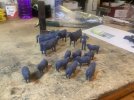
Thingiverse…. There is a cow, and a sheep model, they are noteworthy as they appear to be a Japanese modeller, so I downloaded them, and bunged a few on last night’s print run.

image.jpg

the sheep were printed at 45%, as I looked up the dimensions of a sheep, and Google found a website that provides them, and scaled accordingly! I’m pretty happy with the size. The cows are all different scaling, 100, 95, 90 and 85%, I think any of them are reasonable, but I’m no bovine expert.

I shall add links. I shall search for more. I need a collie or two now…


sheep. https://www.thingiverse.com/thing:182273
 
Last edited:

Pencarrow

Western Thunderer
Thingiverse…. There is a cow, and a sheep model, they are noteworthy as they appear to be a Japanese modeller, so I downloaded them, and bunged a few on last night’s print run.

View attachment 235134

the sheep were printed at 45%, as I looked up the dimensions of a sheep, and Google found a website that provides them, and scaled accordingly! I’m pretty happy with the size. The cows are all different scaling, 100, 95, 90 and 85%, I think any of them are reasonable, but I’m no bovine expert.

I shall add links. I shall search for more. I need a collie or two now…

Did you ever think that you'd be looking up the dimensions of a sheep? I have heard of a song by the Wonder stuff: Size of a Cow...
 

simond

Western Thunderer
3DP is a very useful tool.

image.jpg

Two drilling jigs. Without which, I doubt I could have drilled 32 holes like this without slipping at least once.

image.jpg

if you’re struggling to see them, they’re for the bars that stop the cows‘ noses going out of gauge. 4 long, and 4 short per side. The bars will have their ends flattened, and pinned into the said holes.

Now, I’m quite pleased with this trick, and I’m cursing my lack of foresight - if I had thought to put some kind of slot across the jigs, I could have used them to drill the flattened ends of the bars. As it is, a couple of bits of microstrip will do the same.

The black things are magnetic angle clamps - they work but they’re a bit of a fiddle. The magnets are 5 diameter by 5 long and cost 7 quid for 50.
 

simond

Western Thunderer
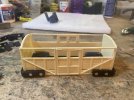
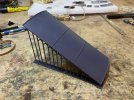
20 hour print…. Happily it came out well.

image.jpg

and it fits

image.jpg

Which is a relief :)

image.jpg

and the girls aren’t complaining, though I very much doubt they’d be allowed any room to move around much in the real world, for their own safety if nothing else. But resin cows are not compliant or compressible!

Next, a chassis!

The sharp eyed amongst the congregation will have noted that I didn’t flatten the bars and drill them, because the picture didn’t show that - I’m sure there was some kind of end fitting but it looked rather like the end was bent over and glued in a hole. So that’s precisely what I did…
 

simond

Western Thunderer
Thanks Tim,

I’m pleased with it, the resin mouldings suggest a good master, and I hope I’ve done the maker justice. It’s not a wagon I’d have gone out of my way to make, though entirely reasonable on a GW line in N Wales, and having found the mouldings, I couldn’t resist!

The CAD time for the roof was truly minutes, maybe less than quarter of an hour, last thing last night, though it took a very long time to print. But then, I was either asleep, or at work, so no worries on that score. To draw up the body sides & ends would be some hours’ work, I think, so having them ready made was a bonus. I’d not have done it otherwise.

cheers
Simon
 

Hayfield1

Western Thunderer
20 hour print…. Happily it came out well.

View attachment 235355

and it fits

View attachment 235356

Which is a relief :)

View attachment 235357

and the girls aren’t complaining, though I very much doubt they’d be allowed any room to move around much in the real world, for their own safety if nothing else. But resin cows are not compliant or compressible!

Next, a chassis!

The sharp eyed amongst the congregation will have noted that I didn’t flatten the bars and drill them, because the picture didn’t show that - I’m sure there was some kind of end fitting but it looked rather like the end was bent over and glued in a hole. So that’s precisely what I did…

Simond

A super bit of printing going on

John
 
Dapol Signals with Arduinos

simond

Western Thunderer
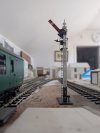
Being curious (and you may read that as you wish) I obtained a Dapol signal to see if I could interface it to my Arduino-CAN set up.

The signals are not at all bad, and are much cheaper than custom made, and much easier than DIY. I like building signals, but they are a fair task, and so an RTP solution is welcome, at least for the simple stuff.

Being curious, I took it to bits. It would appear that a previous owner had done the same as the screws securing the base to the box were missing.

in simple terms, the signal is spring loaded to the off position (it’s an LMS UQ), don’t know if the GW are spring loaded “up” hence danger, or “off”) and a curved arm on a standard 9g servo pushes the actuating rod to move the arm. There are two circuit boards in the box, one to rectify and regulate the voltage, and one to drive the servo.

The same board, with missing components added, would do a junction signal. There is room for the second servo below the first. There are spring pins to carry current to the lamp. Altogether, a decent job.

image.jpg

The signal is operated by means of an SPCO switch. I will order a few optoisolators, because I’m confident that I can replicate the CO function using the Arduino output, which will turn the optos on or off, and they will, I hope, switch the signal.

The other option is to junk the Dapol control system and simply use the Arduino to drive the servo directly, as I do with DIY signals, but that seems a bit unnecessary, and warranty busting.

I’m still left with the question; why they didn’t design it so the actuator box was screwed to the baseboard, and the signal simply plugged in. I’m sure this would have been more popular as the vulnerable bit could easily be removed for transport, or layout cleaning, rather than being fixed sticking out. I guess this way is very simple, and the footprint above ground is pretty much scale.

More soon.
Simon

 

Pencarrow

Western Thunderer
Being curious (and you may read that as you wish) I obtained a Dapol signal to see if I could interface it to my Arduino-CAN set up.

The signals are not at all bad, and are much cheaper than custom made, and much easier than DIY. I like building signals, but they are a fair task, and so an RTP solution is welcome, at least for the simple stuff.

Being curious, I took it to bits. It would appear that a previous owner had done the same as the screws securing the base to the box were missing.

in simple terms, the signal is spring loaded to the off position (it’s an LMS UQ), don’t know if the GW are spring loaded “up” hence danger, or “off”) and a curved arm on a standard 9g servo pushes the actuating rod to move the arm. There are two circuit boards in the box, one to rectify and regulate the voltage, and one to drive the servo.

The same board, with missing components added, would do a junction signal. There is room for the second servo below the first. There are spring pins to carry current to the lamp. Altogether, a decent job.

View attachment 235440

The signal is operated by means of an SPCO switch. I will order a few optoisolators, because I’m confident that I can replicate the CO function using the Arduino output, which will turn the optos on or off, and they will, I hope, switch the signal.

The other option is to junk the Dapol control system and simply use the Arduino to drive the servo directly, as I do with DIY signals, but that seems a bit unnecessary, and warranty busting.

I’m still left with the question; why they didn’t design it so the actuator box was screwed to the baseboard, and the signal simply plugged in. I’m sure this would have been more popular as the vulnerable bit could easily be removed for transport, or layout cleaning, rather than being fixed sticking out. I guess this way is very simple, and the footprint above ground is pretty much scale.

More soon.
Simon


Hi Simon,

Like yourself I was curious about the Dapol 7mm signals and, when I saw they did a LSWR lattice, I picked one up at Kettering.

General impression was favourable when removed from the box and compared to prototype photos. If anything, the lattice is a little bit coarse compared to an etched brass kit, but I suspect a spot of weathering will help there.

Certainly seems to be good value for a fully working and lit signal. At the very least it's a good placeholder which could be replaced at a much later date.

I've heard some grumbles on line about the early 4mm releases expiring electrically and this being something to do with the supply voltage. Would be interesting to see what you think about the internal gubbins in this respect.

PXL_20250302_114733835.MP.jpg

PXL_20250302_115626816.jpg

Like yourself I'm not taken by the means of fixing. The signal is effectively bolted to the baseboard top and a heavyish control box is left dangling off the bottom. OK for a home layout but I suspect will end up damaged on an exhibition layout due to transit knocks and vibrations.

I can see why they have done it that way though as enables the signal to be fitted to a wide variety of baseboard thicknesses.
 

simond

Western Thunderer
I can see no obvious reasons to worry about the internals, but it’s not really my terrain. The boards are clearly made on a high volume automated line, they're neat, clean, properly screened, solder looks good etc, but the design? I’d guess they’re fine.

I could ask a tame electronics Engineer…
 

timbowales

Western Thunderer
Simon, to go back to your cattle wagon for a moment.
Something is bugging me as missing from it. IIRC these long cattle wagons had a moveable partition system so that the available volume could replicate a large cattle wagon or a medium one or a small one, depending on what was being transported and how much the farmer had paid! That appears to be missing from your van?
 

simond

Western Thunderer
Thanks Tim, they did, it seems in common with all the big 4, I suspect there was an edict of some sort. The partition is a chunky wooden affair, which is stowed against the end in the Large position.

the kit did not contain any interior detail, but a piece of plasticard and some bits of strip should suffice.

incidentally it’s a splendid quiz question, “which GW wagons also carried the markings ‘LMS’ ”? Large, Medium & Small…

yesterday, I dug out the CNC mill, and cut back the ends, so the body could sit down correctly over the chassis, again something for which the kit provided no guidance. I believe the kits included all the relevant details, so perhaps it was included in the instructions.

photo to follow
best
Simon
 

simond

Western Thunderer
To return to the Dapol signal control - I managed to get a very simple circuit to work, after much faffing.

The premise is that I will use CAN communications between lever frames and actuators - the actuators might be servo-controlled signals or points, or colour light signals, or Dapol signals (which are servo actuated, see post 1714 just above) which are controlled by a SPCO switch, and all my outputs are driven by a serice of Arduino Nanos which are connected via a CAN tranciever to the CAN network.

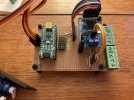
Arduinos can drive Servos, using the servo library. I standardised on a row of 3-pin plugs to provide +5V, control and 0V to each output. This is ideal for servos, as they just plug straight in. This is the Arduino “slave” which can drive 11 or 12 servos (I must check!). The blue board to the right is the CAN transceiver, the green blocks are a pair of sockets to allow daisy-chaining. They are wired for CAN-Hi, CAN-Lo, 12V, Ground & 5V, meaning I can put all the circuits on the same supply if I wish. There’s a 7805 to drop the 12V to 5V hiding under the CAN board.

image.jpg

A trivially small change to a couple of lines of code converts the servo output to a simple High-Low output, and this can then be used to control a colour light, using GOW bulbs or LEDs. Here is a particularly crude (proof of concept) “two aspect colour light signal”.

image.jpg

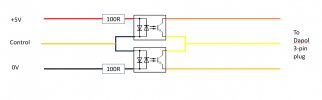
As it switches LEDs very simply, it occurred to me that it would switch a pair of opto-isolators too, and so it proved. The "converter" comprises a postage stamp sized bit of stripboard, two optos, (48p each) and two resistors.

image.jpg

The optos I used were SFH620A from RS, I don’t think it will matter much. Resistors are 100R.

1742497703871.png

The output of the optos replaces the SPCO switch provided by Dapol and the three wires at the other end simply plug into the 3-pin output from the Arduino.

it all seems to work very satisfactorily. No modifications needed to the signal, which runs off a separate supply. I will check, but it should be possible to run it off the same supply without causing problems.

(I've just noticed, the standard wiring for a servo is Black (0v) Red (+6V) and Orange (control) in that order, not as I have it in the photos above!)

EDIT

I’ve just relocated the pins in the socket so they follow the conventional servo wiring, and whilst doing that, I checked whether the Arduino can power the Dapol driver as well as control it. No cigar…. It doesn’t work. It runs fine on a PP3, so it doesn’t need much more, but it doesn’t fly on 5V. If I use Dapol signals, I’ll run a 12V bus to drive them, or pick up 12V from the CAN bus supply.
 
Last edited:
Laser settings

simond

Western Thunderer
Last weekend I failed to laser-cut some W irons for my ongoing wagon projects, and it became obvious that my ancient Chinese laser was not working well. It lives in the garage (because it smells, even with a fierce extract system) and it was a bit cold, but I persevered. I discovered that two of the mirrors had cracked, and one of them was actually broken. I effected a temporary repair and ordered some replacements.

I also stopped being a skinflint, and purchased a new Lightburn licence. My old one had expired in 2018 - they last for ever, but you need a valid licence for updates, so I updated. Should have done so years ago…

I have not fitted the new mirrors yet, job for tomorrow, but I did run the material test cuts that Lightburn provides: I replaced the original controller in the laser (it’s a K40) with a Smoothieboard, though I think I’d use a GRBL if I were doing it now. I think I ought to dig into the firmware settings because the power range is rather odd, the laser won’t light up at less than 5% and is flat out at 23%, and the inertia acceleration and deceleration settings do not seem to prevent vibration and inaccurate cutting at speeds above around 40-50mm/s, but with these limitations in mind, I was able to run test matrices for several materials this evening. Presumably with replacement mirrors it’ll be a bit better.

2mm MDF
image.jpg
Nice clean cuts at 22mm/s and 21%
good engraving at 40-44mm/s and 9-15%

1.1mm Acrylic
image.jpg
Difficult to photograph! A lot of melting, I suspect it would be better cutting larger parts, or with more space between adjacent cuts.
Best cut at 4mm/s and 7%
Engraving gave nice marking at 44mm/s and 9-13%
Note the whole test plaque is distorted. I’m not sure this is a grade of acrylic intended for laser.

1mm Greyboard
image.jpg

Cut very nicely at 44mm/s and 23%.
Engraved cleanly at 26mm/s and 7%, but 44 & 9 is nearly as good and nearly twice as fast.
note, it started smouldering at 4mm/s & 9% and I was turning the laser off & on manually to get a complete plaque

0.2mm Ivory card
image.jpg
Lots of singeing and smouldering!
cleanest cut at 31mm/s and 13%
engraving 13mm/s and 5%

and Trotec, 0.8mm
image.jpg
This is sold as a laserable material, but it does seem to melt at higher powers
clean cut at 35mm/s and 19%, same speed and 9% gives a clean engraved line.

I shall replace the mirrors tomorrow, and have a go at my W irons.
 
Top