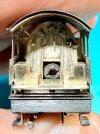
TFW’s workshop & Copenhagen Fields

Tim Watson

Western Thunderer
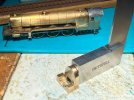
We have had that white box for 50 years on our 2mm layouts: it is actually made of wood with extensive metal protection, having been used for storing batteries in some military / GPO application and is pretty bomb proof. It is used as a receptacle for all our joining bolts and fixings. It is also useful to stand on to reach towards the back of the scene. It’s an essential item when we travel.

Tim
 

Tim Watson

Western Thunderer
After quite a long break, work has resumed on the NER 4-6-2 class, making the very substantial front steps, close by the motion support bracket.
19f93c86-63f9-4102-9bc4-49eedb5403a0.png

These need to be very stiff and robust as the clearances to the moving connecting rod and bracket are pretty tight and it an area where the engine will be handled.
144b63fe-9aae-4b4e-907c-3e8d8b66cc50.jpg

The step back-plate started out as some fairly thick brass channel, tapered off at the sides to give a thin appearance, it was drilled for a pin to locate and reinforce the joint to the underside of the running plate.
53013370-690c-4bc6-9406-6e76b9c66906.jpg

The two backing plates were held in a slotted piece of paxolin in the vice so that the steps could be soldered on without the metal jaws acting as a massive heat sink.
4be732e0-528f-42bf-88ee-15155507969c.jpg

Doing two together made it easier to get consistency. The steps themselves are bent up from steel shim, so that they can be chemically blacked.

f77a465f-fff7-4834-8276-6214d305e027.jpg

The pinning and holes made it much easier to get an accurate location.
6d7f1f9a-9abe-43c3-8665-bc3b07ac06c7.jpg

Soldering them onto the running plate required careful tinning with 145 degree solder, lots of phosphoric acid flux and a very hot iron.
a4e2ebed-6140-4d40-95ca-bc60c1d10e22.jpg
The clearance on the motion support bracket is minimal, but daylight is all it needs.

f79ce3dc-3a2b-43f8-8c4f-e2e5325e4f7a.jpg

22e317bc-ba16-4b82-8451-6088a166d333.jpg

Back steps next I suppose. These should be a bit more straightforward.

Tim
 
Last edited:

Tim Watson

Western Thunderer
Happy New Year from the Darlington Railway Works in Hertfordshire!

8e48182e-1e91-4a3d-ae32-6e999af5e411.jpg
New Year’s Eve was spent chasing elusive electrical shorts between the frames and bodywork. The NER 4-6-2 class now has the rear sand boxes and control valves, rather than the rear steps - they will be next: promise…

6be4bd4a-b794-433e-9ea8-a0dec505b4d0.jpg
These were made as a suitably shaped bar under and across the solid footplate valence, located with pins.

3286c51d-1ffe-49cc-aedd-931440773247.jpg
Once soft soldered in place these were then sectioned with a diamond disc to remove the centre section to allow the frames to pass between.

This type of construction simplifies alignment issues and speeds up construction. Having the silver soldered basic construction is a bonus as that is never going to move at soft solder temperatures.

Putting on the rear steps will help to restore some balance to the rather empty rear end of the loco. Of course, the last four engines had Cartazzi trucks, but did not benefit from the full NER livery carried by the first two.

Tim
 

Tim Watson

Western Thunderer
As promised, the rear steps are now made.
6146dcba-f035-471f-bcc5-294765f45f05.jpg
They were bent up as a U shape across the backplates, to be easier to solder to the steel running plate. To make it easier to get a really crisp 90 deg bend, the corners were scored with a fine slotting file.
a51c7239-0950-4667-978b-d9740356d4cc.jpg
The solid brass valence was slotted to take the step uprights and also the exhaust steam injector pipe-work and fittings. b556bfeb-3fab-47a5-be1c-1c8a6c7660c3.jpg
The exhaust steam supply is via a substantial 4” diameter pipe on the prototype. Afraid I didn’t include one of the control valve rods as it is quite hidden by the steps…2cb7d368-157a-4fad-a69e-67a5e259d491.jpg
The live steam injector appears to be hidden behind the frames on the RHS and so that won’t need to be modelled.
8289f459-cc39-4a50-8573-e55a45678ff4.png
There is a track circuit device visible in the elevation at the back which is most likely in the middle. Not sure whether to include it. I need to source a picture.

Tim
 

65179

Active Member
As promised, the rear steps are now made.
View attachment 254625
They were bent up as a U shape across the backplates, to be easier to solder to the steel running plate. To make it easier to get a really crisp 90 deg bend, the corners were scored with a fine slotting file.
View attachment 254626
The solid brass valence was slotted to take the step uprights and also the exhaust steam injector pipe-work and fittings. View attachment 254627
The exhaust steam supply is via a substantial 4” diameter pipe on the prototype. Afraid I didn’t include one of the control valve rods as it is quite hidden by the steps…View attachment 254628
The live steam injector appears to be hidden behind the frames on the RHS and so that won’t need to be modelled.
View attachment 254629
There is a track circuit device visible in the elevation at the back which is most likely in the middle. Not sure whether to include it. I need to source a picture.

Tim

Raven fog signalling apparatus:


Simon
 

Tim Watson

Western Thunderer
You’re a star Simon. It might be more trouble than it’s worth, probably sitting too close to the drawbar pivot, but on the driver‘s side. We’ll see. I did at least fit the sandbox covers today.
6dd008c8-9375-46bc-a6a3-3287558e6479.jpg
Not that obvious, but a distinctive shape.

Cab floor and seats next.

Tim
 
Last edited:

Willl

Western Thunderer
I just stumbled across your thread Tim, didn't realise you were on here. Looks like I have some catching up to do. Coincidentally, I've just got my hands on the copy of MRJ describing CF's baseboards, only about four decades late!

Will
 

Pete_S

Western Thunderer
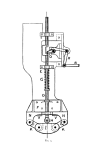
From "Automatic Cab Signalling" by H. Arkell - Swindon Engineering Society lecture 2nd March 1909*:—

Raven’s Mechanical System (Fig. 3). — The shoe on the engine is of good design to stand shock and wear. A spring controlled rod, having a roller bearing on the shoe, operates a valve connected with the train pipe. Air let out from the train pipe operates a whistle, besides causing the brakes to be applied (this apparatus was designed for use with the Westinghouse brake). The valve is closed again by a bell
crank operated by the driver. Should the shoe be damaged or broken the spring will force the rod down and the valve cannot be closed by the driver.
P_091_Automatic_Cab_Signalling-1909.png
Pete.

*Tuesday.
 

Tim Watson

Western Thunderer
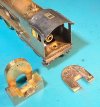
The cab interior on the Raven 4-6-2 class is now substantially complete, excepting floor boards, regulator and a few more fittings.
c9f8ac30-04b5-4aaf-a305-e32a69ea7704.jpg
As noted previously, it started off as a large lump of brass (well two actually) which were milled and filed to shape.
dcd0df9f-c827-4fe1-b502-9055f3146797.jpg
The back head itself was made from layers of 30 thou nickel silver to give the characteristic angles and was drilled with 0.4mm holes for the plumbing and regulator spindle.
d48a2292-e4a1-4c0f-b727-856310887e9a.jpg
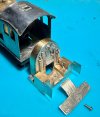
The three components were temporarily glued together with superglue to allow holes to be drilled for pinning the two brass bits together.
8874e0e0-3335-4ee0-9404-ec4a53a95aa7.jpg
Once the pin holes were drilled the components were dismantled, cleaned up , pinned and sweated together with soft solder.
5bc93113-dbd5-48e3-9ace-41a15899cba6.jpg
When all the details are complete, the backhead will be Araldited onto the firebox.
2c793c16-0068-4248-9732-ead149928c82.jpg

4be4a7ee-8487-4c75-8136-fcd7509b123d.jpg
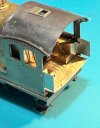
Unusually (to me, at least) the cab doesn’t have a movable fall plate but a rearward extension of the footplate towards the tender - a bit like the BR standard classes - whilst there isn’t a foot plate, as such, on the tender. It will be an interesting detail to make.

Tim
 
Last edited:

Tim Watson

Western Thunderer
I often get asked about the surgical telescopes (loupes) that I use for model making. These are very expensive £1K+ professional 2.8x magnification lightweight flick up lenses with an attachable LED coaxial head light - the latter is invaluable. There are, however, much, much cheaper alternatives out there.

https://www.amazon.co.uk/2-5X420mm-Portable-Surgical-Binocular-Magnifying/dp/B07R58NCGD

Single lens alternatives may give the required magnification for an individual, but at often a reduced field of view and definitely an unergonomic working range.
I encourage the doctors who I teach to at least purchase these, but the challenge arises when they wear prescription lenses. There are clip-on versions available, but these are not very stable and position the lenses a little further from your eyes than ideal, so reducing field of view.

The following shows a set that I have adapted to an old pair of plastic-framed prescription glasses for one of my students.

d74e539d-7a7a-4c25-b7f3-0222f0ba4855.jpg

The bridge of the loupes was adapted with a bur in my Proxxon handpiece to match the shape of the corresponding bridge of the glasses. Both are made from a very slippery plastic which does not glue easily, so some open weave tissue paper was melted into the plastic surface with a dry soldering iron to give a retentive surface for the epoxy resin to infiltrate. The bridge was actually turned upside down so that it would give the correct operating position on these glasses - towards the lower half of the lenses.
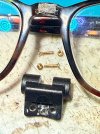
8a2bcfde-27cf-4d11-ae5a-825f449f1d25.jpg

In this pair of glasses the plastic bridge is fairly slender and so I elected to use some 10BA bolts to mount the loupes. They are supplied with some fairly large self tapping plastic screws, but these would have overly weakened the surrounding plastic frame. The hole positions on the frames were marked using a fine white pen paint marker through the holes in the loupe bridge. The holes were drilled to a very tight clearance for 10BA using a 1.2mm TC drill turned by hand and then minimally countersunk on the rear with a round bur. The heads of the countersunk bolts were rounded off so that they would not rub against the glabella.
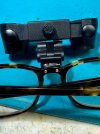
b559a79b-9f88-4de4-90f7-66b384947715.jpg

The 10BA nuts were accommodated within the screw head recess on the loupes bridge.
12e03b61-eb6a-47a8-982c-9fe98036492e.jpg

Once I was happy with everything being centrally positioned, then the whole assembly was fixed in position with 24hr epoxy resin. The nuts were encased in the resin and a good fillet of adhesive placed top and bottom of the loupes bridge to improve stability.

Careful setting up of the loupes is essential, with the individual holding and focussing on one thumb at the required working range (approx 420mm). The interocular distance is adjusted until the thumb doesn’t move left or right when each eye is closed, alternately: once the image is fused, then the central adjuster is tightened in position. The convergence angle of the telescopes is also adjusted to suit the working distance, with no eye strain.

I would suggest that 2.5x magnification is a good starting point, to give a good field of view and depth of focus: 3.5x may suit some people but with a trade off of in viewing volume. The cost is fairly moderate, so if you wanted higher magnification then, so long as you purchased from the same manufacturer, the two should be interchangeable on the modified loupes bridge.

I hope this helps someone, giving an affordable option for reasonable quality magnification.

Tim

 

DavidB

Western Thunderer
When I had my eyes tested followed by new lenses, I got a pair of bifocals made with the top part to my reading prescription an enhancement (about x1.5) to the lower part. I have found this a very satisfactory arrangement which allows me to work on the bench at a comfortable distance. The specs cost me about £45 including the frames - I take my prescription to and buy from a local chap, not any of the chain brands, who deals solely with lenses and spectacles, no testing. I now keep the frames and just replace the lenses as my prescription changes.

On top of that, for the occasional times when I want to see more closely, I bought a x3 watchmaker's loupe from Cousins which fits to a side arm of the specs and flips up or down as required.

I am modelling in 4mm (P4).
 

Tim Watson

Western Thunderer
After all that, the 24hr epoxy mix failed to set as I like it, probably down to a component mis-match in a small quantity, so it was stripped off and re-made this morning.
74ffd98e-6b3f-4494-bc67-6ff62038ca15.jpg
After a good mix of epoxy the front steel running plates are well bonded to the valences. The frames above the running plates are removable at this stage as they were painted Saxony green, with white and black edge lining: this will make life much simpler in the paint shops.
fba2caf7-60ec-46ff-966b-ee5cf9a8a5dd.jpg
Good enough for government work…

Tim
 

Tim Watson
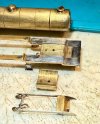
Western Thunderer
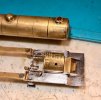
The cab floor and rigid ‘fall plate’ has been made along with the cab doors, so completing this area.
9e7ed0bd-0f26-4797-ac3c-858446b9693b.jpg
The floor and fall plate was made as a separate entity and is held in place with a 16BA bolt.
2a34eb20-d0ef-440c-b361-adc183e25671.jpg
I thought it easier to attach the cab doors to the interior seats, being stronger and keeping the back of the cab as a clean line for painting and lining purposes.
c1e2a92b-4f8a-427f-bb05-323778ec4b64.jpg
The cab floor extension will give somewhere for the fireman to stand and I think the details will have been a worthwhile addition as it is quite an open cab.

Tim
 
Top