
You are using an out of date browser. It may not display this or other websites correctly.
You should upgrade or use an alternative browser.
You should upgrade or use an alternative browser.
Threadmarks
View all 189 threadmarks
Reader mode
Reader mode
Recent threadmarks
( Diversion : painting parts to look like brass ) . . power and radio control GER 14-ton machinery wagon (1886) New ( Diversion : a traction engine as a load for a wagon ) New ( Diversion : Middy steam on Easter Monday ) New Fowler road locomotives New Swapping out Dinghams for 3-links New Fowler road locomotives . . part 2 New

RichardG
Western Thunderer
Agreed.Well, yes, but there are devices that are specifically and suitably prepared for the task.
Fair enough.I believed that the use of stones was actually prohibited, as the have a habit of unpredictably turning into smaller stones, and smaller yet, just when you most need them not to do so.
I do think, if we are to consider actions by a prototype to be unprototypical then the hobby is going to get challenging.
The operators of the Heybridge Railway would not have read either rule book. They might have their own rule book, or use the GER one (I've not seen this yet).I just had a look through the rule books I have - a Reprint BR 1950 book authorised to 1st October 61, and a replica 1904 GWR one, both of which are clear about the use of scotches, and scotch blocks, but neither actually mentions the use of “unauthorised materials”in such an application.
The Essex gravel would definitely be unsuitable, but Heybridge Basin would have had plenty of odd bits of timber to hand. I might just get round to making a set of wedges, if only as a peace offering

My fictional history says the Heybridge Railway rather struggled to get the hang of this continuous brake thing. The fifth and final locomotive owned by the railway (the ex-NER H2 'Quintus'), running from 1907, is set up to receive a Westinghouse pump after it gets painted; and the private coach will have the Westinghouse brake. This will match up with the GER and the LT&SR. Modernity at last.I recall that a runaway train in Ireland was mentioned in Red for Danger, so looked it up: it had been held by the brake van and stones under the wheels but was nudged by the loco and ran away with loss of 80 lives. Newry & Armagh, 12 June 1889.
Railway act 1889 rapidly followed requiring continuous vacuum brakes on passenger trains.
RichardG
Western Thunderer

Blocks and beams instead of scotches.
Link to original file on Flickr with credit and explanatory notes:
Last edited:

simond
Western Thunderer
Couldn’t agree more!I do think, if we are to consider actions by a prototype to be unprototypical then the hobby is going to get challenging.

RichardG
Western Thunderer
The kit includes parts to build a weight box. One of the ends of the box is part-open, the detailing on the sides looks wobbly (as if hand-drawn) and there is no lid.

So I have made a new box. The wheels are Roco H0e ones on 1mm wire axles.

Some of these cranes have a leadscrew to help the operator move the counterweight so I have made one from a machine screw and a washer and some wire handles. The lifting eye is a split pin and another washer.
The box is full of 2mm lead shot. It has ended up a bit heavier than I really want it to be, but I expect I can pose the crane with loads of 40 grams or so without it toppling forwards.
Some cranes carried detailed instructions for use on cast plates fixed to the sides of the weight box. There is space to add these when I can make or find some suitable plates.
So I have made a new box. The wheels are Roco H0e ones on 1mm wire axles.
Some of these cranes have a leadscrew to help the operator move the counterweight so I have made one from a machine screw and a washer and some wire handles. The lifting eye is a split pin and another washer.
The box is full of 2mm lead shot. It has ended up a bit heavier than I really want it to be, but I expect I can pose the crane with loads of 40 grams or so without it toppling forwards.
Some cranes carried detailed instructions for use on cast plates fixed to the sides of the weight box. There is space to add these when I can make or find some suitable plates.
RichardG
Western Thunderer
With the crane almost finished I have made a start on the wagon to carry it.
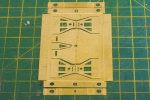
The wagon chassis has a neat and simple design, but the parts do not line up very well.
x
For example the headstocks have to trimmed to make them look symmetrical.
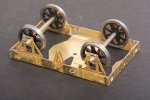
The headstocks and solebars fold down, and then half-etched overlays go on top. The wheel bearings and the wheelsets go in, and it is easy to twist the whole chassis with fingers to make sure the wagon is sitting flat and is not going to rock on a diagonal.

The brake blocks and hangers are laminated together in three layers. The result looks suitably sturdy but the brake blocks are nowhere near the wheels.
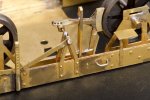
My solution is to add a shim onto one brake block and discard the other brake altogether. The result looks as though it could actually work. I have made the brake lever posable.
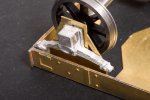
Moving on to the castings, the ends of the springs are going to be sitting in mid-air. I am not sure how to put this right, perhaps each solebar needs an "underneath". Suggestions welcome.
The wagon chassis has a neat and simple design, but the parts do not line up very well.
x
For example the headstocks have to trimmed to make them look symmetrical.
The headstocks and solebars fold down, and then half-etched overlays go on top. The wheel bearings and the wheelsets go in, and it is easy to twist the whole chassis with fingers to make sure the wagon is sitting flat and is not going to rock on a diagonal.
The brake blocks and hangers are laminated together in three layers. The result looks suitably sturdy but the brake blocks are nowhere near the wheels.
My solution is to add a shim onto one brake block and discard the other brake altogether. The result looks as though it could actually work. I have made the brake lever posable.
Moving on to the castings, the ends of the springs are going to be sitting in mid-air. I am not sure how to put this right, perhaps each solebar needs an "underneath". Suggestions welcome.

spikey faz
Western Thunderer
I'm assuming the ride height is correct? If it's too high, then lower the w-irons. If not, then I suppose you could try gently bending the springs to reduce the gap. A bit of metal to fill the remaining gap.
Or, plan C.... replacement springs?
Mike
Or, plan C.... replacement springs?
Mike

Osgood
Western Thunderer
Have you checked the 'ride height' of the axle within the axlebox?
I can't see from your picture but the casting hole may be too high up the box?
Real axle / axlebox relationships should look something like the drawing below - you never know, there might be an option to lower the cavity for the axle end and thus raise the axlebox / spring assy to meet the solebar?
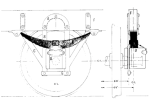
I can't see from your picture but the casting hole may be too high up the box?
Real axle / axlebox relationships should look something like the drawing below - you never know, there might be an option to lower the cavity for the axle end and thus raise the axlebox / spring assy to meet the solebar?
RichardG
Western Thunderer
Have you checked the 'ride height' of the axle within the axlebox?
The error in the vertical alignment of this axle box (the one in my photo above) is quite small, so I am sure I can put this right with an adjustment of the hole in the casting.
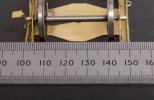
What is more troubling is, the two pairs of axleguards are not placed symmetrically. The axleguards on the brake side are in the right place. I have been trying so hard to make the assembly clean and square I didn't notice the fold lines on two axleguards are adrift.
The wagon chassis has a neat and simple design, but the parts do not line up very well.
In fact, the whole chassis stands on the track with a list of about half a millimetre, and now I see it I cannot un-see it. The etch has been drawn and etched wonky, and like a fool I simply assembled it the way it has been designed.
I must have a think, either continue with it or salvage the wheels for a completely new chassis. Or maybe cut off two axleguards and try to put them back on in the right place.
I suppose, it won't look so bad when everything is painted black.
Last edited:
RichardG
Western Thunderer
this...
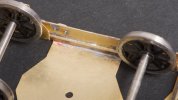
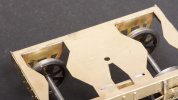
I have duly cut off the two axleguards on the non-brake side, and reattached them using a length of brass L to align them and reinforce the joints.
The model now looks much the same as it did this morning, but with the four W irons placed symmetrically inside the solebars and without the list to one side.
. . inital assembly of crane and chassis
RichardG
Western Thunderer

With the W-irons adjusted, the castings for the springs fit rather well.

The buffer stocks are cast in solid metal, so the first task with these is to bore them out to accept the buffer stems. This means, create tubes in white metal with a 0.5 mm wall thickness. I managed three, the fourth one just fell apart. So I re-built it with some brass tube.
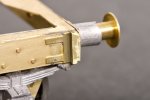
The kit includes four blocks of white metal to complete the ends of the headstocks. These blocks are too fat, too wide and too short, so I used square brass instead. The solebars are deeper than the headstocks, maybe this will show up less after painting. Or maybe I should shorten the brass blocks.
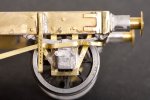
The W irons remain asymmetric. Those on the side with the brake have this open slot below the axlebox; those on the other side have the slot hidden behind the axlebox.
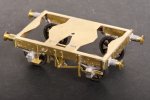
I want to paint the chassis before I attach the decking.
A temporary assembly. The model stays balanced both with and without this 1 oz weight.
I am told, this kit is “of its time”. Experience is starting to tell me, this means some parts will be wrong, or have a low specification, or not fit at all; and I should expect to make some improvisations. This is certainly the case here, and I feel I have making a corrective action at almost every step. Some people revel in this, while I tend to think the manufacturer should have tried harder. Still, no-one was holding a gun against my head telling me to buy the kit or indeed to build it.
Supposing the chassis is black and the crane is a darkish blue-grey, this ought to look fine on the layout

RichardG
Western Thunderer
That's a huge chess set!
And heavy…
My best suggestion is this is a prop for a theatre production. But really, it's a weight from the kitchen scales. The 2 oz one would topple the crane.
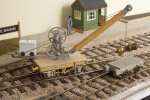
With the jib fixed in the raised position, the model won't pass through the hole in the backscene from layout to fiddle yard. Also, to run in a train the model needs two match trucks one at each end. So I envisage it as part of a static scene, and the load might be a motor car.

The Renault is light enough to suspend from the crane, but the Wolseley is solid pewter.
I found some good photos of the Bentall car in the Museum in the Park in Maldon. If I can work up the Danbury Mint model to a suitable standard, I might feel ready to have a go at a Bentall car. Which is, after all, the centrepiece of the project in its later years.


Dog Star
Western Thunderer
Prototype for everything... The RAIB has published the report into the collision between a footbridge and an excavator jib at St Mary's Halt on the Forest of Dean railway (14th August 2025).With the jib fixed in the raised position, the model won't pass through the hole in the backscene from layout to fiddle yard.
Threadmarks
View all 189 threadmarks
Reader mode
Reader mode