The Heybridge Railway, 1889 to 1913

RichardG

Western Thunderer
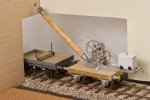
With the jib fixed in the raised position, the model won't pass through the hole in the backscene from layout to fiddle yard.

Prototype for everything... The RAIB has published the report into the collision between a footbridge and an excavator jib at St Mary's Halt on the Forest of Dean railway (14th August 2025).

DSC_1342.jpeg
I don't have a footbridge, rather a hole in the sky to eventually hide behind a building. The hole is high enough to let Nellie the crane tank pass, the top of her crane jib is 2 mm out of gauge because of inexperience when I built the loco.

I want to make a two-storey building with a pitched roof to hide the hole, so I won't cut the hole any taller. Anyway, a crane running with its jib raised will look odd. The crane can make occasional static scenes.
 

RichardG

Western Thunderer
Alastair, this is an exceptionally good idea. Unfortunately I chose to lock the bottom pivot of the jib solid into the frames, "to make the model stronger", so I don't really have an option unless I drill out the pivot pins and put in new ones.

Which I could do, if I can work out how to attach the pairs of tiny magnets.
 
. . rail clips

RichardG

Western Thunderer
Will you fit rail clips, or some other means of support - for when the crane is lifting?

I am not sure about rail clips. I don't know what they look like.

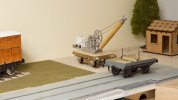
DSC_1357.jpeg
This end of the layout hasn't appeared in many photos. It is supposed to represent a small yard run by the navigation company.

The mobile crane might look good here, supported on beams and blocks like this prototype.

In which case I need not worry about rail clips, though it would be good to learn about them all the same.
 

simond

Western Thunderer
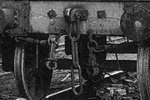
Richard, these are rail clips - the things hanging on hooks either side of the coupling. (This from your photo in #2105). They’re visible in the other photos too.

they each comprise two forged plates that hook around the railhead, and are locked there by a ring that slides down. You can see the shape easily on the left one. They are attached to the sole bars by turnbuckles, that can be tightened to force the suspension to be compressed until the chassis is solid with the track. I believe there will be a pair at the other end of the vehicle too.

Nice detail.

IMG_2867.jpeg
 

RichardG

Western Thunderer
First, find the tiny magnets?

Shouldn't be difficult, as they have been used to couple up air hoses , etc...
Sorry Alastair but I want to pass on this one. Magnets able to hold hoses together won't hold the jib with a load. But maybe next time, there could be tiny hooks and eyes to secure the two sections of the rods.

Richard, these are rail clips - the things hanging on hooks either side of the coupling.
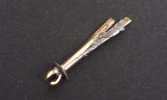
Okay . . . a bit like this?
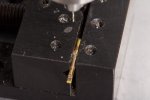
DSC_1399.jpeg
1. Start with a brass split pin and solder the two legs together (this is a 1/16 by 1/2 inch split pin)
2. Mark or trim one leg to length, this creates a guide for drilling
3. Drill a 0.6 mm hole right through both legs

DSC_1402.jpeg
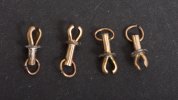
Left to right:
4. Drop a 10BA washer over the legs to represent the locking ring
5. Make a ring from brass wire and put it through the hole
6. Cut through the loop of the split pin and open up the sides to represent the jaws of the clamp
7. Trim the legs to length
DSC_1414.jpeg
Make four in all and clean up.

"So far so good".

Any guidance on making some turnbuckles would be good . . . I would like to do this without consuming four ready-made screw couplings if possible, but maybe there are some cheapo non-working ones I could use.

 
Last edited:

spikey faz

Western Thunderer
Good attention to detail Richard. :thumbs:
I was wondering if I should add something similar to the steam crane I'm building, but in the reference pictures I'm using such 'health & safety' accessories are conspicuous by their absence! :eek:

Mike
 
( Diversion : magnets )

alastairq

Western Thunderer
Sorry Alastair but I want to pass on this one. Magnets able to hold hoses together won't hold the jib with a load. But maybe next time, there could be tiny hooks and eyes to secure the two sections of the rods.

The magnet size was a suggestion...I didn't know how 'big,' or 'small,'' the stay links are........I suggested the air hose thing simply to illustrate just how small these magnets can be obtained.
I have some fairly small diameter magnets, and two stuck together do take some 'pulling apart,' so to speak.
 

RichardG

Western Thunderer
I have some fairly small diameter magnets, and two stuck together do take some 'pulling apart,' so to speak.
The smallest magnets I can find are discs about 1 mm diameter. I can imagine gluing a few together to make a cylinder, and then glueing the assembly inside a brass tube. This would be strong enough but I think the tube would look overscale. My difficult is fixing something onto the magnets. I have read, they can be soldered; but you have to keep them on a larger magnet during the process so the heat does not destroy the magnetism. One day I can try drilling them to accept a guy wire, see what happens.
 

simond

Western Thunderer
The smallest magnets I can find are discs about 1 mm diameter. I can imagine gluing a few together to make a cylinder, and then glueing the assembly inside a brass tube. This would be strong enough but I think the tube would look overscale. My difficult is fixing something onto the magnets. I have read, they can be soldered; but you have to keep them on a larger magnet during the process so the heat does not destroy the magnetism. One day I can try drilling them to accept a guy wire, see what happens.
Drilling won’t have a happy ending, I fear.

There are some magnets in the 1-2mm diameter, 3-5mm long size range, I imagine they’d take some separating if actually touching.
 

RichardG

Western Thunderer
The stays are 0.7 mm diameter n/s wire. I can imagine encasing some 1 mm diameter magnets in thin wall tube, and adding a length of larger tube at one end to locate this assembly over a second tube (containing more magnets) or perhaps a mild steel rod. The n/s wire would then be epoxied into the back of the tube and into a blind hole in the back of the steel rod.
 
Top