Prototype Tim Mills' Photos

hrmspaul

Western Thunderer
The electric units in #890 are 2 x 2BILs and with what looks like a 28 headcode are on a Reading - Waterloo via Richmond service. They were a most comfortable unit to ride in, the picture takes me back to visiting my Aunt and Uncle in Staines 60 odd years ago.
Martin
The photographs at Waterloo also take me back, as I was brought up in Staines. Yes the units used on the semi-fast service to Reading were very comfortable, and had Loos. Something missing from the EPBs, much to my discomfort late one night! But it was the Q1 that was really the star of the photos. [Sorry this system wouldn't let me quote the actual photos, but thanks for posting]

Paul
 

hrmspaul

Western Thunderer
The line started off as a single line branch from High Wycombe to Aylesbury, which did follow the topography more closely. When the “cut off“ upgrading was done, turning it into a main route Paddington to Birmingham, the track was doubled, but the second track was placed in a deep cutting to ease the grade for southbound trains. This happened at a time when mechanical excavation was available.

This set of photos really illustrates how clear railside cuttings could be during the steam days. Was this a cut off from the 1930s Government paid for developments that the GWR took advantage of?

The explanation that this was through the chalk strata does help to explain how bare it all appears.

Paul
 

Yorkshire Dave

Western Thunderer
Was this a cut off from the 1930s Government paid for developments that the GWR took advantage of?

In short no. It was built by the GW & GC Jnt and opened in 1905 as the GC wanted a faster easier route to avoid the heavily graded tortuous Met route via Aylesbury. This also provided the GW a shorter route to Birmingham by cutting off the circuitous route via Oxford.
 

AJC

Western Thunderer
In short no. It was built by the GW & GC Jnt and opened in 1905 as the GC wanted a faster easier route to avoid the heavily graded tortuous Met route via Aylesbury. This also provided the GW a shorter route to Birmingham by cutting off the circuitous route via Oxford.

So roughly contemporary with the Langport cut off and Badminton line - the scale of capital investment the GWR put in about then is genuinely astonishing.

Adam
 

Northroader

Western Thunderer
The GWR was called the Great Way Round for a reason. Going from Paddington, you got to Exeter and the West through Bristol, South Wales through Gloucester, and Birmingham through Oxford. Then there was getting down from Birmingham towards Bristol. It was a huge programme of construction around 1900s.
 

oldravendale

Western Thunderer
Thank you Martin @Martin Shaw for kicking off the identification of the units at Waterloo and to Dave @Yorkshire Dave for what could be considered further and better particulars I guess. That really is a cracking photo of the 2-BIL/2-HAL combination, and with a 28 headcode too. I remember Waterloo at the time of these photos very well, Paul @hrmspaul but took almost no interest in the electric units to my subsequent regret. Thank you, Paul, Dave, Adam @AJC and @Northroader for further discussion about the GW/GC.

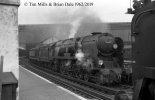
Last seen in post #2627 is rebuilt West Country 34042 Dorchester at Waterloo and on the Bournemouth Belle on 11th April 1962. It was a Bournemouth engine from June 1956, moving to Eastleigh in September 1964 where it was withdrawn in October 1965. (SLS). However, Rail UK and WHTS record withdrawal in July 1967, Rail UK stating withdrawal was from Bournemouth and a scrapping date of April 1966. The Railway Observer advise the loco went to Buttigieg’s, Newport where it was seen being cut up on 23rd September 1966.

img894 TM32A Film ID52 34042 Bournemouth Belle Waterloo 11 Apr 62 copyright FINAL.jpg

57XX pannier tank 4698 was loaned to Nine Elms initially in March 1959 but must have been regarded as satisfactory as it was allocated there at the end of June the same year. In July 1963 it moved to Treherbert, then Gloucester Horton Road at the end of August the same year, Bristol Barrow Road in May 1964 and finally back to Gloucester Horton Road in October where it was withdrawn in November 1965. (SLS). WHTS record it as at Ward’s, Briton Ferry, in January 1966 and BR Database that scrapping occurred in February 1966. There’s a previous photo showing the same engine in post #3433. In the background of this photo can be seen an unidentified Schools Class 4-4-0.

Edit. The Schools is identified as, more than likely, 30936, Cranleigh.

img895 TM33A Film ID52 4698 Waterloo 11 Apr 62 copyright FINAL.jpg

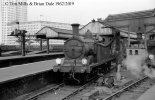
This loco was previously in post #2627. LSWR M7 0-4-4T 30320 taking water at Waterloo on 11th April 1962 with what appears to be its replacement, a GWR 57XX pannier tank alongside. I have fond memories of the M7s on these duties. 30320 had been at Nine Elms since 1952 and was withdrawn in February 1963. (SLS). For some reason the SLS records it being transferred to the Western Region in January! It went to P Woods (Shipbreaking) at Queenborough, Kent, (LCGB) where it was scrapped at the end of April 1964. (BR Database). It was observed intact in the scrapyard on 7th April 1964 (RO) and also 11th July 1964 (WHTS) so either the sighting in July is erroneous or the WHTS given scrapping date is incorrect which we know is a distinct possibility. More EMUs are notable in the left background.

img896 TM34A Film ID52 30320 taking water Waterloo Station Pilots 11 Apr 62  copyright FINAL.jpg

Brian
 
Last edited:

Martin Shaw

Western Thunderer
Some inevitable date conflicts, info from Irwell,

34042 Dorchester wdn 3/10/65, cut up Buttigiegs Newport 4/66.

30320 wdn w/e 2/3/63, Sold for scrap to R.S.Hayes, Queenborough 7/3/64. This suggests a cutting up date post early March so which of either the RO or WHTS is correct is open to an unanswerable question.

The Schools is interesting. It is not a Lemaitre chimney one and blown up the last digit of the numberplate could be a 6. This gives four possibilities,
906 Sherborne which at the time was a Guildford engine so a contender however the fourth digit is almost certainly not 0.
916 Whitgift, a Redhill engine so not likely.
926 Repton, a Stewarts Lane engine so an unlikely possibility.
936 Cranleigh, a Nine Elms engine so the most likely.

All four of them were withdrawn on 29/12/62. 906/916 from Brighton and 926 from Basingstoke and 936 Nine Elms. 926 is preserved at the NYMR, the other three were cut up at Eastleigh Works.

All a speculative observation based on a highly blown up image, alternative offerings gratefully accepted.

Martin
 
Last edited:

paratom

Western Thunderer
I should have recognised the loco from your avatar and handle, Col! It all comes together now. Was a class 15 or 16 also used as a pilot for a period, similarly buffed up? I'm pretty sure that, in the photo of 69657 above, the loco in the background is more likely to be a J69 than an N7 but I guess we'll never know for certain.

Here's 69614 appropriately receiving the attention which was normal for these pilots. I have to spend some time with Tim going through all these photos which I've already post processed, and there are several hundred of them which will appear on here eventually, so he can give me the background including dates.

Details: N7 0-6-2T 69614 carrying a 30A Stratford shed plate at Liverpool Street Station at an unknown date. It became an N7/4 in February 1940 and despite appearances to the contrary the condensers were removed in May 1936. It was at Parkeston Quay in April 1949 and then to Stratford in August 1951. It was withdrawn in December 1960 (SLS) and scrapped at Stratford Works in March 1961. (RO).

View attachment 135863

Tony - thanks for your interest. I reckon one of the best to show the changes - I hesitate to say improvements, as that is a matter of individual judgement - is 69657 which is what has stirred up these comments. I very rarely if ever use the built in automatic quality improvement tools during scanning as too often I've found that they have an unrequired effect, for example dirt removal can result in the suppressing of fine detail, so this is the basic scan and what I started with.

View attachment 135862

You can see the density changes around the smokebox and front frames/cylinder cover and also you can see marks around the dome and boiler top which, on enlargement, look like scabs. The neg is, in fact covered in these but they are difficult to see in the deep shadows. The station platform in the left foreground has some sort of drying marks. I suspected reticulation initially but I think this is related to the similar marks on the dome and boiler. It's also possible that these are microbe attack but to confirm would need a more forensic approach than I am applying as I simply want to get the best from the negs that I can. The whole frame is affected to a greater or lesser extent.

The dirt and scratches are removed as a matter of course and contrast is adjusted. Most of these marks are removed by using the "clone" tool which allows an area of similar density to be copied and used to replace the damage. That's all there is to it but to deal with each issue as a separate entity takes time. It fills the hours sitting in front of the box! It's important to me that every photo receives this treatment and is a "warts and all" approach. Those marks on the ballast which could be interpreted as dust and removed are, in fact physical rubbish. Lights or holes in an overall roof remain in the final picture as they were there when the photo was taken. When requested I have occasionally removed similar debris or painted out the odd crane growing out of a chimney but always have the original image as the reference.

I know there are others on this forum far more skilled than I in the use of Photoshop who may like to comment further.

The next several photos will be those Tim took around Braintree and Witham. Tim asked me yesterday to give these priority as he has a friend who wishes to make use of them.

Brian
I wonder if any of those black faces ever became firemen or drivers?
 

oldravendale

Western Thunderer
Thank you for the info on Dorchester and the M7, Martin. Will be added to the info as usual.

Thanks also to @paratom . Yes, we've discussed the possible importance of that photo of the N7 at Liverpool Street previously. Of course, at this distance in time we have no knowledge of whether any of the people featured in that photo became drivers or firemen.

This is something of a watershed moment as we reach image 899 of this set of photographs. It means there remain only another one hundred to go by which time we've exhausted Tim's black and white photographs. They should last another four or five weeks. We've not done badly though - this thread commenced in October 2020 and the information has gradually become more refined as we've progressed.

Martin @Martin Shaw will doubtless be pleased to see that this photo is almost certainly of the previously unidentified Schools in the previous post. Schools Class 30936 Cranleigh which we saw previously in posts #2627, #3198 and #4349 here at Waterloo Station on 11th April 1962 on the 12.54 Basingstoke train. It was in and out of store at Bricklayers Arms from June 1935 (SLS), went to Ashford in June 1959 (BR Database), and Nine Elms in November 1961 where it was withdrawn in December 1962. (SLS). It was then stored at Eastleigh Works – the SLS report it as there awaiting works or scrapping from May until September 1963 and cut up at Eastleigh Works in November 1963 (Irwell Book of) and the Railway Observer gives a precise date of week ending 2nd November 1963. Quite significant damage to the negative showing on the canopy and right hand edge of the last picture has been painted in.

img897 TM35A Film ID52 30936 12.54 Basingstoke Waterloo 11 Apr 62 copyright FINAL.jpg

img898 TM36A Film ID52 30936 12.54 Basingstoke Waterloo 11 Apr 62  copyright FINAL.jpg

img899 TM37A Film ID52 30936 12.54 Basingstoke Waterloo 11 Apr 62 copyright FINAL.jpg

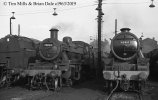
Standard Class 2 2-6-0 previously in post #2029 78063 and Black 5 45410 in Willesden Shed Yard in around 1963. 78063 went to Willesden from Wigan Central at the beginning of June 1963. It's carrying the correct 1A shed plate. It ended up at Shrewsbury in May 1966 by way of Nuneaton and was withdrawn in October. (SLS). It was finally at Cashmore's Newport where it was scrapped in September 1967 (BR Database) although the SLS report it as being dumped at United Wagon Co in Newport on 16th October. The Black 5 is carrying shed code 21B, Bescot, where it was allocated in May 1961, going to Saltley in April and back to Bescot in July 1965 then back to Saltley in April 1966 where it was withdrawn in September the same year. (SLS). It was scrapped at Cashmore’s Great Bridge in February 1967.

img900 TM15A Film ID94 78063 1A shed plate & 45410 21B shed plate Willesden c1963 copyright FI...jpg

Previously in post #4690 at Southampton Station and here at Waterloo is Original West Country 34007 Wadebridge at some time in 1963. This loco was allocated to Nine Elms in April 1951, went in to store there in October and was reinstated in December, all in 1951, before going to Salisbury in September 1964 where it was withdrawn in October 1965. (SLS) It was sent to Woodham’s at Barry and thence into preservation - see 34007 Wadebridge (SR 21C107, BR s21C107 & 34007) for further details.

img901 TM16A Film ID94 34007 75A shed plate Waterloo c1963 copyright FINAL.jpg

Brian
 

Yorkshire Dave

Western Thunderer
More EMUs are notable in the left background.

img896 TM34A Film ID52 30320 taking water Waterloo Station Pilots 11 Apr 62  copyright FINAL.jpg

The EMU left of the M7 is a Bulleid SR designed BR built (1951) 4-EPB. The unit to its left of the 4-EPB is a 2-HAL.

The 4-EPB headcode could be:
13 Waterloo - Woking via Chertsey
16 Waterloo - Effingham Junction or Guildford via Epsom
18 Waterloo - Weybridge via Richmond
18 Waterloo - Chessington South via Motspur Park
19 Waterloo - Worcester Park - Epsom or Leatherhead

However, given the unit is on the Windsor Lines side (North Station) it is more than likely to be 18 Waterloo - Weybridge via Richmond. The other services would have started on the Surbtion side (South Station) to avoid conflicting moves crossing the main lines between Waterloo and Clapham Junction. Main line services would have started from the centre platforms (Central Station). There were 'roundabout' services such as those via the Kingston Loop which started on the Windsor Lines side and terminated on the Surbition side on their return and vice versa.
 

oldravendale

Western Thunderer
Great additional info there, Dave. Thanks again.

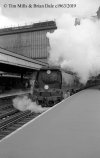
Rebuilt Merchant Navy 35001 Channel Packet on a Bournemouth departure at Waterloo in around 1963. It was a Stewarts Lane loco from January 1957, moving to Bournemouth in September 1964 where it was withdrawn two months later. (SLS). It was scrapped at Bird’s, Morriston, Swansea (RO) and reportedly despatched dead engine from Eastleigh on 28th April 1965. (LCGB).

img902 TM17A Film ID94 35001 on a Bournemouth departure.  Waterloo. c1963 copyright FINAL. Apr...jpg

img903 TM18A Film ID94 35001 on a Bournemouth departure.  Waterloo. c1963 copyright FINAL Remask.jpg

Waterloo Station at some time around 1963 and rebuilt Merchant Navy 35014 Nederland Line. The loco was allocated to Stewarts Lane in June 1955 and didn’t move to Weymouth Radipole until September 1964 where it was withdrawn in March 1967. (SLS). It was scrapped at Cashmore’s, Newport in the following September. (BR Database).

img904 TM19A Film ID94 35014 .  Waterloo. c1963 copyright FINAL.jpg

With an unidentified Merchant Navy in the foreground at Waterloo at some time around 1963 is Q1 33013 and Standard Class 3 2-6-2T 82024. The Q1 had belonged to Feltham since April 1948 and was withdrawn in July 1963. (SLS). It was scrapped at Cohen’s, Kettering in June 1964. (BR Database). Standard Class 3 2-6-2T 82024 was allocated to Nine Elms in November 1962 where it was withdrawn in January 1966. (SLS). It was scrapped at Cohen’s, Morriston in May 1966. (BR Database).

Edit: The "unidentified Merchant Navy" is now determined to be an unidentified West Country/Battle of Britain.

img905 TM20A Film ID94 33013, 82024 and unidentified MN Waterloo c1963 copyright FINAL.jpg

Brian
 
Last edited:

Dave Holt

Western Thunderer
Brian.
I think the unidentified Bulleid pacific is actually a WC/BB rather than a Merchant. The cylinder wrapper and expansion link support bracket are different shapes between the two types and those shown are definitely the light pacific type.
Dave.
 
  • Like
Reactions: AJC

Martin Shaw

Western Thunderer
Dave is right however I would disagree about the expansion link bracket, as far as I can see they are identical in both classes, why wouldn't they be. A far more ready identifier is the vacuum ejector exhaust pipe running along the boiler side. On a WC/BB it is straight whereas on a MN there is a downward offset just before the smoke deflector. Not much use if your looking at the RH side of the engine I know but well illustrated above.
Martin
 

Dave Holt

Western Thunderer
Martin,

Please be assured that the expansion link brackets are different. I have no idea why that should be, but it is.
The light pacific brackets are as seen in the Waterloo photo. MN brackets have a horizontal bottom edge, from the bearing housing, rearwards and then sloping up at a much steeper angle, as seen below.
35006_LHS_3.JPG
35006 at Toddington.
Dave.
 

Yorkshire Dave

Western Thunderer
Was this a cut off from the 1930s Government paid for developments that the GWR took advantage of?

So roughly contemporary with the Langport cut off and Badminton line - the scale of capital investment the GWR put in about then is genuinely astonishing.

Just briefly returning to this and the 1930s capital expenditure by the railway companies.

In 1929 the Chancellor of the Exchequer (Mr Winston Churchill) abolished the Railway Passenger Duty levied on first and second class ticket sales provided the railway companies spent the capitalised value of the duty on improvement and development schemes. The Southern Railway's was valued at £2.0m in 1929 which today roughly equates to (depending upon which indices are used) £110.48m (CPI) to £169.65m (RPI) and was spent mainly on electrification.

Later in 1935 the Government came to an agreement with the four main line railway companies whereby funds would be made available for improvement and development schemes at a lower interest rate than they could obtain on the capital markets. Funds were made available via the Railway Finance Corporation set up at this time as part of the legislation.
 

Martin Shaw

Western Thunderer
Dave
Thanks for pointing that out, I obviously didn't spot it when I looked at some MN pics this morning. It isn't so obvious in a view from an acute angle, well that's my excuse. I wonder if in putting the trunnion a bit further forward the same radius rod can be used on both classes, there will be some good engineering reasons for the difference.

I have found references to the valve gear on both rebuilt classes, the outside to be generally similar to the BR 2-6-4T ( another Brighton Works design) and the inside to follow the design of the Schools class inside valve gear, which one must assume worked well enough. The crank axle on both classes had been designed to take an eccentric in exchange for the chain drive sprocket after they were replaced following the earlier failures. On this basis there can't be that much difference in the valve gear of the two classes, unfortunately I can't find weight diagrams that would give wheel base dimensions which might be a clue.

Martin
 

Barry37

Western Thunderer
Dave
Thanks for pointing that out, I obviously didn't spot it when I looked at some MN pics this morning. It isn't so obvious in a view from an acute angle, well that's my excuse. I wonder if in putting the trunnion a bit further forward the same radius rod can be used on both classes, there will be some good engineering reasons for the difference.

I have found references to the valve gear on both rebuilt classes, the outside to be generally similar to the BR 2-6-4T ( another Brighton Works design) and the inside to follow the design of the Schools class inside valve gear, which one must assume worked well enough. The crank axle on both classes had been designed to take an eccentric in exchange for the chain drive sprocket after they were replaced following the earlier failures. On this basis there can't be that much difference in the valve gear of the two classes, unfortunately I can't find weight diagrams that would give wheel base dimensions which might be a clue.

Martin
Driving wheelbase of the two classes seems to have differed only by 3" (longer on MN), and that was between the centre and rear driving wheels, which shouldn't have affected the expansion link position or shape. Rear axle to pony truck was a foot more on the MNs (ditto). Dimensions in front of the centre axle were identical. Cylinder bore was about 1.5in larger on the MNs.
The MN diagram I found was of an "as built" one, but I doubt that the wheelbase would have been altered when rebuilding.
 

Dave Holt

Western Thunderer
If Brian will indulge us just a little bit longer, here's some further information and thoughts.
The basic inspiration for the valve gear on the modified locos may well have been as Martin suggests. However, I think, certainly for the outside motion, the only similarity with the BR Standard 4 tanks, is the lifting arm arrangement with the slotted extension of the radius arm. As far as I know, most previous Southern locos with outside gear used a swinging lifting link.
Clearly, the motion on the MN and light pacifics is very similar in layout and do have many features in common. The front axle spacing, the centre distance to the cylinders and position of the reversing shaft, relative to the driving axle are all exactly the same. However, because the spacing between the piston rod and valve spindle are different, the radius rod slopes down at a steeper angle on the light pacifics, resulting in the expansion link pivot being lower than on the MNs. The combination levers are also a different length. This slight difference in geometry also results in some further slight differences, with both the return cranks and return crank rods being different lengths - in the case of the return cranks, just 1/32" difference! The position of the expansion link bearings are given on the bracket drawings relative to the reversing shaft bearing and the axle centreline to an accuracy of 1/10000" - can't imagine how that was achieved in the machine shop. On the MN, the expansion link is 1'-9.0477" above the axles and 2'-4.6332" forward from the reversing shaft. For the light pacifics, the dimension are 1'-8.7301" and 2'-4.6342, respectively.
As far as I can see, the connecting rods, expansion links, suspension links, connecting links (connecting the inner part of the suspension link to the valve spindle) and anchor links were all interchangeable. The radius rods differed only in the way the combination rod pin was retained and the return crank and return crank rod (BR drawing terminology for what I tend to call the eccentric rod) and combination lever were different between the two classes, as were the motion support bracket and the slide bar bracket.
Hopefully, that exhausts the subject.
Now back to Brian's photos posts.
Dave.
 
Top