Tom Mallard’s Workbench - Bradwell K1 - Clockwork LNER Q1

Tom Mallard

Western Thunderer
Hampton Court 3 010825.jpgSaints 3 010825.jpg
Ivanhoe 3 010825.jpg

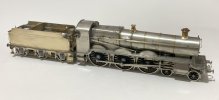
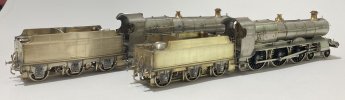
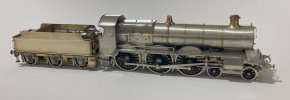
The Saints are now more or less there and remained a little uncooperative to the end... It didn't seem to matter how many photos or drawings I have - there was often something that proved tricky to resolve for the era they are modelled in.

The axlebox and spring casting on the intermediate tender fitted to Hampton Court is for King class tenders from the ABS range, but has something that better represents the type of spring hangers fitted with a little profile milled shackle and a turned pad.

A change of flux has meant that the models are a bit less clean looking as it was more aggressive than the citric acid based stuff I was using before. I am sure it will clean up fine.

A handful of small details are left to be attached and a drawbar, plus the DCC installation. Once all weighted up, I think they should perform very well.

Please do enjoy your modelling.

Tom
 

Tom Mallard

Western Thunderer
828 assembled.jpg

A candid image of CR 828 recently returned from Warren Haywood's paint shop. 828 is a modern scratchbuilt clockwork model in the manner of Beeson and Bassett Lowke, with the novel features of the regulator actuating on/off functions and the reversing lever attached to the motor to control forward/reverse motion.

Enjoy your modelling

Tom
 

40057

Western Thunderer
As previously indicated (post #368 in this thread), 828 will be coming to work in my layout, Rivermead Central.

I hardly need to say how fantastic 828 is: the model speaks for itself.

A tremendous ‘thank you’ to Tom as the builder and to Warren Haywood for the beautiful paint work. Other contributors to the build include the clock maker who rebuilt the motor with a female arbor (easier to hide) and replaced the original governor. And the unknown workers at Gebrüder Bing who made the motor in the first place — over 100 years ago.

On the basis that Rivermead Central, using vintage equipment, is railway preservation in model form, 828 is analogous to a real life ‘new build’ project. It’s a newly built example of the kind of model made a century ago. Except, as with full-size new builds, we have taken advantage of some more recent technological advances (CAD design, better governor).

Tom and I had a lot of discussions about getting the appropriate level of detail on 828. I think Tom has got it exactly right. As with the Henry Greenly designs for Bassett-Lowke pre-WW1, everything that needs to be there to make the model look like a CR 812 class loco is there. All the other stuff (pipe work etc) is omitted. After all, in the interests of aesthetics, the designers of the full size locomotive did their best to conceal ‘the other stuff’. The model simply goes one better!

One other area where the model has relied heavily on vintage practice is the paint work. The blue shade is based on the blue used on the models Bing and others made for Bassett-Lowke before and just after WW1. I trust the manufacturers to have got this right so regard their models as the best contemporary source for the correct blue colour.

Martin
 

Tom Mallard

Western Thunderer
Lovely work with the Saints. A chap can never have too many of these in P4. Here are two of mine (I have three). I should really have taken some pix when they were in bare metal. Hey-ho.
Thanks for sharing your Saint models - they've come out very nicely. Are these from kits or scratchbuilt?
 

Solebay

New Member
Thanks for sharing your Saint models - they've come out very nicely. Are these from kits or scratchbuilt?
Ultrascale wheels and gears, Mashima motors, Malcolm Mitchell tenders. Pretty much all of the rest is scratchbuilt from nickel-silver and brass. There are a few Martin Finney castings here and there (like the injectors) but mostly scratchbuilt.
 

Tom Mallard

Western Thunderer
K1 62015 1 bw.JPG
Screenshot Q1 240126.png

Howdy folks.

The Saints have been beautifully painted and lined as one of Ian Rathbone's last remaining pieces of work. Once collected and final assembly has taken place, I'll update with a photo.

In the meantime I completed construction of a 4mm scale Dave Bradwell ex LNER K1. Aside from Dave's trademark springing of the model, this was surprisingly involved for such a run of the mill prototype! There are plenty of tweaks and refinements, but the overall standard of the kit is very high. It runs on an Exactoscale wheelset, with a custom High Level gearbox and Faulhaber motor. To ease clearances through all of the valvegear, the crankpin design was modified to eliminate the backing washer (the driving wheels have a raised boss here in any case) and gain positive location in the wheel face as per the shouldered Ultrascale crankpin design.

As mentioned on 40057's thread, I've been encouraged to mention the next clockwork powered model I build... This will be a LNER Q1 shunting engine with the wonderful Van Riemsdijk variable speed mechanism. The controls will be kept inconspicuously located in the bunker space and the winding key aperture will be - well watch this space to see if we can get it somewhere else inconspicuous without compromising appearance.

The drawing above is to investigate the fit, postion and orientation of the clockwork motor, plus clearance or otherwise of the chassis on a standard 3' radius curve. Generous sideplay of the coupled wheels will be a necessity whilst of course not impinging on the connecting rods. At this early stage I cannot say precisely what will need to be reviewed in order for the model to operate with the least possible reisistance to motion or drag around these curves.

Anyway, an exciting project awaits.

Best regards

Tom
 

Dave Holt

Western Thunderer
The K1 looks a very nice model, Tom.
It's interesting to compare with the B1 I'm building. Quite a few similarities but surprising differences for two designs by the same engineer at about the same time. Different drafting teams, perhaps?
Dave.
 

Fitzroy

Western Thunderer
Hi Tom, I love your work (as they say in Hollywood). With the key position on the Q1, one option would perhaps be to have a spur gear train from the winding shaft to a remote winding shaft below the footplate, either before or after the second pair of driving wheels.
Cheers
Pieter
 

40057

Western Thunderer
Hi Tom, I love your work (as they say in Hollywood). With the key position on the Q1, one option would perhaps be to have a spur gear train from the winding shaft to a remote winding shaft below the footplate, either before or after the second pair of driving wheels.
Cheers
Pieter
Hi Pieter

There are two difficulties with bringing the winder down below the foot plate. First, access to the key hole would be blocked by the connecting rod/coupling rod when the cranks were near/at the top. An inconvenience, but just push the loco along a bit, and problem solved. More fundamentally, you can’t turn the key because it and/or your hand hits the ground. Low key holes below the running plate are well hidden but not very practical.

Martin
 

Tom Mallard

Western Thunderer
The K1 looks a very nice model, Tom.
It's interesting to compare with the B1 I'm building. Quite a few similarities but surprising differences for two designs by the same engineer at about the same time. Different drafting teams, perhaps?
Dave.
Cheers Dave. I believe the B1 is a Thompson design, so perhaps that would explain the differences. The B1 is a more original LNER design than the K1 which was based on Gresley designs (and a Thompson rebuild of a K4 giving the prototype). The B1's were built over quite a long period, overlapping with the Peppercorn K1 and were viewed as the only Thompson engine of real note! Well by partisan book authors anyway...
Tom
 

James

Western Thunderer
Hi Pieter

There are two difficulties with bringing the winder down below the foot plate. First, access to the key hole would be blocked by the connecting rod/coupling rod when the cranks were near/at the top. An inconvenience, but just push the loco along a bit, and problem solved. More fundamentally, you can’t turn the key because it and/or your hand hits the ground. Low key holes below the running plate are well hidden but not very practical.

Martin

I find clockwork really interesting but I know nothing about how the more sophisticated clockwork mechanisms can be used to operate a model railway, such as Crewchester and the Sherwood Section.
 

40057

Western Thunderer
I find clockwork really interesting but I know nothing about how the more sophisticated clockwork mechanisms can be used to operate a model railway, such as Crewchester and the Sherwood Section.
Hi James

A clockwork locomotive is a true ‘locomotive’ in that it carries its source of power with it. Once you have set it off, it is no longer under your control. So, operationally, you need to make sure you have set the road correctly, there is nothing else on the line etc., as per real practice. Otherwise, as per real practice, your train will derail or be in a collision. The ideal is an end-to-end line a bit shorter than the length travelled on one full winding. Devices such as track-operated brake rails or a well placed rising gradient in the terminus can ensure skilful drivers who know the road and their locomotive will get their train to stop where it should. There can be a definite realism to clockwork operation if it is done well. Both Crewchester and Sherwood had complex timetables and teams of skilled operators. They were closely following the operation of real railways, e.g. locomotives needed to be matched to their train loads because smaller locomotives would not pull long trains.

Martin
 

James Spooner

Western Thunderer
Hi Pieter

There are two difficulties with bringing the winder down below the foot plate. First, access to the key hole would be blocked by the connecting rod/coupling rod when the cranks were near/at the top. An inconvenience, but just push the loco along a bit, and problem solved. More fundamentally, you can’t turn the key because it and/or your hand hits the ground. Low key holes below the running plate are well hidden but not very practical.

Martin
Just following on this train of thought, would it be possible to move the winder either fore or aft (instead of down), so it is just in front of the side tank or in the cab?

Nigel
 

40057

Western Thunderer
Just following on this train of thought, would it be possible to move the winder either fore or aft (instead of down), so it is just in front of the side tank or in the cab?

Nigel
Hi Nigel

Yes, that would be possible though the cab doorway is a long way from the winder position. If the cab door was the ‘target’ location for the winder, you would probably turn the motor and have the main-spring at the back. A downside of that would be having the motor in full view in the cab.

The consequences of having the motor with the spring at the back were tested amongst Tom’s options tried out in CAD. Also, whether driving the third axle was better. Tom will advise if anything arises to change thinking, but the motor position shown above has been identified as the best option overall. That’s the firm intention.

Given this puts the winder where shown, as Tom hinted above, we have a ‘cunning plan’ for the winder which Tom will reveal in due course — if it proves feasible.

Martin
 

Fitzroy

Western Thunderer
Ah! I never thought of that, having always pulled a loco off the track to wind it. But thinking about it, yes. However in that case, how about a geartrain ending in a bevel gear and a vertical key shaft out of the top. Then it could be accessed by the tank filler. Oops, was that the cunning plan?
 

Tom Mallard

Western Thunderer
Ah! I never thought of that, having always pulled a loco off the track to wind it. But thinking about it, yes. However in that case, how about a geartrain ending in a bevel gear and a vertical key shaft out of the top. Then it could be accessed by the tank filler. Oops, was that the cunning plan?
We will see!
 
Top