
Tom Mallard
Western Thunderer
Thanks Ade, much appreciated.Work of art those Tom.

Thanks Ade, much appreciated.Work of art those Tom.
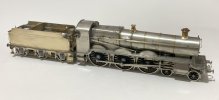
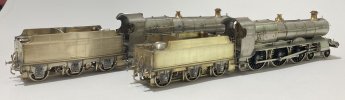
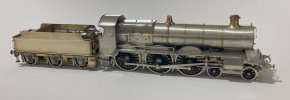

Thanks for sharing your Saint models - they've come out very nicely. Are these from kits or scratchbuilt?Lovely work with the Saints. A chap can never have too many of these in P4. Here are two of mine (I have three). I should really have taken some pix when they were in bare metal. Hey-ho.
Ultrascale wheels and gears, Mashima motors, Malcolm Mitchell tenders. Pretty much all of the rest is scratchbuilt from nickel-silver and brass. There are a few Martin Finney castings here and there (like the injectors) but mostly scratchbuilt.Thanks for sharing your Saint models - they've come out very nicely. Are these from kits or scratchbuilt?


Hi PieterHi Tom, I love your work (as they say in Hollywood). With the key position on the Q1, one option would perhaps be to have a spur gear train from the winding shaft to a remote winding shaft below the footplate, either before or after the second pair of driving wheels.
Cheers
Pieter
Cheers Dave. I believe the B1 is a Thompson design, so perhaps that would explain the differences. The B1 is a more original LNER design than the K1 which was based on Gresley designs (and a Thompson rebuild of a K4 giving the prototype). The B1's were built over quite a long period, overlapping with the Peppercorn K1 and were viewed as the only Thompson engine of real note! Well by partisan book authors anyway...The K1 looks a very nice model, Tom.
It's interesting to compare with the B1 I'm building. Quite a few similarities but surprising differences for two designs by the same engineer at about the same time. Different drafting teams, perhaps?
Dave.

Hi Pieter
There are two difficulties with bringing the winder down below the foot plate. First, access to the key hole would be blocked by the connecting rod/coupling rod when the cranks were near/at the top. An inconvenience, but just push the loco along a bit, and problem solved. More fundamentally, you can’t turn the key because it and/or your hand hits the ground. Low key holes below the running plate are well hidden but not very practical.
Martin
Hi JamesI find clockwork really interesting but I know nothing about how the more sophisticated clockwork mechanisms can be used to operate a model railway, such as Crewchester and the Sherwood Section.

Just following on this train of thought, would it be possible to move the winder either fore or aft (instead of down), so it is just in front of the side tank or in the cab?Hi Pieter
There are two difficulties with bringing the winder down below the foot plate. First, access to the key hole would be blocked by the connecting rod/coupling rod when the cranks were near/at the top. An inconvenience, but just push the loco along a bit, and problem solved. More fundamentally, you can’t turn the key because it and/or your hand hits the ground. Low key holes below the running plate are well hidden but not very practical.
Martin
Hi NigelJust following on this train of thought, would it be possible to move the winder either fore or aft (instead of down), so it is just in front of the side tank or in the cab?
Nigel
We will see!Ah! I never thought of that, having always pulled a loco off the track to wind it. But thinking about it, yes. However in that case, how about a geartrain ending in a bevel gear and a vertical key shaft out of the top. Then it could be accessed by the tank filler. Oops, was that the cunning plan?


