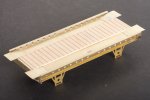
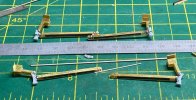
A Tale of Two Serpents

adrian

Flying Squad
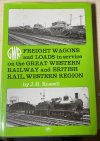
Which edition of this book are the photos from please? Looks like a useful book to add to the collection.


Apologies for the delay - been busy! This is the book - "Reprint 3". Scanning ebay there seems to be a few variations of dust covers (loaded tanks as the lower photo) - presumably earlier prints of the book
serpent - 2 (2).jpeg


Unfortunately I don't have the kit instructions or the GA drawing. This is just for general info for those following the thread as I'm sure Richard and magmouse already have this information regarding the differences between the unfitted and fitted versions of the wagon..

The GWR wagon history book I have includes the following "weight" diagram. It shows the differences between the Diag 9 unfitted and Diag 21 fitted Serpents. However the text does go on to say that in the WWII code reorganisation that the unfitted SERPENT (Diag 9) was reclassified as a CARTRUCK and the fitted SERPENT C Diag 21 reclassified as CARFIT - hence the posting of the floor for the CARFIT..


serpent - 1 (2).jpeg
 

magmouse

Western Thunderer
the fitted SERPENT C Diag 21 reclassified as CARFIT - hence the posting of the floor for the CARFIT..

Yes, except that the picture you posted previously showing an end view and the floor of a Serpent of a different and later diagram to the G9, and so doesn’t (frustratingly) tell us anything about the details of the wagon of interest here.

I’m a little amused by the comment, visible in the text below the diagram you posted, that the floor ramps were to prevent the load rolling off. The more I look at the GA drawing, the more I see how the designer has worked to maximise the available height for the load, including lowering the sole bars and using a metal floor (saving around 2.5 inches compared to a wooden one). The ramps then become necessary to roll the load on and off over the buffers.

Nick.
 

RichardG

Western Thunderer
Unfortunately I don't have the kit instructions or the GA drawing. This is just for general info for those following the thread as I'm sure Richard and magmouse already have this information regarding the differences between the unfitted and fitted versions of the wagon.

We both have the kit instructions, and these are for an unfitted wagon built to diagram G9.

2026-01-14 10.14.49-1.jpg

This is how the instructions describe the prototypes represented by the model.

I am accepting the first four sentences at face value. The last two sentences are misleading. I expect this was all written by the person who drew the etch.
 

RichardG

Western Thunderer
DSC_1709.jpeg
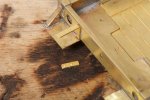
For some fresh entertainment, the backs of the axleboxes don't reach all the way to the W irons.

The W irons are in their correct places, with their visible parts about a millimetre behind the solebars. On the prototype, the W irons had an offset so they fitted flush onto the backs of the solebars. The kit doesn't represent this offset (fair enough), and so the W irons appear to be floating in mid air from this viewpoint.

I am thinking of adding some styrene shims on the backs of the axleboxes, and fixing the castings into place with glue.
 

SimonT

Western Thunderer
GWR Good Wagons by Atkins, Beard & Touret on pages 166 & 167 offers many photos and drawings (not Swindon) of the various Serpents. A few pages before the text confirms that G9 Serpents became CARTRUCK and the fitted G21 became CARFIT. Some vehicles from both pools received insulated floors to match particular containers.
 

RichardG

Western Thunderer
For the benefit of anyone making requests to their local library . . .

The GWR wagon history book I have includes the following "weight" diagram.
Adrian is looking at
Atkins, Beard, Hyde and Tourret, "A History of GWR Goods Wagons - New Edition Combining Parts 1 and 2"
My copy was published by David and Charles
I paid £4 for my copy, but Martin Bott has one at £35 through Abebooks.

GWR Good Wagons by Atkins, Beard & Touret on pages 166 & 167
Simon is looking at
Atkins, Beard and Tourret, "GWR Goods Wagons"
Published by Tourret Publishing, 1999
There are copies of this on Abebooks going for £135 and £150
. . . don't take this one into the bath :D
 

Tony Overton

Western Thunderer
For the benefit of anyone making requests to their local library . . .


Adrian is looking at
Atkins, Beard, Hyde and Tourret, "A History of GWR Goods Wagons - New Edition Combining Parts 1 and 2"
My copy was published by David and Charles
I paid £4 for my copy, but Martin Bott has one at £35 through Abebooks.


Simon is looking at
Atkins, Beard and Tourret, "GWR Goods Wagons"
Published by Tourret Publishing, 1999
There are copies of this on Abebooks going for £135 and £150
. . . don't take this one into the bath :D
Being a Midland modeller I think I need to ask my doctor for stronger medication. I've sent for a copy of the GWR Freight loads book.........
 
Headstocks (Richard)

RichardG

Western Thunderer
DSC_1711.jpeg
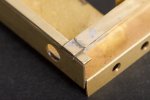
The kit headstocks are not completely wrong. The three holes are in the right place, so I used one of them as a drilling template. My new headstocks are from 6.35 mm (“1/4 inch”) strip, with a bottom flange 0.5 mm thick. The lack of the top flange will never show after the upper floor is in place. (yes it will! - 17 Jan)

DSC_1726.jpeg
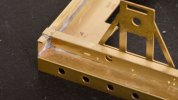
The two rebates in the ends of the solebars are unwanted. A horizontal slot to accept the flange on the headstock would be better but we don't have one of these. So I have patched things up with scrap brass. This is my better corner.

The new headstock sits higher than the kit one, but the floor still does not obstruct the access for the buffer stocks or the coupling. Maybe I can find a brass washer to fill the gap between solebar and W iron :rolleyes:
 
Last edited:

RichardG

Western Thunderer
I found the assembly of the first headstock rather too difficult and slow to be enjoyable. So I have devised a better way for the second end, this is pretty foolproof:

1) Assemble the flange onto the headstock now (not after adding the headstock to the model!).
2) Create two temporary slots using scrap brass, and insert shims to pad out the thickness of the missing ends of the solebars.
3) Turn the model the right way up, rest the flange on the shims and attach the headstock to the lower floor.

DSC_1727.jpeg
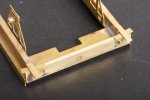
The view underneath is now like this.

DSC_1729.jpeg
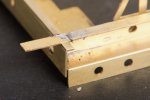
A closer look.

DSC_1731.jpeg
4) Remove shims, unsolder pieces of scrap brass, and add ends of solebars.

DSC_1733.jpeg
5) Trim and clean up.

Everything lines up without trying.
 
Upper floor and access ramps (Richard)

RichardG

Western Thunderer
I am making progress, but not without quite a lot new parts.

For my purposes,
  • The upper floor panel is unsuitable because the planks are too long.
  • The four ramps (on the corners of the upper floor) are unsuitable because they are too narrow.
  • The strips for the tops of the curb rails are unsuitable because they have too many holes and the holes are at the wrong pitch.

DSC_1765.jpeg
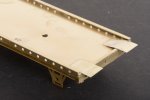
I have worked up the deck of the model using most of the upper floor panel (this installed upside-down) and new parts made from brass. The hole is for a M4 bolt to connect the RSU.

The top surface of the upper floor is about 0.5 mm higher than it ought to be, but I cannot see a way around this without rebuilding the entire underframe and the curb rails. I know that two wrongs don’t make a right, but I have added some shim strip to make the headstocks about 0.4 mm too tall, so the end ramps have something to climb over.

The ramps are from 0.3 mm brass sheet, this is the thinnest I have to hand.

The tops of the curb rails are plain strips because I would rather have no detail than wrong detail.

DSC_1755.jpeg
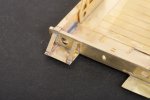
The half-etched bolt detail on the ramp brackets is on the wrong side, and so the parts will not fold up into shape with the embossed detail on the outside.

DSC_1757.jpeg
So I am adding the brackets in pieces.

DSC_1758.jpeg
This is a temporary piece of 1.6 mm plywood. The individual planks are too broad but the photo shows the general appearance.

The plywood is close to the scale thickness of the planks and so, like the upper floor, its top surface is about 0.5 mm too high. If I look through the holes in the curb rails, I can see the top of the ply is just above the centres of the holes, while the GA shows it to be just below them. But the three-dimension shape is about right.

Right now, my model contains six brass parts from the kit (four of them modified) and 16 new parts I have made myself.
 

RichardG

Western Thunderer
Richard,
It might be easier for you to scratchbuild your next wagon............

Yes indeed. The daft thing is, I really want a GER implement wagon. I saw this kit at Kempton, and imagined it would give me a temporary fix. Something I could build during a few leisurely evenings, and enjoy until I could scratchbuild a GER equivalent. Well, the kit is giving me a forced introduction to scratchbuilding.

I recall a bloke asking for directions in Dublin, and the response was "oh, XXX you're wanting is it? Well, I wouldn't be starting from here..."

I am sure, this kit is designed to build a model of the wagon sketched in the weight diagram, with missing details invented by the designer. Not a model of an actual Serpent. More work to follow, but I do now have most of the work planned out in my head.
 

Dog Star

Western Thunderer
If I use 1.6 mm plywood, the wheel chock bars (castings) will not fit. So I need some thinner ply or re-work the wheel chocks or a bit of both.
I buy 0.8mm birch ply from, generally, Cornwall Model Boats - if out of stock then from Jarvis.
 

RichardG

Western Thunderer
Now I have decided how I want the upper deck to look, the worst of the build is probably over. The minor detailing parts have all gone into place without any great difficulties.

DSC_1772.jpeg
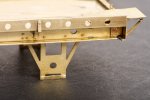
The corner plates (part 11) should have four fixings not five as etched and by good fortune I looked at some photos and the GA before I pressed out the bolt heads.

The corner gussets nearby (2) seem to be a later addition. They don’t appear on the GA and I have missed them off.

The keeper plates (9) are half-thickness, fragile, and attached to the fret along their long sides not at their ends. This is how I came to get this wonky top edge, which I didn't notice until I saw this photo. Now straightened out.

DSC_1768.jpeg
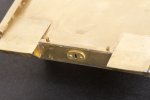
The GA shows two eye bolts on the top of each headstock. These were used to attach chains for securing loads. I have used small split pins (the ones supplied with 7mm couplings) to represent these.

This takes the model as far as I can go before I add the wheels, brakes and other castings.
 

RichardG

Western Thunderer
This seems like a very interesting exercise, though the kit shows all the signs of what I think of as ‘0 gauge syndrome’ (i.e., accuracy and finesse is for locos only - an exaggeration, perhaps, but you know what I mean, I hope?). The design may be modern, but it shows every sign of being drawn up from the weight diagram rather than the GA you have access to. This might account for the holes being the wrong size and the issue with the planked floor.

I must admit, until I looked at the dates on the etch I assumed Jidenco or similar had been involved; this is a very crude kit.

Adam

EDIT - I note the discrepancies with the chassis below which only serves to reinforce that impression. Good luck!

Adam I know exactly what you mean, though many 7mm wagon kits from other firms do make up into pleasing models.

The worst thing for me is the feeling of being taken for a ride. I mean, if this kit had been labelled up as a "GWR-style flat wagon" I would have made the decision to buy on the basis of "I wonder what I can do with this?". And if I had bought it, I would have gone into the build with an open mind and feeling a bit creative.

The entire character of this wagon is set by its steel underframe and solid-spoked wheels, which immediately say "GWR" for my period; plus the arrangement of the floor and its ramps with shallow solebars, which show how the engineers of the day approached their task. The underframe is about right (except for the headstocks), the deck is a fiction. I suppose, my innocence was bliss at the point of sale and right up to getting sight of the GA.

DSC_1780.jpeg
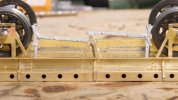
Infuriatingly, the lack of refinement continues to the end. The castings for the brake gear are too shallow and too short. I want brake gear on only one side so I can try for a cut and shut job.

It is refreshing how you could see crudeness in this kit while I was still basking in the luxury of folded-down W-irons. Regarding luck, the best thing for me is I don't model the GWR any more than any other pre-grouping company. Certainly, I don't need to prepare myself for other kits from this stable. Though I doubt this is of any help to Nick :(
 
Top