A Tale of Two Serpents

RichardG

Western Thunderer
They'll look even better when he puts the leaf springs the right way round, you can see the indentation on the hanger to avoid the axleguard.... :cool:

DSC_1814.jpeg
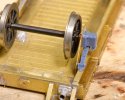
I too have some springs and axleboxes from @ChrisBr, and this is the first one to go onto the model.

To be honest, I feel pretty much completely out of my depth so it is best to ask before I spoil things:
  • I cannot quite figure out what the indentations are, so is this spring the right way round?
  • Does the horizontal gap between spring and axlebox look about right or maybe I should file down the back of the axlebox?
  • Is the 3DP material compatible with etch primer, or maybe I need to prime the model before I add the 3DP parts?
  • What glue is suggested to fix the 3DP parts to brass?
At the moment I have put the axlebox onto the wheel bearing with UHU and it is refusing to set solid. The plan is to put a shim of styrene between axlebox and spring, and jam the spring fixings against the solebar. If I put glue onto these fixings it will surely squeeze out and show.

Sorry there are so many questions. Thank you @magmouse and Chris especially for all of your help so far.
 

RichardG

Western Thunderer
IMG_6869.jpeg

DSC_1815.jpeg
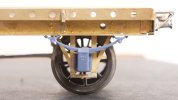
Incidentally, Chris has very kindly given my springs some extra curvature so they meet the solebars when used with the kit W irons, which are too tall.
 

magmouse

Western Thunderer
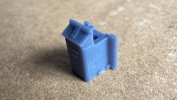
This is my Axlebox print from Chris:

IMG_6896.jpeg

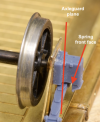
I assume he increased the thickness of the rear part of your axle boxes to accommodate the greater gap between axle guard and solebar, since you didn't move your solebars closer together, which I did. The prototype has a 1 inch joggle in the axleguards, and the whole thing is designed for the springs to sit centred under the solebar and in the slot in the top of the axle box, as Tony @Osgood says. Any adjustments you make should be aimed at achieving that. The middle of the spring should sit immediately behind the raised part at the top of the axle box - no gap.

Note that there should be a small gap between the spring and the axle guard. The spring plates are 4" wide, so project 1/2" either side of the 3" wide solebar flange, leaving a further 1/2" between spring and axle guard face.

To get the springs the right way round, look at the bolt holding the end of the spring into the show - the nut goes on the back. If you look down on the top of the show, you'll see one corner is cut away slightly - that's in the back too.

Nick.
 

magmouse

Western Thunderer
Also -

Not sure about etch primer on 3DP parts - I've used it on polystyrene without issues. I suspect it would be okay.

Brass is tricky to glue to, especially with cyanoacrylates. I suggest roughening the surface, or perhaps tinning it with a wipe of solder. Alternatively use an epoxy glue - though the same surface preparation would be advisable.

Nick.
 

RichardG

Western Thunderer
I don't know how Nick is feeling, but I am totally demoralised by this kit.

The build is simply too difficult to enjoy. I realise the prints from Chris are of a very high standard, but they are too small (and very lightweight of course) for me to hold accurately. And they have to be glued not soldered, which cannot be undone. I can see the nut and bolt heads with a loupe, but I still don't know what the indentation looks like. I cannot see what is straight or crooked without fixing things and taking a photograph

This kit is not a hobby project to me. It is a living Hell, over four weeks on it now and just getting harder and harder at every successive stage. And it barely looks like a Serpent!

I have learnt only one thing, being to never go near anything made by Ennis 75 as long as I live.

If anyone would like to have my model to finish it off, PM me.
 

Overseer

Western Thunderer
I don't know how Nick is feeling, but I am totally demoralised by this kit.
I understand your frustration. Many 7mm etched kits are quite buildable as the designer intended but don’t end up as accurate models. It gets hard trying to make changes to correct inaccuracies. Often easier to start from scratch if you have a good drawing and photos.

I am not sure I should ask, but if you are building this for Heybridge Basin in 1913 wouldn’t the axleboxes have been changed to ‘OK’ type oil axleboxes instead of grease boxes by then?
 

Dog Star

Western Thunderer
I am not sure I should ask, but if you are building this for Heybridge Basin in 1913 wouldn’t the axleboxes have been changed to ‘OK’ type oil axleboxes instead of grease boxes by then?
Chris, @ChrisBr , do your photos of the wagon stock books cover these wagon numbers? If so, can you give the period when oil replaced grease?

Rgds, Graham
 

simond

Western Thunderer
I don't know how Nick is feeling, but I am totally demoralised by this kit.

The build is simply too difficult to enjoy. I realise the prints from Chris are of a very high standard, but they are too small (and very lightweight of course) for me to hold accurately. And they have to be glued not soldered, which cannot be undone. I can see the nut and bolt heads with a loupe, but I still don't know what the indentation looks like. I cannot see what is straight or crooked without fixing things and taking a photograph

This kit is not a hobby project to me. It is a living Hell, over four weeks on it now and just getting harder and harder at every successive stage. And it barely looks like a Serpent!

I have learnt only one thing, being to never go near anything made by Ennis 75 as long as I live.

If anyone would like to have my model to finish it off, PM me.
Richard,

We all get this from time to time. Put it (and all the bits) in a box. Put the box on the shelf. Preferably at the back.

Clear your workbench. Take a deep breath, and say “aaaah”.

Pour yourself a glass/cup/mug of whatever you fancy (I’m currently half way through a Fullers London Porter and it’s very nice) and read a magazine, or a book. Or even see if there’s something of interest on the goggle box. iPlayer is good for this.

Tomorrow morning, find another model that takes your fancy, and make a fresh start. A scenic item, for example.

And in a while (maybe a short while, though I wouldn’t bet on it) you might remember the serpent, and decide to have another bite of the apple…. (I can tell a reasonably good joke about the Garden of Eden, but, another day)

I have built a couple of kits from Jeff’s stable, and found them to be satisfactory, but maybe I didn’t look hard enough. Anyway, most of what he does is GW and most of what you want, isn’t.

Best
Simon

 

magmouse

Western Thunderer
I don't know how Nick is feeling, but I am totally demoralised by this kit.

I'm okay with it at the moment. It's certainly taking much longer to do than I was originally expecting, but I've enjoyed the way I've been forced to study the drawing in detail and understand what seems to have been in the minds of the designers. Perhaps I'm starting from a different place in some ways - modelling to S7, with a commitment to either sprung or compensated wheels, means I am (almost) never building a kit as intended. Since that's my expectation, perhaps I'm less frustrated by the need to make changes.

I have built a couple of kits from Jeff’s stable, and found them to be satisfactory, but maybe I didn’t look hard enough.

I suspect the Serpent is an unlucky choice - as discussed up-thread, it is clear to me he didn't have the GA drawing, and worked from the information that was to hand. Most of the errors are understandable, even logical, from this perspective. We might think (as my wife commented) that one should either get the accurate drawing or not make the kit - a reasonable position. But there's perhaps also an argument the other way.

Anyway, Simon's advice is sound, I think - just leave it for a while. And maybe your next wagon should be a scratch build - that way you are not beholden to the choices of others. As long as you can find a good drawing for your selected prototype, of course!

Nick.
 

ChrisBr

Western Thunderer
Chris, @ChrisBr , do your photos of the wagon stock books cover these wagon numbers? If so, can you give the period when oil replaced grease?

Rgds, Graham
As far as I can tell (some of the records are not visible under archive tape) all but two wagons had been converted to oil by 1908 - ask Nick what his wagon is going to be numbered... so if Richard is looking at 1913, then they should be oil not grease.

As and when Richard chooses to revisit the kit, I can provide OK oil boxes if required and hopefully this time, we can get the distance from axleguad correct...
 

RichardG

Western Thunderer
I am not sure I should ask, but if you are building this for Heybridge Basin in 1913 wouldn’t the axleboxes have been changed to ‘OK’ type oil axleboxes instead of grease boxes by then?

E H Bentall produced their first two prototype motor cars in 1904, and manufacture continued until 1912. For the Heybridge Railway, I want to imagine (guess) they bought a car from another manufacturer and examined it in geat detail. Possibly even took it to pieces.

I bought the kit for the Serpent as a "quick fix" to bring such a car into the scene on the railway around 1904/5. I reckon (another guess) either grease or oil axleboxes (and a red or a grey paint job) would pass for these years.

But to be honest, I really need an implement wagon from the GER - this would be useful for dispatching completed Bentall cars as well. I will probably get more fun from building a simplified model of such a wagon from scratch, at least I will be able to say it is my own work afterwards :thumbs:
 
Last edited:

magmouse

Western Thunderer
As far as I can tell (some of the records are not visible under archive tape) all but two wagons had been converted to oil by 1908 - ask Nick what his wagon is going to be numbered... so if Richard is looking at 1913, then they should be oil not grease.

Of the ones where to stock book is legible, the last two wagons to be converted, in 1908, were 42067 or 42079 - I'll be doing the latter.

Nick.
 

RichardG

Western Thunderer
As and when Richard chooses to revisit the kit, I can provide OK oil boxes if required and hopefully this time, we can get the distance from axleguad correct...

The 3D prints are beautiful and seeing Nick's post immediately above this one I am sure grease 'boxes are fine.

I have packed all of the parts and instructions very carefully into a cardboard box, and put this in my office with my boxes of H0 models set aside for disposal. These boxes get raided from time to time because I cannot bear to part with the models! I could let this Serpent go though - I cannot imagine wanting to see it in a display cabinet, and its application on the layout is very limited.
 
New ramp extensions (Nick) New

magmouse

Western Thunderer
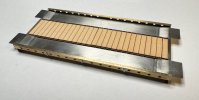
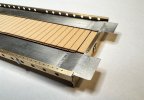
I've been away for a few days, so not much progress on my Serpent. I have though made and fitted the ramps extensions - seen here with the laser cut wooden floor loosely laid in place to check the fit:

IMG_6908.jpeg

IMG_6905.jpeg

IMG_6906.jpeg

The ramp extensions were made of the same 8 thou nickel silver as the new floor - pretty much the correct scale thickness.

I was going to fit the triangular brackets that support the extensions, but I found as Richard did that the parts supplied in the kit couldn't be folded up to actually make a right-angle triangle. I have been prepared to forgive the fact the material they are made from is a bit too wide (2mm, when it should be about 1.5mm), but since they can only be fitted but cutting them into parts and soldering back together (see Richard's post some way up-thread), I'll make new ones. This will give me the opportunity to use a correctly sized brass section, and hopefully get the slightly rounded bends shown in the drawing. I'm going to try 3D printing a jig. More work...

Talking of more work - I had previously thought the triangular reinforcement plates that go where the solebar and headstock meets, and which the kit provides, were not needed. I couldn't see them in early-period photos or on the drawing, though they are visible in a later photo. However, closer examination of the drawing shows they are there, so I'll need to add them. The jury is still out whether I'll use the kit ones, or make my own from something closer to the correct thickness (the 0.5mm brass of the kit is far too thick). Tune in for the next exciting episode...

Nick.
 

adrian

Flying Squad
Talking of more work - I had previously thought the triangular reinforcement plates that go where the solebar and headstock meets, and which the kit provides, were not needed. I couldn't see them in early-period photos or on the drawing, though they are visible in a later photo. However, closer examination of the drawing shows they are there, so I'll need to add them.
I'd need to double check but I seem to recall that the earlier period photos did show "triangulation" but using flat bar stock and open like an orchestral triangle and only in the later photos did it appear as a solid triangular plate.
 

magmouse

Western Thunderer
I'd need to double check but I seem to recall that the earlier period photos did show "triangulation" but using flat bar stock and open like an orchestral triangle and only in the later photos did it appear as a solid triangular plate.

I think we are at crossed purposes. Yes, the supports for the ramps over the buffers are open on this wagon type - that's clear from photos (including yours, above), the GA drawing and is also how the kit is designed (though the parts don't work).

In the final paragraph of my post from last night, I'm talking about the horizontal triangle attached under the headstock and solebar - visible just below the paint date on the solebar in your picture. At first, I though these were not fitted to the wagon as built, but was a later addition - most of these wagons went through several rebuilds to suit changing needs, as is clear from the wagon stock book entries. I thought this because I couldn't see the plate in the drawing - it is only shown on one of the four corners of the plan view - or in the 'as built' photo - the angle of view is so edge-on to the plate, it's practically invisible.

Nick.
 
Top