A Tale of Two Serpents

40057

Western Thunderer
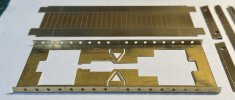
Over the last couple of days I've spend a bit of time preparing some of the main etched parts of the kit - removing the tags, cleaning up the etch cusp, pressing out the rivets using my rivet press, and doing some of the main folds on solebars, headstocks and sides:

View attachment 255044

Now, if I were committed to building the kit as designed, I'd be pretty happy. With a bit of fettling the main parts look like they'll fit together, and everything is neat and tidy.

However... as I've worked through the various parts and examined the GA drawing further, a number of issues have emerged. Firstly, the holes along the side rail are quite a bit too small, so I drilled them out to a scale 3 1/2 inches. I did this with a drill in a pin chuck, as I was concerned using the pillar drill might shift the holes off centre. Doing it by hand meant I could make sure the drill was centring itself in the existing hole. I drilled in from both sides to avoid tear-out as the drill came through. You can see the size difference here - half the top holes are done in this picture:

View attachment 255045

As you can see, it makes a significant difference.

The next issue relates to the floor. The prototype has iron plates at the sides of the wagon, and a wooden floor in the middle. Both ramp up slightly at the ends to get over the buffer heads. The drawing shows that the plates sit on the under frame, and the wooden boards sit on top of that. The kit uses a single piece of brass for the floor, so you don't get the height difference. My initial plan was to make the planks from plasticard and attached that on top - nice and simple.

Further study showed other inaccuracies. The etched outlines of the planks are too wide, so new correct-width planks wouldn't cover the etched lines. Also, the length of the projections over the buffers and the ramped section are incorrect. On the prototype, the flat section of plate work goes all the way to the end, with the ramp a separate piece on top, so there should be a visible edge (but not fasteners - the drawing shows countersunk rivets).

The upshot of all this is that I will use the floor component upside down to make a flat floor, and built up the ramps on top, so I can get the sizes correct and a visible edge where the ramp meets the flat part of the floor. The planking will be done in plasticard. The drawing shows an interesting feature with the planking - it has a small gap (about 1/2 inch) between planks, through which daylight should be visible, as there is no metal plate down the centre of the wagon. I've decided to draw the line at achieving the daylight...

Along the top of the side rails are a series of holes, used to locate the bars that go across the wagon to chock the wheels of the load. The kit has etched holes, which need drilling out to clear them properly - easy enough. However, the kit has holes almost the full length of the wagon, whereas the drawing has not holes in the centre, only at either end. However, the holes don't go far enough to the ends of the wagon.

I have added three holes at either end, and only drilled out a total of 16 holes at either end of the wagon. The undrilled holes will need filling with solder and making good when this part is assembled - see the parts on the right of the first picture in this post. Even with this change, the holes will be wrong, as the kit has them too far apart (2.5mm, when it should be 2mm).

Finally (for now!), The headstocks have a horizontal etched line. I assume the kit designer believed the prototype had a 9 inch deep headstock (the same as the solebars) and then another component on top to make the 12 inch height needed. The drawing shows this is a single C-section part, 12 inches deep, providing the 3" projection above the top of the solebars, so there should be no line there. I plan to fill this etched grove with filler after assembly.

This has all been a bit frustrating, because what is a good kit in terms of the accuracy of the parts and a logical way of building up the wagon from etches has turned out to be inaccurate in various ways. It seems like every time I look at the drawing, I find something else that will add to the total amount of work to be done. I can only assume the designer didn't have the GA drawing I am looking at.

Anyway - onwards and upwards!

Nick.

PS - there won't be much progress next week as I am away for a few days. It'll give time for Richard to ponder whether he wants to make the very rational decision to build the kit as designed and get a model that captures the prototype overall, or follow me down my rabbit hole of lunacy...
As someone who doesn’t build modern kits, I find the errors described above quite extraordinary. All the designer had to do was count the holes and measure their positions. How is it possible to get them so wrong? With vintage models, I am used to ‘inaccuracies’ from true scale. Vehicles too short, wheels too small etc. But these are not errors; they are deliberate, practical, expediencies to cope with small radius curves, use standard parts etc. Putting in the the wrong number of wrong sized holes, wrongly spaced, is just carelessness. Indeed, it would arguably be easier to get it right than go to the trouble of making up a new arrangement. As I say, I don’t build modern kits. In my naivety, had I been building this kit, I would have just assumed the kit designer had copied the prototype.

Martin
 

Dog Star

Western Thunderer
Nick,

Unless I have misunderstood the concern with the floor of the kit... and the proposed solution for the length of the planks... might the answer be to make a new floor?

Two identical brass strips to represent the steel plates adjacent to the wagon sides of a width determined from the dwg..

Lots of ply wood strips for the individual planks thereby giving daylight between planks between the steel plates... and no daylight where the planks are resting on the steel plates.

What thickness is the wood for the planks? I have some birch ply at 0.8mm and at 1.5mm thickness if that helps.

Rgds, Graham
 

magmouse

Western Thunderer
Could ypu not drill series of suitably sized holes to achieve the effect?

28 planks so 27 gaps - that’s an awful lot of chain drilling. One would then need to see the underframe structure in the right places through the gaps, and the compensation mechanism would get in the way of daylight… If this was a scratchbuild, one could do it, but it’s not realistic when starting from the kit.
 

magmouse

Western Thunderer
Putting in the the wrong number of wrong sized holes, wrongly spaced, is just carelessness.

Possibly - but to be fair to the designer, it may be a lack of information. If they didn’t have the GA drawing I’m looking at, then they might be trying to extrapolate from limited evidence (e.g. photos, info about other diagrams).

Also, I am starting to notice that the photos I have show small variations from the drawings, possibly related to the wagons being built in three separate lots, and my drawing shows only one of them. More on that in a future post.

Nick.
 
Introducing the lower and upper floors (Nick)

magmouse

Western Thunderer
might the answer be to make a new floor?

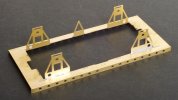
No, because the kit has in effect two ‘floors’. The upper one has the etched lines denoting the planks and intended to form the ramps at either end. This could be replaced. However, the lower floor is internal with the sides (the parts pierced with multiple holes) - this bit:

IMG_6712.jpeg
This lower floor has slots into which the solebars fit. Of course, one could cut the sides off and attach it to a new structure….

At this point, it’s a question of how much of the kit I’m prepared to throw away to be replaced with a scratch build. And is daylight through scale 1/2 inch gaps in 2” thick planking worth it???


What thickness is the wood for the planks? I have some birch ply at 0.8mm and at 1.5mm thickness if that helps.

2 inches. Thanks - I’ll bear that in mind and let you know when I have a plan…

Nick.
 

magmouse

Western Thunderer
How have you got on with finding photos of your Serpent, found what you needed?

I have the usual GW wagon books which have a few. there are a couple in the HMRS collection that may be useful - I need to check the running numbers against the lot lists to be sure which type they are. Even if they are relevant, the HMRS photos tend to be from amateur photographers rather than railway official photos, so you don’t get the detail of a large format film or glass plate photo. what I have yet to find is a good photo that shows the floor in detail, so in that sense the answer to your question is’no’.

Nick.
 

Tony Overton

Western Thunderer
I have the usual GW wagon books which have a few. there are a couple in the HMRS collection that may be useful - I need to check the running numbers against the lot lists to be sure which type they are. Even if they are relevant, the HMRS photos tend to be from amateur photographers rather than railway official photos, so you don’t get the detail of a large format film or glass plate photo. what I have yet to find is a good photo that shows the floor in detail, so in that sense the answer to your question is’no’.

Nick.
I rarely find HMRS photos or drawings helpful for the questions I have.
Someone needs to build a time machine..........
 

adrian

Flying Squad
Hi, another one here struggling to understand the problem of the floors.

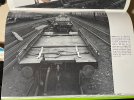
Do you have the Russell OPC book on GWR wagon loads? e.g.
serpent - 1 (1).jpeg

Nothing better to show the floor on this vehicle - the only clues I have is from a later built carfit
serpent - 2 (1).jpeg

Personally I think I would cut a slot in the "upper" floor between the planks and side ramps (marked in red). Leave the planks bit flat and solder to the "lower" floor and just fold up the out "steel" bit to form the ramp up and over the buffers. If you look at the far end of the photo above the end buffer beam does rise above the planked part. So by making the cuts and folding appropriately you'd get something similar. Perhaps a short length of brass L channel on top of the wooden floor behind the buffer beam. Or am I missing something?

serpent_floor.jpg
 

magmouse

Western Thunderer
Thanks, Adrian - yes, I have the wagon loads book. I had considered your approach, and it would allow a better result than the kit as designed. However, the 'planks' etched into the floor are too wide, so the plated areas are too narrow - the ramps and projections over the buffers would also therefore be too narrow with your method.

The construction of the Craft in your second photo is quite different to that of the G9 diagram of the kit. It probably explains why the designer thought that the headstock was 9in deep with another element on top, because that's what is in the picture here. The drawing is quite clear the headstock is 12" deep, and forms the full height of the end, so you can see the flat top of it between the ramps.

I'm pleased not to have to model the arrangements for the restraining bars and other tethering points of the carfit! At least what I am doing is fairly simple in that respect...

Nick.
 
Lower floor (Richard)

RichardG

Western Thunderer
My first impression is, this kit has been designed carefully and presented well. The etching process has left very little cusp to be removed from the edges. At a glance, the tabs and slots for the solebars seem to line up and so I am optimistic the parts will go together without too much butchery. The half-etching goes quite deep and it is easy to bend parts too far. The numbering of parts is peculiar, I haven’t found ‘1’ yet and the lower floor (which forms the core of the whole model) is ’12’.

I could set out a list of objectives here. But really, I am building this to simply make myself another foreign wagon for my layout. So for now, I will say simply that my model will be for finescale 0 gauge, with a rigid chassis. My NER Lomac L (Connoisseur Models) has a longer wheelbase and it runs fine, so I see no need to over-complicate things here. I want to represent a wagon running from 1906 through to 1912, so there will be brake gear on one side and oil axle boxes. I have started with part 12.

DSC_1691.jpeg
I have opened out all of the holes along the sides. Doing this alone is going to make for a much better-looking model. I took the precaution of using a brand-new 2 mm bit, and then set to work using the pillar drill. Like Nick, I worked at the holes from both sides, and I didn’t get any tearing either. Then I lopped out most of the middle section, just in case I can arrange for some daylight between the planks. This will be easier with no compensation units to block the view.

I don’t have any folding bars so I improvised using two lengths of aluminium L section clamped in the vice to help me to form the sides.

All four W irons are the same height, so there is a chance of the model ending up flat, and I won’t be breaking them off and re-attaching them as with the Meteor mobile crane.
 

Dog Star

Western Thunderer
Nick,

What does your drawing show for fitting lamp irons to the headstock? I ask because Adrian's photo of the wagon end tells us that the lamp iron is removable for end loading.
 

Tony Overton

Western Thunderer
Hi, another one here struggling to understand the problem of the floors.

Do you have the Russell OPC book on GWR wagon loads? e.g.
View attachment 255106

Nothing better to show the floor on this vehicle - the only clues I have is from a later built carfit
Which edition of this book are the photos from please? Looks like a useful book to add to the collection.
 

RichardG

Western Thunderer
Nick,

What does your drawing show for fitting lamp irons to the headstock? I ask because Adrian's photo of the wagon end tells us that the lamp iron is removable for end loading.

Graham, I'm not Nick of course but I think a fair reply is this. We are building a Serpent, which was an implement wagon in the parlance of the day, i.e. unfitted. It didn't carry lamp irons.

Adrian's photo shows a Cartruck, which was a carriage truck i.e. fitted to run in passenger trains; and as a fitted wagon it might be the last vehicle in the train and be carrying the tail lamp. So it had lamp irons.

Hope this helps.
 

magmouse

Western Thunderer
Wot Richard said.

My understanding is that at least some Cartrucks were conversions of Serpents, but I’ve not looked into that in any detail, as Cartrucks are well after my period.

Nick.
 

magmouse

Western Thunderer
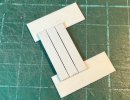
Back to the question of the floor. I was thinking about the issue of the gaps between the floor planks, wondering how this would look, so I made a rough mock-up:

IMG_6714.jpeg

The gaps here are 10 thou - slightly under the prototype. It should be 12 thou. Making this made me think (1) being able to see through the gaps is a waste of time - you really can't, and (2) I'll need to paint the sides of the planks before assembly. It also made me realise that because the 157 thou width of the plastic strip is not exactly right, and the length of the kit is also not exactly right, I will need to be a bit tactical with the width of the gap, to get the right number of planks distributed correctly.

My plan now is to make the 'upper' floor out of two strips with a gap between, as per the prototype. This will be brass or nickel silver sheet, possibly even cut from the kit floor. Then the planks can be held together with a strip of plasticard underneath, that sits between the metal plates. By doing that, the planks will be a single unit, which I won't fix to the wagon until after painting - avoiding the problem of getting a clean paint line where the planks meet the metal floor.

Nick.
 

Dog Star

Western Thunderer
My plan now is to make the 'upper' floor out of two strips with a gap between, as per the prototype. This will be brass or nickel silver sheet, possibly even cut from the kit floor. Then the planks can be held together with a strip of plasticard underneath, that sits between the metal plates.
Now that seems rather like I suggested earlier... ought to be just so when combined with Richard's approach to modifying the lower floor.
 

Tony Overton

Western Thunderer
Looking at the G/A there seems to be a reference to a further brake gear drawing for a vac fitted version. Are you Nick sticking with the unfitted version?
 

AJC

Western Thunderer
This seems like a very interesting exercise, though the kit shows all the signs of what I think of as ‘0 gauge syndrome’ (i.e., accuracy and finesse is for locos only - an exaggeration, perhaps, but you know what I mean, I hope?). The design may be modern, but it shows every sign of being drawn up from the weight diagram rather than the GA you have access to. This might account for the holes being the wrong size and the issue with the planked floor.

I must admit, until I looked at the dates on the etch I assumed Jidenco or similar had been involved; this is a very crude kit.

Adam

EDIT - I note the discrepancies with the chassis below which only serves to reinforce that impression. Good luck!
 
Last edited:
Top