Heljan class 45/0, conversion to S7

RichardG

Western Thunderer
Another person has asked me about the plating on the tyres.

The factory wheels carry chemical blackening on their fronts and backs, and a steel-like colour on the running surfaces of the tyres. I initially thought that this steel colour was a chemical treatment, but it eventually revealed itself to be a plating.

DSC_2672.jpeg
The plating is incredibly thin - perhaps a third of a thou, so 0.0003 in or 0.01 mm.

I don't imagine the plating wearing very well, and I want my wheels to run concentrically and to have matching diameters. I have therefore chosen to turn the all of the tyres down to the bare brass. This leaves me to re-colour the wheels later.
 

Eastsidepilot

Western Thunderer
Richard, this may be of interest, it was an earlier thread of mine back in 2017

Col.
 

RichardG

Western Thunderer
Yes Col. it is a very good post.

I have been doing some things slightly differently. For example I have removed excess wheel thickness from the front as well as the back. I'm not sure whether one way is "better" than the other - we can best compare notes after I post the details.

If you don't have a puller they can be removed by tapping the axle through with a punch whilst supporting the wheel over the vice jaws.
I will suggest, very tongue in cheek, I guess you use a miniature hide mallet to tap the punch? Nothing quite as robust as a ahem hammer :D
 
Last edited:

RichardG

Western Thunderer
Can I ask what size/make of lathe are you using?

Of course - it is a Cowells ME90, bought secondhand and probably around 35 or 40 years old.

The wheel profiling is the most arduous thing I have done on it, and sometimes I have wondered if could ever get enough pressure out of the tailstock spindle. When this happened, I took out the wheel, degreased all the mating surfaces, and tried again. My gut feeling is, I am nearing the limit of what this machine can cope with. Then again, the Heljan brass is horrible to turn, it keeps grabbing and chipping and flaking. A steel wheel e.g. Slater's would turn much more freely.

I have had the machine for a few years and I did a lubrication service on it a few weeks ago - see
Lubrication service on a small lathe
for plenty of photos.
 
Special Tools New

RichardG

Western Thunderer
Special Tools.

DSC_2657.jpeg
These are the special tools I obtained and made to do the conversion.

Clockwise from the back:
  • A loco servicing cradle, improvised from a length of Nomapack U 60-80. I don’t know what this channel is made for, but to me it looks like protective packing for a uPVC window. From the ScaleSeven Group at Albury.
  • A wheel puller, improvised from a small G cramp.
  • A nail punch, with the business end turned down to be a loose fit inside the bush of a Heljan wheel.
  • A wheel profiling tool, from the ScaleSeven stores.
  • Two mandrels and a pressure pad, turned up on the lathe.
  • A back-to-back gauge, also turned up on the lathe (commercial equivalents are available).

DSC_2718.jpeg
Two slightly tired mandrels.
  • There are two mandrels, one for each size of wheel. Each mandrel is turned from aluminium bar, with a steel axle from a child’s metal construction set.
  • The reduced end of the axle is a light press fit into the bush of a Heljan wheel. By light press fit, I mean that I can feel friction but no resistance; and there is no discernible free play.
  • The axle is an interference fit into the mandrel, assembled in the lathe as a permanent fixture. For me, the lathe has sufficient strength to do this, the drill press does not.

DSC_2719.jpeg
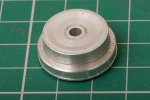
Pressure pad.
  • The pressure pad is small enough to let a cutting tool skim the front of the tyre.
  • The “wheel” side (shown here) is concave to clear the hub of the wheel.

DSC_2642.jpeg
Example arrangement of mandrel, wheel and pressure pad.

When the second bogie was underway, I started to use a couple of 1/4 inch drive sockets in place of the pressure pad. They clamped the wheel more effectively than the pad I had made myself, and so a mixture appears in the photos.

Your wheels are indeed looking very good, but I know from experience that the most difficult task with this is getting the wheels back on the axles without a wobble.
To begin, I am using only one back-to-back gauge.
  • My gauge is as close as I can make it to 31.25 mm, certainly somewhere between the limits of 31.2 and 31.3 mm allowed for ScaleSeven.
  • The limits of the allowable back to back dimension (+/- 0.05 mm) emphasise the importance of not having wobbly wheels.
If the rebuilt locomotive does not negotiate pointwork correctly, I can revisit this gauge and maybe make a second one, so I have a go / no-go pair.
 

Ian@StEnochs

Western Thunderer
Richard,

Wheel re-profiling is one of those tasks that, once you are confident in the process, one does on autopilot. As I use a chuck with soft jaws for holding wheels while the thickness is reduced I like to do as many as possible at the one setting before mounting the dedicated size mandrels for the final form tool shaping. All wheels the same size end up exactly that. My last job was tender wheels when I did enough for 6 locos worth, I got through a couple of Sherlock Holmes stories on the player in that session!

You may not have considered it but I mount the form tool in a rear tool-post upside down. That way the swarf falls away from the cutting edge rather than build up and you can mount another tool to do the front tyre chamfer on the top slide without having to remount the wheel later.

Ian.
 

JimG

Western Thunderer
Of course - it is a Cowells ME90, bought secondhand and probably around 35 or 40 years old.

The wheel profiling is the most arduous thing I have done on it, and sometimes I have wondered if could ever get enough pressure out of the tailstock spindle.
Are you using backgear? I've turned and formed 1/32 scale wheels on my ME90 with little problem. The tyres were mild steel and I used backgear.

Jim.
 

RichardG

Western Thunderer
Are you using backgear? I've turned and formed 1/32 scale wheels on my ME90 with little problem. The tyres were mild steel and I used backgear.

Yes I am using the backgear. In my case with the pulleys were giving the fastest drive so 180 rpm.

My struggle was with the wheel flanges, where the profile tool kept snagging and stopping the wheel. This was worse with the smaller wheels than the larger wheels, which surprised me. When the profile tool reached the running surface of the tyre, everything settled down and the cutting was much smoother.

The circumference of the flange had been left quite sharp by facing the back of the wheel. Maybe I should have smoothed this down before starting with the profile tool.

Facing the fronts of the wheels (using a standard left-hand cutting tool) was straightforward.

I turned some Slater's wagon wheels as a practice piece and these were easier.
 

JimG

Western Thunderer
Yes I am using the backgear. In my case with the pulleys were giving the fastest drive so 180 rpm.

My struggle was with the wheel flanges, where the profile tool kept snagging and stopping the wheel. This was worse with the smaller wheels than the larger wheels, which surprised me. When the profile tool reached the running surface of the tyre, everything settled down and the cutting was much smoother.
It looks like you have got a pretty bad brass alloy as the wheel rims - probably a very hard variety to minimise wear on the wheel tyres. If it were me, I would have turned the brass tyres off and fitted, and turned, steel tyres using a nice free-cutting steel. But I'm a bit late suggesting that. :) And sourcing steel tyres, if a thick-walled tube is not available of the correct size, can be a bit of a pain, usually requiring the making of blanks from rod and trepanning the centre out.

I did, some years ago, get a bit of steel bar offcut from a friendly engineering firm for my 1/32 scale drivers. The really friendly bit was the person on a very large lathe offering to put a 1 1/2" drill though the offcut to save all the boring or trepanning. :)

Jim.
 

RichardG

Western Thunderer
Yes it can escalate very quickly! The wheels on the class 45 will be mostly hidden. If they wear out then they are a common size and I could buy replacements ready made.

I did wonder about pushing out the axle bushes and annealing the brass, but I wouldn't know how to restore the hardness beyond waiting a few years.
 

simond

Western Thunderer
It looks like you have got a pretty bad brass alloy as the wheel rims - probably a very hard variety to minimise wear on the wheel tyres. If it were me, I would have turned the brass tyres off and fitted, and turned, steel tyres using a nice free-cutting steel. But I'm a bit late suggesting that. :) And sourcing steel tyres, if a thick-walled tube is not available of the correct size, can be a bit of a pain, usually requiring the making of blanks from rod and trepanning the centre out.

I did, some years ago, get a bit of steel bar offcut from a friendly engineering firm for my 1/32 scale drivers. The really friendly bit was the person on a very large lathe offering to put a 1 1/2" drill though the offcut to save all the boring or trepanning. :)

Jim.
I have no idea of the costs, but the water cutters can generally produce steel rings of appropriate dimensions for tyres. Certainly saves the boring bit…
 

RichardG

Western Thunderer
Wheel re-profiling is one of those tasks that, once you are confident in the process, one does on autopilot. As I use a chuck with soft jaws for holding wheels while the thickness is reduced I like to do as many as possible at the one setting before mounting the dedicated size mandrels for the final form tool shaping. All wheels the same size end up exactly that. My last job was tender wheels when I did enough for 6 locos worth, I got through a couple of Sherlock Holmes stories on the player in that session!

You may not have considered it but I mount the form tool in a rear tool-post upside down. That way the swarf falls away from the cutting edge rather than build up and you can mount another tool to do the front tyre chamfer on the top slide without having to remount the wheel later.

Ian you are completely correct. I mean, I got into a new gear yesterday afternoon and turned all of the wheels for the second bogie. I mounted the usual left-hand form tool and did eight backs, then eight fronts. Mounted the profile tool and did six tyres. Mounted the internal thread tool and did six bevels. Swapped mandrels and did two more tyres and bevels. It didn't take long and I amazed myself at the consistency I was achieving.

I have pondered getting a rear tool post, not for the profile tool but as a general-purpose place to put a second tool. Most likely the parting tool. This would take up less space than one of those four-way posts you can turn round, and would be less likely to get in the way. My lathe can run backwards so I have the option to mount the rear tool the right way up. But it It is very clear, with no need for the compound slide, I agree, the rear tool post is an ideal place to put the profile tool.

Also:

I am really pleased to write, I have put the driving wheels back into the second bogie, put the loco on the track, and watched it run it backwards and forwards without climbing off the rails or other bad behaviour. A one-metre length of flexi track is hardly a test for a half-metre loco, but there is a huge sense of satisfaction and I will have a bit more conviction in what I post next :)
 
Last edited:

Brian McKenzie

Western Thunderer
I have pondered getting a rear tool post, not for the profile tool but as a general-purpose place to put a second tool. Most likely the parting tool.

Unlike front mounted parting-off tools, rear mounted parting tools don't dig in, but lift away from the work when encountering resistance.

My lathe can run backwards so I have the option to mount the rear tool the right way up.

Richard, don't do that !! The chuck will unscrew, and the workpiece will snag on the tool. This applies to any lathe that has screw thread chuck mounting.
Use rear mounted tools upside down - with the spindle turning in the usual anti-clockwise direction (as when viewing the front of the chuck).

-Brian McK.
 
Dismantling and Inspection New

RichardG

Western Thunderer
Dismantling and Inspection.

With the model supported upside down, it would be good to run the motors and look for any wobble in the factory wheels. This approach doesn’t work because there is so much side play on the axles, and the wheels just oscillate from left to right. Most on this play disappears after the conversion.

So I suggest, the best test is to run the model on an 0 gauge layout, and make sure it runs properly before starting. I ran mine at NEEGOG for 20 minutes.

DSC_2630.jpeg
Remove all four wheel sets from one bogie.

The three sets of driving wheels are easy, just remove the keeper plate and lift them out (photo above). Place each wheel in turn over the jaws of the vice and use the modified punch to knock each axle out of its bush. Most bushes stay put in the wheels, a few stick to the axle. If they stick to the axle, they pull off with fingers or a small open-ended spanner.

(no photo)
The axle of carrying wheels is more awkward. The pony truck is trapped between the two castings which form the bogie chassis, and so it has to stay put. There is no benefit in removing the compression spring, so don’t ;). Remove the two screws below the buffer beam, and pull off the two plastic side frames. Then use the wheel puller to remove one wheel from the axle, and withdraw the axle.

The wheel puller seems to be a necessity for the carrying wheels, the nail punch is quicker for the driving wheels.

I worked up one bogie at a time. This way, I could evolve a more efficient approach for the second bogie. I also had an assembled bogie in front of me, in case I forgot how to put things back together.

DSC_2624.jpeg
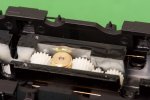
When I opened up my model I found factory grease most everywhere inside the bogies except on the gears. It would be worth checking similar models from Heljan before running them extensively on a layout, even if you are not altering anything. I wiped away the surplus grease and deferred relubrication until later.

Now is as good a time as any to blacken the axle from the carrying wheels. I used hot bluing, with a microflame torch and a pot of vegetable oil. This gets rid of the shiny finish on the axle ends which is so obvious in the original model.
 

Eastsidepilot

Western Thunderer
Yes Col. it is a very good post.

I have been doing some things slightly differently. For example I have removed excess wheel thickness from the front as well as the back. I'm not sure whether one way is "better" than the other - we can best compare notes after I post the details.


I will suggest, very tongue in cheek, I guess you use a miniature hide mallet to tap the punch? Nothing quite as robust as a ahem hammer :D
I use a puller :D
 
Tyre Width New

RichardG

Western Thunderer
Tyre Width.

The Heljan wheel is about 0.5 mm too thick for ScaleSeven. I remove about half of the excess from the back and the remainder from the front. This leaves enough of the original flange to form the new flange without having to cut into the tread.

The most important action must surely be, to arrange the wheel to not wobble. The wheel must be flat; and perpendicular to its axle hole. I know the ends of the mandrel are flat and parallel. I also know the front of the tailstock spindle is true; and so is the drill plate (not shown here). What I do not know, is whether the factory hole for the wheel bush is orthogonal; though after subsequently putting the wheel back onto its axle, most likely it is.
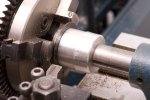
DSC_2638.jpeg
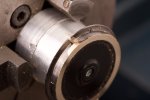
I press the front of the wheel onto the mandrel, and use the tailstock spindle to move the wheel into the chuck. Then nip up the jaws of the chuck. Placing the the lathe tool lightly against the wheel and rotating the chuck by hand will show whether the wheel is held true.

I am using ordinary hard jaws in the three-jaw chuck. They haven’t left marks on the finished wheels.

I tried mounting the plain drill plate into the tailstock, but it didn't seem to improve anything so I put it away.
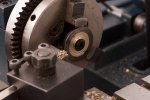
DSC_2665.jpeg
As supplied, the backs of some wheels are convex. Furthermore, although the brass is very hard, the lathe tool can easily deform the flange, pushing it over towards the tread of the tyre.

Therefore, it seems sensible to start the cut part-way across the back, and to then work inwards and outwards. The light score marks near the periphery of the wheel help to confirm it is true in the chuck.

DSC_2658.jpeg
I remove about 0.22 mm in a few passes . . .

DSC_2663.jpeg
. . . and finish with a skim of around 0.03 mm to impart a reasonably smooth finish.

Do this for the other seven wheels.
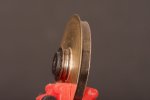
DSC_2692.jpeg
Some deformation of the flange seems inevitable, however hard I try. This is easier to see when the profile tool is against the wheel (later). The factory plating on the tread is so thin it is translucent.

There is now a choice as to what to do next. For the first bogie, I formed the flange and tyre; and for the second bogie, I faced off the front of the wheel. The second method keeps the same tool in the toolpost for longer. I illustrate the second method here.

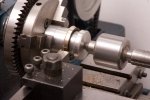
Secure the large mandrel into the chuck and install the live centre into the tailstock spindle.
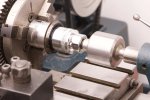
DSC_2673.jpeg
I turned a pressure plate from aluminium but the 1/4 inch socket works better. It grips better and it lets the tailstock sit further away. The live centre fits very happily into the square hole in the socket.

Now, I don’t want to state the blindingly obvious, but do remove any grease sitting on the mandrel or wheel. This has caught me out a couple of times. The clue is when the tailstock hand wheel feels like an impossible stop cock.

Reduce the front of the tyre to give the desired thickness.

Some of the specifications for ScaleSeven quote hundredths of a millimetre. I am thinking especially of the tyre width, 3.21 mm. The micrometer is more believable than the digital caliper, and I used the micrometer to check the tyre width. I took each wheel down to around 3.22 mm.
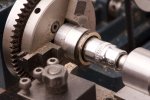
DSC_2675.jpeg
The same mandrel and a smaller socket hold the smaller wheel for the same process.

Do this for all eight wheels.

(next: tyre profile)

 
Last edited:
Top