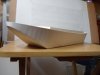
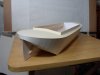
"Oh!" said my wife, when she came home from shopping, "you've scribbled all over it now!"
"That's the whole point" I replied, but she didn't seem to be that interested in any sort of explanation - probably because she knows full well that the answer would have been far too long winded?!
She is a very patient lady, she has had to be, but there are limits!
Anyway, here is the result of much measuring in the marsh:

And where the harsh reality dawns: The sad truth is that those lovely graceful lines did look quite pretty in their almost smooth, off white clothing, but the rather brutal plate work, dictated by the structures beneath, does rather draw the eye and spoil it!
There is some consolation, in that on (most of) the prototypes, the vertical joints on the hull plating were butted, and flush rivetted with a strip behind that lay between adjacent frames, while only the long horizontal joint was lapped. That had to be thus anyway, as there would have been gaps in the reinforcement, and an inherent weakness at the perpendicular crossing point with each frame. The lapped joint was always upper plate over lower, and commonly joggled to set flush, with the resulting bulge usually covered over with a half-round, or other deep moulding - presumably to act as an additional stiffener?
As usual, there always appear to be exceptions to the rule - as can be seen in the rather splendid example below, taken in 1937...

(Image reproduced for research and illustrative purposes only)
The four joints on the lower three hull plates seem to be far too obvious at the distance viewed from the camera, despite the superb quality of the original negative? Maybe they were lapped also in this case?
Another decision that had to be made was whether to mark out the horizontal joint parallel with the chine, (as in the pic) or curved in line with the sheer, which would be a slightly more attractive, but marginally less representative form?
I opted for the former, while hoping to do the latter in a later, lighter, lighter variant at some time soon...?!!
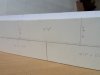

The odd plate sizes, and stepping are purely determined by the frame spacing and most likely, economic use of steel stock, lightly drawn in and then checked for scale before committing.
More perplexing was the problem of placing the precious few deck fittings.
All of course have to align correctly with the beams beneath, and while the the types fitted were more or less universal, their precise locations seemed to be simply a matter of whim!

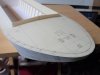
There are few good enough reference photographs to show them, but in at least one the windlass bits straddle a deck beam - something that I imagine to be slightly strange: I would have assumed that they were more likely to be fitted in between - with straining support shared more evenly between two?? I have drawn it as per the pic, but may well decide to move them forward in the end!
Otherwise, I am fairly happy with how it is turning out.
I already have some plastic sheet to be getting on with, but will have to order several bundles of Plastruct half round styrene, in three jolly sizes, to go twice all round the huge hull, and once round the gaping hold!!
Then the mucky and smelly fun can really start!
Pete.



 Gap
Gap